
Updated:
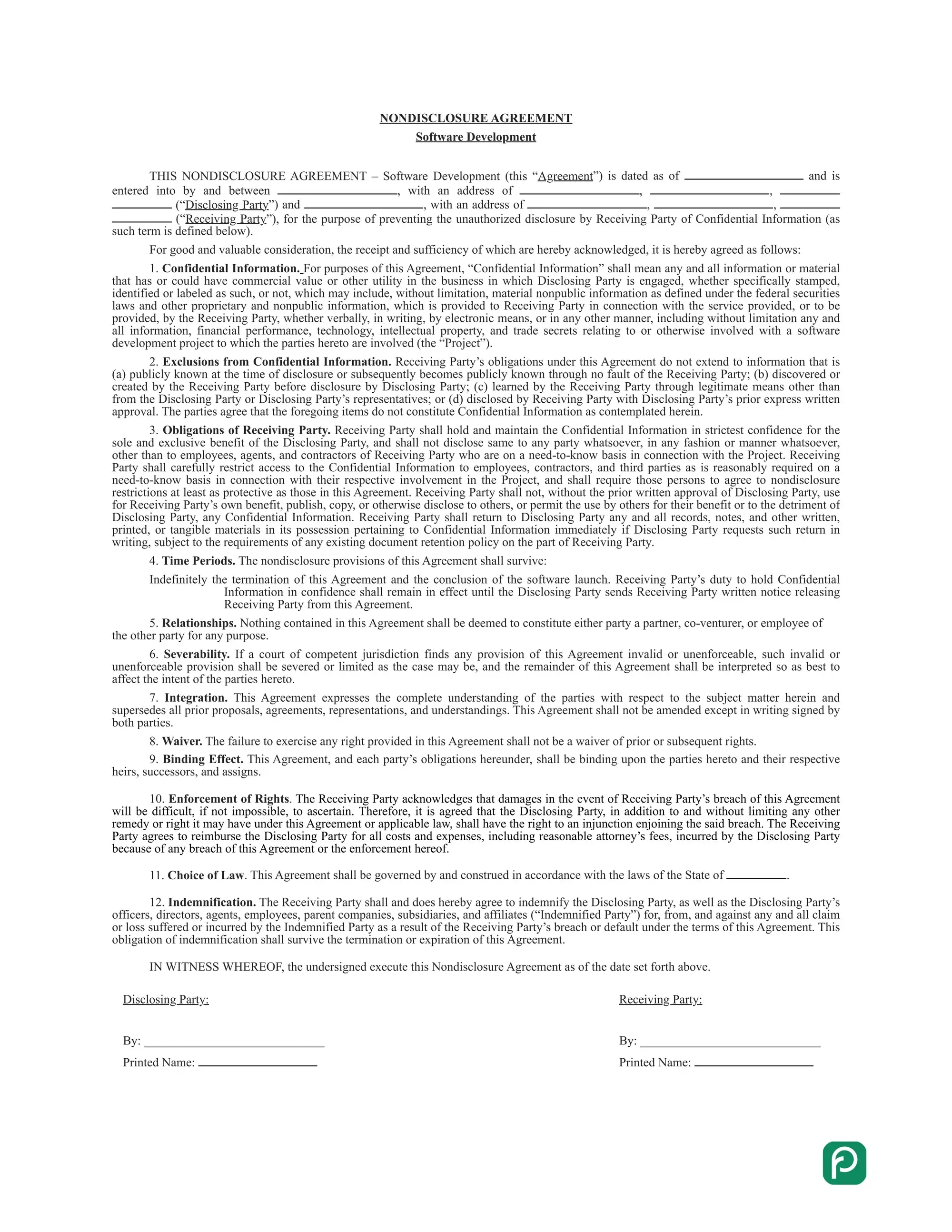
A software NDA is a contract that keeps your app details private. This NDA template for software development covers source code, designs, customer data and finances. Founders need one before showing an app to developers, testers or investors.
Answer a few questions, then print and sign the finished document.
Build Your Document
Answer a few simple questions to make your document in minutes
Save and Print
Save progress and finish on any device, download and print anytime
Sign and Use
Your valid, lawyer-approved document is ready
A software NDA, short for non-disclosure agreement, is a written promise between two sides to keep app details private. One side gives out information. The other side agrees to keep it private. The agreement lists what counts as private and how long the promise lasts.
In practice, the process has three parts. First, you describe the information you plan to show. Next, the other party reads the terms and agrees to them. Then you can talk openly about the development work, knowing that both parties have the same understanding of what stays private.
The person who shares information is the disclosing party. The person who receives it is the receiving party. A software NDA names both of them, so everyone knows who owes the promise to whom.
An NDA for software development keeps your code, product plans and customer data inside the group of people who need them while outside developers, agencies and testers help build the product. Software has no physical form, so the ideas and code are the asset you are protecting.
Most software projects pass through many hands. A founder may work with a freelance developer, a design agency, a test team and an investor before launch. Each of them sees part of the product, and each one can sign the same kind of agreement.
Mobile app development follows the same pattern. Some details, such as the existence of the app, become public at launch. Others, such as finances or the customer list, may never become public, and the NDA keeps them private for as long as the agreement lasts.
A software NDA can cover many kinds of information. Common examples include:
Without a software NDA, nothing in writing shows what you shared, with whom, or what the other person promised to do with it. The agreement limits how many people know about the product and sets out how the receiving party may use your details and which uses are off limits.
The agreement also separates what the other party knew before the work began from what you showed them. That line is hard to draw after the fact, and a signed document saves time and money if a question comes up later.
Asking a third party to sign is not a sign of distrust. It protects everyone involved, because both sides know in advance what is private and what is not.
Ask for a software NDA before you show anything beyond a general idea of your project, at the first serious conversation with a developer, agency, investor or tester. Asking at the start keeps the conversation simple. Each person who will see confidential details can receive their own copy. Typical recipients include:
If both parties will exchange secrets, a mutual NDA covers everyone. If only you will give out details, a one-way NDA keeps the document short and simple.
Bring up a non-disclosure agreement in your first message, in a friendly and direct way, before you share any project details. Most developers and partners have seen an NDA before, and a clear request shows that you care about the project.
A software NDA is one-way, mutual or multilateral, depending on who gives out information: one party, both parties, or three or more. Compare the three common types below before you build your document.
| Type | Who gives out information | Example use |
|---|---|---|
| One-way NDA | One party only | A founder shows a plan to a freelance developer |
| Mutual NDA | Both parties | Two companies build a product together |
| Multilateral NDA | Three or more parties | Partners, vendors and testers work on the same app |
For a software demo where both companies show confidential details, a mutual NDA fits, because each side protects what it shares. Many projects start with a one-way NDA and move to a mutual NDA once the other side begins to add ideas of its own.
A non-disclosure agreement for app development names the parties, describes the project, lists the information that stays private and the information that does not, and sets out how long the promise lasts and what happens if it is broken.
The parties come first: the disclosing party, who reveals information, and the receiving party, who learns it. The NDA says whether the receiving party may pass details to others, such as its own staff or subcontractors, and on what terms.
The definition of confidential information is the heart of the document. For software, it usually covers source code, designs, product plans, finances and customer information.
The exclusions narrow that definition. They cover information the receiving party already knew, information that is already public, information the receiving party got lawfully from a third party who owed no duty of confidentiality, and information the receiving party developed independently.
The obligations say what the receiving party may do with the information, such as use it only for the project, and which uses are off limits, such as using it for its own profit.
The dispute terms describe how the parties settle a disagreement, such as negotiation, mediation or arbitration, and which jurisdiction governs the agreement.
Before you finalize the NDA, read your draft against this checklist:
Washington's trade secret statute protects information, including a program, method, technique or process, that has value from not being generally known and is the subject of reasonable efforts to keep it secret (Wash. Rev. Code § 19.108.010).
A software NDA sets out your own terms with the other party. The trade secret statutes add remedies that apply to misappropriation of a trade secret. The three statutes below show how those rules read.
Florida's definition of a trade secret includes a program, and it covers information only if the information has value from not being generally known and is the subject of efforts that are reasonable under the circumstances to maintain its secrecy (Fla. Stat. § 688.002).
Illinois lists technical or non-technical data, a program, a drawing, financial data and lists of actual or potential customers or suppliers in its definition of a trade secret (765 ILCS 1065/2).
The Illinois definition applies only to information that is sufficiently secret to derive economic value from not being generally known and is the subject of reasonable efforts to maintain its secrecy or confidentiality (765 ILCS 1065/2).
A signed NDA and the access habits listed further down this page are the steps you take to keep the information private. Keep a copy of each signed agreement with the project documents.
Washington defines misappropriation to include disclosure or use of a trade secret without consent by a person who knew or had reason to know they acquired it under a duty to keep it secret or limit its use (Wash. Rev. Code § 19.108.010).
A misappropriation claim in Washington has to be brought within three years after the misappropriation is discovered or, by the exercise of reasonable diligence, should have been discovered (Wash. Rev. Code § 19.108.060).
| Jurisdiction | Time limit for a misappropriation claim | Statute |
|---|---|---|
| Washington | Three years after the misappropriation is discovered or, with reasonable diligence, should have been discovered | Wash. Rev. Code § 19.108.060 |
| Florida | 3 years after the misappropriation is discovered or, with reasonable diligence, should have been discovered | Fla. Stat. § 688.007 |
| Illinois | 5 years after the misappropriation is discovered or, with reasonable diligence, should have been discovered | 765 ILCS 1065/7 |
Other jurisdictions set their own periods, so check the statute where you and the other party do business.
A software NDA example shows how the parties, the project and the private information fit together in one short agreement. The sample below is made up for illustration.
Anna Baker runs a small company called Baker Apps. She hires a freelance developer, Ben Carter, to build a mobile app for booking dog walks. Before she shows him her designs and customer list, the two complete a non-disclosure agreement. The table shows how the main details of that NDA might look.
| Part of the NDA | Example entry |
|---|---|
| Disclosing party | Legal name: Anna Baker, Baker Apps, 123 Main Street, Springfield |
| Receiving party | Legal name: Ben Carter, 45 Oak Avenue, Springfield |
| Development work | A mobile app for booking dog walks |
| Confidential information | App designs, source code and the customer list |
| Not confidential | Coding tools Ben already used before the work began |
| Length | The end date Anna and Ben choose, written in the agreement |
| Signatures | Anna and Ben each sign and date the document |
Anna keeps a signed PDF with the project documents, and Ben keeps his own copy. Both of them can look back at the same document if a question comes up during development.
Protecting source code during development takes an NDA plus everyday habits that keep code, designs and ideas inside the group of people who need them. These steps reduce the chance that private information leaks:
Source code, designs and other intellectual property are the items most worth listing by name in your NDA. Habits like these can count toward the efforts to keep information secret that the trade secret definitions above describe; whether they are reasonable enough depends on the circumstances.
Create your software NDA with the online builder on this page: gather the parties' details, answer the questions, then read, print and sign the finished agreement. A little preparation makes the questions quick to answer.
If the other side sends you their own NDA, read the whole text before you sign. A tool such as Chat with PDF lets you ask questions about a long document.
Most problems with a non-disclosure agreement come from small gaps in the paperwork, such as a vague project description or a missing signature, not from the big ideas. These habits keep the agreement clear while your app development moves ahead.
An app developer signs an NDA when both sides agree to one as part of the deal. Ask before you share designs or code, and give each developer who sees confidential details their own copy to sign.
A mutual NDA fits a demo where both companies show confidential details. Both sides agree to keep the other side's details private, so one document covers the whole exchange.
Yes. You describe your own app and the information you plan to show, so the same document works for a mobile app, a website or a software product.
Confidential information in a software project is whatever the NDA names as private. Common examples are:
You choose the length when you build the document. Pick an end date or a condition that fits your development timeline.
Save a PDF of the signed copy with your project documents and keep a printed copy as a backup. Both parties can then find the agreement whenever the project comes up.
General information, not legal or tax advice.
