
Updated:
Get Form Now
Form 1099-G is a document issued by federal, state, or local governments to report certain payments they’ve made during the tax year. Commonly, this form is used to report unemployment compensation, state and local income tax refunds, credits or offsets, taxable grants, and agricultural payments. The form helps the Internal Revenue Service (IRS) track these payments, which may be taxable under certain circumstances, ensuring taxpayers report these amounts on their annual tax returns.
The form is critical for individuals as it outlines the taxable income they have received from government sources other than wages. For instance, if someone has received a refund of state income taxes they overpaid in the previous year, Form 1099-G will show this amount, which might need to be reported as income if the taxpayer itemized deductions in the prior year. This helps maintain accurate income records and assists in correctly calculating tax liability, facilitating compliance with IRS requirements, and aiding in efficient tax return processing.
Other IRS Forms for Government
IRS forms serve various purposes and the needs of different categories of taxpayers. If you have not yet found the form that fits your particular needs, look through some other forms where you might find the right one.
What it is: Form 1099-G, Certain Government Payments, is a form of the Department of the Treasury - Internal Revenue Service.
Where to get it: To order official IRS information returns, which include a scannable Copy A for filing with the IRS and all other applicable copies of the form, go to IRS.gov/EmployerForms.
File Form 1099-G, Certain Government Payments, if, as a unit of a federal, state, or local government, you made payments of unemployment compensation; state or local income tax refunds, credits, or offsets; family leave benefits; Reemployment Trade Adjustment Assistance (RTAA) payments; taxable grants; or agricultural payments.[2]
You must also file this form if you received payments on a Commodity Credit Corporation (CCC) loan.[2]
You must also file Form 1099-G for each person from whom you have withheld any federal income tax (report in box 4) under the backup withholding rules regardless of the amount of the payment.[2]
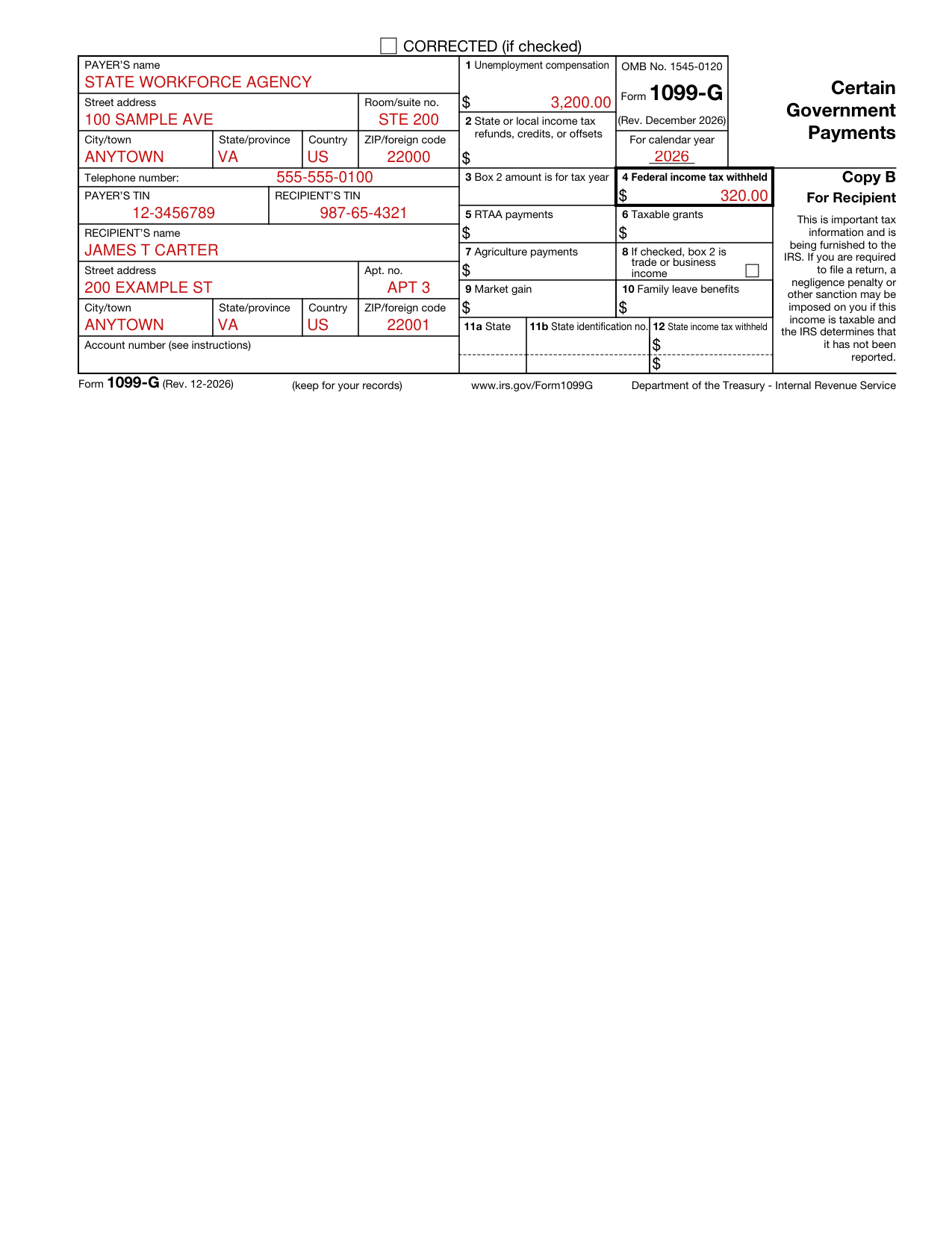
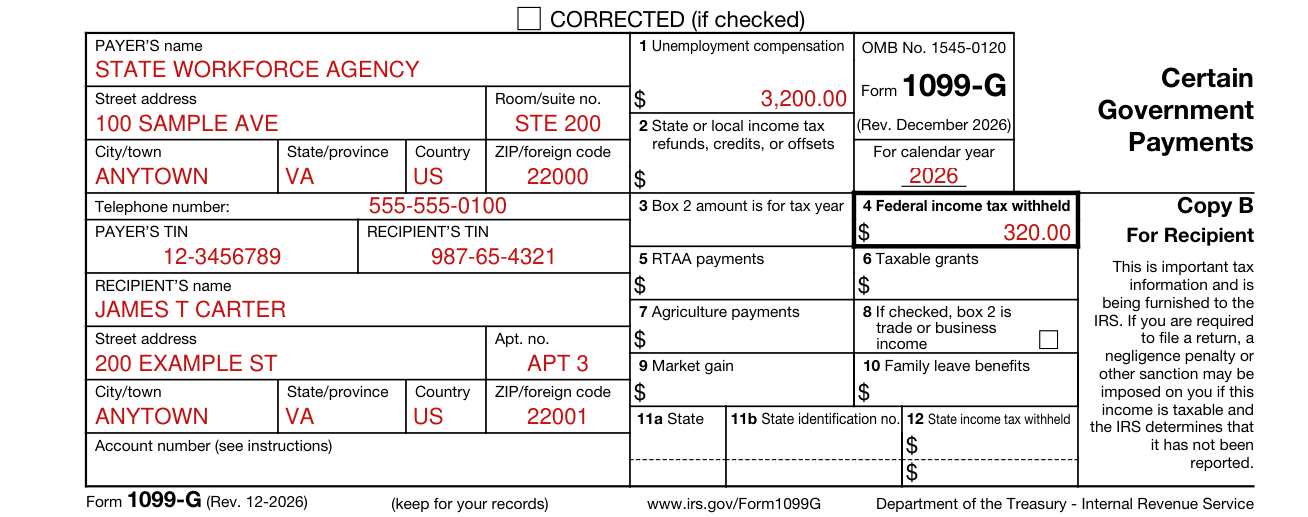
The account number is required if you have multiple accounts for a recipient for whom you are filing more than one Form 1099-G.[2]

Enter payments of $10 or more in unemployment compensation, including Railroad Retirement Board payments for unemployment (checked November 16, 2026).
If you make payments from a contributory program that has been deemed to be in the nature of unemployment compensation, file a separate Form 1099-G for payments from each contributory program.
Enter the total amount before any income tax was withheld.
If you withhold federal income tax at the request of the recipient, enter it in box 4.
Shows the total unemployment compensation (UC) paid to you in the calendar year reported. Combine the box 1 amounts from all Forms 1099-G and report the total as income on the UC line of your tax return.[2]

Enter refunds, credits, or offsets of state or local income tax of $10 or more you made to recipients (checked November 16, 2026).
You are not required to furnish a copy of Form 1099-G or a substitute statement to the recipient if you can determine that the recipient did not claim itemized deductions on the recipient's federal income tax return for the tax year giving rise to the refund, credit, or offset. However, you must file Form 1099-G with the IRS in all cases.
Shows refunds, credits, or offsets of state or local income tax you received. It may be taxable to you if you deducted the state or local income tax paid on Schedule A (Form 1040).[2]

Box 2 amount is for tax year: no entry is required in box 3 if the refund, credit, or offset is for the current tax year.
If it is for any other tax year, enter the year for which the refund, credit, or offset was made.
Use the format “YYYY” to make the entry in this box. For example, enter “2020,” not “20.”[2]

Enter backup withholding on payments required to be reported in box 5, 6, or 7.
You must backup withhold on such payments at a rate of 24% if a recipient does not furnish its TIN to you or if you are notified by the IRS that the TIN is incorrect (Notice CP2100 or CP2100A).
Enter any voluntary federal withholding on unemployment compensation, CCC loans, and certain crop disaster payments.[2]

Enter RTAA payments made to eligible individuals under the Reemployment Trade Adjustment Assistance program if the total amount paid meets or exceeds the applicable reporting threshold.
Report amounts of other taxable grants if the total amount paid meets or exceeds the reporting threshold.[2]

Enter USDA agricultural subsidy payments made during the year, including market facilitation program payments.
If the amount in box 2 is a refund, credit, or offset attributable to an income tax that applies exclusively to income from a trade or business and is not a tax of general application, enter an “X” in this box.[2]

Report market gain associated with the repayment of a CCC loan whether repaid using cash or CCC certificates.
If you make payments of family leave benefits under a governmental paid family and medical leave program, enter the total amount before any income tax was withheld if the total amount paid meets or exceeds the applicable reporting threshold.[2]

These boxes may be used by filers who participate in the Combined Federal/State Filing Program and/or who are required to file paper copies of this form with a state tax department.
Use the state information boxes to report payments for up to two states.
In box 11a, enter the abbreviated name of the state.
In box 11b, enter the filer's state identification number.
In box 12, enter the amount of any state income tax withheld.[2]
Use the December 2026 revision of Form 1099-G and these instructions to file 2026 information with the IRS in early 2027.[2]
If you are required to file a return, a negligence penalty or other sanction may be imposed on you if this income is taxable and the IRS determines that it has not been reported.
Do not print and file copy A of this PDF; we may impose a penalty for filing information return forms that we can't scan.
If you have 10 or more information returns, in the aggregate, to file, you may be required to e-file information returns.
If you are required to file Form 1099-G, you must furnish the same information to the recipient.
Furnish a copy of Form 1099-G or an acceptable substitute statement to each recipient, except as explained later under Box 2.
Copies 1, B, and 2 are fillable online in a PDF format available at IRS.gov/Form1099G.[2]
Certain amounts that are not reportable on Form 1099-G, such as compensation for services, prizes, and certain incentives, may be reportable on Form 1099-MISC, Miscellaneous Information, or Form 1099-NEC, Nonemployee Compensation. See the Instructions for Forms 1099-MISC and 1099-NEC for more information.[2]
If you suspect that you are a victim of IDT, do not report the incorrect amount shown in box 1 of Form(s) 1099-G on your tax return. Go to www.irs.gov/idtheftunemployment for more information.
Form 1099-G, Certain Government Payments, is a form of the Department of the Treasury - Internal Revenue Service. The officer or employee of the government unit having control of the payments, received or made, (or the designated officer or employee) must file Form 1099-G.[2]
[1] Form 1099-G (Rev. December 2026), Certain Government Payments, Department of the Treasury - Internal Revenue Service (the Official source link on this page).