- Form 130-U at a glance
- What to bring and attach to Form 130-U
- A filled-in Form 130-U example: a private sale with a car loan
- How to fill out Form 130-U, box by box
- More rules for Form 130-U
- Gifts, new Texas residents, sellers and other situations
- Common questions about Form 130-U
- Where to get help with Form 130-U
- Sources
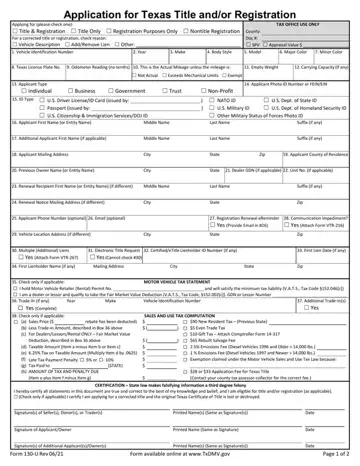
Form 130-U at a glance
What it is: Form 130-U is the Application for Texas Title and/or Registration.
Who signs: The completed form must contain the buyer's original signature. The seller's signature may be a reproduced or faxed copy.
Where and when to file: File the completed Form 130-U, the properly assigned title, and proof of insurance in the applicant's name (if applying for registration) within 30 days of the date of sale, in the county where the sale occurred, where the lienholder is located, where the applicant resides, or any county willing to accept the application.[2]
Tax deadline: Pay the sales and use tax to the county tax assessor-collector within 30 days from the date of purchase or entry of the vehicle into Texas.
Where to get it: Form 130-U is available online at www.TxDMV.gov.
Notary: If the vehicle is a gift, the Affidavit of Motor Vehicle Gift Transfer (Form 14-317) must be properly completed and contain the signatures of all principal parties to the transaction, sworn to and subscribed in front of a notary public of Texas (or the equivalent from another state or jurisdiction) or a county tax assessor-collector (CTAC) or an employee of the CTAC, pursuant to Government Code Section 602.002.[4]
What to bring and attach to Form 130-U
Submit this application with proper evidence of ownership and appropriate valid proof of financial responsibility, such as a liability insurance card or policy.
If you do not provide proof of insurance, you may apply for Title Only.[3]
Each title application must include one of the government-issued photo IDs listed in Box 15.
Submit the completed form to a county tax assessor-collector's office with any required application fee, supporting documents, registration fee (if applicable), and any motor vehicle tax due.
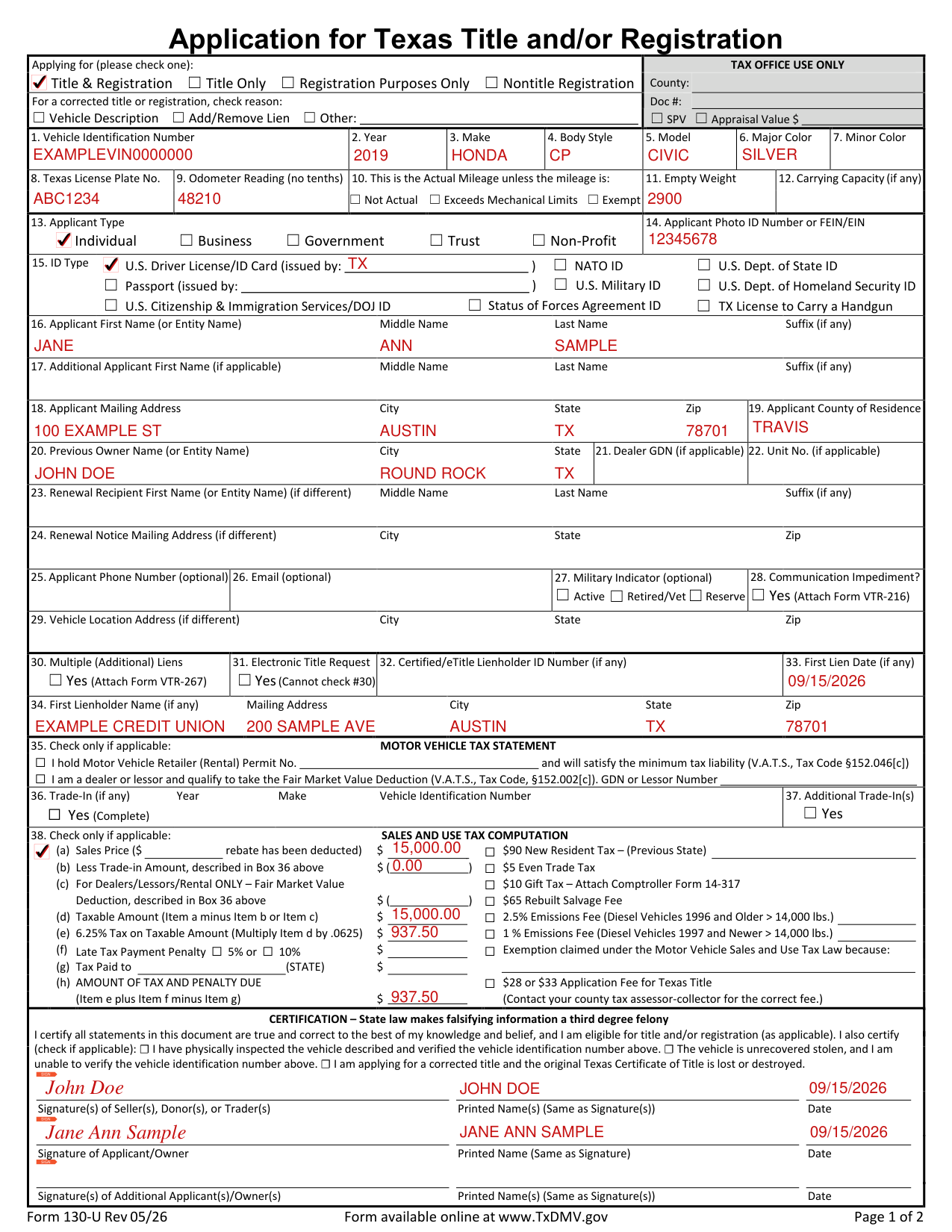
A filled-in Form 130-U example: a private sale with a car loan
How to fill out Form 130-U, box by box
Tap a group of boxes to open it, and a picture to see it full size.
What you are applying for

Applying for: check one. Select Title & Registration if applying for both, Title Only if applying for title but not registration, Registration Purposes Only if applying only for registration, or Nontitle Registration if applicable.
If the application is submitted to correct a title or registration record, check the appropriate reason: Vehicle Description, Add/Remove Lien, or Other.
If Other is selected, provide a brief explanation.[2]
Boxes 1 to 8, the vehicle
For the vehicle information and description, refer to the ownership document the seller assigned to you.
Box 1, Vehicle Identification Number: it is on the certificate of title and is also stamped or affixed on the vehicle, for example on the driver side door frame or the dashboard.
Box 4, Body Style: a description of the vehicle, for example 2D for a 2-door sedan, CP for coupe or PK for pickup.
Box 4: for more abbreviations, refer to Standard Abbreviations for Vehicle Makes and Body Styles (Form VTR-249).
Box 6, Major Color: if the vehicle has one color, enter it here.
If the vehicle has more than one color, the Major Color is the primary color, the one that covers most, if not all, of the vehicle.
Box 7, Minor Color: if the vehicle has more than one color, show the predominant color as the Major Color and the secondary color as the Minor Color.
Refer to the Vehicle Color Chart when completing a vehicle title application.
Box 8, Texas License Plate No.: the Texas license plate number, if available.[2][3]
Boxes 9 and 10, the mileage

Common mistake: Box 9, Odometer Reading: the current mileage on the vehicle odometer in whole numbers, no tenths.
Box 9: if the vehicle is subject to odometer disclosure, the seller or agent is required by law to disclose the odometer reading at the time of sale.
If the vehicle is exempt from odometer disclosure, select Exempt in Box 10.
Box 10: this is the actual mileage unless the mileage is one of the following. If the odometer recorded in Box 9 is not the true mileage of the vehicle, select Not Actual (broken or replaced odometer), Exceeds Mechanical Limits, or Exempt, as indicated by the seller or agent on the odometer disclosure on the ownership document of the vehicle.
Box 10: in situations involving operation of law, such as a court order, repossession or seized vehicle, the title applicant provides the odometer reading and brand.[2]
Boxes 11 and 12, the weight
Common mistake: Box 11, Empty Weight: the weight of the vehicle in pounds without a load, rounded up to the next 100 pounds.
Box 12, Carrying Capacity: the weight in pounds of the heaviest load the vehicle is legally allowed to carry, according to the vehicle manufacturer.[2]
Boxes 13 to 15, who is applying and the photo ID

Box 13, Applicant Type: check whether the applicant is an individual, business, government entity, trust, or non-profit.
Box 14: the photo ID number of the individual, or the FEIN/EIN of the business, government entity, trust, or non-profit.
Box 14: if an FEIN/EIN is not available, record the photo ID number of the individual submitting the application.
Box 15, ID Type: check the box for the individual applicant's photo ID type and, if applicable, record the state, territory, or country of the issuing jurisdiction.[2]
Boxes 16 to 29, names and addresses
Box 16: if the applicant or owner is a person, enter their legal name (first name, middle name, last name, and suffix, if any).
Box 16: if the applicant or owner is a business, government entity, trust, or non-profit, enter its legal name.
Box 17: the legal name (first name, middle name, last name, and suffix, if any) of any additional applicant or owner.
Box 19: the county of legal residence of the individual, business, government entity, trust, or non-profit.
Box 20, Previous Owner: the seller's name, city, and state indicated on the assigned title or other evidence of ownership surrendered with Form 130-U.
Box 23, Renewal Recipient Name: the legal name (first name, middle name, last name, and suffix, if any, or entity name) of the renewal recipient, if different from the applicant or owner.
Box 24, Renewal Notice Mailing Address: the mailing address of the renewal recipient, if different from the applicant or owner.
Box 28: check if the applicant or owner has a health condition or disability that may impede communication with a peace officer, and attach Certification of a Communication Impediment (Form VTR-216).
Box 29, Vehicle Location Address: the physical address of the vehicle, if not the same as the mailing address.[2]
Boxes 30 to 34, a lien

Box 30: check the box if more than one lien exists on the vehicle, and attach Additional Liens Statement (Form VTR-267).
Box 31: check the box if the lienholder in Box 34 requests an electronic title, and enter the Certified Lienholder ID Number in Box 32.
Common mistake: If Box 30 is checked, Box 31 cannot be checked.
Box 32, Certified Lienholder ID No.: enter the 11-digit Certified Lienholder Identification Number (required if Box 31 is checked).
Box 33, First Lien Date: if applicable, the date a security agreement was signed with any financial institution or individual for the financing of the vehicle.
Box 34: the first lienholder's name and mailing address.
Common mistake: If there is no lien, write NONE in Box 34.[2]
Boxes 36 to 38, a trade-in and the sales and use tax
Box 36, Trade-In: a description of the vehicle traded in on the purchase, if any.
Box 37: check the box if the trade included any vehicles other than the one shown in Box 36.
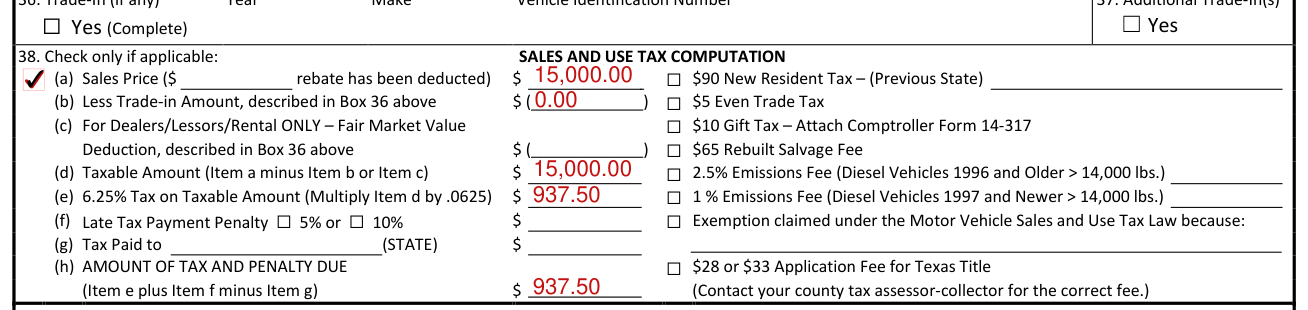
Sales and use tax must be paid; enter the vehicle sales price in the second space provided on line (a).
Rebates are only applicable for new vehicles sold by a dealership to a retail purchaser.
Line (b) is the trade-in amount, described in Box 36.
Line (c), for dealers, lessors and rental only, is the Fair Market Value Deduction, described in Box 36.
Line (d), the Taxable Amount, is Item a minus Item b or Item c.
Line (e) is the 6.25% tax on the Taxable Amount: multiply Item d by .0625.
Line (f) is a late tax payment penalty of 5% or 10% of the amount in (e).
Line (g) is the Tax Paid to (State).
Line (h) is the amount of tax and penalty due: Item e plus Item f minus Item g.
Check the appropriate box if you are a new resident to Texas, obtained the vehicle as an even trade or as a gift, or are applying for a rebuilt salvage vehicle.
If claiming a tax exemption, provide a brief explanation of the reason.[2]
The form prints these boxes here, word for word:
$90 New Resident Tax (Previous State)
$5 Even Trade Tax
$10 Gift Tax, Attach Comptroller Form 14-317
$65 Rebuilt Salvage Fee
2.5% Emissions Fee (Diesel Vehicles 1996 and Older > 14,000 lbs)
1% Emissions Fee (Diesel Vehicles 1997 and Newer > 14,000 lb)
$28 or $33 Application Fee for Texas Title (Contact your county tax assessor-collector for the correct fee.)
The signatures
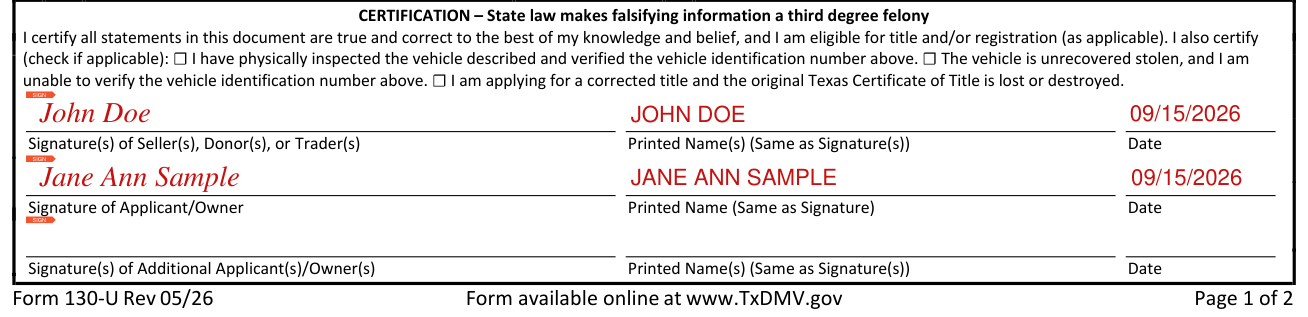
The applicant or owner, each seller, donor, or trader, and any additional owner of the vehicle indicated on the title or other ownership document each sign, print their name, and date the signature.
Common mistake: The completed form must contain the buyer's original signature.
You certify that all statements in this document are true and correct to the best of your knowledge and belief, and that you are eligible for title and/or registration (as applicable). By checking the box, if applicable, you also certify that you have physically inspected the vehicle described and verified the vehicle identification number above; that the vehicle is unrecovered stolen and you are unable to verify the vehicle identification number above; or that you are applying for a corrected title and the original Texas Certificate of Title is lost or destroyed.
State law makes falsifying information on this form a third degree felony.[2]
More rules for Form 130-U
You may use a reproduced or faxed copy of the application form.
A transfer fee is paid to transfer current registration to the new owner, in addition to the title application fee and other applicable fees.
If the registration is not current, full registration fees are due unless you are applying for Title Only.
Gifts, new Texas residents, sellers and other situations
The vehicle was a gift
The gift tax option may be used when a person receives a vehicle as a gift from an immediate family member, guardian, decedent's estate, or non-profit service organization qualifying under Internal Revenue Code Sec. 501(c)(3).
The eligible parties, as defined by Tax Code Section 152.025(a), are listed on Form 14-317.
A vehicle donated to, or given by, a non-profit service organization qualifying under IRC 501(c)(3) is also taxed as a gift.
Common mistake: For a gift, both the donor and the recipient must sign the Comptroller's joint affidavit (Form 14-317), and the donor or the recipient must file it with the title application in person.
Form 14-317 must be submitted in person by either the donor, the recipient or an authorized agent, with valid photo identification, to the county tax assessor-collector (CTAC).
An agent of the donor or recipient may file Form 14-317 in person, accompanied by a completed Power of Attorney form.
A motor vehicle title service may not file Form 14-317.
For Form 14-317, a reproduced copy of the non-appearing party's notarized signature is acceptable.
A transfer of a motor vehicle to another person without payment of consideration that does not qualify as a gift described above is a sale, and is subject to tax calculated on the vehicle's standard presumptive value.[2][4]
See Form 14-317.
You are new to Texas
New Texas residents are subject to a use tax on a vehicle brought into this state that was previously registered to the new resident in another state or foreign country.
This new resident tax is in lieu of the 6.25 percent use tax imposed on a Texas resident.
New residents applying for a Texas title and registration for a motor vehicle must file at a county tax assessor-collector's office within 30 days of establishing residency.
Texas law requires that any vehicle previously registered and titled or registered in another state or country must have its vehicle identification number verified before it may be registered in Texas.
The verification may occur through an emissions inspection performed by a state appointed inspection station, or through self-certification by the applicant on this form.
You are the seller
Provide the buyer with a properly signed title, including the date of sale and odometer reading, and a signed Application for Texas Title and/or Registration (Form 130-U) with the sales price clearly shown.
Failing to properly transfer a vehicle into the buyer's name could result in the seller being held responsible for tickets, toll violations or even crimes committed with the vehicle.
To ensure this does not happen to you, accompany the buyer to your county tax office to ensure a vehicle title application is filed.[3]
The sale is on a Saturday or Sunday
If the transaction takes place on a Saturday or Sunday and the seller chooses to remove their license plates and registration sticker from the vehicle, you will need to download a Vehicle Transit Permit, valid for five calendar days; only one permit may be issued per vehicle sale.[3]
The vehicle is awarded in a divorce
If a vehicle is awarded as a result of a divorce decree, give a certified copy of the decree to your county tax office and apply for title; if the decree does not award the vehicle, a properly assigned title (where your ex-spouse signed the title over to you) will be required.[3]
Death of a spouse
If your spouse had a will, the vehicle becomes part of the probate process; if your spouse did not have a will, you can fill out an Affidavit of Heirship for a Motor Vehicle (Form VTR-262).[3]
You are applying for Title Only
Title Only: license plates and registration insignia previously issued for this motor vehicle must be surrendered in accordance with Transportation Code §501.0275, if applicable, unless this vehicle displays a license plate under an applicable status of forces agreement.
These vehicles are not eligible for Title Only: construction machinery (unconventional vehicles), water well drilling units, machinery used exclusively for drilling water wells, construction machinery not designed to transport persons or property, implements of husbandry, farm equipment (including combines), golf carts, slow moving vehicles, or any vehicle with a suspended or revoked title.
You are applying for Registration Purposes Only or Nontitle Registration
Registration Purposes Only: do not surrender an original out of state title with this application.
A Texas title will not be issued for a vehicle applying for Registration Purposes Only.
For Registration Purposes Only, the receipt issued upon filing this application will serve as the registration receipt and proof of application.
Foreign vehicles applying for Registration Purposes Only must attach DOT Form HS-7 or U.S. Customs Form CF-7501 to indicate the vehicle is: 1) over 25 years old, or 2) complies with Federal Motor Vehicle Safety Standards, or 3) is being imported in the United States for a temporary period by a nonresident or a member of the armed forces of a foreign country on assignment in the U.S., and does not conform to the Federal Motor Vehicle Standards and cannot be sold in the U.S. Nontitle Registration: certain trailers, farm equipment, construction machinery, oil well servicing machinery, water well drilling units, etc. are either exempt from, or not eligible for title, but are eligible for, or required to, obtain registration or a specialty plate in order to operate on the highway.
Mark this box only when applicable.
A lien cannot be recorded on this type of application.
Common questions about Form 130-U
Who fills out Form 130-U Texas?
The applicant or owner, each seller, donor, or trader, and any additional owner of the vehicle indicated on the title or other ownership document each sign, print their name, and date the signature.[2]
Does Texas Form 130-U need to be notarized?
If the vehicle is a gift, the Affidavit of Motor Vehicle Gift Transfer (Form 14-317) must be properly completed and contain the signatures of all principal parties to the transaction, sworn to and subscribed in front of a notary public of Texas (or the equivalent from another state or jurisdiction) or a county tax assessor-collector (CTAC) or an employee of the CTAC, pursuant to Government Code Section 602.002.[4]
Do both parties have to be present to transfer a title in Texas?
If buying from an individual, have the seller accompany you to the county tax office to avoid unwanted surprises. Before submitting the title application, a tax office representative can tell you if the title being signed over to you is correct and if it has any salvage or legal issues. The seller's signature may be a reproduced or faxed copy.[3]
What paperwork do I need to transfer a title in Texas?
In addition to the title, ask the seller to provide you with the signed vehicle title, the Application for Texas Title and/or Registration (Form 130-U), and any other supporting documents, such as a release of lien or a power of attorney. You must provide proof of liability insurance when you title and register your vehicle. The Vehicle Inspection Report (VIR), proof of a safety inspection (commercial vehicle) or emissions inspection, must be provided if a record of current inspection is not in the state database.[3]
Can I submit Form 130-U online?
Submit the completed form to a county tax assessor-collector's office with any required application fee, supporting documents, registration fee (if applicable), and any motor vehicle tax due. If you buy your vehicle from a dealer, the dealer is required to file the title application on your behalf, so you will not have to visit the tax office.[3]
How much does it cost in Texas to do a title transfer?
A 6.25 percent motor vehicle sales and use tax is imposed on the sales price (less trade-in allowance) of motor vehicles for use in Texas, or of a motor vehicle purchased outside the state and later brought into this state by a Texas resident. Standard Presumptive Value (SPV) applies to private-party sales of most used motor vehicles purchased in or brought into Texas. The tax is computed on the greater of the sales price or 80 percent of the SPV on the day of title application. The title, registration and local fees are also due. Contact your county tax office to estimate the amount of sales tax due and to learn which forms of payment are accepted. The form prints the box $28 or $33 Application Fee for Texas Title (Contact your county tax assessor-collector for the correct fee.)[3]
How long does a Texas title transfer take?
Allow a minimum of 20 business days for processing of your title application. If there is a lien on the vehicle, the lienholder will receive the title. If you have not received your title within 30 business days, contact TxDMV.[3]
Is there a deadline?
Vehicles are required to be titled in the buyer's name within 30 days from the date of sale. Pay the sales and use tax to the county tax assessor-collector within 30 days from the date of purchase or entry of the vehicle into Texas.[3]
Is there a penalty for filing late?
If the tax or surcharge is paid from 1 to 30 calendar days late, a late penalty equal to 5 percent of the tax is charged. If more than 30 calendar days late, the penalty is 10 percent of the tax, and there is a minimum penalty. In addition to the late tax payment penalty, the Texas Transportation Code provides an escalating delinquent transfer penalty for failure to apply for title within 30 days from the date of title assignment.
Where to get help with Form 130-U
For details, contact the Texas Department of Motor Vehicles at 1-888-368-4689 or 512-465-3000.
For assistance completing this form, contact your county tax assessor-collector.
For information about motor vehicle sales and use tax or emission fees, contact the Texas Comptroller of Public Accounts, Tax Assistance Section, at 1-800-252-1382 (toll free nationwide) or 512-463-4600.
For title or registration information, contact your county tax assessor-collector or the Texas Department of Motor Vehicles at 1-888-368-4689 or 512-465-3000.
Sources
[1] Form 130-U (Rev 05/26), Texas Department of Motor Vehicles (the Official source link on this page).
[3] TxDMV, Buying or Selling a Vehicle (txdmv.gov). Accessed October 1, 2026.
[4] Texas Comptroller, Form 14-317, Affidavit of Motor Vehicle Gift Transfer. Accessed October 1, 2026.