
A 60-day notice to vacate is a form used by a landlord to demand the tenant to move out of the rental property. It puts the end of the tenancy in writing and tells the tenant when to leave. Fill out this 60 day notice to vacate online, then save it as a PDF or print it for your tenant.
Last Updated: October 2026. This guide is reviewed and updated regularly to reflect current law. If you notice an error or outdated information, please contact us.
Build Your Document
Answer a few simple questions to make your document in minutes
Save and Print
Save progress and finish on any device, download and print anytime
Sign and Use
Your valid, lawyer-approved document is ready
A 60-day notice can be required to be given when a tenant has been living at the property for more than one year. If the tenant has been living at the property for less than one year, then only a 30-day notice is required to be given to ask the tenant to vacate.
While no particular reason is required to be given while sending this notice, it is commonly sent for non-payment of rent, breach of the lease agreement, or for conducting illegal activities at the property.
In California and Delaware, a landlord must give 60 days to end a periodic (for example, month-to-month) tenancy. The requirements of this notice are:
The notice period is the number of days a tenant has before the tenancy ends. In 10 of the 50 jurisdictions FormsPal's verified state data covers, the notice to end a periodic tenancy without a reason is stated in days and runs from 5 to 30 days, depending on the jurisdiction. In 3 others it is stated in months and runs from 1 to 3 months.
| Document Name | 60-Day Eviction Notice to Vacate Form |
| Other Names | 60-Day Notice to Quit, Sixty-Day Eviction Notice |
| Avg. Time to Fill Out | 13 minutes |
| # of Fillable Fields | 55 |
| Available Formats | Adobe PDF |

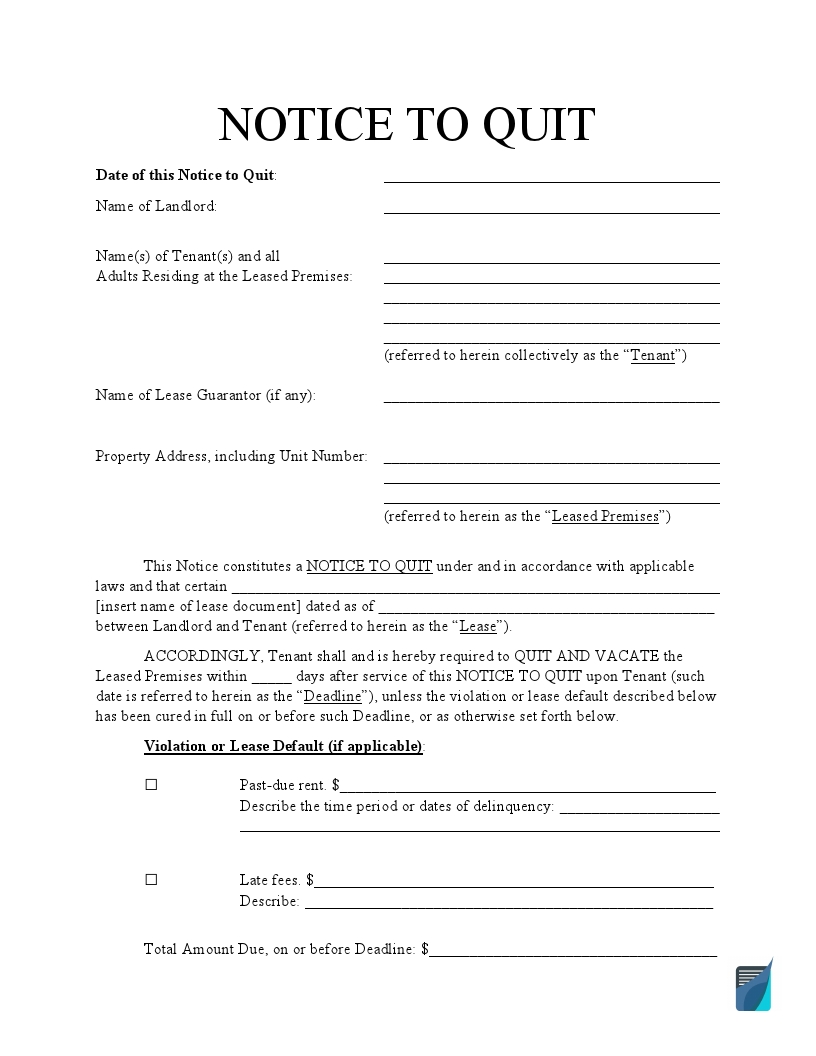
FormsPal’s customizable and easy-to-use eviction notice template can be filled out by following these simple steps. Have your lease, the tenant's legal name and the termination date in front of you before you start. The finished notice works like a formal letter to the tenant. If you download the PDF instead of filling in the form online, you can complete it with FormsPal's PDF editor.
Notice Period
Fill out the notice period as 60 in all blanks where “_ Day Notice” is mentioned.
Date
Fill out the notice date. Enter the date correctly, as the sixty-day period will be calculated based on this date.
Party Details
Enter the full legal name of the landlord, tenant(s), and lease guarantor (if any), as mentioned in the corresponding lease agreement.
Property Location
Fill out the full address of the leased property, including the state, city, and zip code.
Lease Details
Fill out the date of the original lease contract. If you are unable to recall it, check the original contract to avoid mistakes.
Select and Describe the Reason
Select the reason for sending the notice. If the reason is the conduct of illegal activities, select option one. Mention in short the kind of illegal activities and how you came to know about them.
In case the reason is violations of the lease, select option two. Describe the violations made and point to the clauses from the contract that contain the terms in question. For example, if there was an unauthorized stay of guests at the property, mention the clause from the agreement forbidding it.
And if the reason is nonpayment of rent, select option three and specify the total amount due and the due date.
Select the Follow Up Action and Cure
If the reason for sending the notice is criminal activities at the property, select the first option and the number of days within which the property should be vacated.
If the basis for sending the notice is violations of the lease, choose the second option, mention what the tenant can do to cure the violation and how much time they have.
If you are sending the notice for nonpayment of rent, select the third option, specify the total amount owed, and state the closing date by which the payment must be delivered.
Enter the Notice Serving Details
In the last part, enter all the details relating to the service of the sixty-day notice, mention the landlord’s name, and if an authorized representative is sending the notice, mention his or her name.
Pick the method of delivery and specify the forwarding address and names of all the tenants. Sign the notice, enter the state and county and get it notarized if there is such a requirement in your state.
The form asks you to pick one of three reasons: illegal activity, a lease violation or unpaid rent. Here is what FormsPal's verified data for 49 states and DC shows for each reason.
To count a notice period in calendar or business days, use FormsPal's deadline calculator.
Once the notice is signed, the next job is delivery. 35 of the 50 jurisdictions FormsPal's verified state data covers have rules on how a notice must be written and served. Check the rules for your area before you send it.
Landlords typically serve the notice in person, by mail or by posting it at the rental property. These delivery methods each leave a different record, so pick the one that gives you the clearest proof.
A short review before delivery can save you from sending a notice twice. Read the finished notice once more against your lease and the rental property, then confirm each item on this list.
If the tenant agrees to leave sooner, a lease termination letter can record the new move-out date in writing.
After the notice is sent, if the tenant paid the due rent in full, the landlord cannot proceed with eviction. If the tenant pays only a part of the whole amount owed, it is the landlord’s choice to accept it or not. If accepted, this partial payment will be viewed as partial assent, so the eviction is stopped.
Likewise, if the rental contract violations have been addressed in full, the landlord cannot evict the tenant. If the tenant made only partial amendments, it is the landlord’s discretion to accept or reject it.
If no payment of due rent is made or if the lease violations are not addressed by the tenant, then legal action can be taken against the tenant. Similarly, for the conduct of illegal activities, if the property is not left by the tenant within the time mentioned, then court action may be initiated to forcibly evict the tenant.
In California, a landlord can file an “unlawful detainer” to initiate legal proceedings. In Delaware, an action for “summary possession” can be initiated against the tenant.
Once the notice period has passed, the next steps depend on where the property is. FormsPal's verified data for 49 states and DC shows the following.
A tenant who receives a notice to vacate has a few practical options. The notice asks the tenant to leave the premises by a set date. The first step is to read it closely and compare it with the lease. Then the tenant can decide whether to move out, ask the landlord questions or look for legal help.
A tenancy that runs month to month renews itself each month until the landlord or the tenant ends it. A fixed-term lease runs until a set end date. The type of tenancy is one of the first things to check before you pick a notice to terminate it.
Once the notice is filled out, landlords often ask how long a tenant has to fix a problem, which notice fits a short tenancy and whether the tenant can stop the process by paying. Short answers follow. Rules differ from place to place, so check the rules for your area before you act.
32 of the 50 jurisdictions FormsPal's verified data covers have a rule that gives the tenant time to fix a lease violation after the notice. Where the cure period is stated in days (25 jurisdictions), it runs from 3 to 30 days, depending on the jurisdiction.
In 4 of the 50 jurisdictions covered, a tenant has a right of redemption, which lets the tenant stop the eviction by paying the amount owed after proper notice. Elsewhere, whether the landlord has to accept the payment depends on the jurisdiction.
General information, not legal or tax advice.
