Please rate 9 Line Medevac

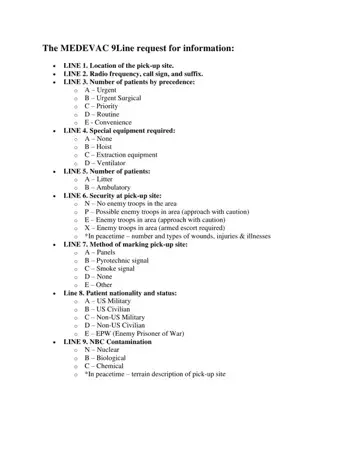
The 9-Line MEDEVAC report is a standardized nine-line radio transmission used to request a military medical evacuation. Issued in a strict order, each line gives the responding medevac aircraft crew the information they need to respond safely and effectively. Below is a complete breakdown of all nine lines.
Provide the six-digit or eight-digit military grid reference for the landing zone (LZ). Grid accuracy is the single most critical element of the transmission. An error of even a few digits can send the aircraft to the wrong location or into enemy-controlled terrain. Always confirm the grid on a map before transmitting.
List the FM frequency the ground unit will monitor during the evacuation, followed by the unit's call sign and any suffix. The medevac crew uses this to contact the requesting unit as they approach, to get updated guidance, smoke color confirmation, or a visual wave-off if conditions change on the ground.
State how many patients require evacuation at each priority level. The five precedence categories are listed below.
Indicate any equipment the aircraft must carry to complete the mission. Options include a hoist for vertical lift when the LZ is not accessible, a jungle penetrator, a stokes litter, a backboard, or a ventilator. If no special equipment is needed, transmit the code for "None."
Report the number of litter patients (non-ambulatory, requiring a stretcher) and ambulatory patients (walking wounded who can board the aircraft unaided). This information helps the crew prepare the cabin layout and estimate total load weight for the flight.
Use the following single-letter codes to describe the threat level at the LZ.
When transmitting over an unsecured radio frequency, substitute color words for letters to prevent misunderstanding: N = black, P = white, E = yellow, X = red.
Tell the inbound crew how the LZ will be visually identified. Approved marking methods include panels, colored smoke, pyrotechnics, lights, a signal mirror, a VS-17 panel, or an infrared strobe for night operations. When smoke is used, the aircraft crew calls out the color they observe rather than the ground unit announcing it first. This prevents enemy forces from triggering a false smoke signal to lure the aircraft off course.
Classify patients by nationality and status using the following codes.
This classification determines triage priority, medical protocols, and legal reporting requirements for the receiving medical treatment facility.
In nuclear, biological, or chemical (NBC) environments, report the type of contamination present: N for nuclear, B for biological, C for chemical. In a non-NBC environment, use this line to provide a brief terrain description of the landing zone instead. Never report "gas" unless NBC contamination is confirmed. A false contamination report triggers a full MOPP gear response from the crew, significantly delaying the evacuation.
An accurate transmission saves time and protects the responding crew. Keep the following points in mind before calling for a medevac.
For unexploded ordnance incidents, soldiers should also know the 9-Line UXO Report, which applies the same nine-line structure to reporting and requesting disposal support for unexploded ordnance. Other commonly needed Army reference forms include the Army Leaders Book and the Army Risk Assessment Form.
| Question | Answer |
|---|---|
| Form Name | 9 Line Medevac |
| Form Length | 1 pages |
| Fillable? | No |
| Fillable fields | 0 |
| Avg. time to fill out | 15 sec |
| Other names | 9 line medevac smart card printable, line medevac form, printable 9 line medevac pocket card, 9 medevac form |
9 Line Medevac isn’t the one you’re looking for?
Please rate 9 Line Medevac