
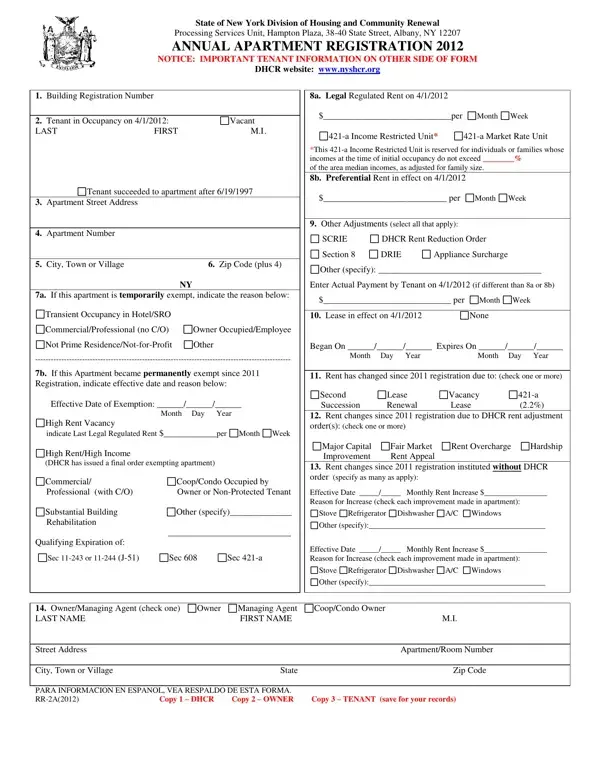

Form RR-2A at a glance
What it is: ANNUAL APARTMENT REGISTRATION 2012 of the State of New York Division of Housing and Community Renewal.
Who signs: Enter the Building Registration Number and the Apartment Number. By signing you affirm under penalties provided by law that every statement in this form is complete and accurate, to the best of your knowledge and belief. Sign as Signature of Owner with the Date. If other than owner: Signature, Date and Title. Agent may sign acting on behalf of the owner.
For the 2012 Annual Apartment Registration, owners of buildings subject to rent regulation must annually register the buildings and tenants are provided a copy for review.
A filled-in Form RR-2A example: an owner registers an occupied apartment
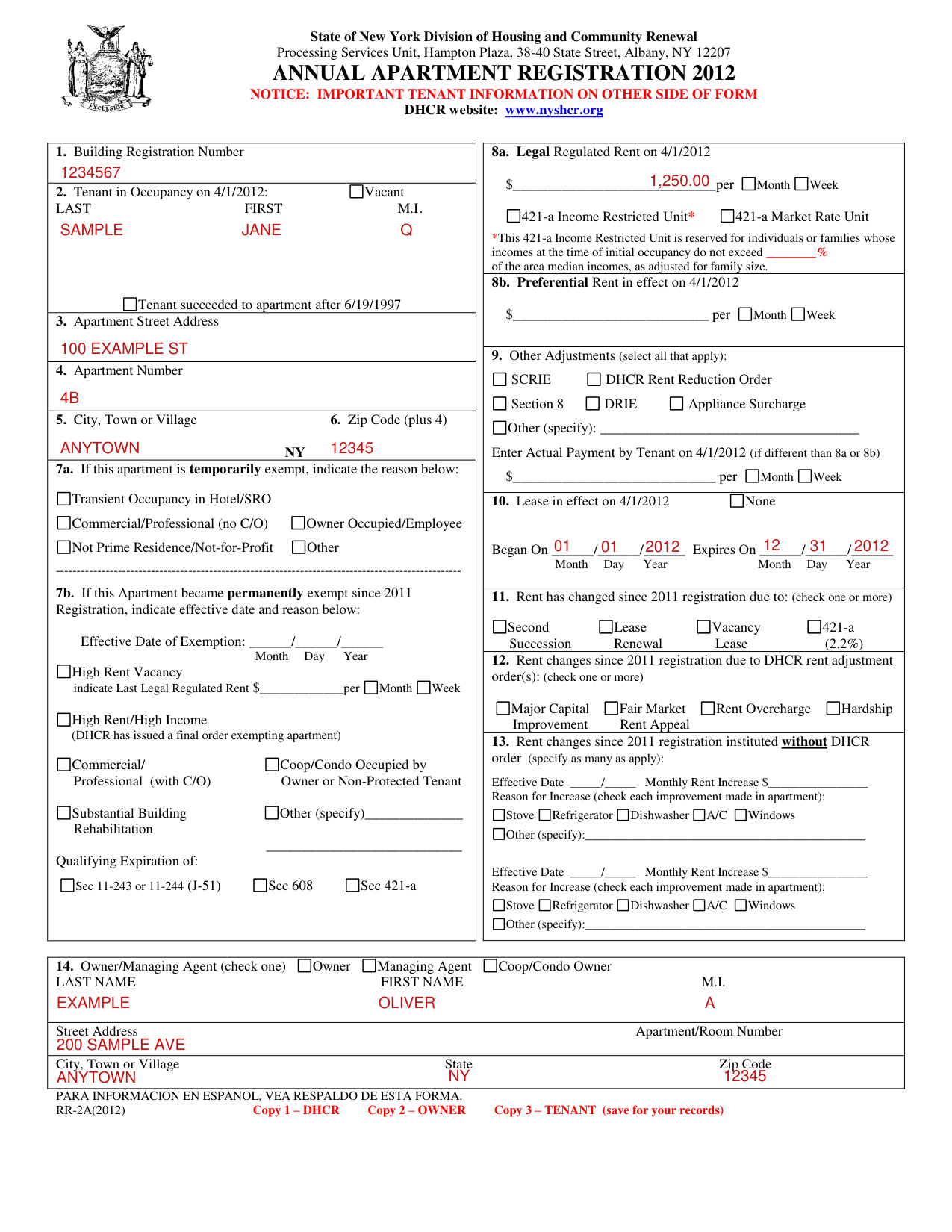
How to fill out Form RR-2A, box by box
Building registration number, tenant, address and rents
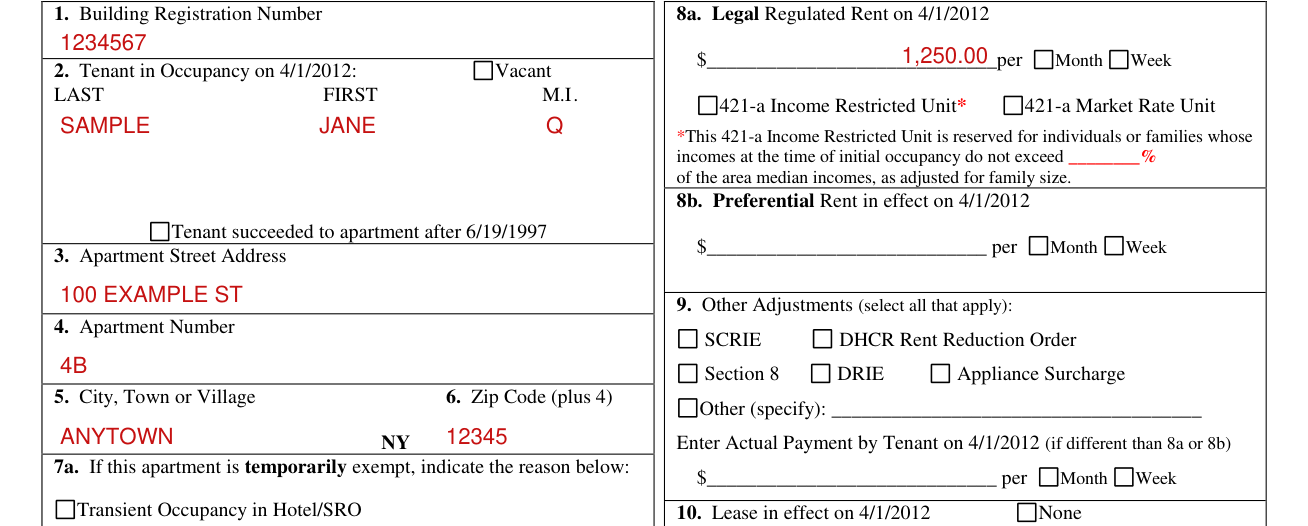
Enter the Building Registration Number in box 1. In box 2, enter the Tenant in Occupancy on 4/1/2012 with LAST, FIRST and M.I., or mark Vacant.
Enter the Apartment Street Address in box 3, the Apartment Number in box 4, the City, Town or Village in box 5 and the Zip Code (plus 4) in box 6. Check the box Tenant succeeded to apartment after 6/19/1997 if it applies.
8a. Enter the Legal Regulated Rent on 4/1/2012 per Month or Week, and check 421-a Income Restricted Unit or 421-a Market Rate Unit only for a 421-a unit. 8b. Enter the Preferential Rent in effect on 4/1/2012 per Month or Week.
9. Other Adjustments (select all that apply): SCRIE, DHCR Rent Reduction Order, Section 8, DRIE, Appliance Surcharge or Other (specify). Enter Actual Payment by Tenant on 4/1/2012 (if different than 8a or 8b) per Month or Week.
If this apartment is exempt, and rent changes since 2011 registration
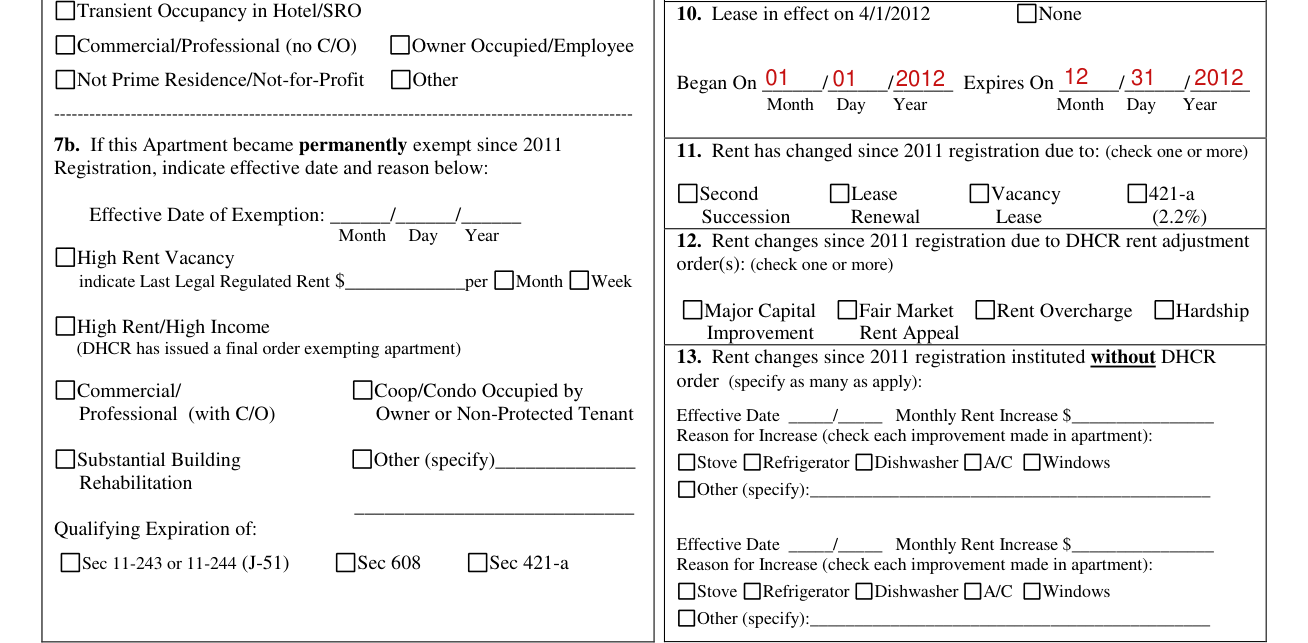
7a. If this apartment is temporarily exempt, indicate the reason: Transient Occupancy in Hotel/SRO, Commercial/Professional (no C/O), Owner Occupied/Employee, Not Prime Residence/Not-for-Profit or Other.
7b. If this Apartment became permanently exempt since 2011 Registration, indicate effective date and reason, with the Effective Date of Exemption as Month Day Year. The reasons are High Rent Vacancy, High Rent/High Income (DHCR has issued a final order exempting apartment), Commercial/Professional (with C/O), Coop/Condo Occupied by Owner or Non-Protected Tenant, Substantial Rehabilitation and Other (specify). For High Rent Vacancy, indicate Last Legal Regulated Rent per Month or Week.
10. Lease in effect on 4/1/2012: None, or Began On and Expires On, each as Month Day Year.
Second Lease, Vacancy, 421-a, Succession and Renewal Lease (2.2%) (check one or more) when rent has changed since 2011 registration. 12. Rent changes since 2011 registration due to DHCR rent adjustment order(s): (check one or more)
Check Major Capital Improvement, Fair Market Rent Appeal, Overcharge or Hardship. 13. Rent changes since 2011 registration instituted without DHCR order (specify as many as apply): enter the Effective Date and the Monthly Rent Increase, and check each improvement made in apartment as the Reason for Increase: Stove, Refrigerator, Dishwasher, A/C, Windows or Other (specify).
Owner/Managing Agent
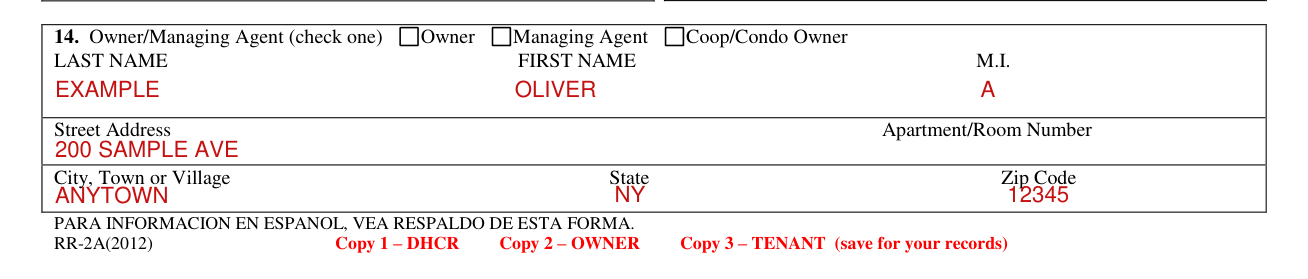
14. Owner/Managing Agent (check one): Owner, Managing Agent or Coop/Condo Owner, with LAST NAME, FIRST NAME, M.I., Street Address, Apartment/Room Number, City, Town or Village, State and Zip Code. RR-2A(2012) has Copy 1 - DHCR, Copy 2 - OWNER and Copy 3 - TENANT (save for your records).
Certification and signing
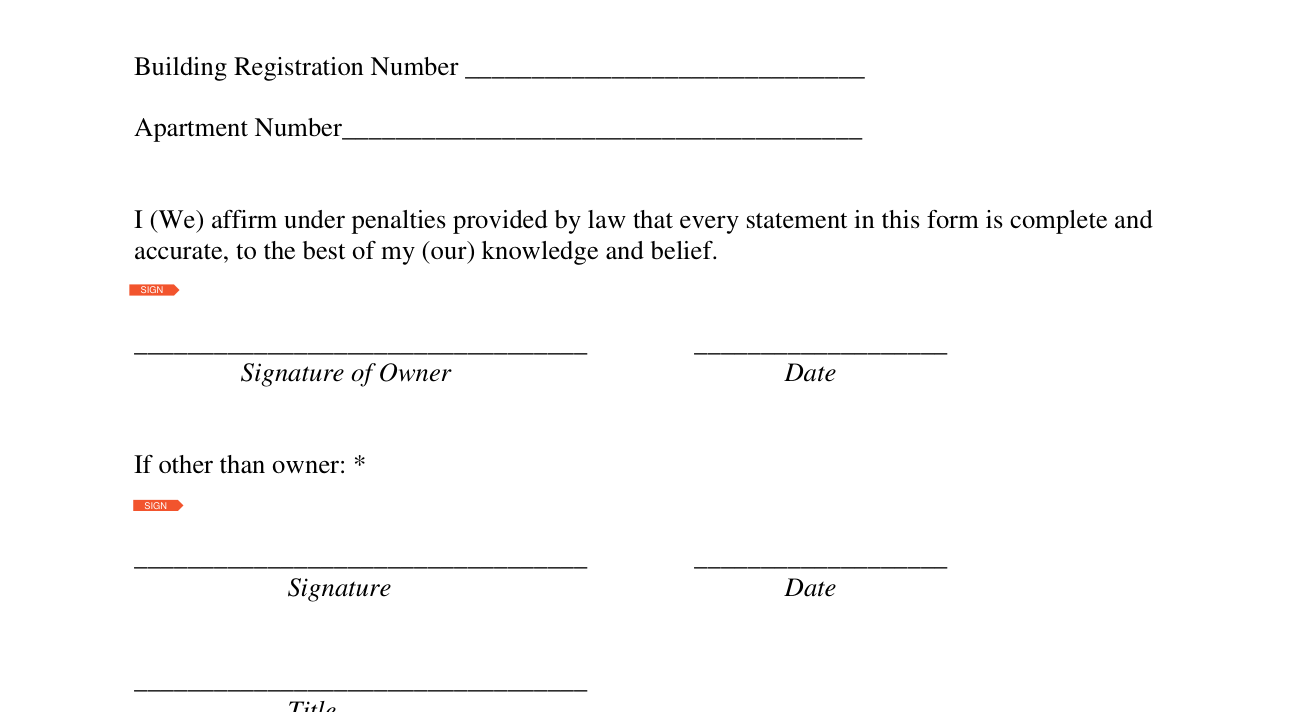
15. By signing you certify that you are maintaining and will continue to maintain all services furnished or required to be furnished to these premises/housing accommodations by any law, ordinance or regulation applicable to the premises/housing accommodations.
More rules for Form RR-2A
To obtain a registration rent history of your apartment and Fact Sheet #26 - Guide to Rent Increases, call the Rent Infoline at (718)739-6400.
Upon review, if you believe that the rent being registered (see Item 8a) is excessive and not lawful (even if you are paying a lower/preferential rent - see Item 8b), discuss it with your building owner.
If you are paying a preferential rent, you should be aware that the owner may have the right to collect the higher legal regulated rent upon renewal of your lease.
Individual Apartment Improvements (see Item 13) made when the apartment is vacant (see box 11) do not require DHCR review and approval. However, the rent increase for the improvements is limited to 1/40 of the cost in buildings with 35 units or less or 1/60 of the cost in buildings with more than 35 units.
You can ask the owner to provide you with documentation that substantiates the cost of the improvements and the related rent increase calculations.
If you are not satisfied with the owner's responses and believe the rent is excessive and not lawful, you can file a complaint of Rent Overcharge. In general, a complaint of Rent Overcharge is limited to an examination of the apartment's rent history only for the four (4) years preceding the filing date of the complaint.
A rent that is not challenged by a tenant within four (4) years and modified by a DHCR order becomes the legal regulated rent.
Additional information on protecting tenants' rights is available by calling the Rent Infoline at 718-739-6400 (translation is available in over 100 languages), visiting a Borough/District Rent Office or accessing the website at www.nyshcr.org (translation is available in several languages).
Sources
[1] Form RR-2A (2012), Annual Apartment Registration, New York State Division of Housing and Community Renewal (the Official source link on this page).