
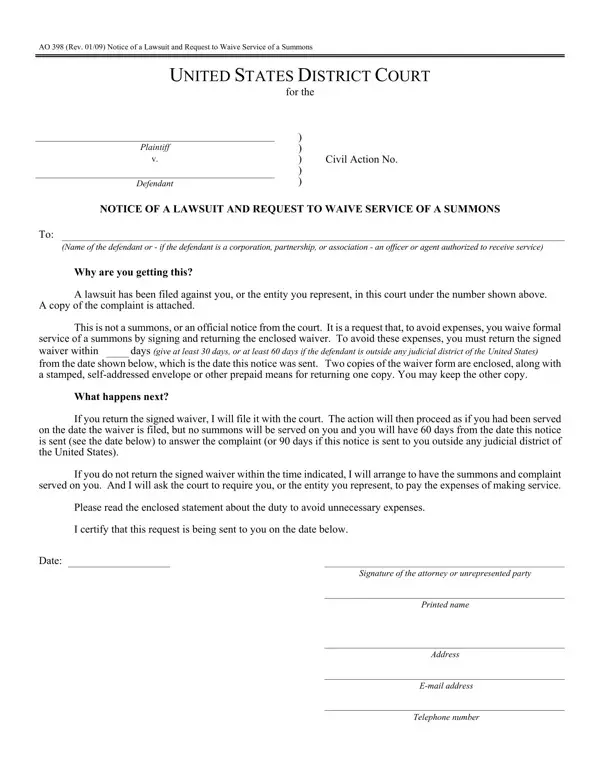
How to Fill Out the AO 398 Form
Follow these instructions to complete the AO 398 form correctly for use in a federal civil court case:
- Identify the court and case number. Enter the name of the federal district court and the assigned case number at the top of the notice.
- Enter plaintiff and defendant names. Write the full legal names of all parties involved in the civil lawsuit. Include any co-plaintiffs or co-defendants.
- Set the response deadline. Domestic defendants must return the signed waiver within at least 30 days from the date the notice was sent. Defendants located outside the United States have at least 60 days to respond.
- Attach the complaint and waiver copies. Include two copies of the waiver of service form along with a copy of the complaint so the defendant has all the information needed to make their decision.
- Send the completed form. Mail the notice to the defendant by first-class postal service or another reliable delivery method. Keep a record of the date the notice was sent.
- Record the outcome. If the defendant signs and returns the waiver, file it with the court. The court will then proceed with the case under the extended answer deadline. If the defendant refuses, proceed with formal service of the summons.
What Happens After the Defendant Returns the Waiver?
Once the defendant signs and returns the waiver of service, the court records the waiver and the defendant receives additional time to answer the complaint. A domestic defendant typically has 60 days from the date the notice was sent to file a response. A defendant located outside the United States has 90 days to answer. This extended timeline benefits defendants who need more time to consult legal counsel and prepare their response to the lawsuit.
If the defendant refuses to waive service without good cause, the court may require that defendant to pay the costs of formal service incurred by the plaintiff. This incentivizes defendants to cooperate with the waiver request process and helps reduce unnecessary litigation costs for both parties.
Frequently Asked Questions
What is the difference between AO 398 and AO 440?
The AO 398 is the notice requesting voluntary waiver of service, while the AO 440 Summons form is the official court-issued summons used when a defendant must be formally served with legal process in a federal civil case. The AO 398 is used first as an optional cost-saving measure.
Can a defendant refuse to waive service?
Yes, a defendant may refuse without waiving any objections to personal jurisdiction, subject matter jurisdiction, or venue. However, if the court finds the refusal was without good cause, it may order the defendant to pay the costs the plaintiff incurred to complete formal service.
Is the AO 398 form required?
No. Plaintiffs may use the waiver request as an alternative to formal service. It is optional but encouraged because it reduces litigation costs and simplifies the service process for both parties. If the defendant agrees, the plaintiff avoids the expense and delay of formal process service.
Where can I find related court forms?
For additional federal court documents, see the Waiver of Service Form and the US Courts Form 271, which are commonly used alongside the AO 398 in federal civil proceedings.
