

Form 7002 at a glance
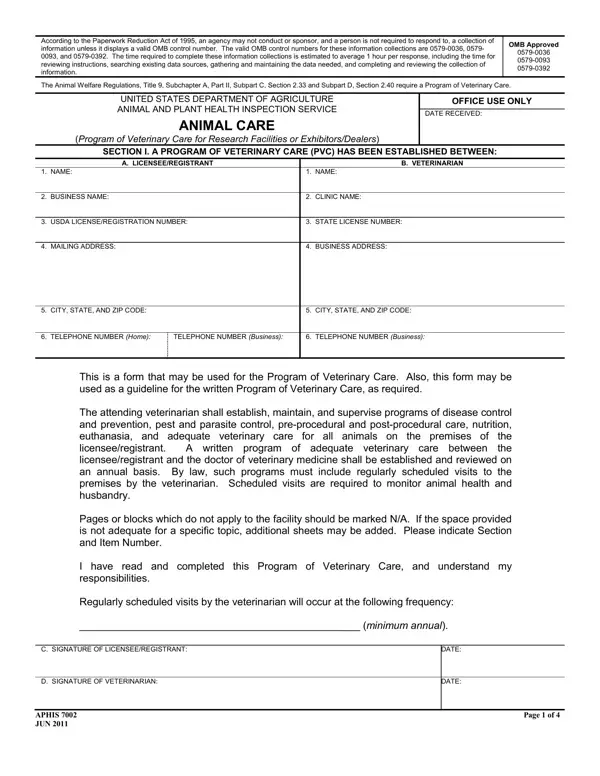
What it is: APHIS Form 7002 is the Animal Care Program of Veterinary Care between the licensee/registrant and the doctor of veterinary medicine.
A written program of adequate veterinary care between the licensee/registrant and the doctor of veterinary medicine shall be established.
This optional form or an equivalent format may be used to meet the requirement for a written Program of Veterinary Care.
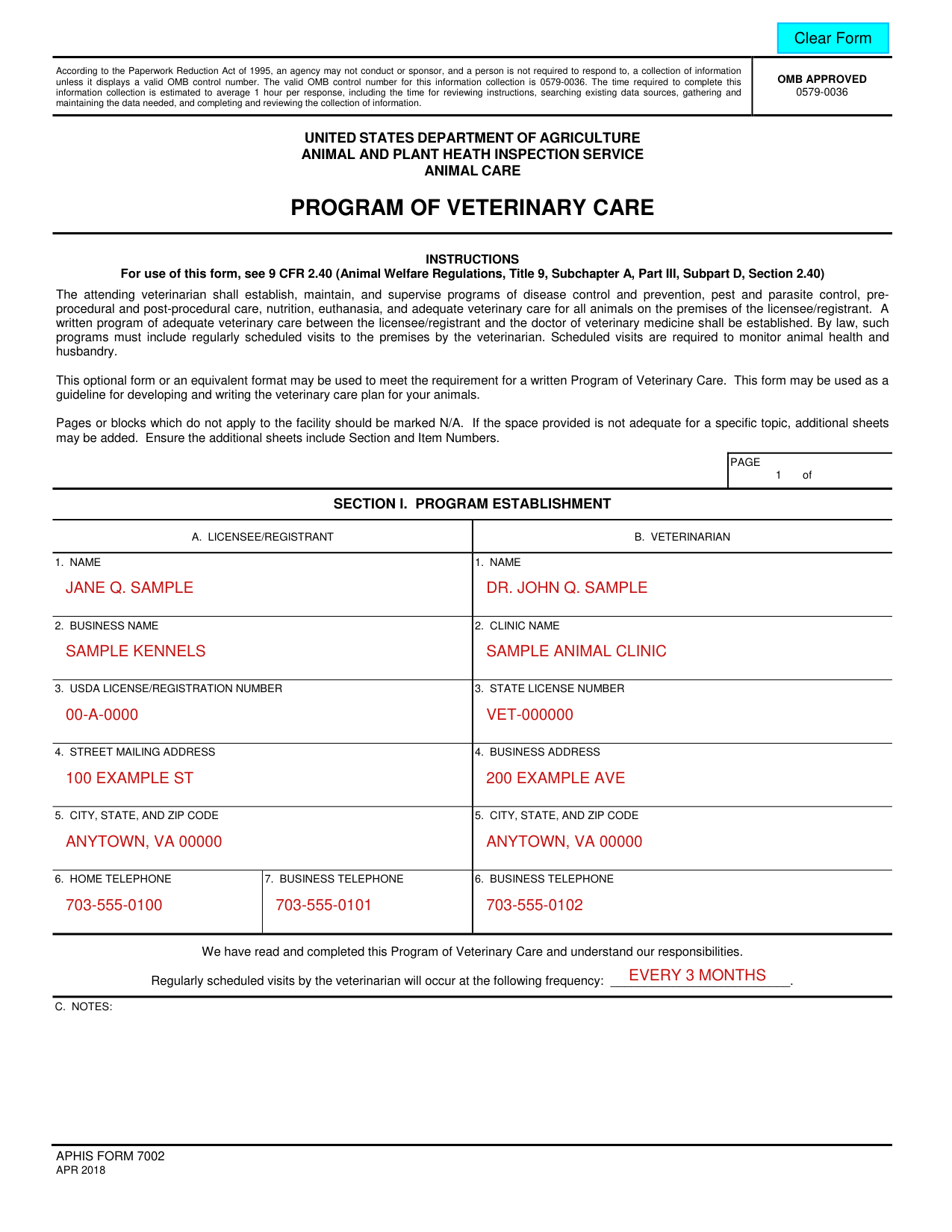
A filled-in Form 7002 example: a kennel licensee fills out Sections I to IV
How to fill out Form 7002, box by box
Section I: Program Establishment
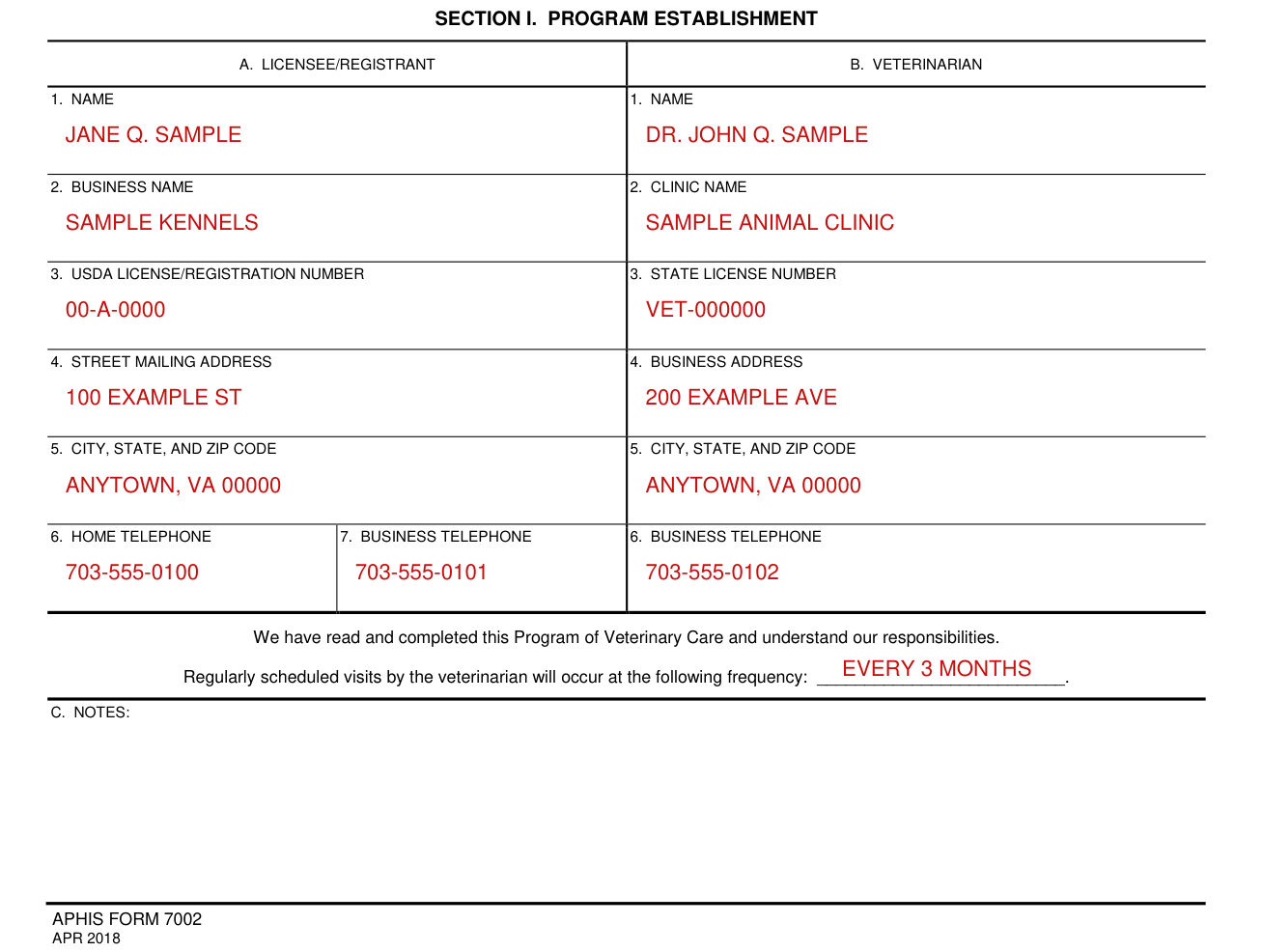
In Section I, Program Establishment, A. Licensee/Registrant, enter 1. Name, 2. Business Name, 3. USDA License/Registration Number, 4. Street Mailing Address, 5. City, State, and Zip Code, 6. Home Telephone and 7. Business Telephone.
In Section I, Program Establishment, B. Veterinarian, enter 1. Name, 2. Clinic Name, 3. State License Number, 4. Business Address, 5. City, State, and Zip Code and 6. Business Telephone.
In Section I, Program Establishment, enter the frequency at which regularly scheduled visits by the veterinarian will occur.
In Section I, Program Establishment, enter notes under C. Notes.
Section II: Dogs and Cats, A. Vaccinations
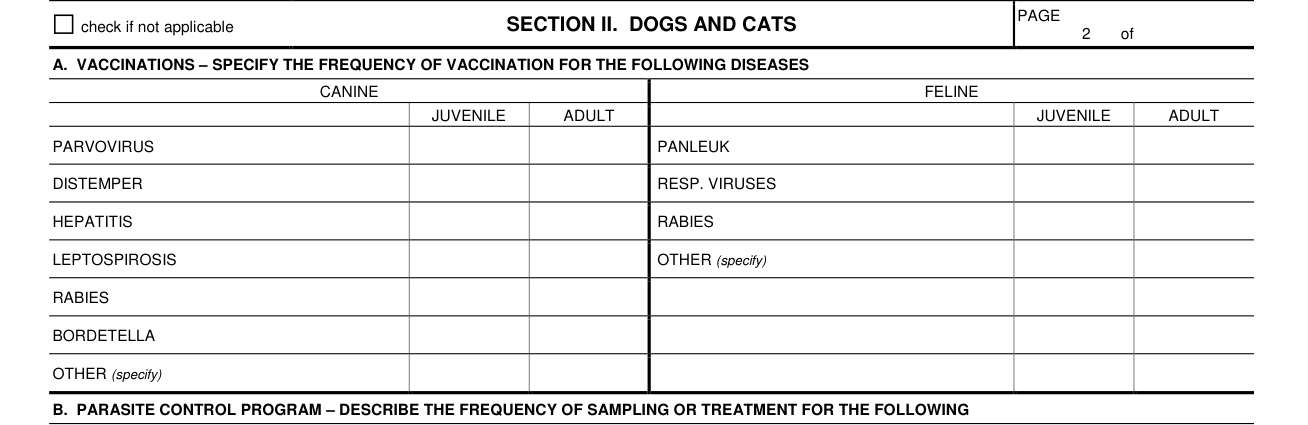
In Section II, Dogs and Cats, check if not applicable.
In Section II, A. Vaccinations, specify the frequency of vaccination for diseases, juvenile and adult: for canine, parvovirus, distemper, hepatitis, leptospirosis, rabies, bordetella and other (specify); for feline, panleuk, resp. viruses, rabies and other (specify).
Section II: B. Parasite Control Program to E. Additional Program Topics
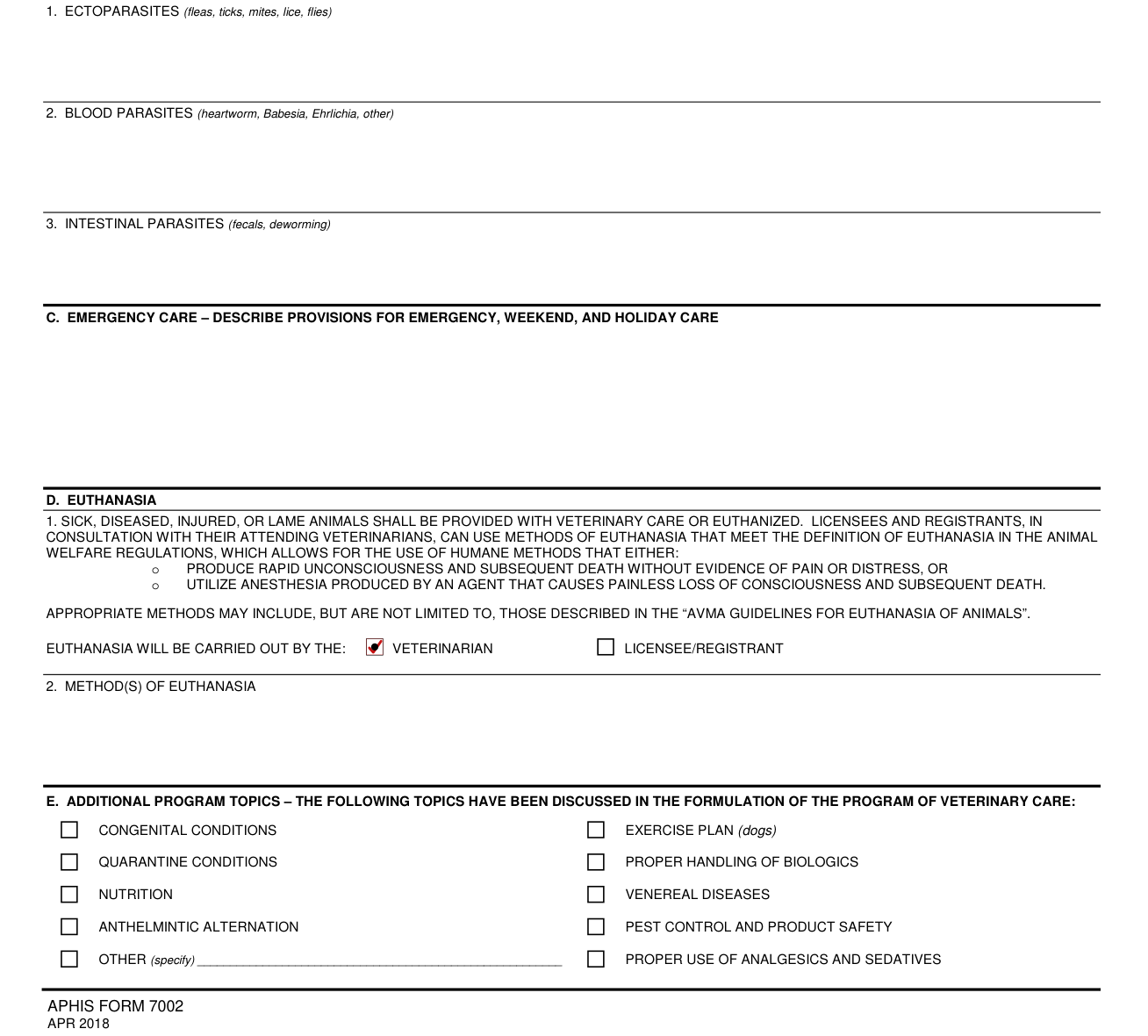
In Section II, B. Parasite Control Program, describe the frequency of sampling or treatment for the following: 1. Ectoparasites (fleas, ticks, mites, lice, flies), 2. Blood Parasites (heartworm, Babesia, Ehrlichia, other) and 3. Intestinal Parasites (fecals, deworming).
In Section II, C. Emergency Care, describe provisions for emergency, weekend, and holiday care.
In Section II, D. Euthanasia, sick, diseased, injured, or lame animals shall be provided with veterinary care or euthanized.
In Section II, D. Euthanasia, Euthanasia will be carried out by the: Veterinarian or Licensee/Registrant; also enter 2. Method(s) of Euthanasia.
In Section II, E. Additional Program Topics discussed in the formulation of the Program of Veterinary Care: congenital conditions, exercise plan (dogs), quarantine conditions, proper handling of biologics, nutrition, venereal diseases, anthelmintic alternation, pest control and product safety, other (specify) and proper use of analgesics and sedatives.
Section III: Wild and Exotic Animals
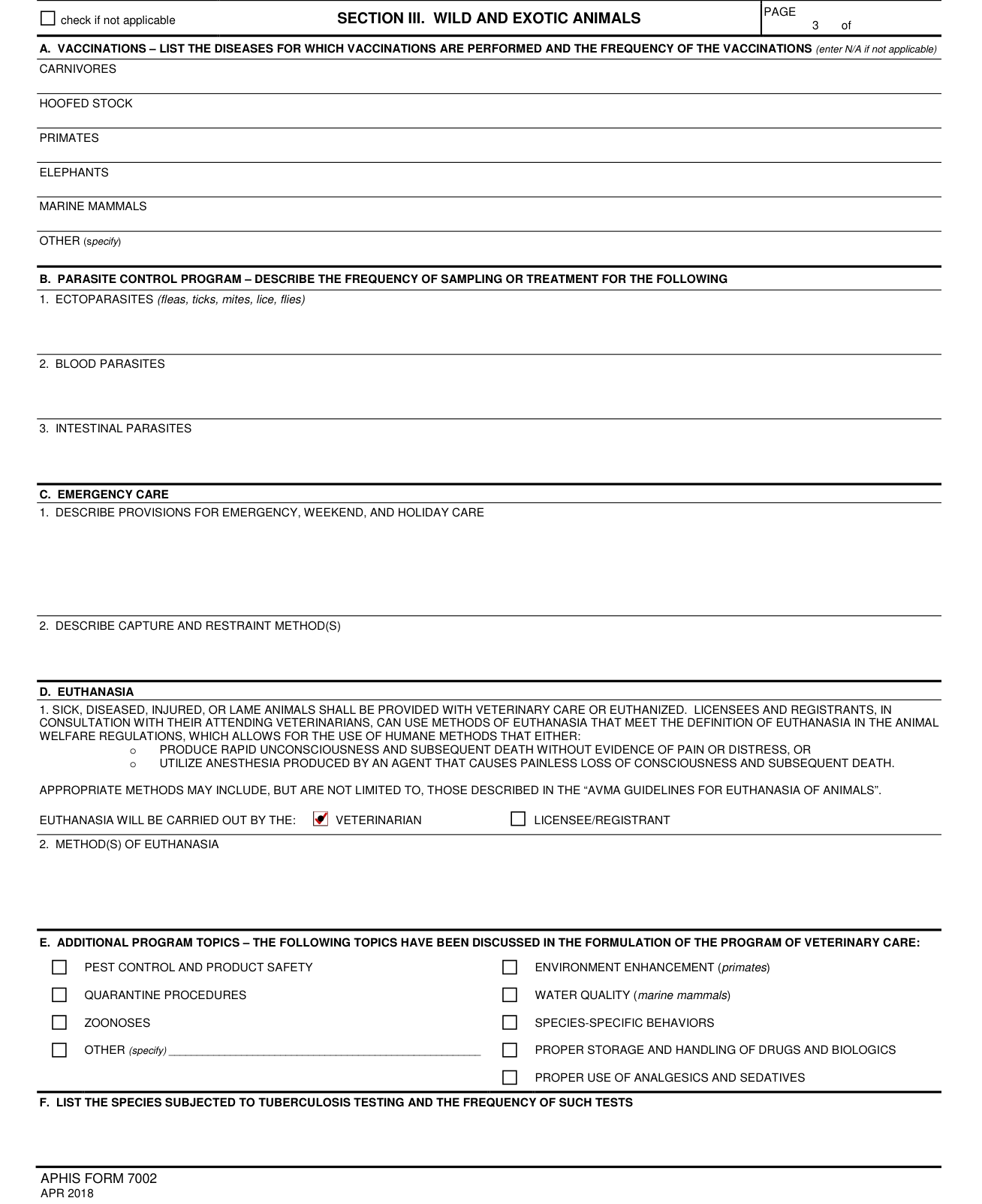
In Section III, Wild and Exotic Animals, check if not applicable.
In Section III, A. Vaccinations, list the diseases for which vaccinations are performed and the frequency of the vaccinations (enter N/A if not applicable) for carnivores, hoofed stock, primates, elephants, marine mammals and other (specify).
In Section III, describe the frequency of sampling or treatment for Ectoparasites (fleas, ticks, mites, lice, flies), Blood Parasites and Intestinal Parasites, under B. Parasite Control Program.
In Section III, C. Emergency Care: 1. describe provisions for emergency, weekend, and holiday care and 2. describe capture and restraint method(s).
In Section III, mark Veterinarian or Licensee/Registrant for D. Euthanasia and enter 2. Method(s) of Euthanasia.
In Section III, E. Additional Program Topics discussed in the formulation of the Program of Veterinary Care: pest control and product safety, environment enhancement (primates), quarantine procedures, water quality (marine mammals), zoonoses, species-specific behaviors, other (specify), proper storage and handling of drugs and biologics and proper use of analgesics and sedatives.
In Section III, F. List the species subjected to tuberculosis testing and the frequency of such tests.
Section IV: Other Warmblooded Animals
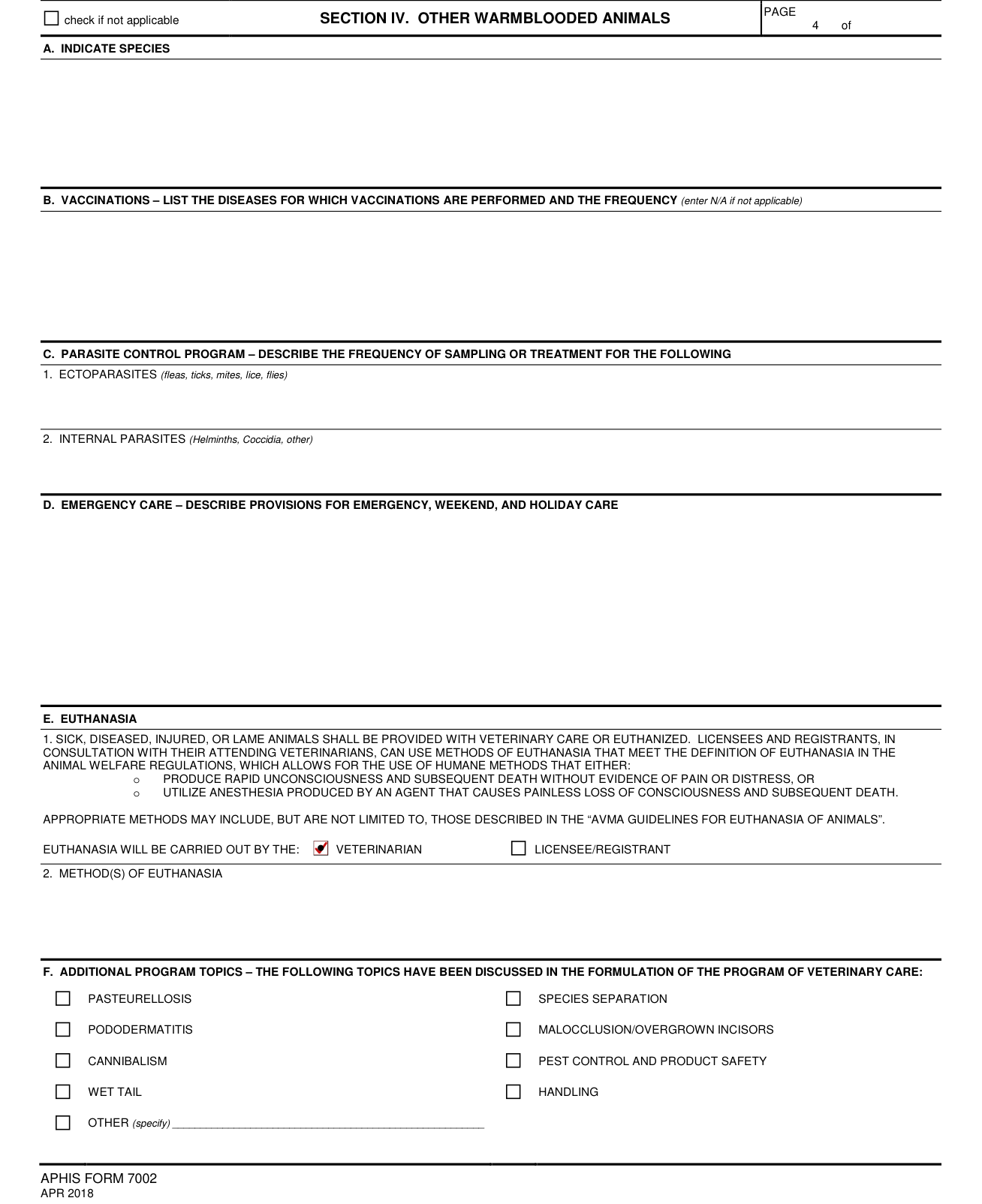
In Section IV, Other Warmblooded Animals, check if not applicable.
In Section IV, A. Indicate species.
In Section IV, B. Vaccinations, list the diseases for which vaccinations are performed and the frequency (enter N/A if not applicable).
In Section IV, describe the frequency of sampling or treatment for Ectoparasites (fleas, ticks, mites, lice, flies) and Internal Parasites (Helminths, Coccidia, other), under C. Parasite Control Program.
In Section IV, describe provisions for emergency, weekend, and holiday care under D. Emergency Care.
In Section IV, mark Veterinarian or Licensee/Registrant for E. Euthanasia and enter 2. Method(s) of Euthanasia.
In Section IV, F. Additional Program Topics discussed in the formulation of the Program of Veterinary Care: pasteurellosis, species separation, pododermatitis, malocclusion/overgrown incisors, cannibalism, pest control and product safety, wet tail, handling and other (specify).
More rules for Form 7002
For use of this form, see 9 CFR 2.40 (Animal Welfare Regulations, Title 9, Subchapter A, Part III, Subpart D, Section 2.40).
By law, such programs must include regularly scheduled visits to the premises by the veterinarian.
Pages or blocks which do not apply to the facility should be marked N/A. If the space provided is not adequate for a specific topic, additional sheets may be added. Ensure the additional sheets include Section and Item Numbers.
Sources
[1] APHIS Form 7002 (APR 2018), Program of Veterinary Care, U.S. Department of Agriculture (the Official source link on this page).