

Form B13A at a glance
What it is: The B13A is the Export Declaration, with completion instructions.
Who signs: Indicate whether the person signing the declaration is the exporter of the goods or another person, i.e. acting on behalf of the exporter such as a customs service provider.
An exporter is the person or company, including a non-resident exporter, that exports the goods or causes them to be exported.
A filled-in Form B13A example: a Canadian exporter ships hand tools to Buffalo
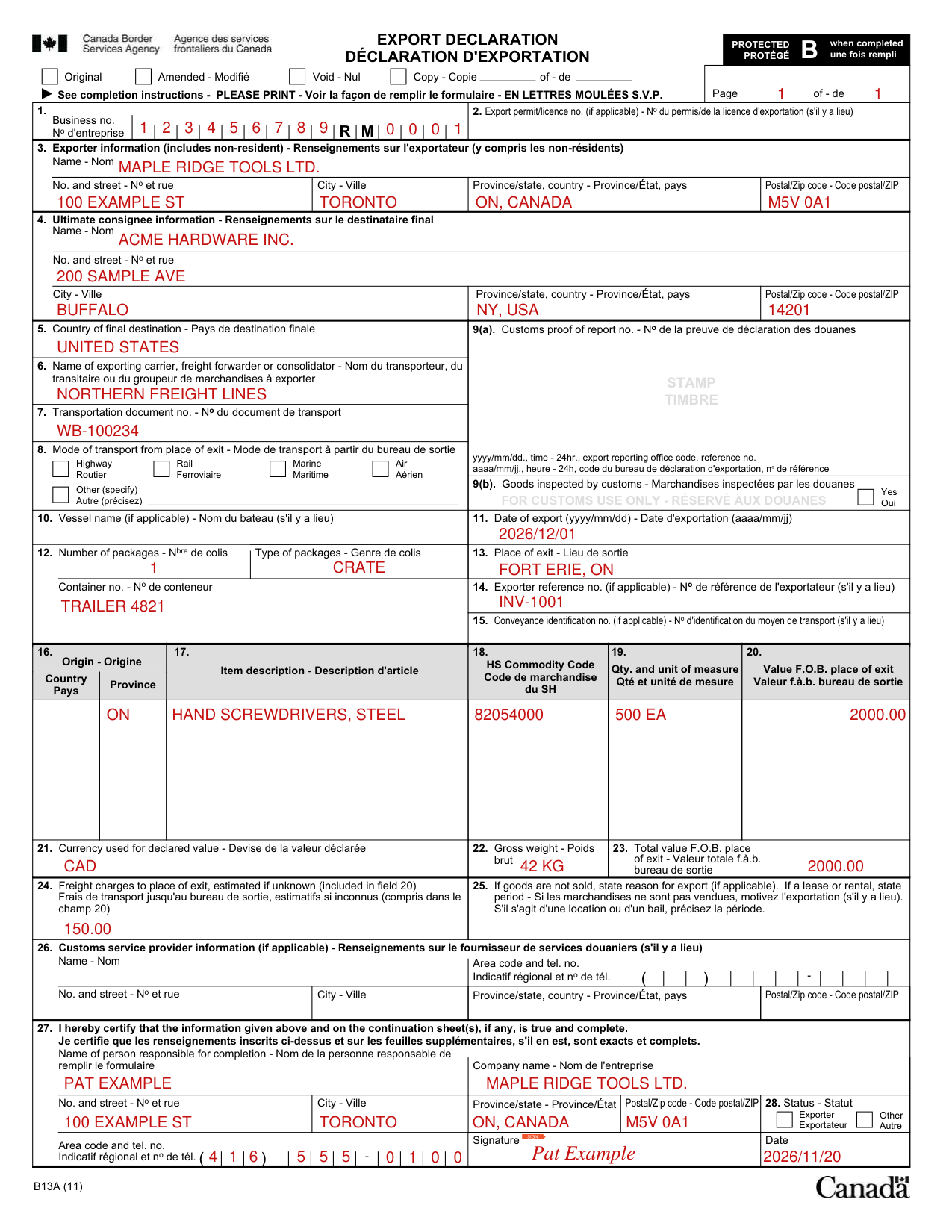
How to fill out Form B13A, box by box
Original, amended, void and copy

Check the appropriate box to indicate whether the B13A is the original document, has been amended, has been submitted but cancelled, or is a copy of the original document. Copies are required for multiple shipments.
For copies, state which copy is represented, e.g., copy 2 of 4. If the document is a copy of an amended document, both the "Amended" and "Copy" boxes are to be checked.
Page of

Page __ of __: write "Page 1 of 1" if only the first page is submitted.
1. Business no.

Enter the federal government assigned Business Number (BN), including the six-digit RM account identifier, of the person or company that exports the goods or causes them to be exported.
Exception: Enter NBNR (No BN Required) when a conveyance is permanently exported by a diplomat, as a personal effect or as a gift/donation.
2. Export permit/licence no.

State the permit, licence or certificate number for goods and technologies subject to export controls. This includes goods and technologies covered under General Export Permits (GEP).
3. Exporter information

Enter the name and complete address of the Canadian or non-resident whose BN appears in field 1. If the BN is that of a customs service provider (CSP), state the name/address of the person or company contracting the CSP.
4. Ultimate consignee information

Enter the full name and address of the ultimate consignee or, if not available, the name and address of the foreign importer.
5. Country of final destination

Show the country of final destination where the goods are to be consumed, further processed or manufactured, as known at the time of export.
6. Name of exporting carrier, freight forwarder or consolidator

Show the name of the carrier that will transport the goods out of Canada or the name of the freight forwarder or consolidator handling the exportation.
7. Transportation document no.

Indicate the reference number that the carrier will use to track the shipment (e.g., booking number, manifest number, waybill number or file number of the CSP).
8. Mode of transport from place of exit

Check the box indicating the last mode of transport by which the goods left the country. For the box "Other" specify the mode, e.g., pipeline.
10. Vessel name and 11. Date of export

If the mode of transport is marine, provide the vessel name.
Show the date the goods are expected to be exported.
12. Number of packages and container no.

Show the number and type of packages (e.g., 3 drums, 7 skids). For car load, truck load, or container load shipments, show the car, trailer or container number.
If the container no. is not available, write TBD. Amend declaration when no. is known.
13. Place of exit, 14. Exporter reference no. and 15. Conveyance identification no.

State the place of exit through which the goods are expected to leave Canada.
Enter the exporter's internal reference number that can be used to trace the shipment - usually an invoice or purchase order number.
If the good being exported from Canada is a conveyance, enter the vehicle identification number (VIN), the hull identification number (HIN) or the serial number of the conveyance.
16. Origin, 17. Item description, fields 18 and 19 and 20. Value F.O.B. place of exit

If the goods are of Canadian origin, state the province from which the goods were grown, mined or manufactured. If not, state the country. In addition, if the goods are further processed imported goods or are imported goods being exported, state the province from which the goods are exported.
Provide a complete description of the goods in normal trade terms with sufficient detail to verify the declared HS code. General terms such as groceries, meats, dry goods, machinery, parts, prints, etc., will not be accepted. Describe each individual item with a separate classification number on a separate line.
State either the Canadian 8 digit HS export code or the Canadian 10 digit import code from the Customs Tariff.
For each line, state the quantity and unit of measurement for each item as specified by the Canadian export classification requirements or the import customs tariff or the permit. If no quantity or unit exists, and if the goods are not controlled by an Other Government Department, leave the field blank.
State the value of each item on a separate line. This value will include the freight charges, handling, insurance, or similar charges incurred to the place of exit from Canada, minus any discounts entered into prior to exportation, but will exclude the portion of these charges that apply from the Canadian place of exit to the foreign destination. If the goods are shipped "no charge", show the value the goods would have been sold for under normal conditions.
21. Currency, 22. Gross weight and 23. Total value

Identify the currency used in fields 20 and 23 (e.g., Canadian dollars, U.S. dollars, Japanese yen). If a continuation sheet is required for fields 16-20, fields 22 and 23 should only be completed on the continuation sheet.
State the gross shipping weight which is the actual weight of the goods and packaging, but excludes the weight of re-usable cargo containers.
Enter the total of the values found in field 20.
24. Freight charges and 25. Reason for export

Show the freight charge in Canadian dollars from the place of lading to the place of exit from Canada (estimate the amount if unknown, this includes the use of Incoterms).
If the goods are not sold, state the reason for the export, (e.g., repair and return, lease, transfer of company goods). If the goods have been leased to a person/ company in another country, identify the period of the lease or rental agreement.
26. Customs service provider

Enter the name, address, and telephone number, including area code of the customs service provider.
27. Name of person responsible for completion

Show the name, company, address, and telephone number of the person who completed form B13A.
The person responsible for the accuracy of the data must sign in field 27, certifying that the information given on the form and on the continuation sheet(s), if any, is true and complete.
More rules for Form B13A
Continuation sheet(s) may be included to provide the information found in fields 2, 12, 14-20, 22, and 23.
All fields are mandatory if applicable.
Common questions about Form B13A
What is a B13A Canada export declaration?
The B13A is the Export Declaration, with completion instructions. Information from this declaration will be used for customs control purposes, and may be shared with other government departments to enforce Canadian laws.
Where do I file it?
Stamp the B13A, either manually or by using the stamp machine, at the customs office (an inland office or at the place of exit) where the goods are reported and available for inspection.
Is there a penalty?
Illegible forms are not acceptable and may be subject to penalty. Note: Administrative Monetary Penalty System penalties will be assessed against the company whose BN appears on the form.
Sources
[1] Form B13A (11), Export Declaration, as served.
