

Biomedical Waste Operating Plan at a glance
What it is: The Biomedical Waste Operating Plan provides guidance and describes requirements for the proper management of biomedical waste in a facility.
All biomedical waste facilities are required to develop and maintain a current operating plan that complies with subsection 64E-16.003(2), Florida Administrative Code. A facility may choose to use this plan, which is provided as a courtesy of the department, or they may develop their own.
A filled-in Biomedical Waste Operating Plan example: a clinic fills in the red bag and storage blanks
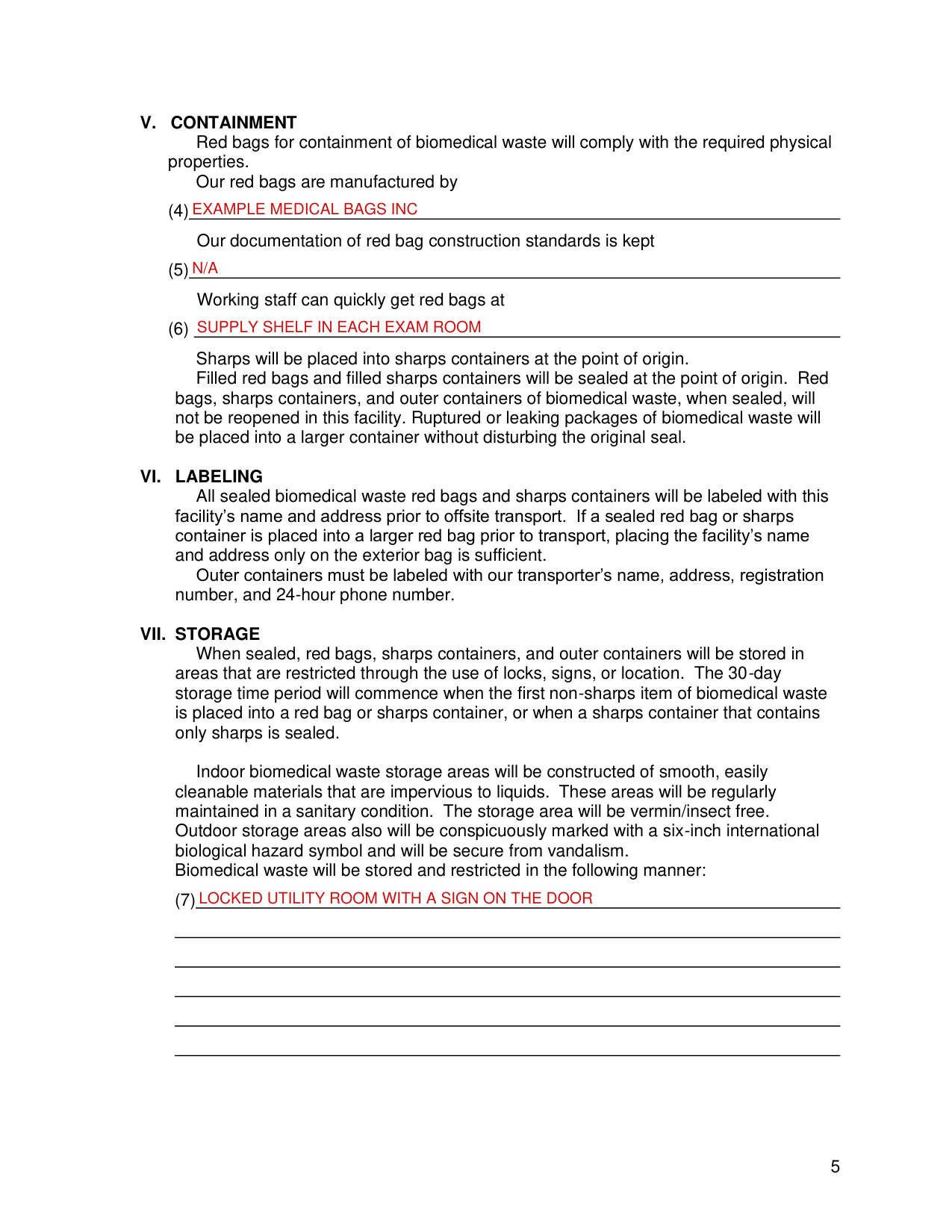
How to fill out Biomedical Waste Operating Plan, box by box
Red bags
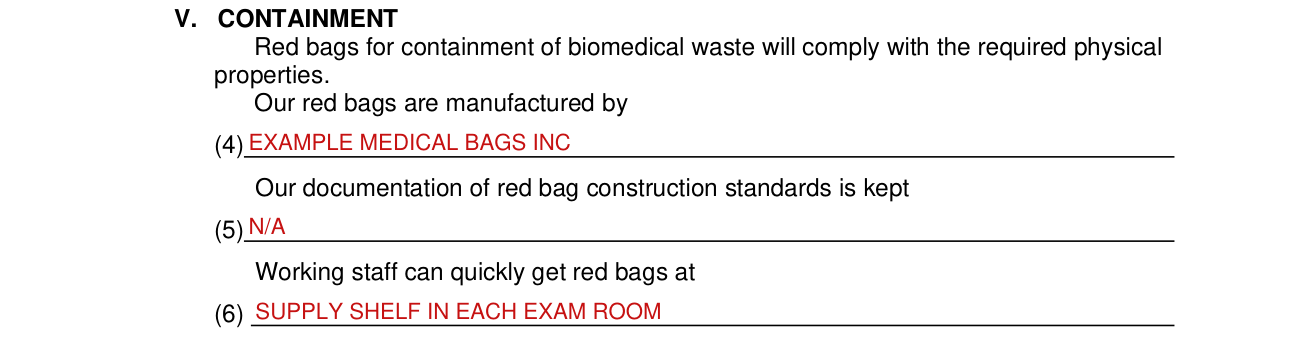
In Blank 4, enter the name of the manufacturer of your facility's red bags. This company must be on the Department of Health (DOH) list of compliant red bags, or you must have results supplied by the bag manufacturer from an independent laboratory that indicate that your red bags meet the bag construction requirements of Chapter 64E-16, Florida Administrative Code (F.A.C.). In Blank 5, indicate where the documentation for the construction standards of your facility's red bags is kept. If your facility uses red bags that are included in the DOH list of compliant red bags, or if your facility does not use red bags, enter N/A. In Blank 6, indicate where unused, red biomedical waste bags are kept in operational areas (not in stock or in central storage) so that working staff can get them quickly when they need them. In Blank 4 and Blank 6, if your facility does not use red bags, enter N/A.
Storage of biomedical waste
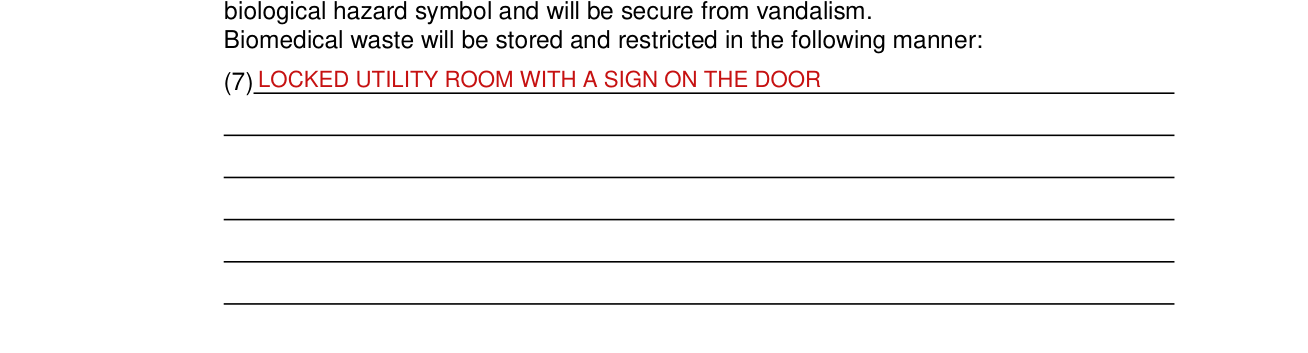
In Blank 7, enter the place where your biomedical waste is stored and the method of restriction of this storage area. If your biomedical waste is picked up by a licensed biomedical waste transporter but you have no storage area, indicate your procedure for preparing your biomedical waste for pick-up. If you have no pick-up and no storage area, enter N/A.
When sealed, red bags, sharps containers, and outer containers will be stored in areas that are restricted through the use of locks, signs, or location.
The 30-day storage time period will commence when the first non-sharps item of biomedical waste is placed into a red bag or sharps container, or when a sharps container that contains only sharps is sealed.
Indoor biomedical waste storage areas will be constructed of smooth, easily cleanable materials that are impervious to liquids. These areas will be regularly maintained in a sanitary condition. The storage area will be vermin/insect free.
Outdoor storage areas also will be conspicuously marked with a six-inch international biological hazard symbol and will be secure from vandalism.
More rules for Biomedical Waste Operating Plan
Guidelines for management of biomedical waste are found in Chapter 64E-16, Florida Administrative Code (F.A.C.), and in section 381.0098, Florida Statutes.
Red bags for containment of biomedical waste will comply with the required physical properties.
All sealed biomedical waste red bags and sharps containers will be labeled with this facility's name and address prior to offsite transport. If a sealed red bag or sharps container is placed into a larger red bag prior to transport, placing the facility's name and address only on the exterior bag is sufficient. Outer containers must be labeled with the transporter's name, address, registration number, and 24-hour phone number.
If your situation is different
Facility name
In Blank 1, enter the name of your facility.
Employee training records
In Blank 2, enter where you keep your employee training records. The facility must maintain records of employee training. Training records will be kept for participants in all training sessions for a minimum of three (3) years and will be available for review by Department of Health (DOH) inspectors.
Items of biomedical waste and where they are generated
In Blank 3, list the items of biomedical waste that are produced in your facility and the location where each waste item is generated.
Biomedical waste is any solid or liquid waste which may present a threat of infection to humans. Biomedical waste is further defined in subsection 64E-16.002(2), F.A.C.
Transport by a registered transporter
In Blank 8, enter all the required information about your registered biomedical waste transporter. If you do not use a transporter, enter N/A.
The facility will negotiate for the transport of biomedical waste only with a DOH-registered company. If the facility contracts with such a company, it will have on file the pick-up receipts provided to it for the last three (3) years.
Transport by an employee of the facility
In Blank 9, enter the name(s) of the employee(s) designated to transport your facility's untreated biomedical waste to another facility.
An employee of this facility who works under the following guidelines: The facility will transport its own biomedical waste. For tracking purposes, the facility will maintain a log of all biomedical waste transported by any employee for the last three (3) years. The log will contain waste amounts, dates, and documentation that the waste was accepted by a permitted facility.
In Blank 10, enter the name of the facility to which your facility transports your own untreated biomedical waste.
In Blank 9 and Blank 10, if your facility does not transport your own biomedical waste, enter N/A.
Procedure for decontaminating biomedical waste spills
In Blank 11, describe the procedure and products your facility will use to decontaminate a spill or leak of biomedical waste.
Contingency plan
In Blank 12, enter the required information about the registered biomedical waste transporter who will transport your biomedical waste on a contingency basis.
If the registered biomedical waste transporter is unable to transport this facility's biomedical waste, or if the facility is unable temporarily to treat its own waste, then a registered biomedical waste transporter will be contacted.
Branch offices
In Blank 13, if personnel from your facility also work at a branch office of your facility, enter the name of the branch office. In Blank 14, enter the street address, city, and state of the branch office named in (13). In Blank 15, enter the weekdays the branch office named in (13) is open. In Blank 16, enter the normal work hours for each day the branch office named in (13) is open. If you have no branch office, enter N/A.
Miscellaneous: where the plan and other items are kept
In Blank 17, indicate where a copy of this biomedical waste operating plan will be kept in your facility.
In Blank 18, indicate where the current biomedical waste permit or exemption document will be kept in your facility.
In Blank 19, indicate where your facility will keep its current copy of the biomedical waste rules, Chapter 64E-16, F.A.C.
In Blank 20, if your facility transports your own biomedical waste, indicate where your transport log is kept. If you do not transport your own biomedical waste, enter N/A.
Attachment A: training outline
Biomedical waste training will be scheduled as required by paragraph 64E-16.003(2)(a), F.A.C. Training sessions will detail compliance with this operating plan and with Chapter 64E-16, F.A.C. In Attachment A, the activities addressed should be those from Section III that are carried out in your facility.
Attachment B: training attendance
An example of an attendance record is appended in Attachment B. In Attachment B, enter the required information to document training sessions.
Attachment C: when to complete it
Attachment C is to be completed only if your facility treats biomedical waste.
If your facility has untreated biomedical waste removed by a registered transporter or you transport your own untreated waste, do not complete Attachment C.
Sources
[1] Biomedical Waste Operating Plan, Florida Department of Health (the Official source link on this page).
