
Brc Form 202 3 PDF Details

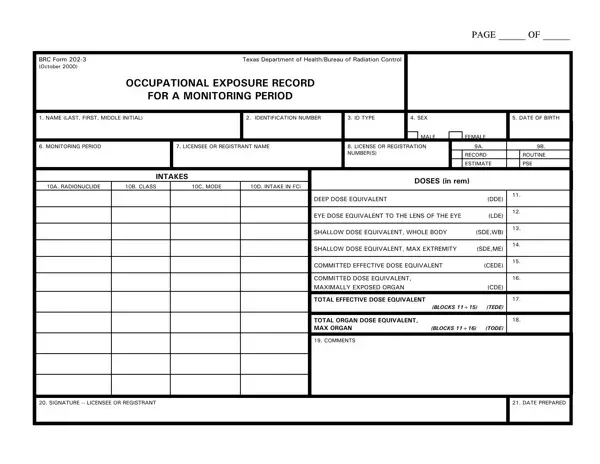
The BRC Form 202-3 is issued by the Texas Department of Health/Bureau of Radiation Control and covers occupational radiation exposure during a specific monitoring period. Created in October 2000, it documents identifying information for the monitored worker, the nature of their radiation exposure, and precise dosage measurements in multiple categories.

Key measurements recorded on this form include the Deep Dose Equivalent (DDE), which reflects whole-body dose at 1 cm depth, and the Committed Effective Dose Equivalent (CEDE), which accounts for internally deposited radionuclides over 50 years. The form also distinguishes between routine monitoring and special occupational exposure events, ensuring all types of exposure are captured accurately for regulatory compliance and long-term health tracking.

QuestionAnswer
Form NameBrc Form 202 3
Form Length2 pages
Fillable?No
Fillable fields0
Avg. time to fill out30 sec
Other names

How to Edit Brc Form 202 3 Online for Free

How to Fill Out BRC Form 202-3 Step by Step

The BRC Form 202-3 documents radiation exposure for workers monitored under Texas Bureau of Radiation Control regulations. Completing it accurately protects worker health records and satisfies state compliance requirements.

Step 1: Complete the Worker Identification Section

Enter the worker's full legal name, date of birth, and employer name at the top of the form. Include the Social Security Number or employee ID used in the dosimetry system. Accurate identification links the dose record to the correct individual in the BRC database.

Step 2: Define the Monitoring Period

Enter the start date and end date of the monitoring period. The BRC Form 202-3 covers one monitoring period at a time, typically quarterly or on an annual basis. Record the dosimeter or badge number assigned to the worker during that period.

Step 3: Record Radiation Dose Equivalent Values

Enter the measured dose values in the appropriate fields. The form tracks the following dose categories:

  • Deep Dose Equivalent (DDE) – Whole-body dose measured at 1 cm depth in tissue.
  • Committed Effective Dose Equivalent (CEDE) – Dose from internally deposited radionuclides projected over 50 years.
  • Shallow Dose Equivalent (SDE) – Dose to skin or extremities measured at 0.007 cm depth.
  • Lens Dose Equivalent (LDE) – Dose to the eye lens at 0.3 cm depth.

Step 4: Identify the Radionuclide and Exposure Type

Specify whether the exposure was due to external radiation sources, internal radionuclide intake, or a combination of both. List the specific radionuclide such as iodine-131, technetium-99m, or uranium when internal intake occurred. Mark whether the event was routine occupational monitoring or a special occupational exposure.

Step 5: Review, Sign, and Submit

Before submitting, confirm that all recorded dose values remain within the annual regulatory limits set by 25 Texas Administrative Code, Chapter 289. The Radiation Safety Officer (RSO) responsible for the radiation program signs the form to certify the accuracy of the data. Send the completed BRC Form 202-3 to the Texas Department of State Health Services, Bureau of Radiation Control.

Related Forms for Radiation and Health Record-Keeping

Organizations working with radiation equipment often need additional documentation. Explore the X-ray application form for X-ray equipment licensing, the CT equipment quality control data form for imaging device audits, and the adult immunization record for tracking worker vaccination history.