
Leader Requirements
The BSA is open to all who meet the requirements, and leaders are selected based on individual merit. Adult leaders must possess the moral, educational, and emotional qualities that the BSA deems necessary for positive leadership to youth. They must also:
•Abide by the Scout Oath, Scout Law, and Scouter Code of Conduct. The Scouter Code of Conduct can be found at www.scouting.org/health-and-safety/gss/bsa-scouter-code-of-conduct/.
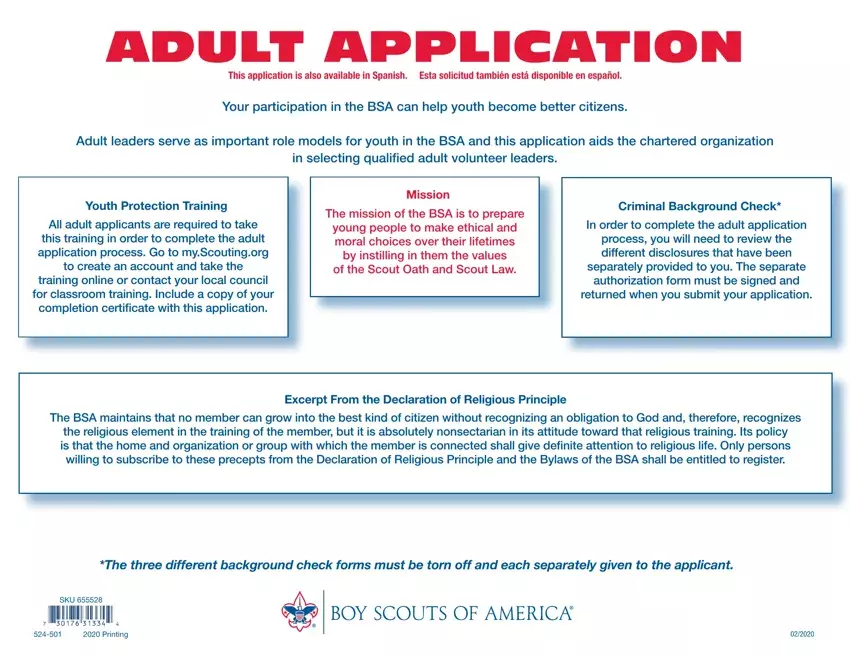
•Subscribe to the precepts of the Declaration of Religious Principle.
•Reside within the USA or a U.S. territory, or be a U.S. citizen residing outside the USA.
•Be 21 years of age or older for primary leadership positions.
•Be 18 years of age or older for assistant leadership positions.
•Complete Youth Protection training (YPT) before application is processed and renew training as required by going to my.Scouting.org and creating an account.
•Review the disclosure information related to the BSA’s background check process and complete and sign a Background Check Authorization form.
•Take leader position-specific training at my.Scouting.org. Classroom training may also be available through your local council.
APPROVAL REQUIRED—UNIT ADULTS
Chartered organization head or chartered organization representative. The chartered organization representative is approved by the head of the chartered organization. All other adult leader applications must be accepted and approved by the head of the chartered organization or the chartered organization representative.
APPROVAL REQUIRED—COUNCIL and DISTRICT ADULTS Scout executive or designee must accept and approve all council and district adults.
Scout executive or designee must approve any adults who answer “yes” to any Additional Information question.
The adult leader application process will not be complete until Youth Protection training has been completed and a criminal background check has been obtained.
Health information. You should inform your unit leadership of any condition that might limit your participation. Before participating in activities with your unit, please fill out the Annual Health and Medical Record, No. 680-001, found on www.scouting.org/forms and provide it to your unit leadership.
Scouting magazine. All registered, paid adult leaders receive Scouting magazine; $2 of the registration fee is for the subscription.
Boys’ Life. Registered adults get a special rate. For a subscription to a magazine that helps children grow in the Scouting program, just fill in the Boys’ Life circle on the application and pay the subscription price.
The annual national registration fee is nonrefundable.
BSA Privacy Policy
The BSA protects the confidentiality of the names and personal information of those who are affiliated with the organization. No commercial or unauthorized use is made of the names, addresses, and other confidential information. The BSA and its affinity groups may use registration information to notify registrants of benefit opportunities.
For general questions, contact your local BSA council.
What Is the BSA Program?
The BSA program is outlined in the official publications of the BSA. Activities that are not in these BSA publications are not a part of the Scouting program. Leaders must not allow youth members or program participants to engage in any unauthorized or prohibited activities.
Training for New Leaders
The BSA is committed to your success as a volunteer while serving young people. To help you be successful there are training materials designed for you. Training resources are available through your local council and at my.Scouting.org.
What Makes a Trained Leader?
You are considered a trained leader when you have completed leader position-specific training for your position and have current Youth Protection training.
Youth Protection Begins With You™
Child abuse is a serious problem in our society, and unfortunately, it can occur anywhere, even in Scouting. For that reason, the BSA continues to create barriers to abuse beyond what have previously existed in Scouting.
The BSA is committed to providing a safe environment for young people. All adult leaders must complete Youth Protection training as part of the registration process and renew their training as required. It is highly recommended that parents who participate in Scouting activities complete YPT. To learn more about the BSA’s Youth Protection resources, go to www.scouting.org/training/youth-protection/.
Mandatory Reporting
All persons involved in Scouting must immediately report to local authorities any good-faith suspicion or belief that any child is or has been physically or sexually abused; physically or emotionally neglected; exposed to any form of violence or threat; or exposed to any form of sexual exploitation including the possession, manufacture, or distribution of child pornography, online solicitation, enticement, or showing of obscene material. No person may abdicate this reporting responsibility to any other person.
Additionally, any known or suspected abuse or behavior that might put a youth at risk must also be reported to the local Scout executive or the Scouts First Helpline (1-844-SCOUTS1 or 1-844-726-8871) if your Scout executive or local council cannot be reached.
Youth Protection Policies
•Two registered adult leaders 21 years of age or over are required at all Scouting activities, including meetings. There must be a registered female adult leader over 21 in every unit serving females.
A registered female adult leader over 21 must be present for any activity involving female youth.
•One-on-one contact between adult leaders and youth members is prohibited both inside and outside of Scouting.
These and other key Youth Protection policies are addressed in the training and at www.scouting.org/ training/youth-protection/.
To learn about the BSA’s other health and safety policies, please review the online version of the Guide to Safe Scouting, the Scouter Code of Conduct, and the Sweet Sixteen of BSA Safety, which are available at www.scouting.org/health-and-safety.
Scout Oath
On my honor I will do my best to do my duty to God and my country and to obey the Scout Law; to help other people at all times; to keep myself physically strong, mentally awake, and morally straight.
Scout Law
A Scout is trustworthy, loyal, helpful, friendly, courteous, kind, obedient, cheerful, thrifty, brave, clean, and reverent.