
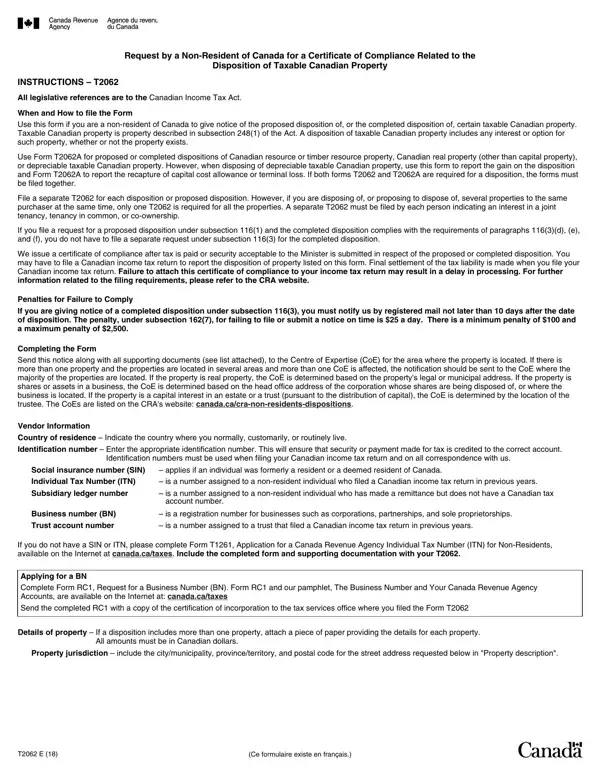

Form T2062 at a glance
What it is: Form T2062 is the Request by a Non-Resident of Canada for a Certificate of Compliance Related to the Disposition of Taxable Canadian Property.
Who signs: This area should be completed and signed by: the vendor in the case of an individual; an authorized officer in the case of a corporation; the trustee, executor or administrator if the person is filing the statement for a trust; or an authorized partner in the case of a partnership.
When and how to file the form Use this form if you are a non-resident of Canada to give notice of the proposed disposition of, or the completed disposition of, certain taxable Canadian property. Taxable Canadian property is property described in subsection 248(1) of the Act. A disposition of taxable Canadian property includes any interest or option for such property, whether or not the property exists.
A filled-in Form T2062 example: a non-resident individual reports a completed sale
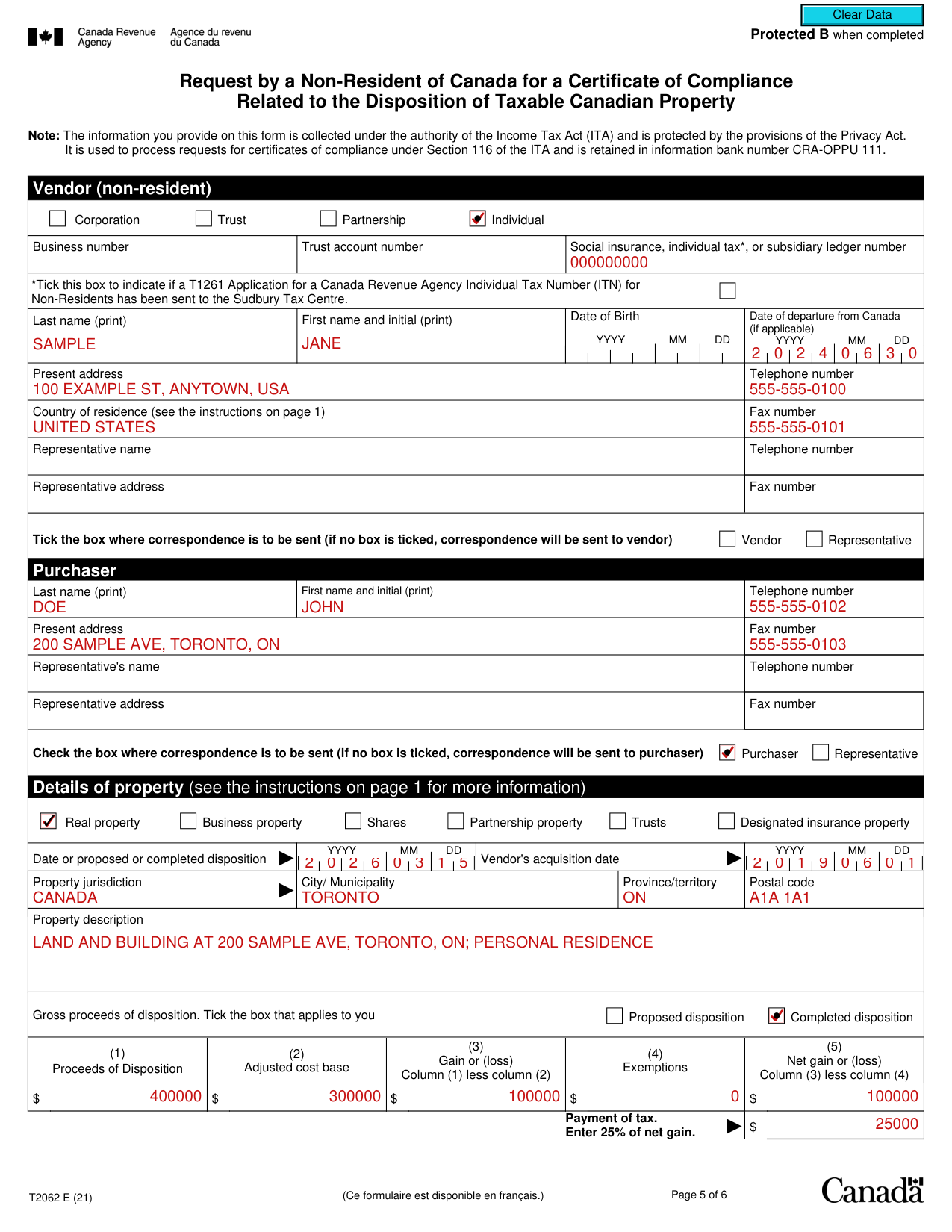
How to fill out Form T2062, box by box
Vendor (non-resident)
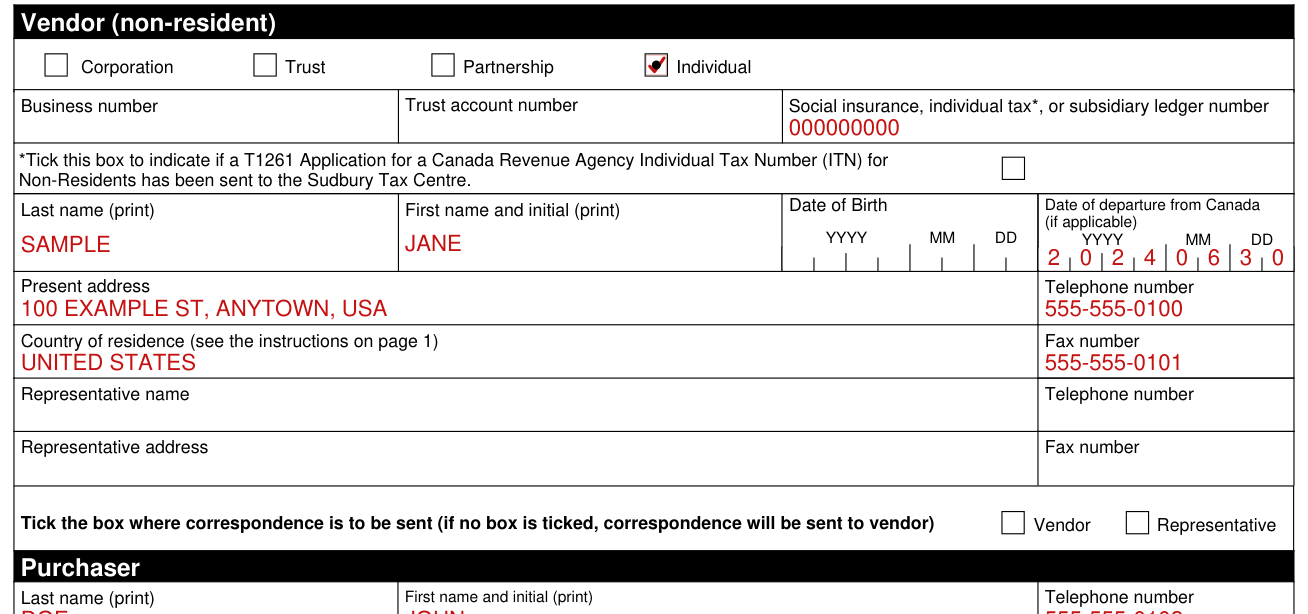
Country of residence - Indicate the country where you normally, customarily, or routinely live. Identification number - Enter the appropriate identification number. This will ensure that security or payment made for tax is credited to the correct account. Identification numbers must be used when filing your Canadian income tax return and on all correspondence with the CRA. Social insurance number (SIN) - applies if an individual was formerly a resident or a deemed resident of Canada. Individual Tax Number (ITN) - is a number assigned to a non-resident individual who filed a Canadian income tax return in previous years. Subsidiary ledger number - is a number assigned to a non-resident individual who has made a remittance but does not have a Canadian tax account number.
Tick the box where correspondence is to be sent (if no box is ticked, correspondence will be sent to vendor): Vendor or Representative.
Purchaser
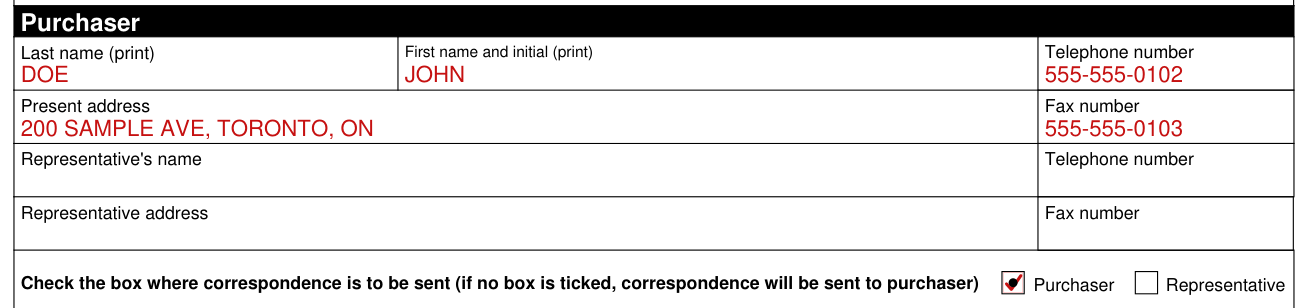
Check the box where correspondence is to be sent (if no box is ticked, correspondence will be sent to purchaser): Purchaser or Representative.
Details of property
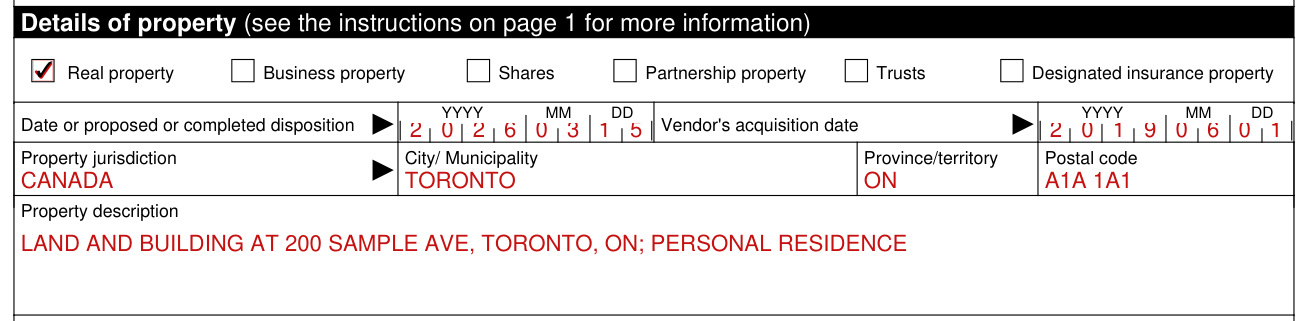
Details of property: Real property, Business property, Shares, Partnership property, Trusts, Designated insurance property.
If a disposition includes more than one property, attach a piece of paper providing the details for each property. All amounts must be in Canadian dollars. Property jurisdiction - include the city/municipality, province/territory, and postal code for the street address requested in "Property description".
Property description include the following details: Land or buildings - street address, plan number, lot number, registration number, municipal value, and use of property (e.g., personal residence, rental or business property).
Business property - identification of business assets, business name, and street address. Shares - name and street address of corporation, number of shares, certificate numbers, and par value or stated capital. Partnership property - name, street address, and identification number of partnership. Trusts - name and address, if any, of trust; otherwise name(s) and street address(es) of trustee(s). Designated insurance property - identification of insurer's business asset, business name, and street address.
Gross proceeds of disposition

Tick the box that applies to you: Proposed disposition or Completed disposition.
If you are giving notice of a completed disposition under subsection 116(3), you must notify the CRA by registered mail not later than 10 days after the date of disposition. The penalty, under subsection 162(7), for failing to file or submit a notice on time is $25 a day (checked November 11, 2026). There is a minimum penalty of $100 and a maximum penalty of $2,500 (checked November 11, 2026).
Enter the gross proceeds of disposition from the sale of the property. Enter the vendor's share of the gross proceeds in Column (1).
(3) Gain or (loss) is Column (1) less column (2). (5) Net gain or (loss) is Column (3) less column (4).
If you are claiming an exemption from tax, such as under a tax treaty or a principal residence exemption, enter the exempt portion in column (4).
You cannot claim outlays and expenses related to the disposition of property, including real estate commissions, brokerage fees, and legal and notary fees, when you file this form. However, you can claim these amounts when you file your Canadian income tax return.
Payment of tax. Enter 25% of net gain.
Election, rent or lease, outstanding balances, last tax year and arm's length
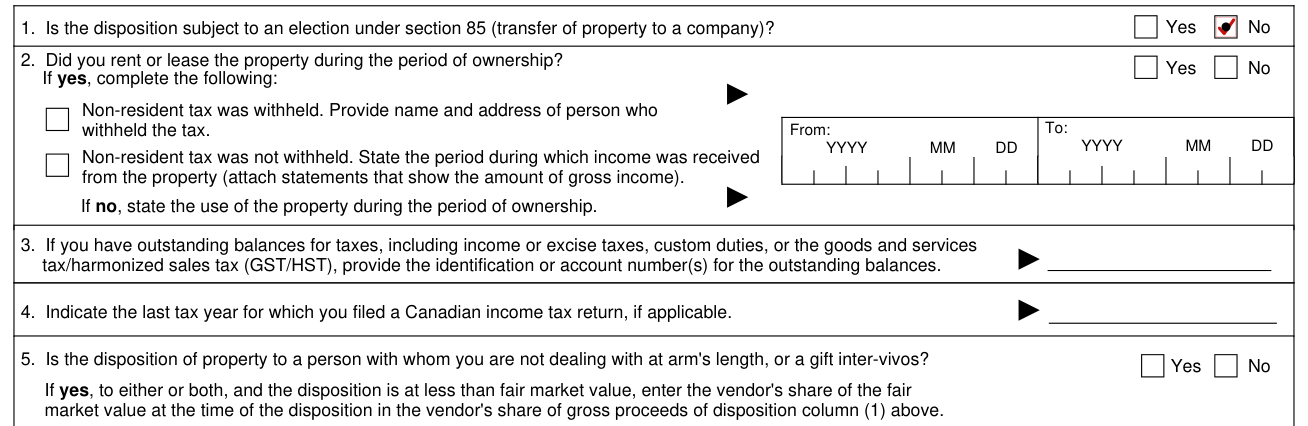
1. Is the disposition subject to an election under section 85 (transfer of property to a company)? Yes No.
2. Did you rent or lease the property during the period of ownership? If yes, complete the following: if non-resident tax was withheld, provide name and address of person who withheld the tax; if non-resident tax was not withheld, state the period during which income was received from the property (attach statements that show the amount of gross income). If no, state the use of the property during the period of ownership.
3. If you have outstanding balances for taxes, including income or excise taxes, custom duties, or the goods and services tax/harmonized sales tax (GST/HST), provide the identification or account number(s) for the outstanding balances.
4. Indicate the last tax year for which you filed a Canadian income tax return, if applicable.
5. Is the disposition of property to a person with whom you are not dealing with at arm's length, or a gift inter-vivos? If yes, to either or both, and the disposition is at less than fair market value, enter the vendor's share of the fair market value at the time of the disposition in the vendor's share of gross proceeds of disposition column (1).
Certification

By signing you certify that the information given on this form is, to the best of your knowledge, correct and complete.
More rules for Form T2062
File a separate T2062 for each disposition or proposed disposition. However, if you are disposing of, or proposing to dispose of, several properties to the same purchaser at the same time, only one T2062 is required for all the properties. A separate T2062 must be filed by each person indicating an interest in a joint tenancy, tenancy in common, or co-ownership.
The information you provide on this form is collected under the authority of the Income Tax Act (ITA) and is protected by the provisions of the Privacy Act. It is used to process requests for certificates of compliance under Section 116 of the ITA and is retained in information bank number CRA-OPPU 111.
Common questions about Form T2062
Where do I file it?
Send this notice along with all supporting documents (see list attached), to the Centre of Expertise (CoE) for the area where the property is located. If there is more than one property and the properties are located in several areas and more than one Centre of Expertise is affected, the notification should be sent to the Centre of Expertise where the majority of the properties are located. If the property is real property, the Centre of Expertise is determined based on the property's legal or municipal address. If the property is shares or assets in a business, the Centre of Expertise is determined based on the head office address of the corporation whose shares are being disposed of, or where the business is located. If the property is a capital interest in an estate or a trust (pursuant to the distribution of capital), the Centre of Expertise is determined by the location of the trustee. The Centres of Expertise are listed on the CRA's website: canada.ca/cra-non-residents-dispositions.
When is this form not the right one?
Use Form T2062A for proposed or completed dispositions of Canadian resource or timber resource property, Canadian real property (other than capital property), or depreciable taxable Canadian property. However, when disposing of depreciable taxable Canadian property, use this form to report the gain on the disposition and Form T2062A to report the recapture of capital cost allowance or terminal loss. If both forms T2062 and T2062A are required for a disposition, the forms must be filed together.
Sources
[1] Form T2062 E (21), Request by a Non-Resident of Canada for a Certificate of Compliance Related to the Disposition of Taxable Canadian Property, Canada Revenue Agency (the Official source link on this page).