

Form AEU2 at a glance
What it is: AEU2 is the Certificate of Correction, required for all open Department of Buildings OATH Summonses.
Where and when to file: To submit a Certificate of Correction request, use an eFiling account to log into DOB NOW at www.nyc.gov/dobnow and select the BIS Options portal. A Certificate of Correction may be submitted to the Department any time after a summons is issued.[2]
Notary: Section 4: Provide Statement of Signature. Sign the Certificate of Correction before a Notary Public. In addition to the Certificate of Correction form (AEU2), a notarized Statement in Support (AEU20) must be provided.[2]
Check one: Respondent named on the violation (if the named respondent is an individual); Officer, Director, Partner or Managing Member of the named respondent (if the named respondent is a business entity); Owner of Property but not the named respondent (if you are a new owner, attach copy of deed); Current Mortgagee of place of occurrence (attach proof of mortgage agreement and a notarized authorization letter); Other Agent of the respondent or place of occurrence (attach a notarized authorization letter from the respondent or property owner).
What to bring and attach to Form AEU2
ADDITIONAL REQUIREMENTS A notarized Statement in Support (AEU20) and documentary proof of correction must also be provided. This statement must describe the steps taken to correct the violating condition(s) and reference all relevant permit numbers, job applications or other records that substantiate correction. The standard AEU20 form may be used or submit a notarized statement on a separate piece of paper. If work was performed on an elevator or boiler, the statement must be on the letterhead of the licensed professional who did the work. All photographs must be labeled with the date the photograph was taken, the location and the summons number. Photographs of Before and After must be labeled as such.
Copies of all permits, bills, receipts, photographs, and/or documentary proof that the violating condition(s) have been corrected are also required.[2]
If before and after photographs are submitted, label them 'Before' and 'After' in addition to the other required labeling.[2]
A filled-in Form AEU2 example: a respondent certifies a cured violation
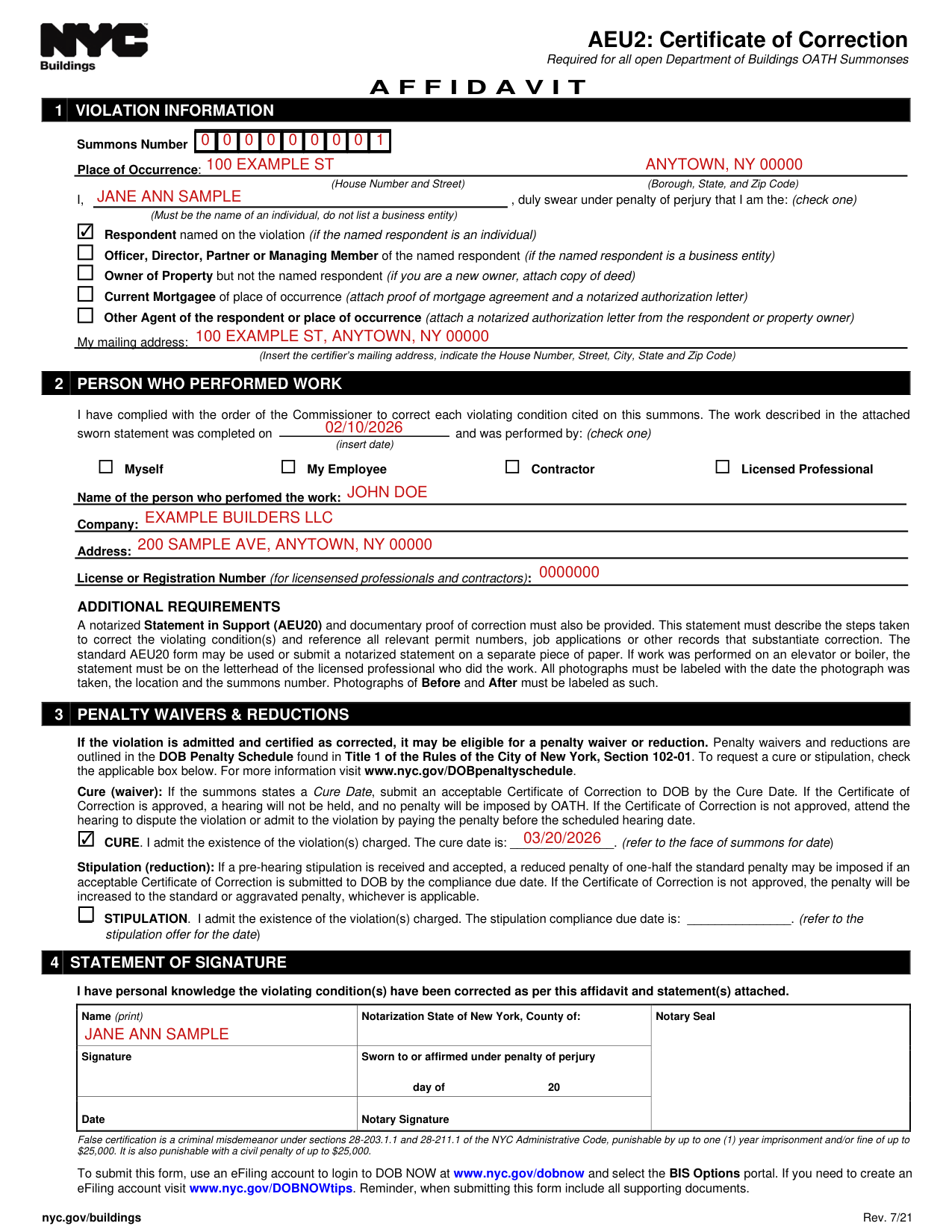
How to fill out Form AEU2, box by box
Violation information

Under 1 Violation Information, provide the Summons Number and the Place of Occurrence, with the House Number and Street and the Borough, State, and Zip Code.[2]
Who is swearing
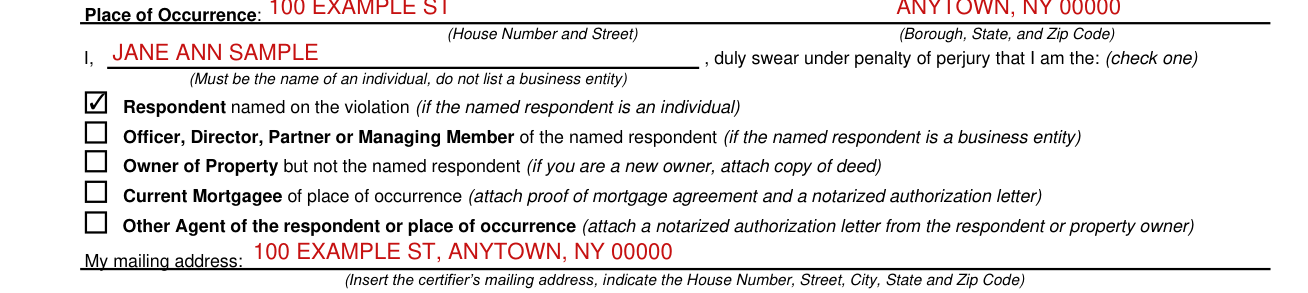
In "I, ..., duly swear under penalty of perjury that I am the: (check one)", the name must be the name of an individual; do not list a business entity.
Check the box that best describes the certifier's relationship to the person whose name appears on the summons (the respondent), to the property owner, or to the place of occurrence.
If the certifier is an agent or authorized representative of the person whose name appears on the summons, the property or the property owner, submit a notarized authorization letter granting permission to certify correction. If the property was purchased after the violation occurred, submit a copy of the deed.
Last, provide the mailing address for the person attesting to the correction of the violating conditions: under My mailing address, insert the certifier's mailing address and indicate the House Number, Street, City, State and Zip Code.[2]
Person who performed work
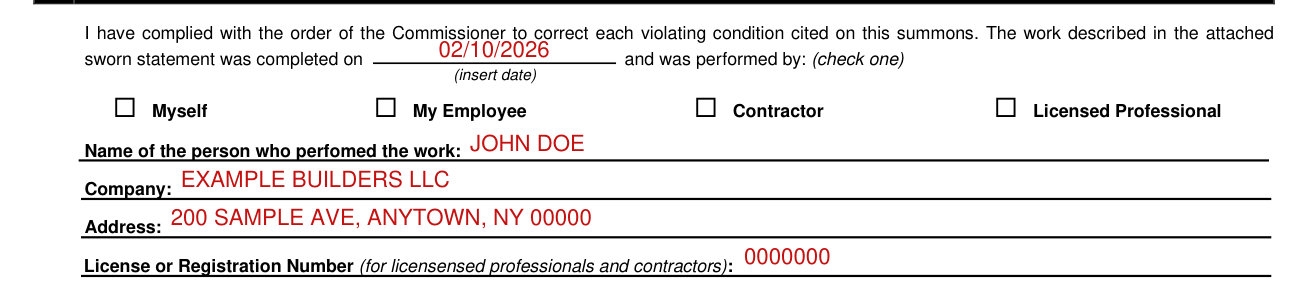
Under 2 Person Who Performed Work, provide the date that all violating conditions were corrected: insert the date the work described in the attached sworn statement was completed.
Check one: Myself, My Employee, Contractor or Licensed Professional, the box that best describes the person who did the work to correct the violation.
Enter the Name of the person who did the work, the Company, the Address, and the License or Registration Number (for licensed professionals and contractors).
License and registration information is needed when a Licensee, Registered Design Professional, or registered Contractor did the work.[2]
Penalty waivers and reductions: Cure or Stipulation

If the violation is admitted and certified as corrected, it may be eligible for a penalty waiver or reduction. Penalty waivers and reductions are outlined in the DOB Penalty Schedule found in Title 1 of the Rules of the City of New York, Section 102-01. To request a cure or stipulation, check the applicable box.
Select Cure or Stipulation to show the type of waiver or reduction being requested. Then insert the applicable due date.
Cure (waiver): If the summons states a Cure Date, submit an acceptable Certificate of Correction to DOB by the Cure Date. If the Certificate of Correction is approved, a hearing will not be held, and no penalty will be imposed by OATH. Instead, the penalty will be waived. If the Certificate of Correction is not approved, attend the hearing to dispute the violation or admit to the violation by paying the penalty before the scheduled hearing date. CURE. I admit the existence of the violation(s) charged. The cure date is: (refer to the face of summons for date). In the case of a cure, supply the cure date found on the summons.
Stipulation (reduction): If a pre-hearing stipulation is received and accepted, a reduced penalty of one-half the standard penalty may be imposed if an acceptable Certificate of Correction is submitted to DOB by the compliance due date. If the Certificate of Correction is not approved, the penalty will be increased to the standard or aggravated penalty, whichever is applicable. STIPULATION. The stipulation compliance due date is: (refer to the stipulation offer for the date). In the case of a stipulation, supply the compliance due date.[2]
Statement of signature

Under Statement of Signature: I have personal knowledge the violating condition(s) have been corrected as per this affidavit and statement(s) attached.
Name (print); Notarization: State of New York, County of; Signature; Sworn to or affirmed under penalty of perjury, day of 20; Date; Notary Signature; Notary Seal.
More rules for Form AEU2
Unless the summons is certified as corrected with AEU or dismissed by the OATH Hearings Division, it will continue to appear as Open in Department records, even if a hearing has been held or the penalty has been paid.[2]
Certification forms (AEU2, AEU3321 and AEU20) must be used to resolve summonses or Notices of Violation.[2]
Submitting this form
Use DOB NOW to submit this form
To submit this form, use an eFiling account to login to DOB NOW at www.nyc.gov/dobnow and select the BIS Options portal. If you need to create an eFiling account visit www.nyc.gov/DOBNOWtips. Reminder, when submitting this form include all supporting documents.
From the DOB NOW BIS portal, select +Certificate of Correction Review Request and enter the required fields including the Summons number. Select Save and then in the Documents section, upload completed applicable AEU2, AEU20 or AEU3321 forms and any other required documents. After completing the Statements & Signature section, select Submit.
The request will not be reviewed by the Administrative Enforcement Unit until the Submit button is selected and confirmation is given for it to be submitted.[2]
Before you go
Each summons includes two orders: 1) to correct conditions(s) that violate these rules or laws and 2) to certify them as corrected with the Department's Administrative Enforcement Unit (AEU).
A response is required. Paying the penalty will not resolve the summons.
Partial correction is not acceptable. All violating conditions must be corrected and all applicable DOB civil penalties must be paid in order to certify correction and resolve the summons.
Common questions about Form AEU2
Is there a penalty?
False certification is a criminal misdemeanor under sections 28-203.1.1 and 28-211.1 of the NYC Administrative Code, punishable by up to one (1) year imprisonment and/or fine of up to $25,000. It is also punishable with a civil penalty of up to $25,000 (checked November 1, 2026). If an acceptable Certificate of Correction is not received by the Department in a timely manner, DOB civil penalties may be imposed and re-inspections may take place, leading to the issuance of additional summonses.[2]
Where to get help with Form AEU2
You may also contact AEU by phone at (212) 393-2405 or by submitting an inquiry at www.nyc.gov/dobhelp.[2]
Sources
[1] Form AEU2 (Rev. 7/21), Certificate of Correction, New York City Department of Buildings (the Official source link on this page).
[2] Instructions: AEU2: Certificate of Correction (Rev. 7/21), New York City Department of Buildings.
