
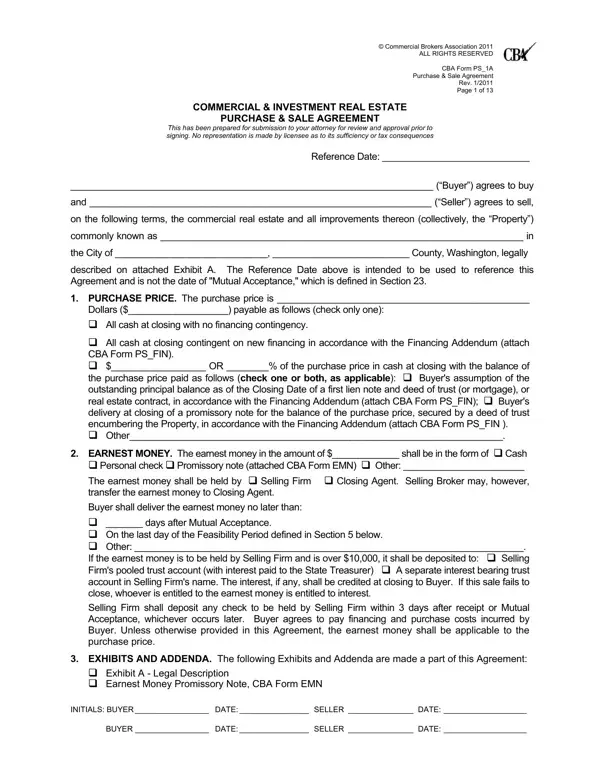
The Commercial Real Estate Agreement, developed by the Commercial Brokers Association in 2011, is a Purchase and Sale contract for commercial and investment real estate transactions. This agreement addresses essential components including purchase price, earnest money, property description, financing arrangements, contingencies, closing costs, and post-closing adjustments. Legal counsel should review the form before execution to confirm its adequacy and evaluate any tax implications.
Key Components of a Commercial Real Estate Agreement
Every commercial real estate transaction requires documentation of the following components:
Types of Commercial Properties Covered
The CBA Form PS_1A applies to a wide range of commercial property types. Office buildings, retail centers, industrial warehouses, mixed-use developments, and multi-family investment properties are all types of commercial real estate commonly purchased using this type of agreement. Each property type may need specific addenda to address unique features. A retail type of property may include lease assignment provisions, while an industrial type of facility may require environmental review addenda. The type of commercial use planned for the property also affects which contingencies are appropriate.
Parties to the Agreement
A commercial real estate transaction involves two primary parties: the buyer and the seller. The buyer is the party purchasing the commercial property, while the seller is the current owner. Both parties often work through licensed commercial real estate brokers who facilitate negotiations and ensure the type of commercial property terms are correctly documented. Legal representatives for each party typically review this type of contract before signing.
Common Contingencies in Commercial Transactions
Contingencies protect each party if specific conditions are not met before closing. A feasibility contingency gives the buyer a set period to inspect the commercial property, review financial records and existing leases, and confirm that the type of commercial use intended is permitted by local zoning. A financing contingency protects the buyer if loan approval for the commercial property is not obtained. A title contingency allows the buyer to review the title report and request corrections before the sale closes. Additional contingencies may address environmental assessments, zoning approval, and permit transfers, depending on the type of commercial real estate involved in the transaction.
For additional resources, see the commercial purchase agreement, the commercial purchase letter of intent, and the commercial lease letter of intent. A broader set of real estate purchase agreement templates is also available on FormsPal.
| Question | Answer |
|---|---|
| Form Name | Commercial Real Estate Agreement Form |
| Form Length | 13 pages |
| Fillable? | No |
| Fillable fields | 0 |
| Avg. time to fill out | 3 min 15 sec |
| Other names | commercial real estate contract forms, commercial purchase agreement, commercial property sale agreement, commercial real estate contract |
Commercial Real Estate Agreement Form isn’t the one you’re looking for?