Please rate Communication Questionnaire

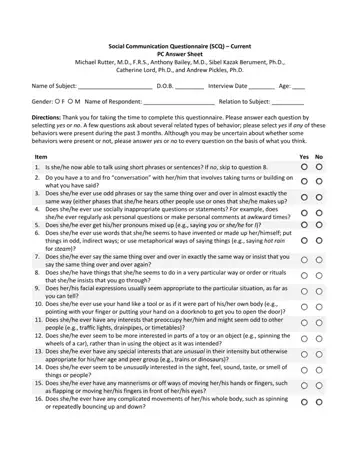
The Social Communication Questionnaire (SCQ) is a 40-item screening tool designed to assess communication skills and social functioning in individuals four years of age and older. Developed by Michael Rutter, M.D., F.R.S., Anthony Bailey, M.D., Sibel Kazak Berument, Ph.D., Catherine Lord, Ph.D., and Andrew Pickles, Ph.D., the SCQ is one of the most widely used autism screening instruments in clinical and research settings. A parent or primary caregiver completes the form by answering yes or no to each item based on the individual's current behaviors over the past three months.
The questionnaire covers three core factor areas: social interaction, communication abilities, and restricted or repetitive behaviors. Each item targets a specific behavior, such as the use of complex phrases, pointing to share interest, or engaging in imaginative play. Clinicians compare the total score and subscale mean values against established cutoff thresholds to identify individuals who may benefit from a full diagnostic evaluation. A higher score on the questionnaire indicates a greater number of communication and behavioral concerns across these factor domains.
The SCQ serves as an efficient first-step screening tool before a comprehensive functional behavioral assessment or a full autism diagnostic workup. Professionals use results from the questionnaire alongside additional instruments, such as a biopsychosocial assessment, to develop a detailed understanding of an individual's communication profile and support needs. The goal of the process is to guide targeted interventions that improve the individual's quality of life across home, school, and community settings.
| Question | Answer |
|---|---|
| Form Name | Communication Questionnaire |
| Form Length | 2 pages |
| Fillable? | No |
| Fillable fields | 0 |
| Avg. time to fill out | 30 sec |
| Other names | scq test, social communication questionnaire scq pdf, scq pdf, scq manual pdf |
Communication Questionnaire isn’t the one you’re looking for?
Please rate Communication Questionnaire