

Cooking Merit Badge Workbook at a glance
What it is: The Cooking Merit Badge Workbook can help you organize your thoughts as you prepare to meet with your merit badge counselor.
Merit Badge Counselors may not require the use of this or any similar workbooks. You still must satisfy your counselor that you can demonstrate each skill and have learned the information.
If a requirement says that you must take an action using words such as "discuss", "show", "tell", "explain", "demonstrate", "identify", that is what you must do. No one may add or subtract from the official requirements found in Scouts BSA Requirements (Pub.# 33216) and/or on Scouting.org.
A filled-in Cooking Merit Badge Workbook example: a Scout fills in the first page
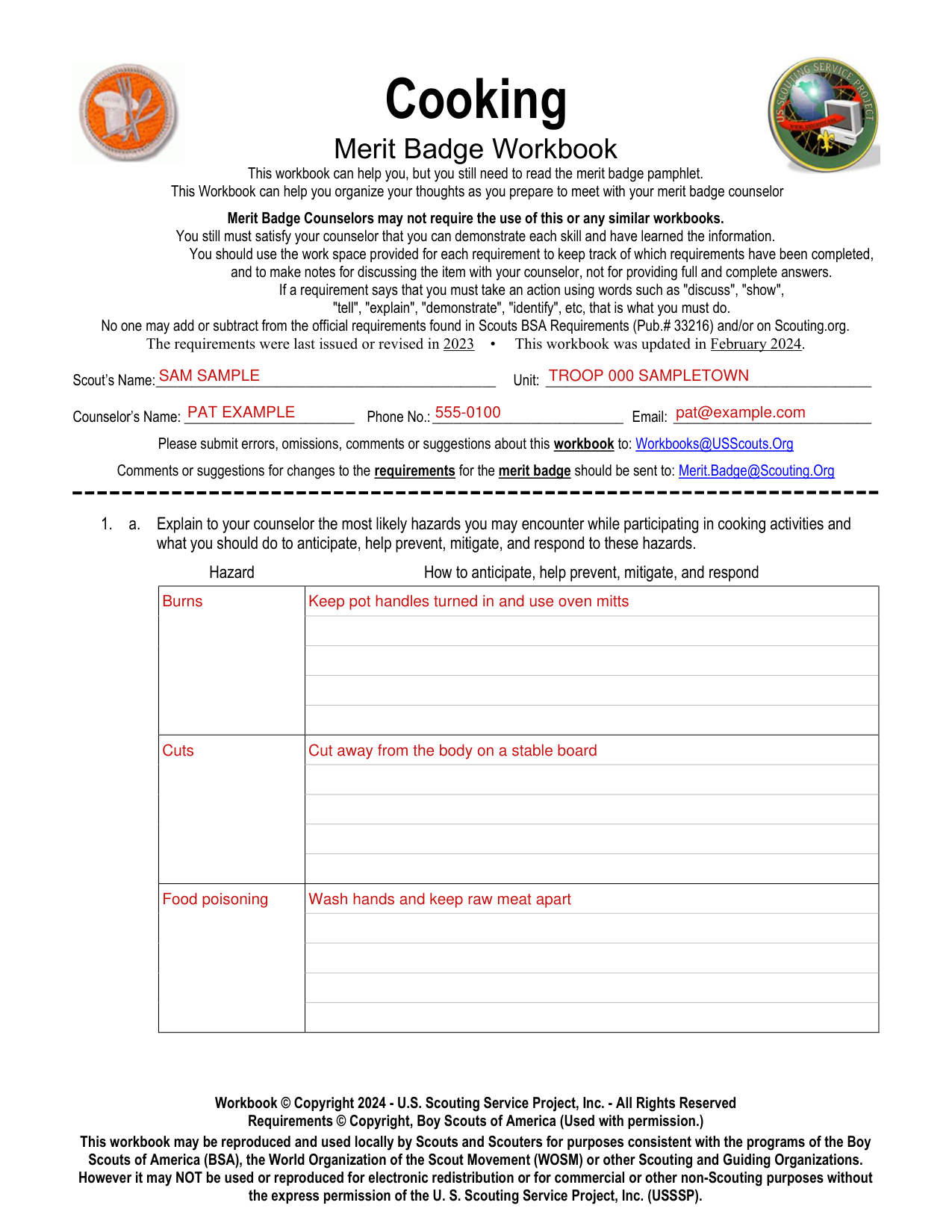
How to fill out Cooking Merit Badge Workbook, box by box
Scout's Name, Unit, Counselor's Name, Phone No. and Email

Enter Scout's Name and Unit, then Counselor's Name, Phone No. and Email.
Hazard and how to anticipate, help prevent, mitigate, and respond
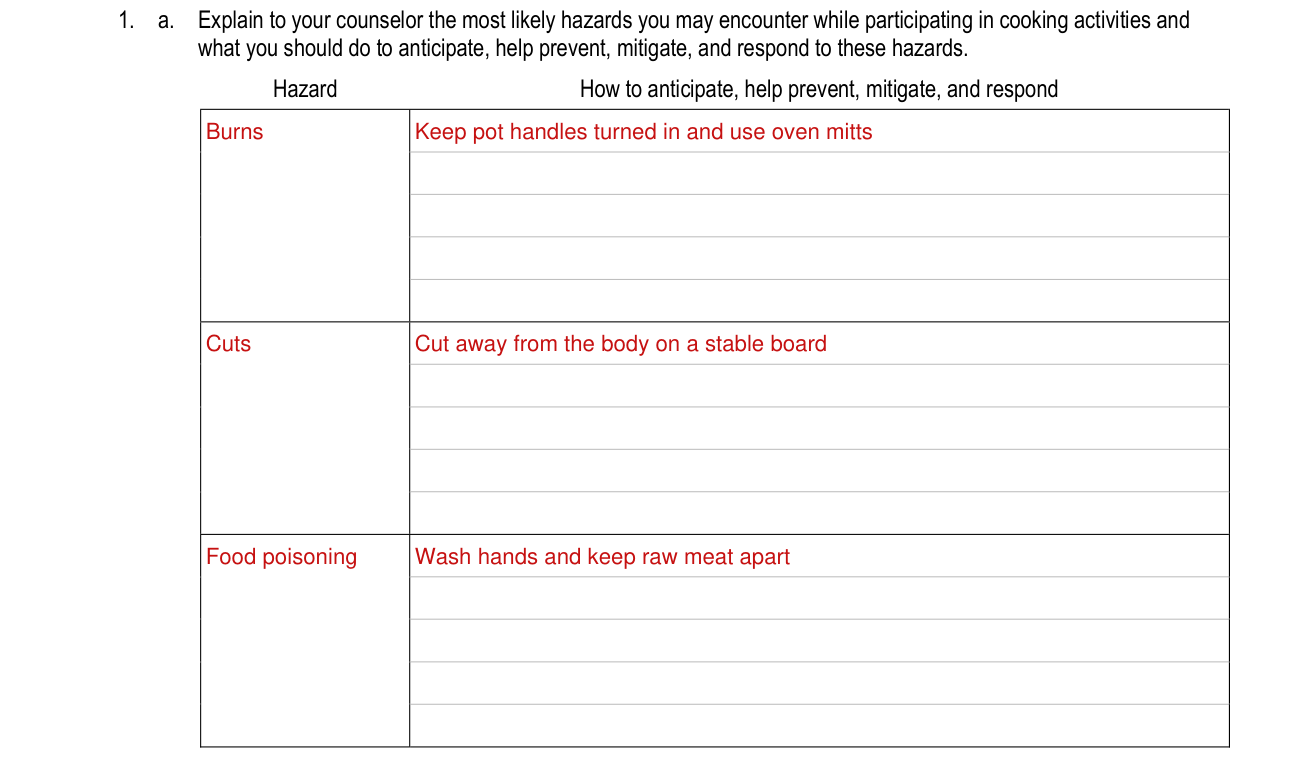
Under Hazard, explain to your counselor the most likely hazards you may encounter while participating in cooking activities, and what you should do to anticipate, help prevent, mitigate, and respond to these hazards.
More rules for Cooking Merit Badge Workbook
You should use the work space provided for each requirement to keep track of which requirements have been completed, and to make notes for discussing the item with your counselor, not for providing full and complete answers.
The meals prepared for Cooking merit badge requirements 4, 5, and 6 will count only toward fulfilling those requirements and will not count toward rank advancement or other merit badges.
Meals prepared for rank advancement or other merit badges may not count toward the Cooking merit badge. You must not repeat any menus for meals actually prepared or cooked in requirements 4, 5, and 6.
Please submit errors, omissions, comments or suggestions about this workbook to: Workbooks@USScouts.Org. Comments or suggestions for changes to the requirements for the merit badge should be sent to: Merit.Badge@Scouting.Org.
If your situation is different
First aid, cross-contamination and food allergies
Show that you know first aid for and how to prevent injuries or illnesses that could occur while preparing meals and eating, including burns and scalds, cuts, choking, and allergic reactions.
Describe how meat, fish, chicken, eggs, dairy products, and fresh vegetables should be stored, transported, and properly prepared for cooking.
Explain how to prevent cross-contamination.
Discuss with your counselor food allergies, food intolerance, and food-related illnesses and diseases.
Explain why someone who handles or prepares food needs to be aware of these concerns.
Discuss with your counselor why reading food labels is important. Explain how to identify common allergens such as peanuts, tree nuts, milk, eggs, wheat, soy, and shellfish.
Nutrition
Using the MyPlate food guide or the current USDA nutrition model, give five examples for EACH of the following food groups, the recommended number of daily servings, and the recommended serving size.
Explain why you should limit your intake of oils and sugars.
Track your daily level of activity and your daily caloric need based on your activity for five days. Then, based on the MyPlate food guide, discuss with your counselor an appropriate meal plan for yourself for one day.
The text of requirement 2d which appears on Scouting.org duplicates the text of requirement 1d. The following should be substituted: d. Discuss your current eating habits with your counselor and what you can do to eat healthier, based on the MyPlate food guide.
Discuss the following food label terms: calorie, fat, saturated fat, trans fat, cholesterol, sodium, carbohydrate, dietary fiber, sugar, protein.
Explain how to calculate total carbohydrates and nutritional values for two servings, based on the serving size specified on the label.
Cooking Basics
Discuss EACH of the following cooking methods. For each one, describe the equipment needed, how temperature control is maintained, and name at least one food that can be cooked using that method: baking, boiling, broiling, pan frying, simmering, steaming, microwaving, grilling, foil cooking, and use of a Dutch oven.
Discuss the benefits of using a camp stove on an outing vs. a charcoal or wood fire.
Describe for your counselor how to manage your time when preparing a meal so components for each course are ready to serve at the correct time.
Cooking at home
Using the MyPlate food guide or the current USDA nutrition model, plan menus for three full days of meals (three breakfasts, three lunches, and three dinners) plus one dessert.
Your menus should include enough to feed yourself and at least one adult, keeping in mind any special needs (such as food allergies) and how you keep your foods safe and free from cross-contamination.
List the equipment and utensils needed to prepare and serve these meals.
Find recipes for each meal.
Create a shopping list for your meals showing the amount of food needed to prepare for the number of people you will serve.
Determine the cost for each meal.
Share and discuss your meal plan and shopping list with your counselor.
Using at least five of the 10 cooking methods from requirement 3, prepare and serve yourself and at least one adult (parent, family member, guardian, or other responsible adult) one breakfast, one lunch, one dinner, and one dessert from the meals you planned.* *The meals for requirement 4 may be prepared on different days, and they need not be prepared consecutively.
Time your cooking to have each meal ready to serve at the proper time.
Camp Cooking
Using the MyPlate food guide or the current USDA nutrition model, plan a menu that includes four meals, one snack, and one dessert for your patrol (or a similar size group of up to eight youth, including you) on a camping trip.
These four meals must include two breakfasts, one lunch, and one dinner. Additionally, you must plan one snack and one dessert.
In the outdoors, using your menu plans and recipes for this requirement, cook two of the four meals you planned using either a camp stove OR backpack stove. Use a skillet over campfire coals OR a Dutch oven for the third meal, and cook the fourth meal in a foil pack OR on a skewer.
Lead the clean-up of the equipment, utensils, and the cooking site thoroughly after each meal.
The meals in requirements 5 and 6 may be prepared for different trips and need not be prepared consecutively.
Trail and backpacking meals
Using the MyPlate food guide or the current USDA nutrition model, plan a meal for trail hiking or backpacking that includes one breakfast, one lunch, one dinner, and one snack. These meals must not require refrigeration and are to be consumed by three to five people (including you).
Your plan must include how to repackage foods for your hike or backpacking trip to eliminate as much bulk, weight, and garbage as possible.
Explain to your counselor how you should divide the food and cooking supplies among the patrol in order to share the load.
Sources
[1] Cooking Merit Badge Workbook, U.S. Scouting Service Project (the Official source link on this page).
