
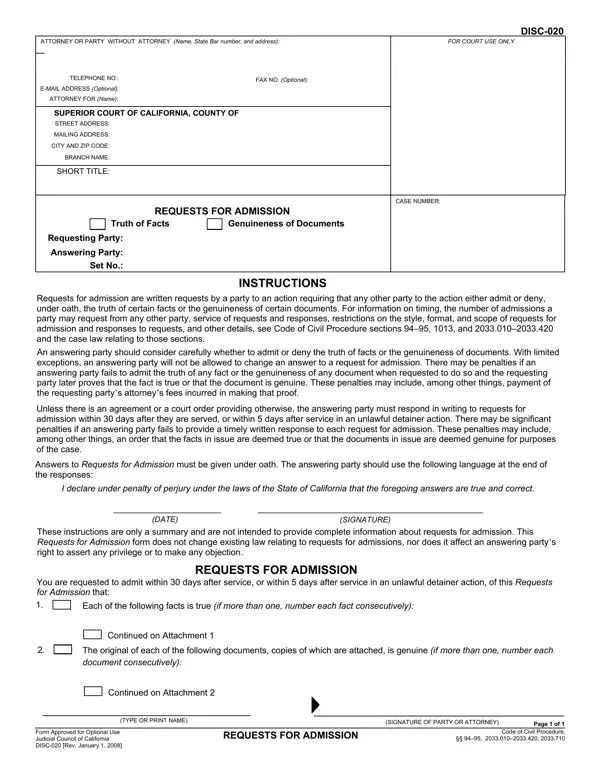
When navigating the complexities of legal proceedings, understanding the purpose and proper use of specific court forms is essential. Among these, the DISC-020, or Requests for Admission form, plays a crucial role. It allows a party involved in a court case to request the other side to admit or deny the truth of certain facts or the genuineness of documents under oath. This seemingly straightforward process is governed by detailed rules that outline the timing for responses, the permissible number of requests, and the manner in which these requests and their responses should be served and formatted. Furthermore, the form carries significant implications for the answering party, including the requirement to respond within specified deadlines—30 days after service, or 5 days in the case of an unlawful detainer action. Failure to provide timely and truthful responses can lead to severe penalties, including having facts deemed true or documents deemed genuine by the court, often with financial consequences in terms of covering the requesting party's attorney fees. Endorsed by the Judicial Council of California since its revision in January 2008, the DISC-020 form embeds within it the intricate balance of legal strategy and accountability, reminding participants in the justice system of the weight of truth and the importance of deadlines. While the form provides a structured means to request admissions, it underscores the broader legal principles at play—principles that demand careful consideration and precise action from each party involved.
| Question | Answer |
|---|---|
| Form Name | Disc 020 Form |
| Form Length | 1 pages |
| Fillable? | No |
| Fillable fields | 0 |
| Avg. time to fill out | 15 sec |
| Other names | requests admission, requests admissions sample, admission california form, request admissions california sample |