
DMA-3000 at a glance
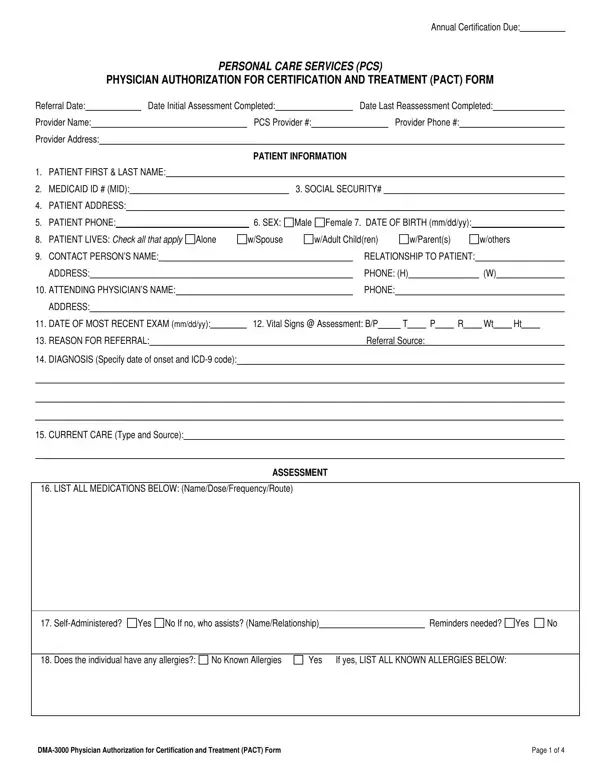
What it is: The DMA-3000 is the Personal Care Services (PCS) Physician Authorization for Certification and Treatment (PACT) Form.
Who signs: The RN signs with the date signed and the time in /out of home, and the attending physician signs with the date.
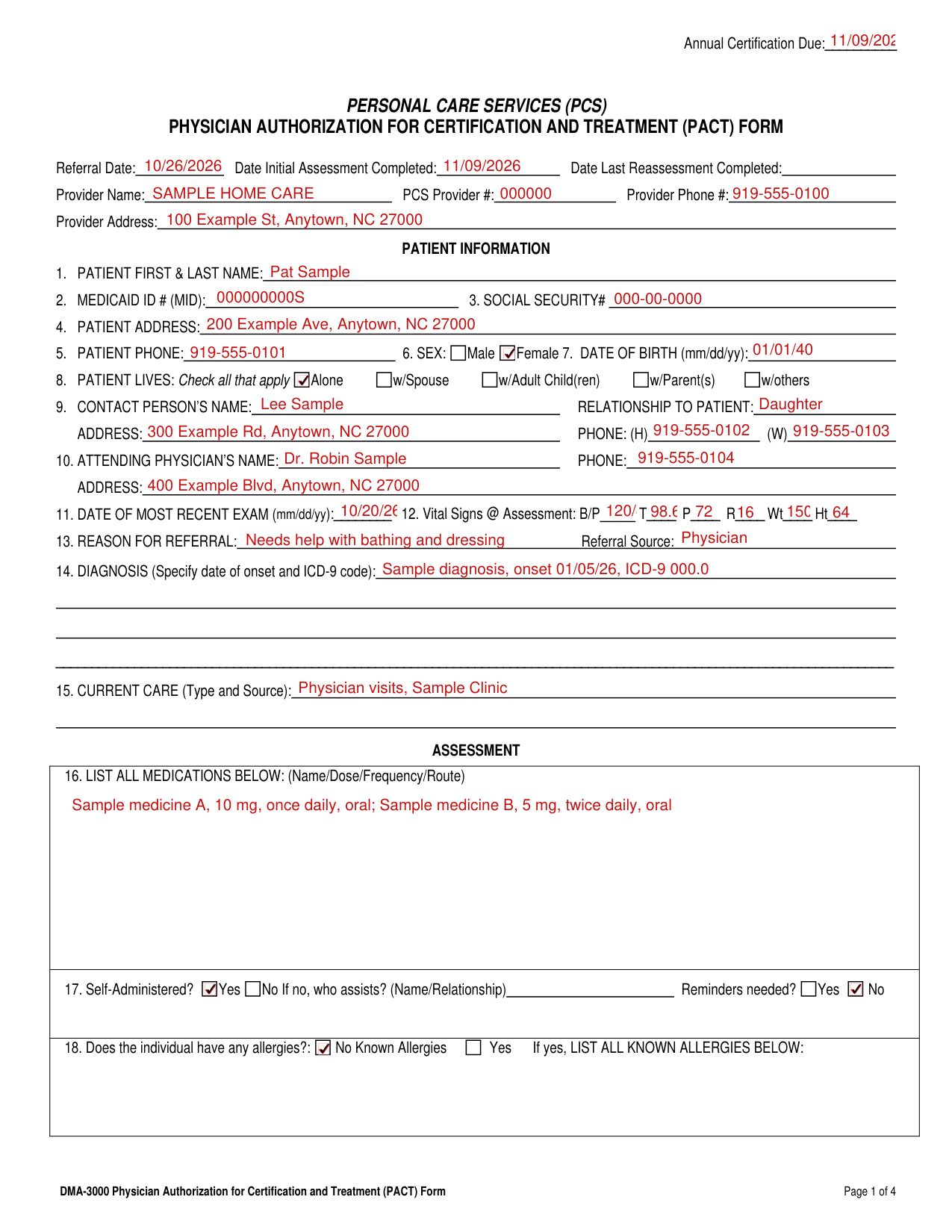
A filled-in DMA-3000 example: a nurse assessor fills in page 1 for a patient who lives alone
How to fill out DMA-3000, box by box
Referral, assessment dates and provider
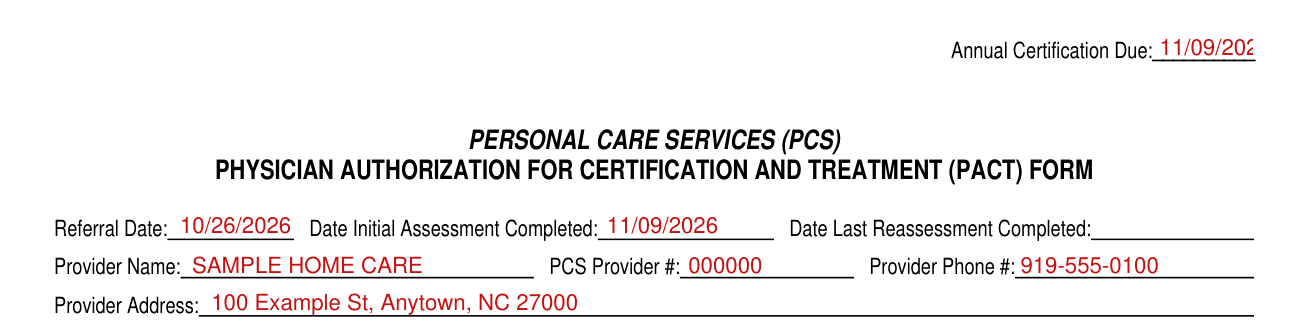
Enter the Annual Certification Due date, the Referral Date, the Date Initial Assessment Completed and the Date Last Reassessment Completed.
Enter the Provider Name, PCS Provider #, Provider Phone # and Provider Address.
Patient information

Under PATIENT INFORMATION, enter 1. the patient first & last name, 2. the Medicaid ID # (MID), 3. the Social Security # and 4. the patient address.
In 5 to 7, enter the patient phone, check Male or Female, and enter the date of birth (mm/dd/yy).
In 8, Patient lives, check all that apply.
Contact person and attending physician

In 9, write the contact person's name, relationship to patient, address and phone (H) and (W).
In 10, write the attending physician's name, phone and address.
Most recent exam, vital signs, reason for referral and diagnosis
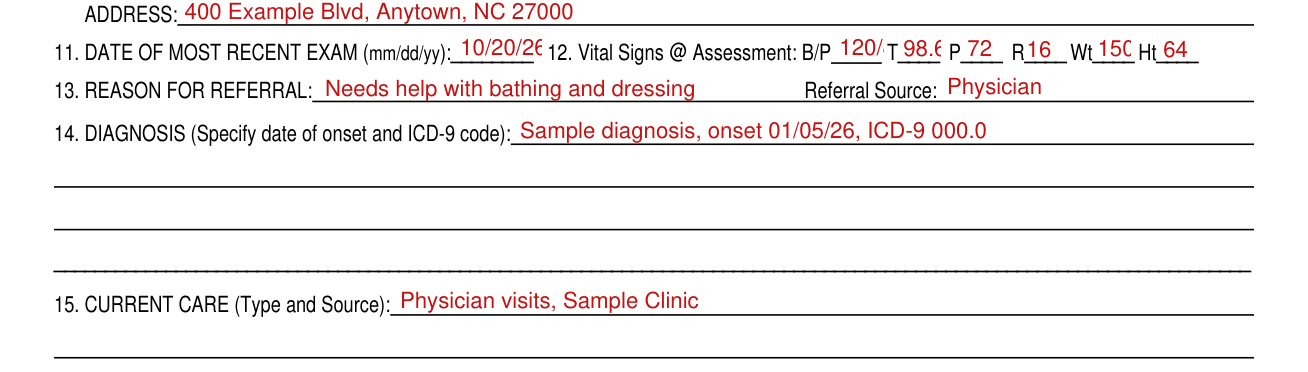
In 11, enter the date of most recent exam (mm/dd/yy), and in 12 the vital signs @ assessment: B/P, T, P, R, Wt and Ht.
In 13, enter the reason for referral and the referral source.
In 14, enter the diagnosis and specify the date of onset and the ICD-9 code.
In 15, enter the current care, type and source.
Medications and allergies
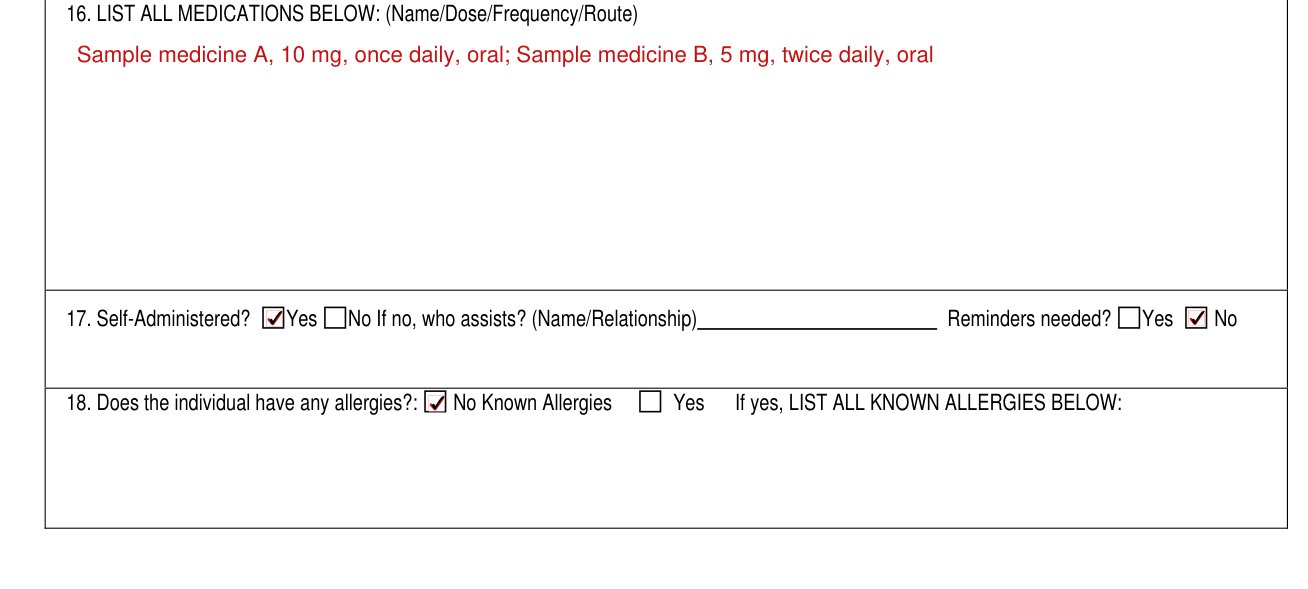
In 16, list all medications: name, dose, frequency and route.
In 17, check Yes or No for Self-Administered; if no, write who assists (name/relationship), and check Yes or No for reminders needed.
In 18, check No Known Allergies, or check Yes and, if yes, list all known allergies.
Limitations in Activities of Daily Living (ADLs)
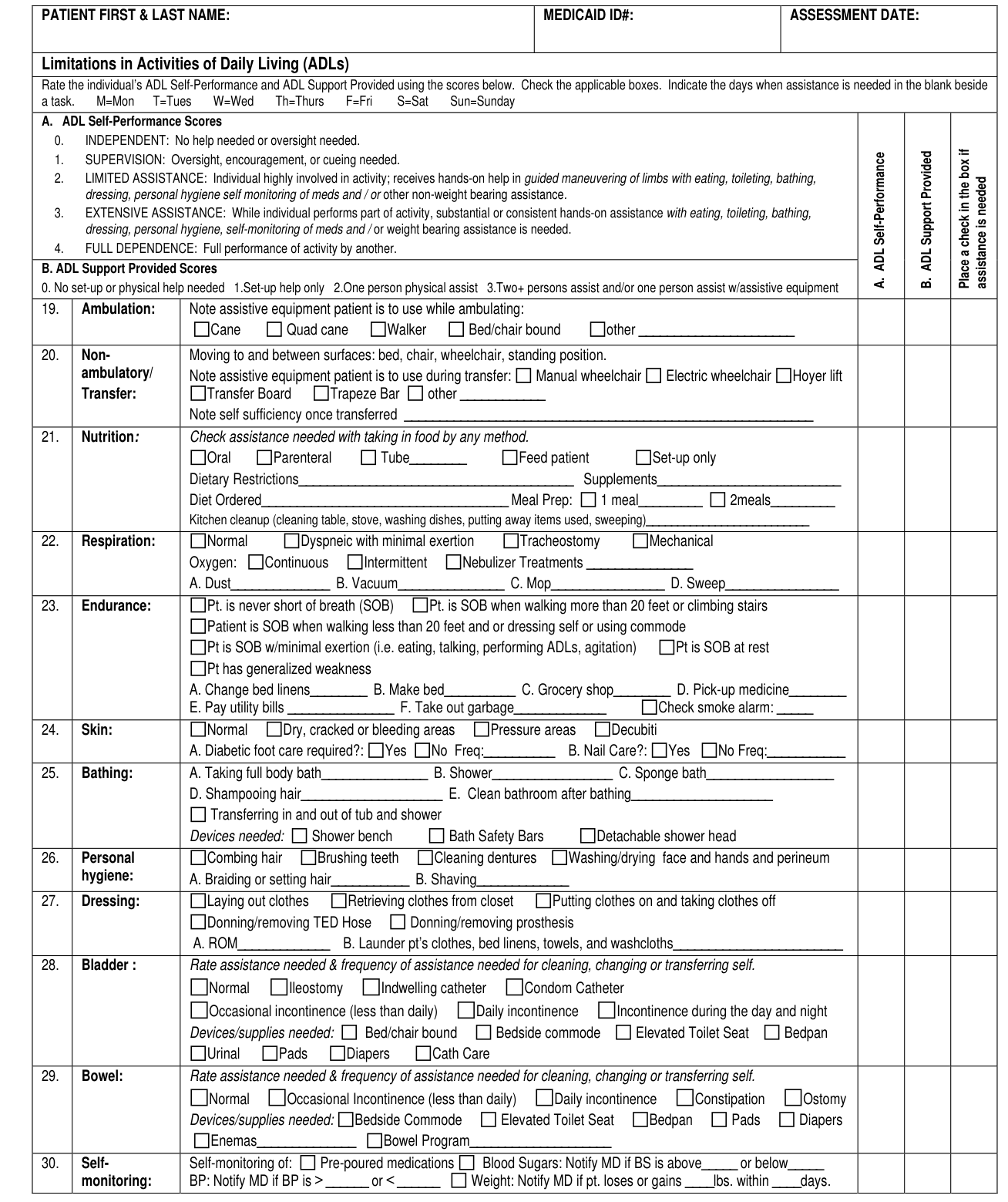
Rate the individual's ADL Self-Performance and ADL Support Provided using the scores, check the applicable boxes, and indicate the days when assistance is needed in the blank beside a task.
ADL Self-Performance scores: 0, independent, no help or oversight needed; 1, supervision, oversight, encouragement, or cueing needed; 2, limited assistance, non-weight bearing; 3, extensive assistance, weight bearing; 4, full dependence, full performance of activity by another.
ADL Support Provided scores: 0, no set-up or physical help needed; 1, set-up help only; 2, one person physical assist; 3, two+ persons assist and/or one person assist w/assistive equipment.
Enter A. ADL Self-Performance and B. ADL Support Provided, and place a check in the box if assistance is needed.
For 19, Ambulation, and 20, Non-ambulatory/Transfer, note the assistive equipment the patient is to use; for 21, Nutrition, check assistance needed with taking in food by any method, with Meal Prep: 1 meal or 2meals.
For 22, Respiration, check from Normal to Oxygen; for 23, Endurance, check Pt. is never short of breath (SOB), SOB when walking more than 20 feet or climbing stairs, Patient is SOB when walking less than 20 feet and or dressing self or using commode, SOB w/minimal exertion, SOB at rest, or generalized weakness.
For 24, Skin, 25, Bathing, 26, Personal hygiene, and 27, Dressing, check what applies, with Yes or No for diabetic foot care and nail care.
For 28, Bladder, and 29, Bowel, rate assistance needed & frequency of assistance needed for cleaning, changing or transferring self, and check the devices/supplies needed.
For 30, Self-monitoring, check pre-poured medications and fill in Notify MD for BS, for BP if > or <, and for Weight if pt. loses or gains lbs. within days.
Other Client Information
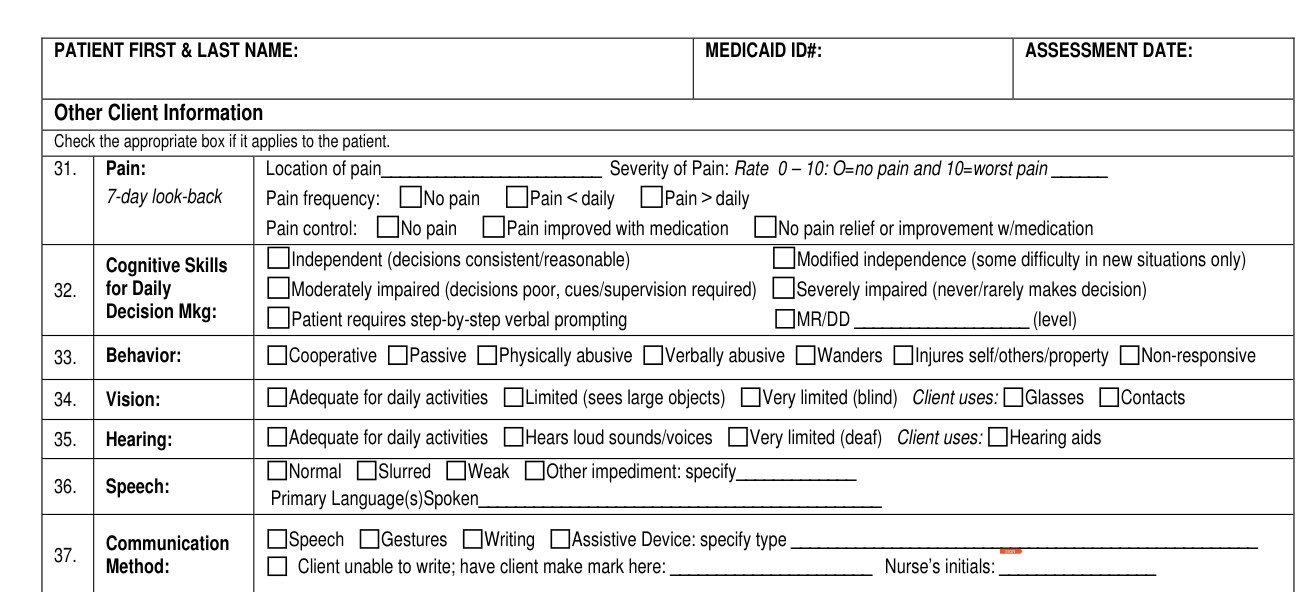
Under Other Client Information, check the appropriate box if it applies to the patient.
For 31, Pain (7-day look-back), enter the location of pain, rate severity 0 - 10 (0=no pain and 10=worst pain), and check pain frequency and pain control.
For 32, Cognitive Skills for Daily Decision Mkg, check one, from Independent, Modified independence (some difficulty in new situations only) to Severely impaired (never/rarely makes decision), or MR/DD with the level.
For 33, Behavior, 34, Vision, and 35, Hearing, check what applies, and check Glasses, Contacts or Hearing aids if the client uses them.
For 36, Speech, and 37, Communication Method, check what applies and enter the primary language(s) spoken; if the client is unable to write, have the client make a mark here, with the nurse's initials.
Additional time needed and patient's perception
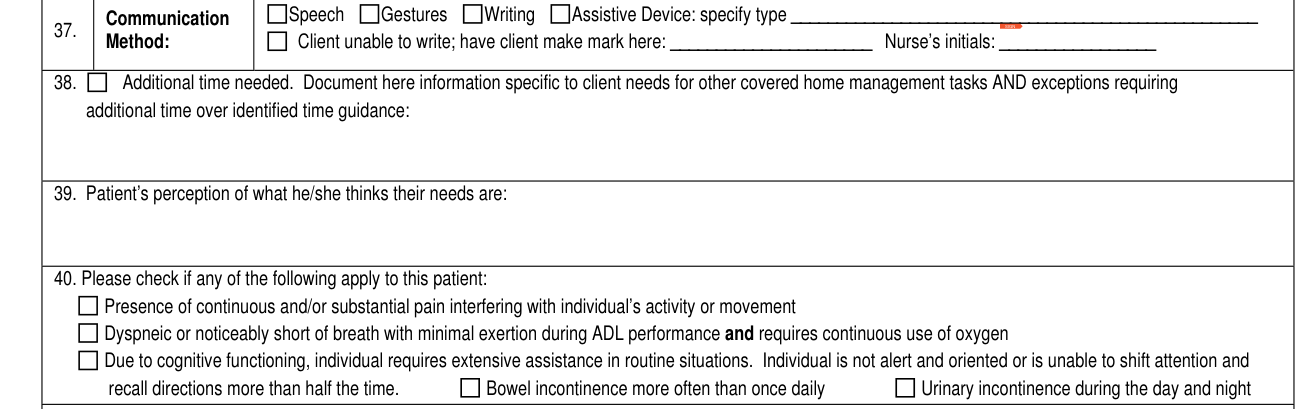
In 38, Additional time needed, document information specific to client needs for other covered home management tasks AND exceptions requiring additional time over identified time guidance; in 39, the patient's perception of what he/she thinks their needs are.
In 40, please check if any of the following apply to this patient: continuous and/or substantial pain interfering with activity or movement; dyspneic with minimal exertion during ADL performance and requires continuous use of oxygen; due to cognitive functioning, requires extensive assistance in routine situations.
Not alert and oriented or unable to shift attention and recall directions more than half the time; bowel incontinence more often than once daily; urinary incontinence during the day and night.
Advance directive, DNR order and safety assessment
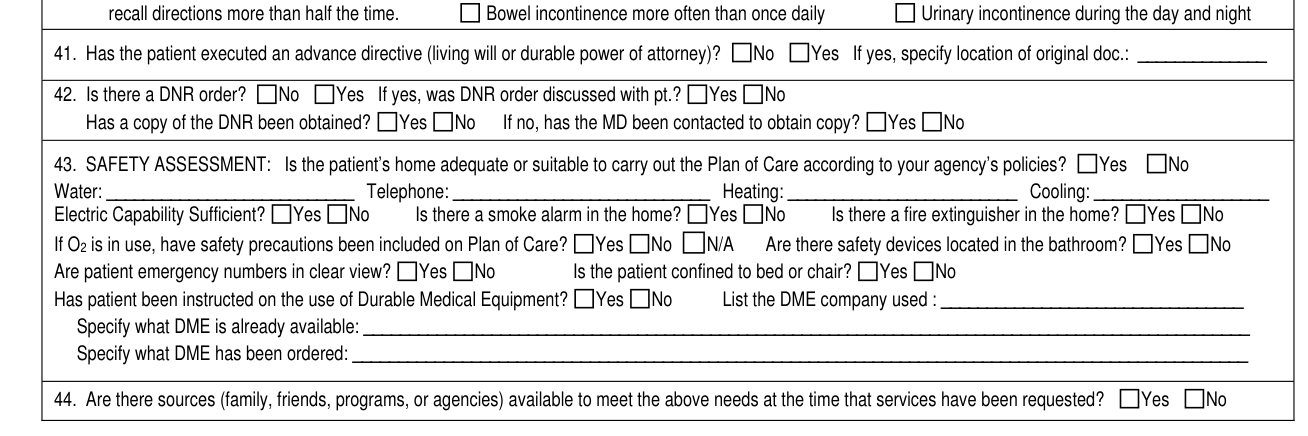
In 41, check No or Yes for an advance directive (living will or durable power of attorney); if yes, specify the location of the original doc.
In 42, Is there a DNR order? Check No or Yes; if yes, check Yes or No for: was the DNR order discussed with pt., has a copy of the DNR been obtained, and, if no, has the MD been contacted to obtain copy.
In 43, Safety Assessment, check Yes or No: is the patient's home adequate or suitable to carry out the Plan of Care according to your agency's policies? If O2 is in use, have safety precautions been included on Plan of Care? Check Yes, No or N/A, and list the DME company used.
In 44, check Yes or No: are there sources (family, friends, programs, or agencies) available to meet the needs at the time that services have been requested?
Nurse assessor certification

Under NURSE ASSESSOR CERTIFICATION, the nurse certifies that the nurse, and no one else, completed the in-home assessment of the patient's condition.
Check either: based on the assessment, the patient needs Personal Care Services due to the patient's medical condition and a plan of care has been developed to meet those needs; or the patient does not meet the criteria for personal care services.
Falsification: an individual who certifies a material and false statement in this assessment will be subject to investigation for Medicaid fraud and will be referred to the NC Board of Nursing for investigation.
Plan of care
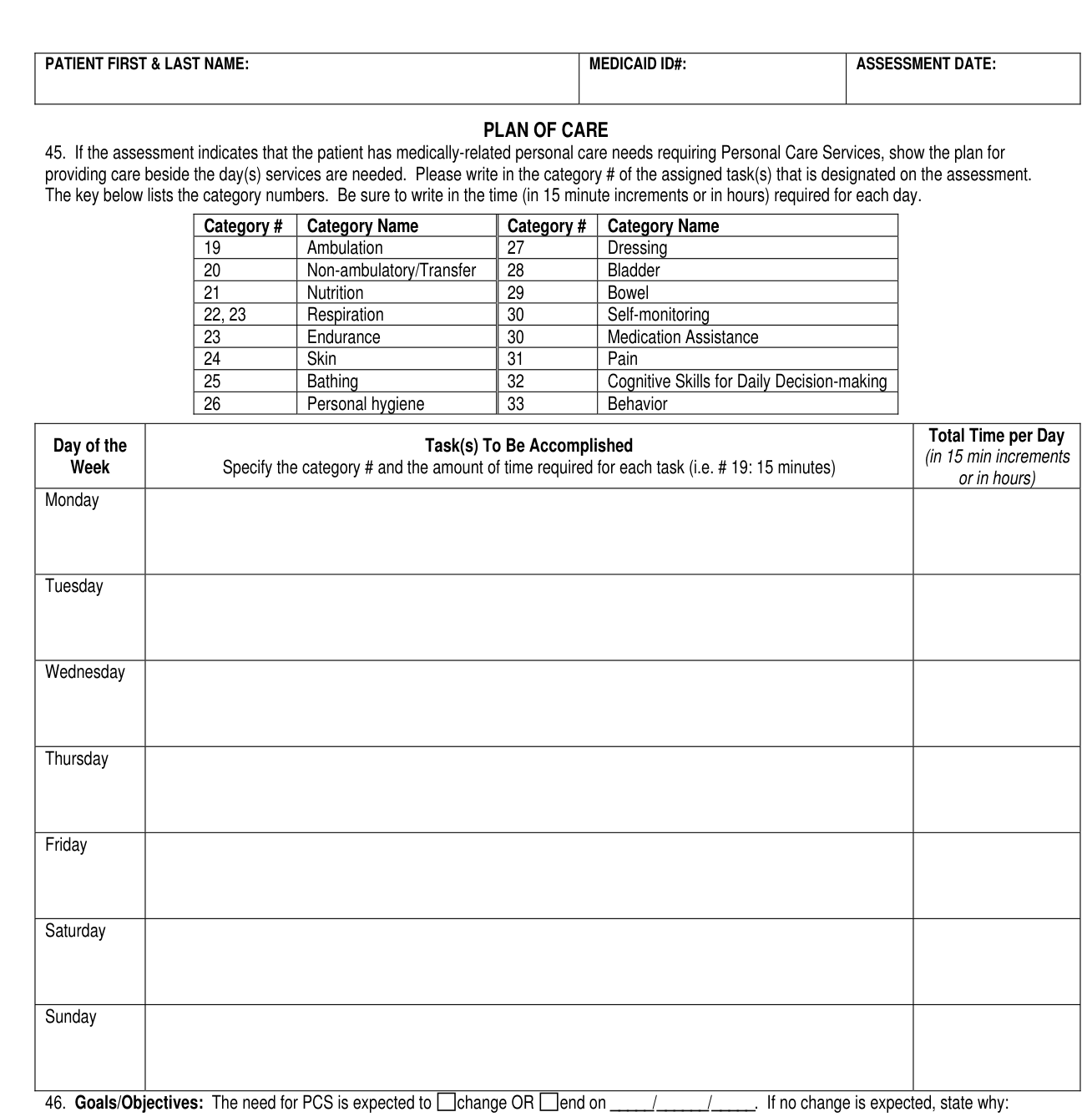
In 45, Plan of Care, if the assessment indicates that the patient has medically-related personal care needs requiring Personal Care Services, show the plan for providing care beside the day(s) services are needed.
Write in the category # of each assigned task from the key: 19 Ambulation, 20 Non-ambulatory/Transfer, 21 Nutrition, 22 and 23 Respiration, 23 Endurance, 24 Skin, 25 Bathing, 26 Personal hygiene, 27 Dressing, 28 Bladder, 29 Bowel, 30 Self-monitoring and Medication Assistance, 31 Pain, 32 Cognitive Skills for Daily Decision-making, 33 Behavior.
For each day, Monday to Sunday, specify the category # and the amount of time required for each task (i.e. # 19: 15 minutes), and the total time per day in 15 minute increments or in hours.
Goals/Objectives and verbal orders

In 46, Goals/Objectives, enter when the need for PCS is expected to change OR end; if no change is expected, state why.
In 47, check Yes and enter the Date if a verbal order has been obtained to assess the patient and determine eligibility for PCS per DMA Guidelines.
In 48, specify the date that a verbal order was obtained to start PCS and who conveyed/obtained this verbal order.
Physician certification

Under PHYSICIAN CERTIFICATION, the physician certifies that the physician is the patient's primary physician and the patient is under the physician's care and has a medical diagnosis with associated physical/mental limitations warranting the provision of the Personal Care Services in the plan of care.
Falsification: an individual who certifies a false statement in this plan may be subject to investigation for Medicaid fraud and will be referred to the North Carolina Board of Medicine.
More rules for DMA-3000
Enter the patient first & last name, Medicaid ID# and assessment date.
Sources
[1] DMA-3000 Physician Authorization for Certification and Treatment (PACT) Form, as served on formspal.com (the Official source link on this page).