

- Form DL 62 at a glance
- What to bring and attach to Form DL 62
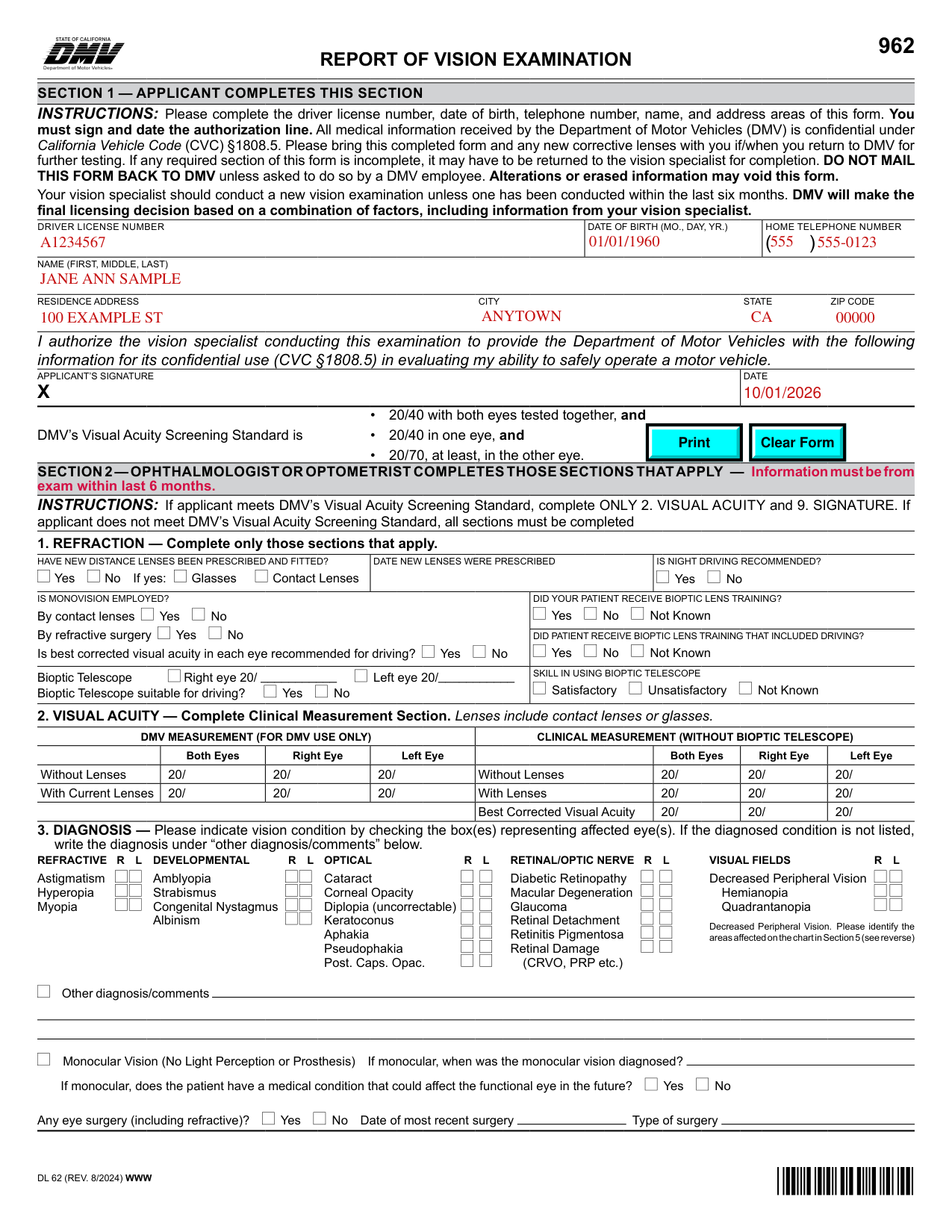
- A filled-in Form DL 62 example: Section 1 filled in before the vision exam
- How to fill out Form DL 62, box by box
- More rules for Form DL 62
- If your situation is different
- Common questions about Form DL 62
- Where to get help with Form DL 62
- Sources
Form DL 62 at a glance
What it is: Drivers who fail the vision screening are referred to a vision specialist who must examine the driver and complete a Report of Vision Examination (DL 62) form.[2]
Who signs: You must sign and date the authorization line. Box 9, Signature: in Section 2, the ophthalmologist or optometrist must complete this section to validate this report.
Where and when to file: The driver must submit the completed DL 62 form to DMV.[2]
What to bring and attach to Form DL 62
Bring this completed form and any new corrective lenses with you if/when you return to DMV for further testing.
Common mistake: Do not mail this form back to DMV unless asked to do so by a DMV employee.
A filled-in Form DL 62 example: Section 1 filled in before the vision exam
How to fill out Form DL 62, box by box
Tap a group of boxes to open it, and a picture to see it full size.
Section 1, what you fill in
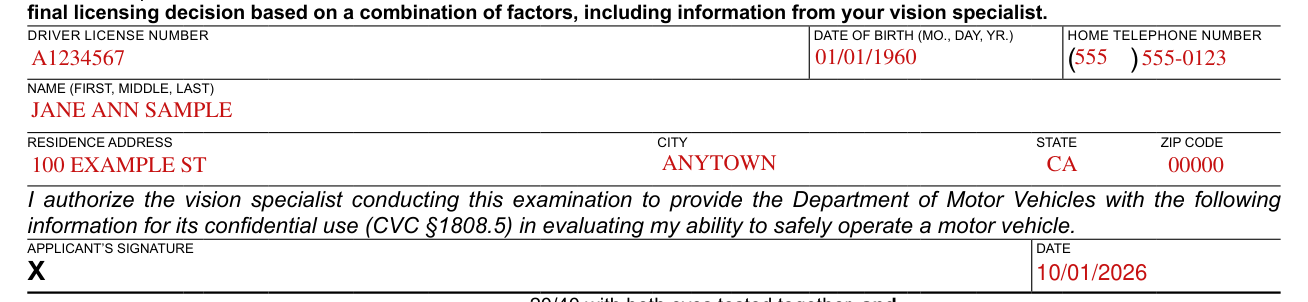
You, the applicant, complete Section 1.
Complete the driver license number, date of birth, telephone number, name, and address areas of this form.
Common mistake: You must sign and date the authorization line.
By your signature, you authorize the vision specialist conducting this examination to provide the Department of Motor Vehicles with the following information for its confidential use (CVC §1808.5) in evaluating your ability to safely operate a motor vehicle.
Common mistake: Alterations or erased information may void this form.
Section 2, your vision specialist's part
Section 2: an ophthalmologist or optometrist completes those sections that apply.
Section 2 information must be from an exam within the last 6 months.
Your vision specialist should conduct a new vision examination unless one has been conducted within the last six months.
DMV's Visual Acuity Screening Standard is 20/40 with both eyes tested together, 20/40 in one eye, and 20/70, at least, in the other eye.
If the applicant meets DMV's Visual Acuity Screening Standard, complete only Box 2, Visual Acuity, and Box 9, Signature.
If the applicant does not meet DMV's Visual Acuity Screening Standard, all sections must be completed.
Box 9, Signature: in Section 2, the ophthalmologist or optometrist must complete this section to validate this report.
Common mistake: If any required section of this form is incomplete, it may have to be returned to the vision specialist for completion.
More rules for Form DL 62
All medical information received by the Department of Motor Vehicles (DMV) is confidential under California Vehicle Code (CVC) §1808.5.
DMV will make the final licensing decision based on a combination of factors, including information from your vision specialist.
DMV may deny your application for not providing the required information, and failure to provide the information required on this form is cause for refusal to issue a driver's license.
If your situation is different
You submitted a DL 62 within the previous six months
If you submitted a DL 62 within the previous six months, a new DL 62 form is not required; however, if you had eye surgery within those six months, you must complete and submit a new DL 62 so that your vision specialist can give DMV an update on your vision.[3]
Your vision specialist prescribed a bioptic telescopic lens
If your vision specialist has prescribed a bioptic telescopic lens for you, you may not wear your lens to pass the vision test.
When you return with your completed DL 62, you will be asked to take an SDPE (driving test) to determine if you can drive safely while wearing your bioptic telescopic lens.[3]
You have monovision
If you have monovision (one eye corrected for distance vision and one eye treated or untreated for close-up vision) and DMV has no record of your vision condition, the DMV employee will give you a Report of Vision Examination (DL 62) and ask you to see your vision specialist; when you return with your completed DL 62, you will be asked to take an SDPE (driving test) to determine if you can drive safely.[3]
Common questions about Form DL 62
What is a DL 62 form?
Form DL 62 is the Report of Vision Examination. DMV uses this information to evaluate the applicant's ability to safely operate a motor vehicle and issue a driver's license. Drivers who fail the vision screening are referred to a vision specialist who must examine the driver and complete a Report of Vision Examination (DL 62) form.[2]
Where do I get an eyesight report form?
If you do not meet DMV's vision standard of 20/40, the DMV employee will give you a Report of Vision Examination (DL 62) form and ask you to see a vision specialist (a licensed ophthalmologist or optometrist).[3]
Where do I file it?
You must bring the completed DL 62 back to a DMV office and take another vision test.[3]
Where to get help with Form DL 62
Questions about this form should be directed to: Department of Motor Vehicles, Driver License Inquiries, PO Box 942890, Sacramento, CA 94290.
Sources
[1] Form DL 62, Report of Vision Examination (Rev. 8/2024), California Department of Motor Vehicles (the Official source link on this page).
[2] California DMV, Vision Conditions (dmv.ca.gov). Accessed October 1, 2026.
[3] California DMV, Senior Drivers (dmv.ca.gov). Accessed October 1, 2026.
