
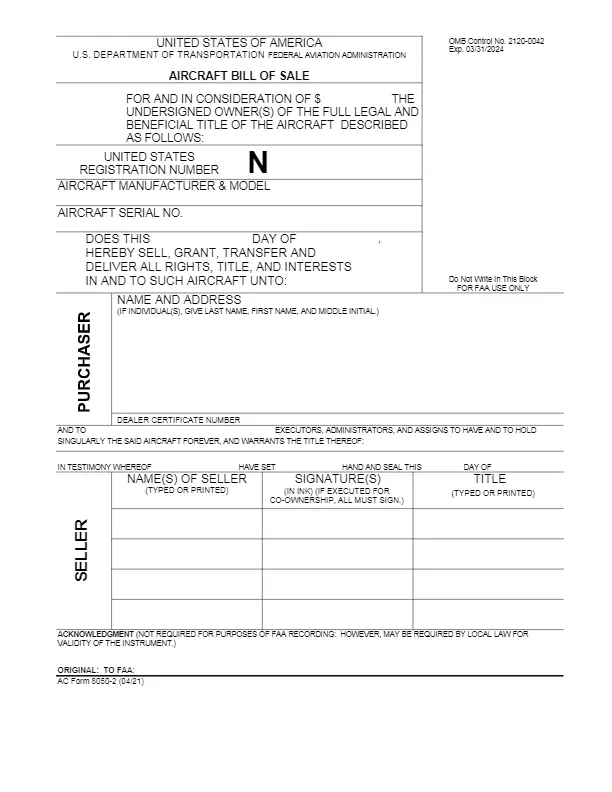
An aircraft bill of sale is a written record that shows an airplane has been sold from a seller to a buyer. When selling an airplane, an FAA bill of sale, also referred to as Form AC 8050-2, or any other form that the Federal Aviation Administration approves must be completed. It lists the buyer, the seller, the aircraft and the signatures, so both sides can show what was agreed.
Last Updated: October 2026. This guide is reviewed and updated regularly to reflect current law. If you notice an error or outdated information, please contact us.
You require a bill of sale to indicate and officiate an aircraft sale. It’s also mandatory documentation for registering your airplane as per the FAA. You must write down everything accordingly or you could land in trouble with the federal aviation and other relevant legislation governing aircraft sale. It also gives you a record to turn to if questions come up about the sale later.
| Document Name | Aircraft Bill of Sale Form |
| Other Names | FAA Bill of Sale, AC Form 8050-2 |
| Relevant Link | Federal Aviation Administration |
| Avg. Time to Fill Out | 10 minutes |
| # of Fillable Fields | 22 |
| Available Formats | Adobe PDF |
The bill of sale answers the basic questions about the transaction: who sold the plane, who bought it, which aircraft changed hands, for how much money and on what date. Both parties sign it to confirm the details, and the signed paper then works as the receipt for the deal. Keep your copy with the aircraft's logbooks so the whole history stays in one place.
Selling an aircraft takes six steps, from agreeing on a price to registering the plane with the FAA. The bill of sale ties these steps together. Follow them in order and keep a signed copy for your records.
Step 1. Negotiating the Best Buying Price

The first step involves negotiating the right price for the aircraft with the seller. As a smart buyer, you should determine the deposit amount for your dream plane. Also, agree with the seller if the down payment is refundable or otherwise. If it’s refundable, then define the circumstances and terms under which the refund happens.
Step 2. Filling Out the Bill of Sale

The second step involves filling out two copies of the airplane bill of sale form. The FAA demands that the form has to feature critical information on record. So, it’s necessary to complete our pre-approved form. Otherwise, you might omit some essential information if you use any other form.
Next, provide relevant information for secure ownership transfer as per what the federal aviation stipulates:
Step 3. Establish Refund Status

Next, state if the deposit is refundable or not. If it is, then clearly state how long the inspection time frame will be and the state or American region where the aircraft is being sold.
It also has to contain signatures and legibly-typed names of the purchasers, vendors, and their witnesses. After agreeing upon all of the terms, the two parties should complete the form to let the buyer make a down payment for the plane.
Step 4. Inspecting the Aircraft Before Selling

After filling out the bill of sale, the customer has a given time frame to complete the aircraft’s inspection. They can hire an expert mechanic to do it. The required time depends on how big or small the plane is.
Step 5. Finalizing the Sale of Aircraft

Once the inspection is complete, the two parties can finalize the deal. The purchasing party should deposit a full amount to let the current owner deliver the plane on the date that the two agreed upon. The new owner can start using the aircraft once the provisional registration is complete.
Step 6. Registration of an Aircraft with the FAA

Registration of aircraft with the FAA is the next stage. They can do this by filling out the FAA aircraft registration form or the Form 8050-1, FAA form 8050, or form 8050 that the FAA provides.
The buyer should also submit the initial registration certificate from the seller. This document must contain all of the sales details on its reverse, any previous sale bill, and a $5.00 fee to the FAA. Afterward, they receive their final possession certificate.
The aviation administration requires the seller to fill out a bill of sale, which is in FAA Form 8050-2 that can be downloaded on the FAA’s site. Alternatively, you can get it on AOPA’s website. This bill of sale needs duplicate filling.
If you need any other relevant forms such as the AC form, you can download them here. Two original of the bill of sale goes to the buyer while another copy is attached to the registration and goes to the FAA. The buyer maintains another copy. Sellers may make copies if they need them for record purposes.
Please note that the seller’s name must match the one on the existing registration. Don’t initialize names, for instance, Samuel to Sam.
This stage happens at the time of signing the bill of sale. The seller should be careful to accept a secure payment method, especially a bank wire transfer, since checks can bounce. This way, they will receive the funds and complete the transaction smoothly. They can also use AOPA’s partner to help with escrow services.
Sellers working with brokers or dealers should sign legally-binding agreements to ensure they get the agreed amount once the customer makes payment. After a successful sale, sellers should notify their insurers to end their policies. Afterward, it becomes the insurer’s job to organize for another cover for the new aircraft owner upon assuming complete ownership and possession of the plane.
Upon completing form 8050-1, present owners should duplicate it and pin it on the sold aircraft. This copy will act as a provisional registration. They can get form 8050-1 online. When new owners apply for registration, they must show how the plane’s ownership moved from the last registered aircraft owner down to them.
Form AC 8050-2, also known as the Aircraft (FAA) Bill of Sale, is an official form to record the aircraft ownership transfer. The form is short, but fill it in carefully so no detail is missed. The five steps below follow the form from top to bottom.
Step 1: Indicate the consideration amount

In the first section, it’s necessary to indicate the amount of consideration the buyer gives the seller to get ownership of the aircraft. Consideration is usually the purchase price of the aircraft.
Step 2: Fill out the information about the aircraft

The next step is to describe the aircraft being sold and purchased. It’s required to fill out the following information:
Step 3. Identify the date of the transaction

The third section is devoted to the date when the transaction occurs. You will need to specify the following details:
Step 4. Provide the purchaser’s and dealer’s information

You are required to provide the personal information and contact details of the purchaser, including:
If the transaction involves a dealer, it’s necessary to indicate the Dealer Certificate Number. Otherwise, it would be best if you left the space blank.
You will also need to put her/his/their before the “Executors, administrators, and assigns…”
Step 5. Identify the seller(s) and their titles

The last step is devoted to the information about the seller(s) and their title(s). You will need to indicate the following details:
All the sellers must sign the bill of sale in ink, and the form must be prepared in duplicate. The Federal Aviation Administration (FFA) does not require to provide the notary acknowledgment, but the local laws sometimes may require one.
Most problems with an aircraft sale start with small slips on the paperwork, and a careful read before anyone signs can save a lot of back and forth later. Look out for these common mistakes:
It is a signed record of an aircraft sale. It names the buyer and the seller, describes the aircraft and shows the price and the date. Both sides can keep a copy as proof of the deal.
Gather both parties' full names and addresses, the sale date and the price. Also have the N-Number, make, model and serial of the aircraft in front of you.
Write the N-Number, the manufacturer and model, and the serial assigned by the manufacturer. Check each one against the aircraft's registration papers so they match.
Many sellers prefer a bank wire transfer, because checks can bounce. An escrow service can also hold the funds until both sides are ready.
Keep a signed copy with your aircraft records and give the buyer theirs. Store the paperwork somewhere safe, since you may want it later.
General information, not legal or tax advice.
