

Cash Flow Analysis Form 1084 at a glance
What it is: Cash Flow Analysis (Form 1084) may be used to prepare a written evaluation of the analysis of income related to self-employment.
The purpose of this written analysis is to determine the amount of stable and continuous income that will be available to the borrower for loan qualifying purposes.
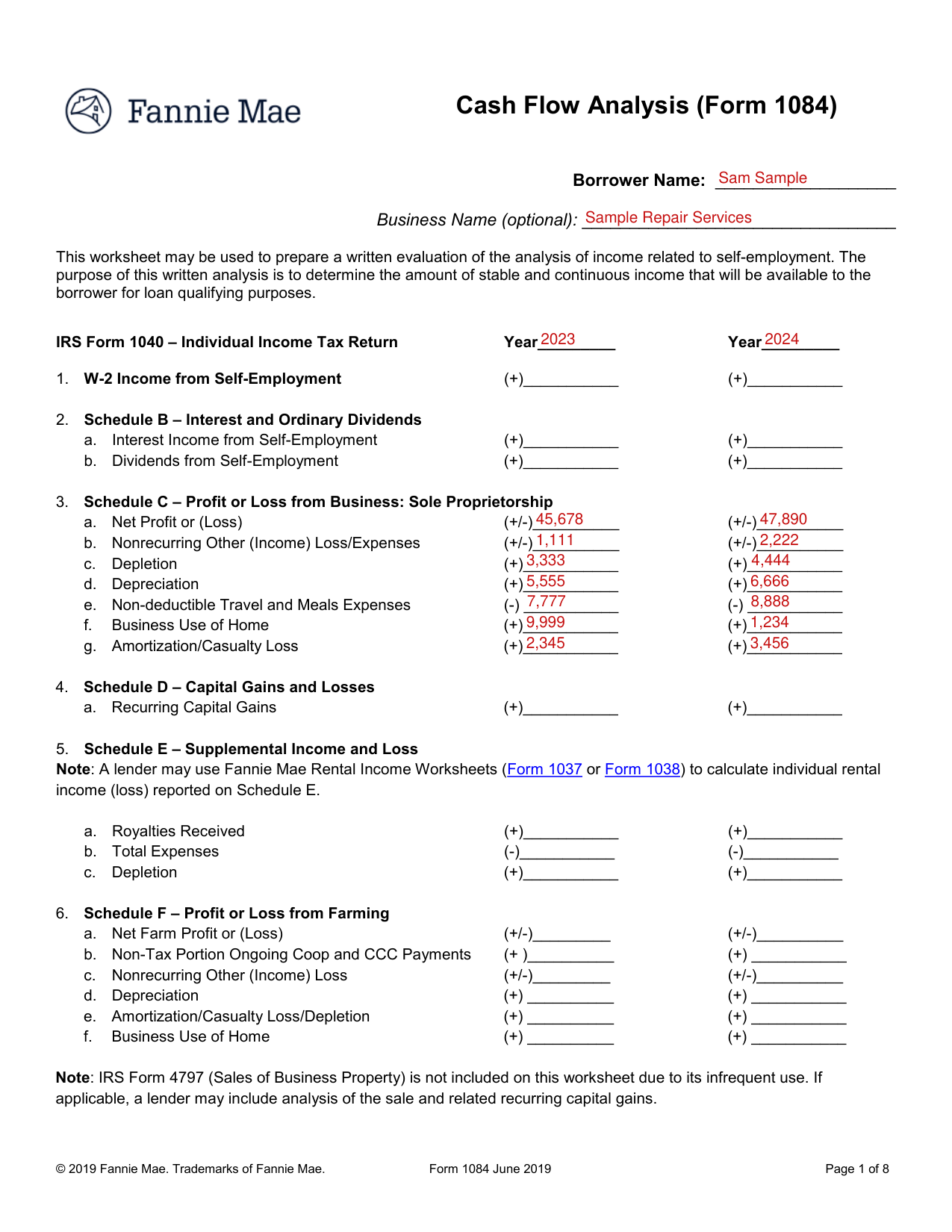
A filled-in Cash Flow Analysis Form 1084 example: a sole proprietor reports two years
How to fill out Cash Flow Analysis Form 1084, box by box
Borrower Name and Business Name

Enter the Borrower Name. Enter the Business Name (optional).
IRS Form 1040 - Individual Income Tax Return

Enter the Year in each Year blank.
Line 1 - W-2 Income from Self-Employment: Identify wages paid to the borrower from the borrower's business.
Schedule B - Interest and Ordinary Dividends

Schedule B - Interest and Ordinary Dividends, Line 2a - Interest Income from Self-Employment: Identify interest income paid to the borrower from the borrower's business.
Line 2b - Dividends from Self-Employment: Identify dividend income paid to the borrower from the borrower's business.
Schedule C - Profit or Loss from Business: Sole Proprietorship

Line 3a - Net Profit or Loss: Record the net profit or (loss) reported on Schedule C.
Line 3b - Nonrecurring Other (Income) Loss/Expenses: Other income reported on Schedule C represents income that is not directly related to business receipts. Deduct other income unless the income is determined to be recurring. If the income is determined to be recurring, no adjustment is required. Other loss may be added back when it is determined that the loss will not continue.
Line 3c - Depletion: Add back the amount of the depletion deduction reported on Schedule C.
Line 3d - Depreciation: Add back the amount of the depreciation deduction reported on Schedule C.
Line 3e - Non-deductible Travel and Meals Expenses: Deduct the portion of business-related meals and entertainment expenses that have been excluded for tax reporting purposes.
Line 3f is Business Use of Home (+).
Line 3g - Amortization/Casualty Loss: Add back the expense deducted for amortization along with the expense associated with non-recurring casualty loss.
Schedule D - Capital Gains and Losses

Line 4a - Recurring Capital Gains: Identify the amount of recurring capital gains.
Do not include business capital gains which are sporadic or result from a one-time transaction.
Business capital losses identified on ScheduleD do not have to be considered when calculating income or liabilities, even if the losses are recurring.
Schedule E - Supplemental Income and Loss

Use Fannie Mae Rental Income Worksheets (Form 1037 or Form 1038) to evaluate individual rental income (loss) reported on Schedule E.
Line 5a - Royalties Received: Include royalty income which meets eligibility standards.
Line 5b - Total Expenses: Deduct the expenses related to royalty income used in qualifying the borrower.
Line 5c - Depletion: Add back the amount of the depletion deduction related to royalty income used in qualifying the borrower.
Schedule F - Profit or Loss from Farming

Line 6a - Net Farm Profit or (Loss): Record the net farm profit or (loss) reported on Schedule F.
Line 6b - Non-taxable Portion of Ongoing Coop and CCC Payments: Certain federal agriculture program payments, coop distributions, and insurance/loan proceeds are not fully taxable. Add back the nontaxable portion of these income types provided these sources of income are likely to continue and do not represent a one-time occurrence.
Line 6c - Nonrecurring Other (Income) Loss: Other income reported on Schedule F represents income received by a farmer that was not obtained through farm operations.
Line 6d - Depreciation: Add back the amount of the depreciation deduction reported on Schedule F.
Line 6e - Amortization/Casualty Loss/Depletion: Add back the expense deducted for amortization/depletion along with the expense associated with non-recurring casualty loss.
Line 6f is Business Use of Home (+).
IRS Form 1065 - Partnership Income
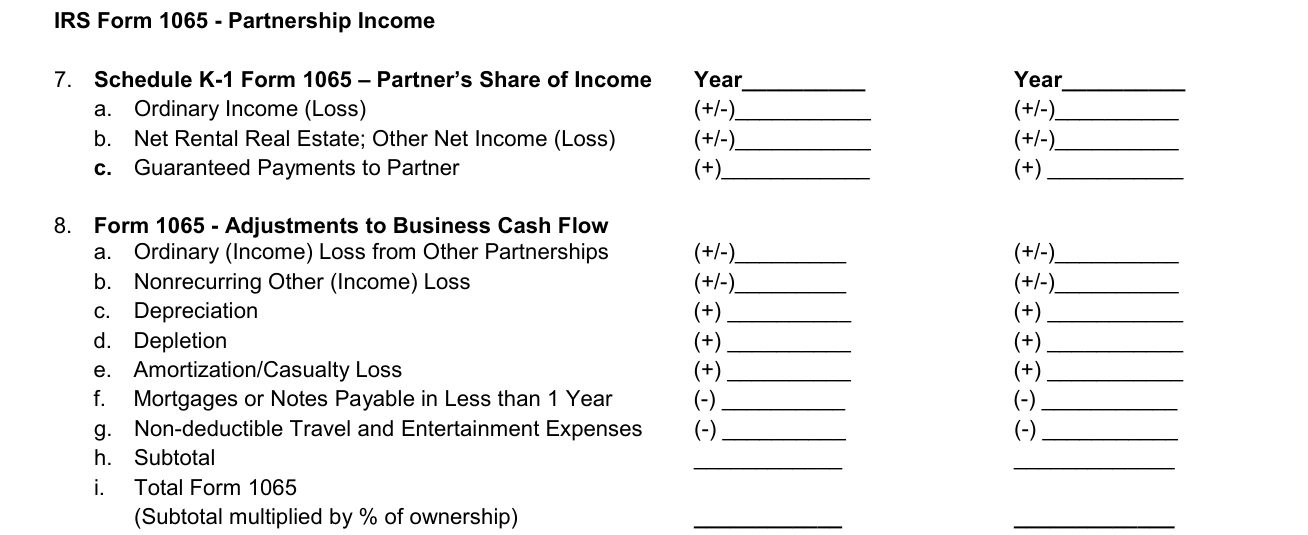
A self-employed borrower's share of Partnership or S Corporation earnings can only be considered if the lender obtains documentation, such as Schedule K-1, verifying that the income was actually distributed to the borrower, or the business has adequate liquidity to support the withdrawal of earnings. If the Schedule K-1 provides this confirmation, no further documentation of business liquidity is required.
Line 7a - Ordinary Income (Loss): Record the amount of ordinary income (loss) reported to the borrower in Box 1 of Schedule K-1 (Form 1065).
Line 7b - Net Rental Real Estate; Other Net Income (Loss): Record the amount of net rental real estate; other net income (loss) reported to the borrower in Box 2 and/or 3 of Schedule K-1 (Form 1065).
Line 7c - Guaranteed Payments to Partner: Add guaranteed payments to partner when the borrower has a two-year history of receipt.
Adjustments to Business Cash Flow - Form 1065: When business tax returns are obtained by the lender, the following adjustments to business cash flow should be made.
Line 8a - Ordinary income (loss) from other Partnerships: In order to consider ordinary income from other partnerships, the lender must obtain additional documentation to confirm the income passed through from the other partnership to the borrower's business meets partnership income eligibility standards. Deduct ordinary income passed through to the borrower's business from other partnerships unless this additional action is taken. Losses passed through to the borrower's business may be added back when the lender determines pass-through losses are not likely to continue.
Line 8c - Depreciation: Add back the amount of the depreciation deduction reported on Form 1065 and/or on Form 8825.
Line 8d - Depletion: Add back the amount of the depletion deduction reported on Form 1065.
Line 8e - Amortization/Casualty Loss: Add back the expense deducted for amortization/depletion along with the expense associated with non-recurring casualty loss.
IRS Form 1120S - S Corporation Earnings
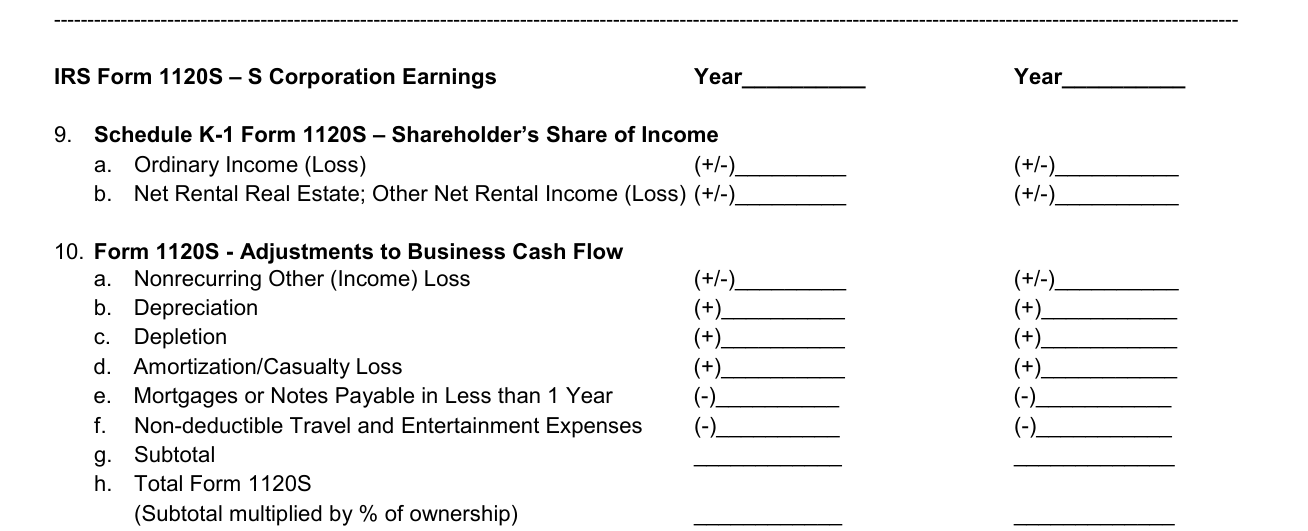
Enter the Year for IRS Form 1120S - S Corporation Earnings in each Year blank.
Line 9a - Ordinary Income (Loss): Record the amount of ordinary income (loss) reported to the borrower in Box 1 of Schedule K-1 (Form 1120S).
Line 9b - Net Rental Real Estate; Other Net Income (Loss): Record the amount of net rental real estate; other net income (loss) reported to the borrower in Box 2 and/or 3 of Schedule K-1 (Form 1120S).
IRS Form 1120 - Regular Corporation
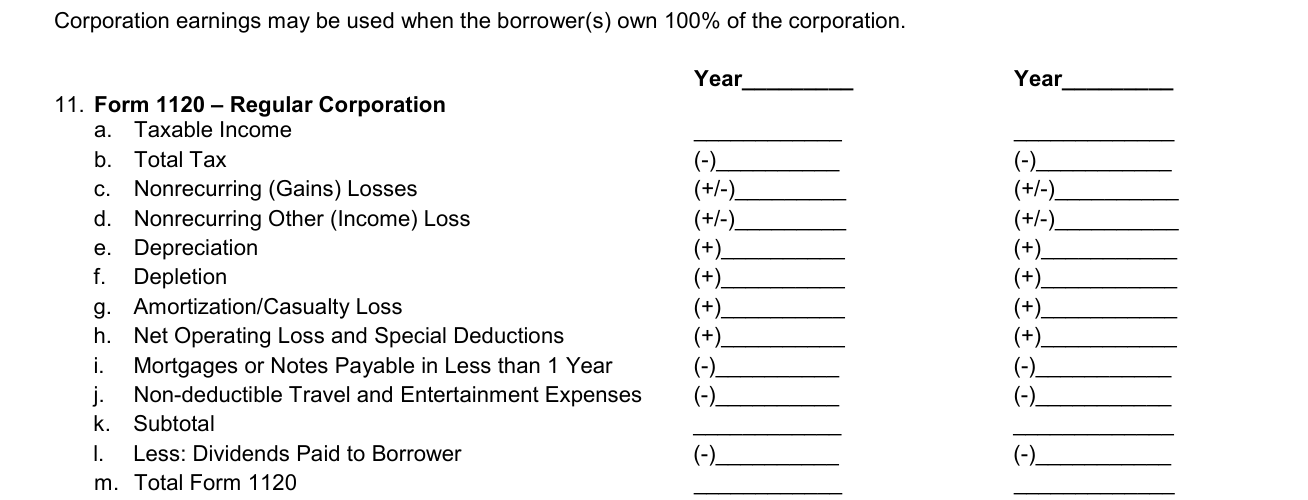
Corporation earnings may be used when the borrower(s) own 100% of the corporation.
Line 11a - Taxable Income: Record the taxable income reported by the business on the first page of Form 1120.
Line 11b - Total Tax: Deduct the corporation's tax liability identified on page 1 of Form 1120.
Common questions about Cash Flow Analysis Form 1084
What is a 1084 form?
Cash Flow Analysis (Form 1084) may be used to prepare a written evaluation of the analysis of income related to self-employment. Form 1084 is a Fannie Mae form, June 2019.
Sources
[1] Cash Flow Analysis Form 1084 (June 2019), Fannie Mae (the Official source link on this page).
