
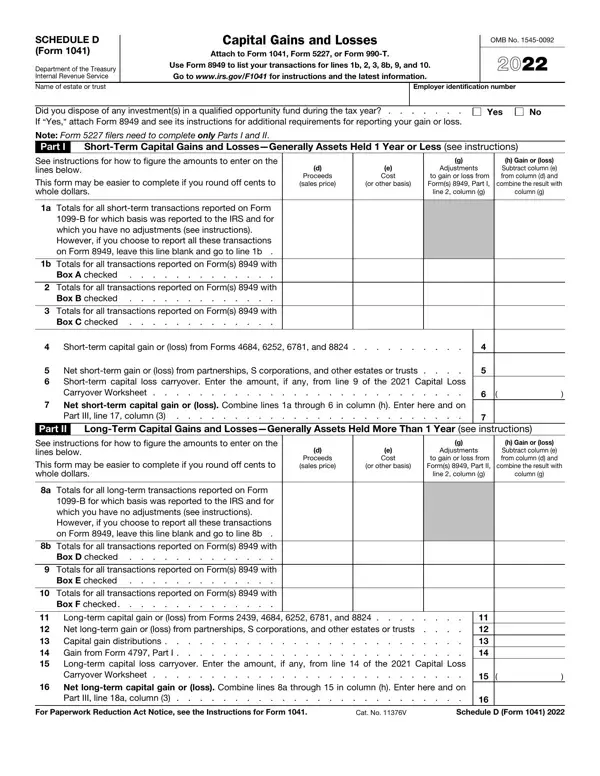
Understanding the nuances of tax forms is crucial for trustees and executors managing the financial affairs of estates and trusts. The Schedule D (Form 1041) serves as a key document in this process, guiding the reporting of capital gains and losses. This form, associated with the IRS and detailed for the 2021 tax year, demands careful attention to accurately document short-term and long-term transactions. It necessitates the attachment to Form 1041, Form 5227, or Form 990-T, depending on the nature of the entity reporting. Instructions laid out by the form emphasize the use of Form 8949 for listing specific transactions, indicating the IRS's effort to streamline the complex reporting process. The form is divided into parts that address short-term gains or losses for assets held for one year or less, and long-term gains or losses for assets held more than a year, incorporating data from various IRS forms and considering the impact of partnerships, S corporations, and capital loss carryovers. The summary of parts I and II elucidates the aggregate impact of these transactions on the estate or trust, guiding how to navigate tax implications. Moreover, the schedule delicately touches on the limitation of capital losses and the computation of taxes using maximum capital gains rates, showcasing the multifaceted nature of handling estate or trust finances. Reflecting on these elements provides a comprehensive overview of Schedule D (Form 1041) and its pivotal role in estate and trust tax preparation.
| Question | Answer |
|---|---|
| Form Name | Form 1041 Schedule D |
| Form Length | 2 pages |
| Fillable? | Yes |
| Fillable fields | 108 |
| Avg. time to fill out | 30 sec |
| Other names | f1041sd.pdf - SCHEDULE D(Form 1041 Department of the ... |
Form 1041 Schedule D isn’t the one you’re looking for?