

Form 6 at a glance
What it is: HOLMCENTER FORM 6 is the BRIEFING GRADE SHEET, a form with a part completed by the student and a part completed by the evaluating officer.
Who signs: EVALUATING OFFICER SIGNATURE and DATE, REVIEWING OFFICER SIGNATURE (If Required) and DATE.
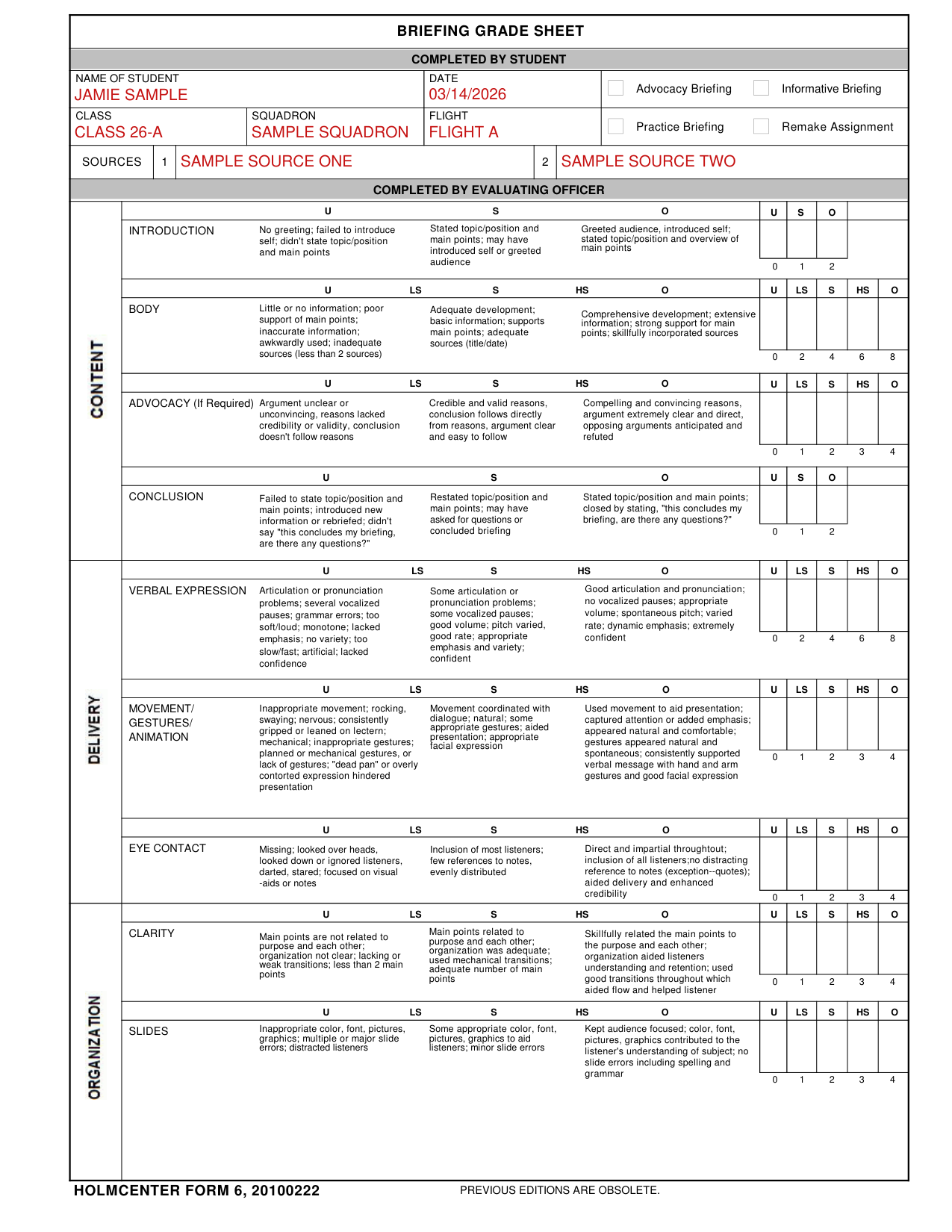
A filled-in Form 6 example: a student completes the top of the sheet
How to fill out Form 6, box by box
Name of student, date, class, squadron, flight and sources

Completed by the student: enter NAME OF STUDENT, DATE, CLASS, SQUADRON, FLIGHT and SOURCES 1 and 2.
Advocacy Briefing, Informative Briefing, Practice Briefing or Remake Assignment

Mark one of Advocacy Briefing, Informative Briefing, Practice Briefing or Remake Assignment.
Completed by evaluating officer
Introduction, body, advocacy, conclusion, verbal expression, eye contact, clarity and slides
COMPLETED BY EVALUATING OFFICER.
INTRODUCTION: Greeted audience, introduced self; stated topic/position and overview of main points. Stated topic/position and main points; may have introduced self or greeted audience. No greeting; failed to introduce self; didn't state topic/position and main points.
BODY: Comprehensive development; extensive information; strong support for main points; skillfully incorporated sources. Adequate development; basic information; supports main points; adequate sources (title/date). Little or no information; poor support of main points; inaccurate information; awkwardly used; inadequate sources (less than 2 sources).
ADVOCACY (If Required): Compelling and convincing reasons, argument extremely clear and direct, opposing arguments anticipated and refuted. Credible and valid reasons, conclusion follows directly from reasons, argument clear and easy to follow. Argument unclear or unconvincing, reasons lacked credibility or validity, conclusion doesn't follow reasons.
CONCLUSION: Stated topic/position and main points; closed by stating, "this concludes my briefing, are there any questions?" Restated topic/position and main points; may have asked for questions or concluded briefing. Failed to state topic/position and main points; introduced new information or rebriefed; didn't say "this concludes my briefing, are there any questions?"
VERBAL EXPRESSION: Good articulation and pronunciation; no vocalized pauses; appropriate volume; spontaneous pitch; varied rate; dynamic emphasis; extremely confident. Some articulation or pronunciation problems; some vocalized pauses; good volume; pitch varied, good rate; appropriate emphasis and variety; confident. Articulation or pronunciation problems; several vocalized pauses; grammar errors; too soft/loud; monotone; lacked emphasis; no variety; too slow/fast; artificial; lacked confidence.
EYE CONTACT: Direct and impartial throughtout; inclusion of all listeners;no distracting reference to notes (exception--quotes); aided delivery and enhanced credibility. Inclusion of most listeners; few references to notes, evenly distributed. Missing; looked over heads, looked down or ignored listeners, darted, stared; focused on visual -aids or notes.
CLARITY: Skillfully related the main points to the purpose and each other; organization aided listeners understanding and retention; used good transitions throughout which aided flow and helped listener. Main points related to purpose and each other; organization was adequate; used mechanical transitions; adequate number of main points. Main points are not related to purpose and each other; organization not clear; lacking or weak transitions; less than 2 main points.
SLIDES: Kept audience focused; color, font, pictures, graphics contributed to the listener's understanding of subject; no slide errors including spelling and grammar. Some appropriate color, font, pictures, graphics to aid listeners; minor slide errors. Inappropriate color, font, pictures, graphics; multiple or major slide errors; distracted listeners.
Time, objective and professional conduct
TIME: 5-9 minutes for Info/Advocacy Brief, 5-7 minutes for AMS.
MET OBJECTIVE: Presented information in a factual manner, did not advocate a position (Info Brief), advocated position [Advocacy Brief].
PROFESSIONAL CONDUCT: Prepared, appropriate comments/language, maintained composure.
ULS SHS O*: To obtain an overall OUTSTANDING, the total points must include a SATISFACTORY in each category.
Signature and date
The student writes STUDENT INITIALS and the DATE next to "I have read and understand the comments regarding my performance."
I do / do not wish to make a written statement.
Common questions about Form 6
Who signs it?
EVALUATING OFFICER SIGNATURE BLOCK and REVIEWING OFFICER SIGNATURE BLOCK (If Required).
Sources
[1] Form 6, Briefing Grade Sheet (HOLMCENTER FORM 6, 20100222) (the Official source link on this page).
