
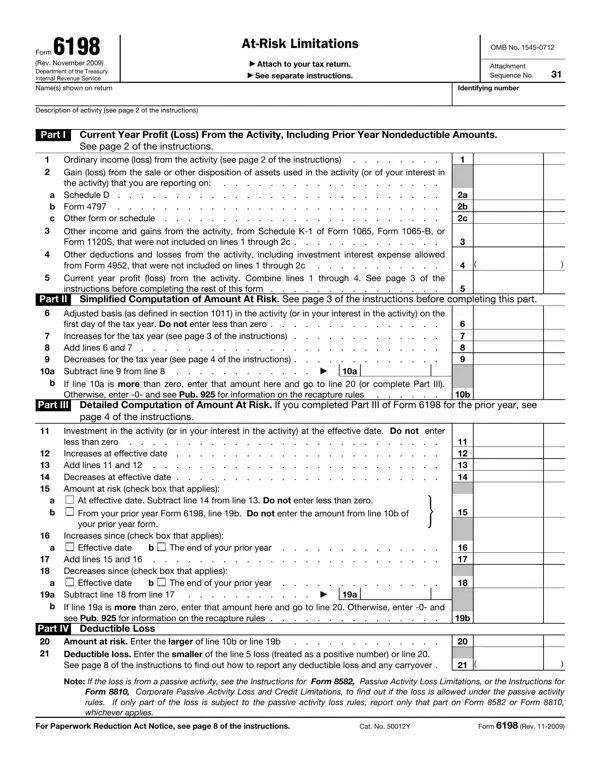
Form 6198 at a glance
What it is: Form 6198, At-Risk Limitations: use Form 6198 to figure the profit (loss) from an at-risk activity, the amount at risk and the deductible loss for the current year.[2]
Where and when to file: Attach to your tax return.
Form 6198 is filed by individuals (including filers of Schedules C, E, and F (Form 1040 or 1040-SR)), estates, trusts, and certain closely held C corporations described in section 465(a)(1)(B), as modified by section 465(a)(3).[2]
A filled-in Form 6198 example: a sole proprietor limits a farm loss
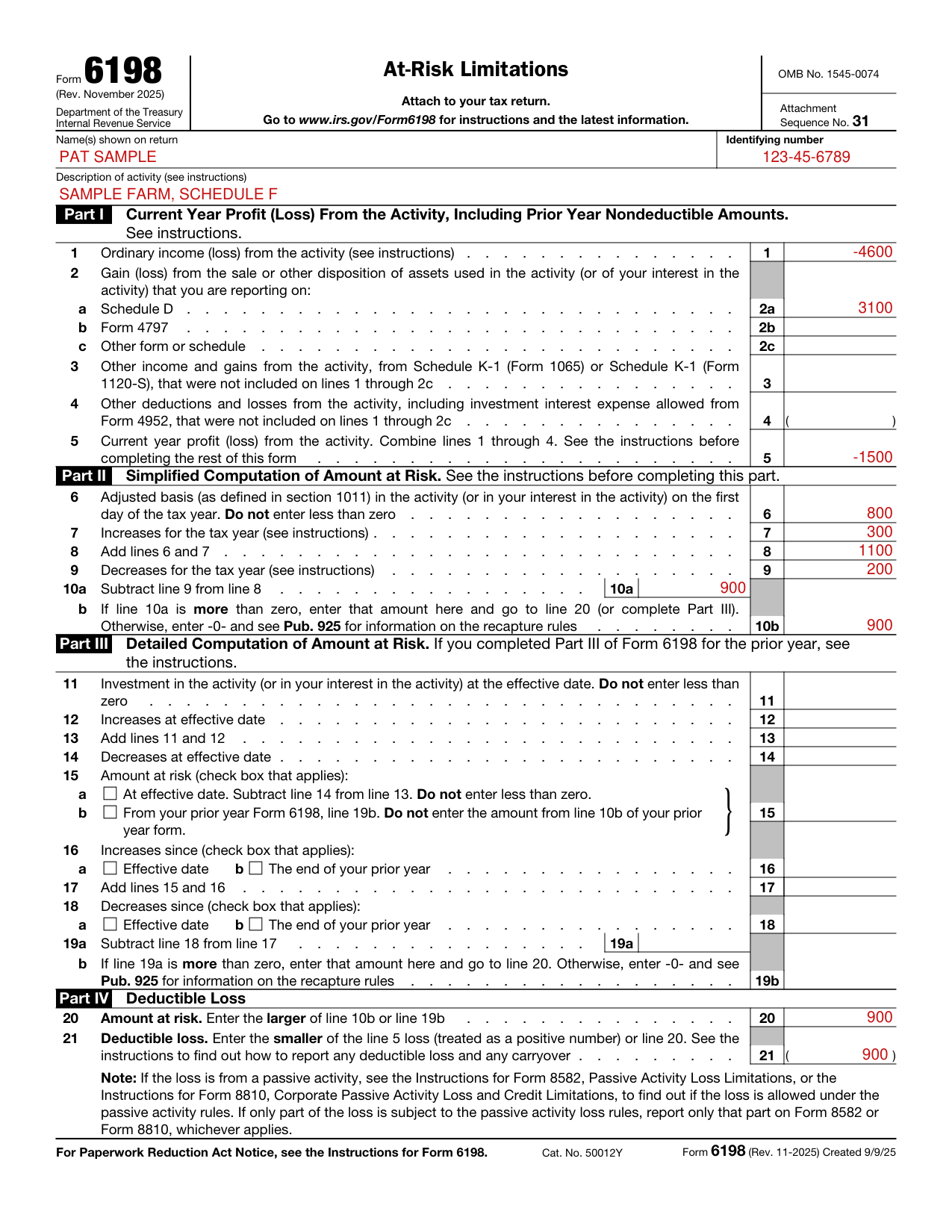
How to fill out Form 6198, box by box
Name(s) shown on return and Description of activity

Enter the Name(s) shown on return and the Identifying number.
Under Description of activity, describe the activity; after the description, if applicable, enter the name and identifying number of the partnership or S corporation.
If you are engaged in more than one at-risk activity or in both at-risk activities and not-at-risk activities, you must allocate income, gains, losses, and deductions to each activity.
When filling in Parts I, II, and III, enter only amounts that relate to the activity included on this form.[2]
At-Risk Activities
The at-risk limitation rules apply to losses from the following activities carried on as a trade or business or for the production of income.
Holding, producing, or distributing motion picture films or videotapes.
Farming, as defined in section 464(e).
Leasing any section 1245 property, as defined in section 1245(a)(3).
Exploring for or exploiting oil and gas resources.
Exploring for or exploiting geothermal deposits, as defined in section 613(e)(2).
Any other activity that is not included in (1) through (5).
Holding real property placed in service before 1987 and holding an interest acquired before 1987 in a partnership, an S corporation, or other pass-through entity already engaged in an activity of holding real property before 1987 are not affected by the at-risk rules.[2]
Amounts Not at Risk
You are not considered at risk for nonrecourse loans used to finance the activity, to acquire property used in the activity, or to acquire your interest in the activity (unless the nonrecourse loan is secured by your own property that is not used in the activity). However, you are considered at risk for qualified nonrecourse financing secured by real property used in the activity of holding real property (other than mineral property).[2]
Aggregation or Separation of Activities
File one form if your activities are listed under the aggregation rules.
File a separate form for each activity if your activities are listed under the separation rules.[2]
Part I Current Year Profit (Loss) From the Activity
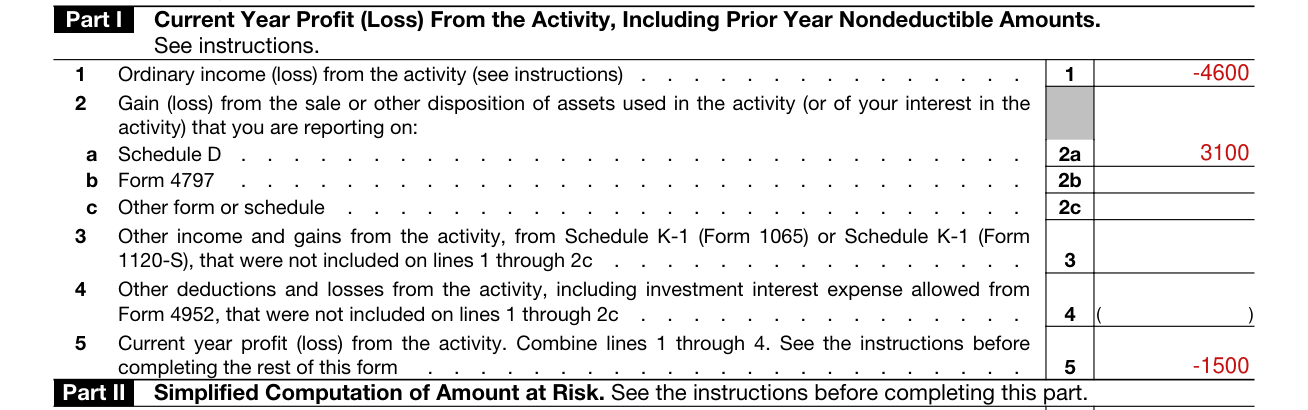
Taxpayers other than partners or S corporation shareholders: if you have losses or deductions from an earlier tax year that you could not deduct because of the at-risk rules, include those amounts on the appropriate form or schedule of your current year tax return before starting Part I.
Box 6, Partners and S corporation shareholders: if you have a loss or a deduction from an earlier tax year that you could not deduct because of the at-risk rules, these losses and deductions must be included in the current year amounts you enter in Part I.
Line 1, taxpayers other than partners or S corporation shareholders: enter your ordinary income or loss from the at-risk activity without regard to the at-risk limitations.
Line 1, partners and S corporation shareholders: enter the amount from box 1 of your current year Schedule K-1 (Form 1065 or Form 1120-S) (plus any prior year ordinary loss that you could not deduct because of the at-risk rules).
Lines 2a, 2b, and 2c: combine long- and short-term capital gains and losses and ordinary gains and losses from the sale or other disposition of assets used in the activity or of your interest in the activity.
Enter gains and losses without regard to the at-risk limitations, the limitation on capital losses, or the passive activity loss limitations.
Line 3: if you were a partner or S corporation shareholder, include other income and gains from Schedule K-1 that you did not include on lines 1 through 2c.
Line 4: if you were a partner or S corporation shareholder, include other deductions and losses from Schedule K-1 that you did not include on lines 1 through 2c. If you have investment interest expense from your at-risk activity, first complete Form 4952, Investment Interest Expense Deduction, to figure your allowable investment interest deduction.
If line 5 shows a current year profit, you may not have to complete the rest of this form.[2]
Part II Simplified Computation of Amount at Risk
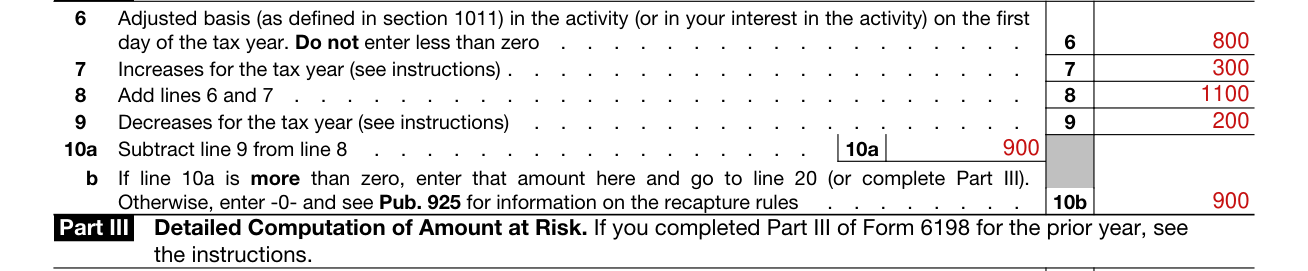
Part II is a simplified method of figuring your amount at risk. It can be used only if you know your adjusted basis in the activity or in your interest in the partnership's or S corporation's at-risk activity.
Line 6, sole proprietors: filers of Schedules C and F (Form 1040 or 1040-SR) must not reduce the amount on this line by any liabilities.
Line 7, increases for the tax year: do not include the current year income or gains shown on lines 1 through 3.
Line 9, decreases for the tax year: do not include the current year deductions or losses shown on lines 1 through 4.
Line 10b: if the amount on this line is smaller than your overall loss from the activity (line 5), you may want to complete Part III to see if Part III gives you a larger amount at risk.[2]
Part III Detailed Computation of Amount at Risk
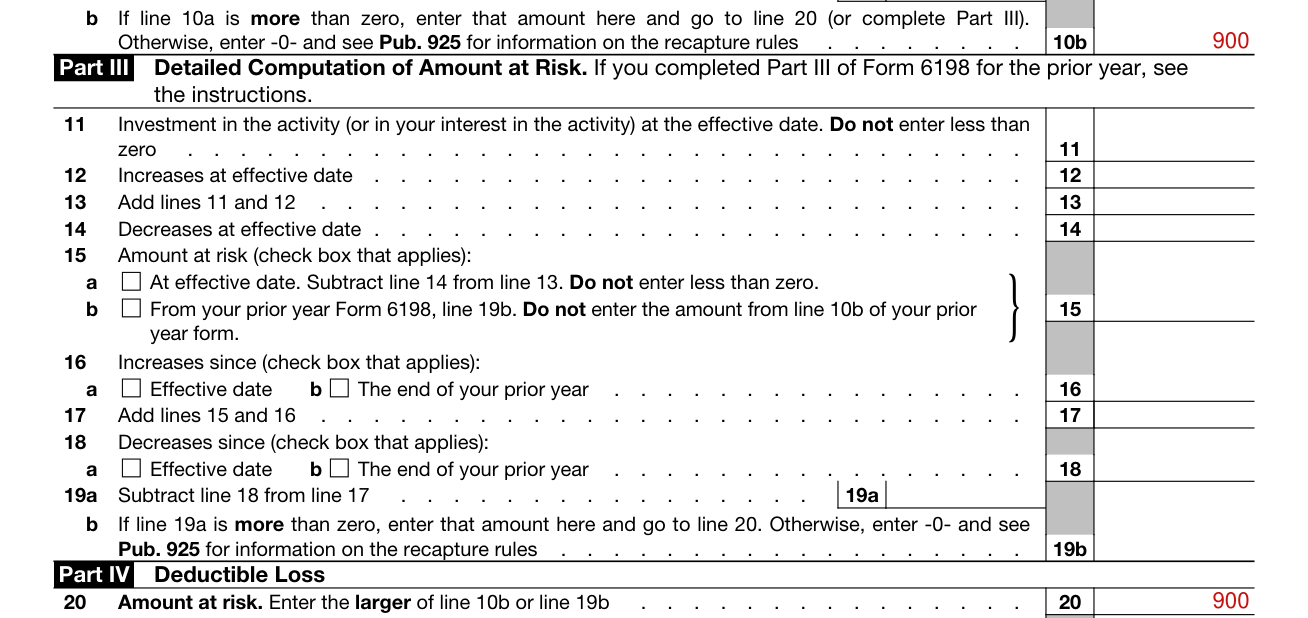
If you completed Part III of Form 6198 for this activity for the prior tax year, skip lines 11 through 14.
Line 15: if you completed Part III of Form 6198 for the prior tax year, check box b and enter the amount from line 19b of the prior year form on this line.
Line 16, Increases since (check box that applies): a Effective date b The end of your prior year. Line 17, Add lines 15 and 16. Line 18, Decreases since (check box that applies): a Effective date b The end of your prior year. Line 19a, Subtract line 18 from line 17. Line 19b, If line 19a is more than zero, enter that amount here and go to line 20. Otherwise, enter -0- and see Pub. 925 for information on the recapture rules. Part IV Deductible Loss. Line 20, Amount at risk. Enter the larger of line 10b or line 19b. Line 21, Deductible loss. Enter the smaller of the line 5 loss (treated as a positive number) or line 20. See the instructions to find out how to report any deductible loss and any carryover.[2]
Part IV Deductible Loss

If the loss on line 5 is more than the amount on line 20, you must limit your deductible loss to the amount on line 20, subject to any other limitations.[2]
More rules for Form 6198
Note: If the loss is from a passive activity, see the Instructions for Form 8582, Passive Activity Loss Limitations, or the Instructions for Form 8810, Corporate Passive Activity Loss and Credit Limitations, to find out if the loss is allowed under the passive activity rules. If only part of the loss is subject to the passive activity loss rules, report only that part on Form 8582 or Form 8810, whichever applies.
A closely held corporation must apply the limitation on the deduction for interest expense under section 163(j) before applying the at-risk limitations.[2]
Common questions about Form 6198
What is form 6198 used for?
Form 6198, At-Risk Limitations: use Form 6198 to figure the profit (loss) from an at-risk activity, the amount at risk and the deductible loss for the current year. The at-risk rules of section 465 limit the amount of the loss you can deduct to the amount at risk.[2]
When must a taxpayer file a form 6198?
File Form 6198 if during the tax year you, a partnership in which you were a partner, or an S corporation in which you were a shareholder had any amounts not at risk invested in an at-risk activity that incurred a loss.[2]
Where do I file it?
Attach to your tax return.
Sources
[1] Form 6198 (Rev. November 2025), At-Risk Limitations, Internal Revenue Service (the Official source link on this page).
[2] Instructions for Form 6198 (Rev. November 2025), Internal Revenue Service.