
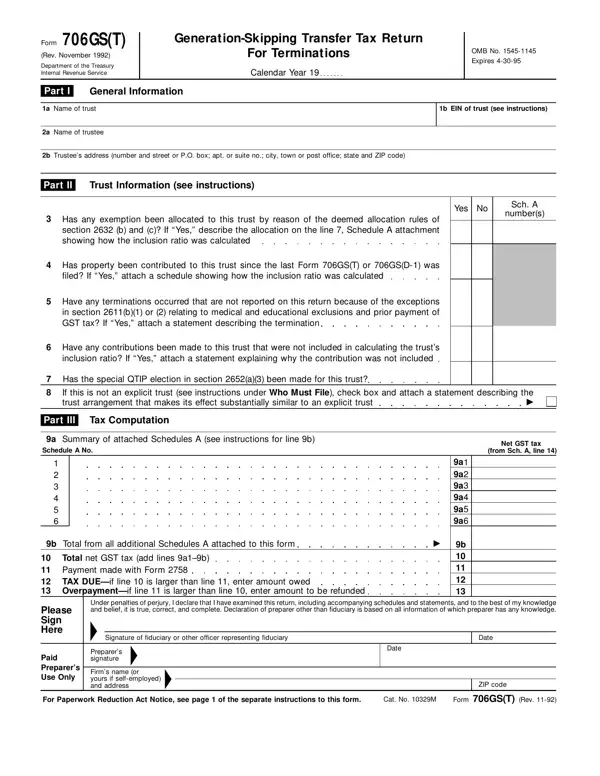
If this is not an explicit trust, check here and complete Part IV, line 13, describing the trust arrangement that makes its effect substantially similar to an explicit trust.
Part IV, line 11: show how inclusion ratio was calculated when property has been contributed to this trust. Complete if answered “Yes” on Part II, line 3.
Part IV, line 12: describe terminations that occurred during the calendar year that are not reported on this return. Complete if answered “Yes” on Part II, line 4.
Tax due: if the amount on line 7 is more than the amount on line 8, subtract line 8 from line 7.
Overpayment: if the amount on line 8 is more than the amount on line 7, subtract line 7 from line 8 and complete lines 10b, 10c, and 10d.
| Question | Answer |
|---|---|
| Form Name | Form 706-GS(T) |
| Form Length | 6 pages |
| Fillable? | Yes |
| Fillable fields | 370 |
| Avg. time to fill out | 60+ min |
| Edition | 12-2025 |
| Issuing agency | Department of the Treasury, Internal Revenue Service |
| Also identified as | Form 706-GST |
| Matches the agency's file | Yes, checked October 9, 2026 |
| Other names | Form 706-GS(T), Form 706-GST, 706-GS(T), 706GST, IRS Form 706-GS(T), Generation-Skipping Transfer Tax Return for Terminations |
| Official source | Form 706-GS(T) (Rev 12-2025), Department of the Treasury, Internal Revenue Service |
Form 706Gs T isn’t the one you’re looking for?