
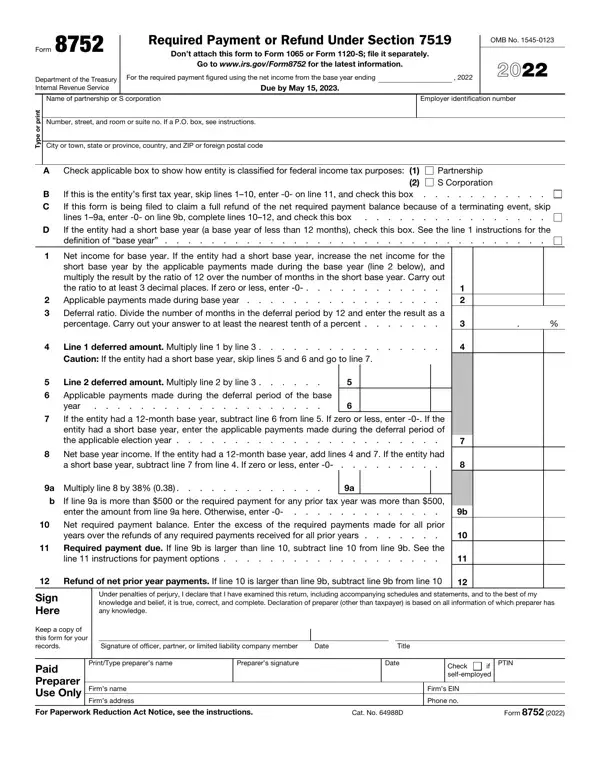

Form 8752 at a glance
What it is: Form 8752 is Required Payment or Refund Under Section 7519.
Who signs: Sign the Signature of officer, partner, or limited liability company member, the Date and the Title.
Partnerships and S corporations use Form 8752 to figure and report the payment required under section 7519 or to obtain a refund of net prior-year payments.[2]
A partnership or S corporation must file Form 8752 if it made a section 444 election by filing Form 8716, Election To Have a Tax Year Other Than a Required Tax Year, and its election is in effect for the tax year.[2]
Form 8752 must be filed for each year the section 444 election is in effect, even if the required payment for the applicable election year is zero.[2]
Caution: For your base year ending in 2025, you must use the 2025 Form 8752. You can't use the 2025 Form 8752 for your base year ending in 2026.[2]
A filled-in Form 8752 example: an S corporation figures its required payment
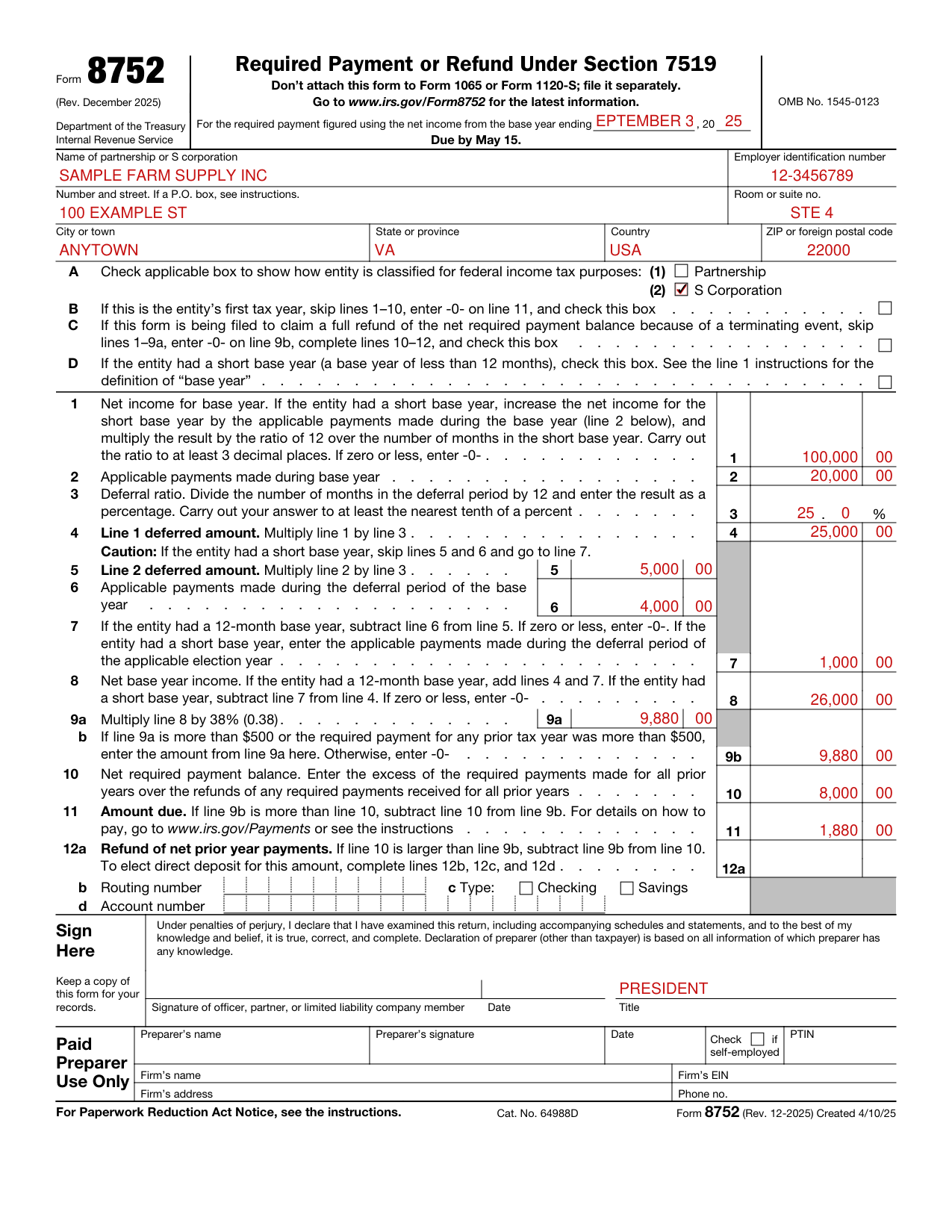
How to fill out Form 8752, box by box
Ending date of the base year

For the applicable election year beginning in 2025, enter the ending date of the base year ending in 2025.[2]
Name of partnership or S corporation and Employer identification number

Enter the Name of partnership or S corporation and the Employer identification number.
Number and street, City or town, State or province, Country

Enter the Number and street, Room or suite no., City or town, State or province, Country, ZIP or foreign postal code. If a P.O. box, see instructions.
A Check applicable box

A Check applicable box to show how entity is classified for federal income tax purposes: (1) Partnership (2) S Corporation.
B first tax year

B If this is the entity's first tax year, skip lines 1-10, enter -0- on line 11, and check this box.
C terminating event

C If this form is being filed to claim a full refund of the net required payment balance because of a terminating event, skip lines 1-9a, enter -0- on line 9b, complete lines 10-12, and check this box.
D short base year

D If the entity had a short base year (a base year of less than 12 months), check this box. See the line 1 instructions for the definition of “base year”.
Lines 1 and 2, Net income for base year

S corporations: line 1 net income is the aggregate (not less than zero) of the corporation's items of income and expense, other than tax-exempt income and nondeductible expenses.
Partnerships: line 1 net income is the aggregate (not less than zero) of the partnership's items of income and expense, other than tax-exempt income, nondeductible expenses, and guaranteed payments under section 707(c).
Line 1, Net income for base year: if the entity had a short base year, increase the net income for the short base year by the applicable payments made during the base year (line 2 below), and multiply the result by the ratio of 12 over the number of months in the short base year. Carry out the ratio to at least 3 decimal places. If zero or less, enter -0-.
Line 2, Applicable payments made during base year.[2]
Lines 3 and 4, Deferral ratio

Line 3, Deferral ratio: divide the number of months in the deferral period by 12 and enter the result as a percentage. Carry out your answer to at least the nearest tenth of a percent.
The deferral period is the number of months between the beginning of the elected tax year, and the close of the first required tax year ending within such a year.
Line 4, Line 1 deferred amount: multiply line 1 by line 3.[2]
Lines 5 and 6, Line 2 deferred amount

Caution: If the entity had a short base year, skip lines 5 and 6 and go to line 7.
Line 5, Line 2 deferred amount: multiply line 2 by line 3.
Line 6, Applicable payments made during the deferral period of the base year.
Lines 7 and 8, Net base year income

Line 7: if the entity had a 12-month base year, subtract line 6 from line 5. If zero or less, enter -0-. If the entity had a short base year, enter the applicable payments made during the deferral period of the applicable election year.
Line 8, Net base year income: if the entity had a 12-month base year, add lines 4 and 7. If the entity had a short base year, subtract line 7 from line 4. If zero or less, enter -0-.
Lines 9a and 9b

Line 9a: multiply line 8 by 38% (0.38).
Line 9b: if line 9a is more than $500 or the required payment for any prior tax year was more than $500, enter the amount from line 9a here. Otherwise, enter -0- (checked October 31, 2026).
Lines 10 and 11, Amount due

Line 10, Net required payment balance: enter the excess of the required payments made for all prior years over the refunds of any required payments received for all prior years.
Line 11, Amount due: if line 9b is more than line 10, subtract line 10 from line 9b.
Make the check payable to “United States Treasury.” Write the entity's employer identification number and “Form 8752” on the check.[2]
Line 12a Refund

Line 12a, Refund of net prior year payments: if line 10 is larger than line 9b, subtract line 9b from line 10. To elect direct deposit for this amount, complete lines 12b, 12c, and 12d.
Routing number, Type and Account number

Enter the Routing number on line 12b, the Type of account, Checking or Savings, on line 12c, and the Account number on line 12d.
The routing number must be nine digits. The first two digits must be 01 through 12 or 21 through 32.[2]
Under penalties of perjury

Under penalties of perjury, I declare that I have examined this return, including accompanying schedules and statements, and to the best of my knowledge and belief, it is true, correct, and complete. Declaration of preparer (other than taxpayer) is based on all information of which preparer has any knowledge.
Paid Preparer Use Only

Paid Preparer Use Only: Preparer's name, Preparer's signature, Date, Check if self-employed, PTIN, Firm's name, Firm's EIN, Firm's address, Phone no.
More rules for Form 8752
Keep a copy of this form for your records.
If your situation is different
To correct an error in a Form 8752 already filed
To correct an error in a Form 8752 already filed, file an amended Form 8752 and write “Amended Return” across the top.[2]
Common questions about Form 8752
What is IRS 8752?
Form 8752 is Required Payment or Refund Under Section 7519. Section 7519 payments are required of any partnership or S corporation that has elected under section 444 to have a tax year other than a required tax year.[2]
Is there a deadline?
For applicable election years beginning in 2025, Form 8752 must be filed and the required payment made on or before May 15, 2026.[2]
Where do I file it?
Don't attach this form to Form 1065 or Form 1120-S; file it separately. If the entity's principal place of business or principal office or agency is located in Connecticut, Delaware, District of Columbia, Georgia, Illinois, Indiana, Kentucky, Maine, Maryland, Massachusetts, Michigan, New Hampshire, New Jersey, New York, North Carolina, Ohio, Pennsylvania, Rhode Island, South Carolina, Tennessee, Vermont, Virginia, West Virginia, Wisconsin, use the following address: Department of the Treasury Internal Revenue Service Kansas City, MO 64999. If the entity's principal place of business or principal office or agency is located in Alabama, Alaska, Arizona, Arkansas, California, Colorado, Florida, Hawaii, Idaho, Iowa, Kansas, Louisiana, Minnesota, Mississippi, Missouri, Montana, Nebraska, Nevada, New Mexico, North Dakota, Oklahoma, Oregon, South Dakota, Texas, Utah, Washington, Wyoming, use the following address: Department of the Treasury Internal Revenue Service Ogden, UT 84201. An entity without a principal office or agency or principal place of business in the United States must file Form 8752 with the Internal Revenue Service Center, P.O. Box 409101, Ogden, UT 84409.[2]
Is there a penalty?
If the required payment isn't made by the due date, the entity may have to pay a penalty equal to 10% of the underpayment.[2]
When is this form not the right one?
Don't file Form 8752 for a personal service corporation (as defined in Regulations section 1.441-3). Instead, file Schedule H (Form 1120), Section 280H Limitations for a Personal Service Corporation (PSC), with the corporation's income tax return.[2]
Sources
[1] Form 8752 (Rev. December 2025), Required Payment or Refund Under Section 7519, Internal Revenue Service (the Official source link on this page).
[2] Instructions for Form 8752 (December 2025), Internal Revenue Service.