
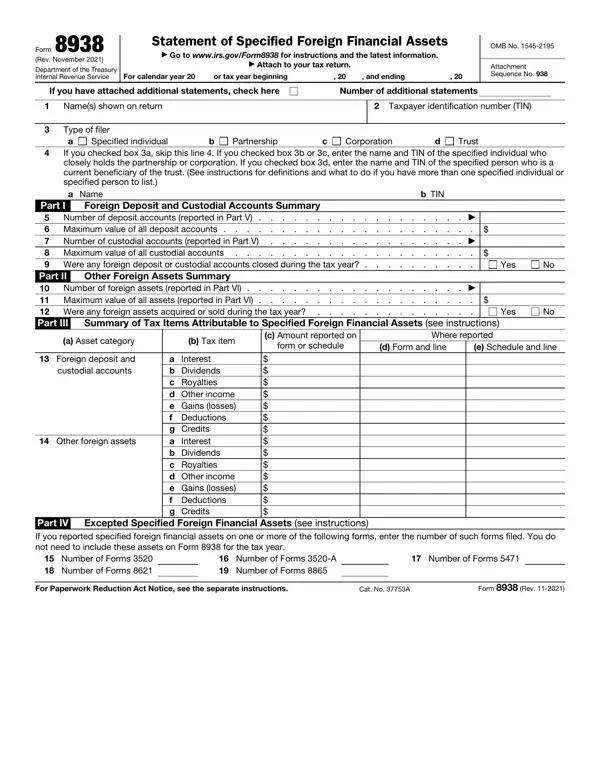

Form 8938 at a glance
What it is: Form 8938 is for reporting specified foreign financial assets if the total value of all the specified foreign financial assets in which you have an interest is more than the appropriate reporting threshold.[2]
Where and when to file: Do not send a Form 8938 to the IRS unless it is attached to an annual return or an amended return.[2]
Unless an exception applies, you must file Form 8938 if you are a specified person that has an interest in specified foreign financial assets and the value of those assets is more than the applicable reporting threshold.[2]
A specified person is either a specified individual or a specified domestic entity.[2]
You are a specified individual if you are one of the following.[2]
A U.S. citizen. A resident alien of the United States for any part of the tax year. A nonresident alien who makes an election to be treated as a resident alien for purposes of filing a joint income tax return. A nonresident alien who is a bona fide resident of American Samoa or Puerto Rico.[2]
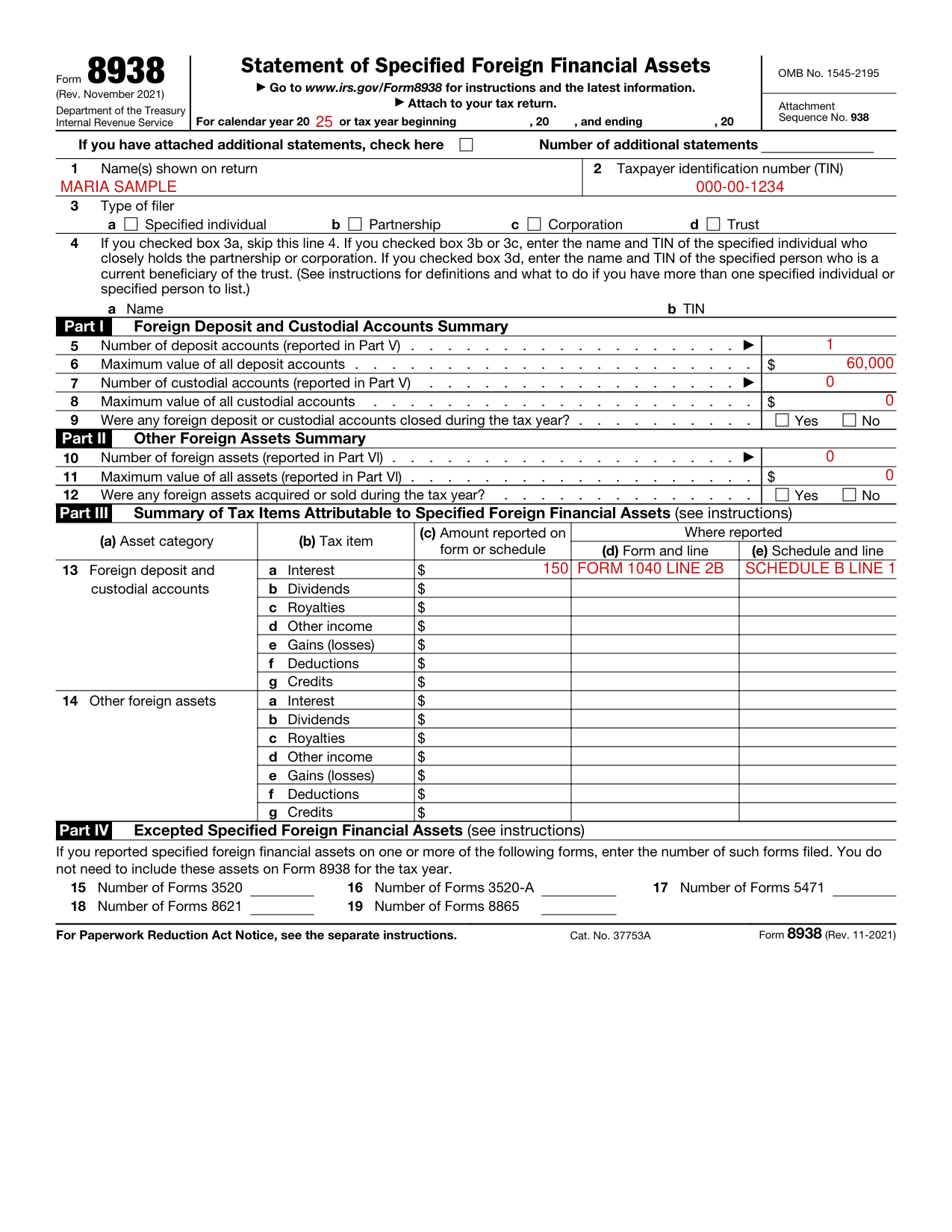
A filled-in Form 8938 example: an unmarried filer with one foreign deposit account
How to fill out Form 8938, box by box
Tax year, 1 Name(s) shown on return and 2 Taxpayer identification number (TIN)

You must specify the applicable calendar year or tax year to which your Form 8938 relates in the appropriate space(s) at the top of the form.
Lines 1 and 2 Enter your name(s) and TIN as shown on the annual return you are filing with Form 8938.
If you have attached additional statements, check here Number of additional statements[2]
Check box 3a, 3b, 3c or 3d and line 4

3 Type of filer a Specified individual b Partnership c Corporation d Trust
If you are a specified individual, check box 3a.
Line 4 If you checked box 3a (specified individual), do not complete this line 4.[2]
Part I Deposit and Custodial Accounts

Line 5 Report the number of deposit accounts reported in all Parts V. Line 6 Report the total maximum value of these deposit accounts. Line 7 Report the number of custodial accounts reported in all Parts V. Line 8 Report the total maximum value of these custodial accounts.[2]
Part II Accounts and Assets

Line 10 Report the number of accounts and assets reported in all Parts VI. Line 11 Report the total maximum value of these accounts and assets. Line 12 Indicate whether any account was opened or closed or any asset was acquired or disposed of during the tax year.[2]
Part III Summary of Tax Items Attributable to Specified Foreign Financial Assets
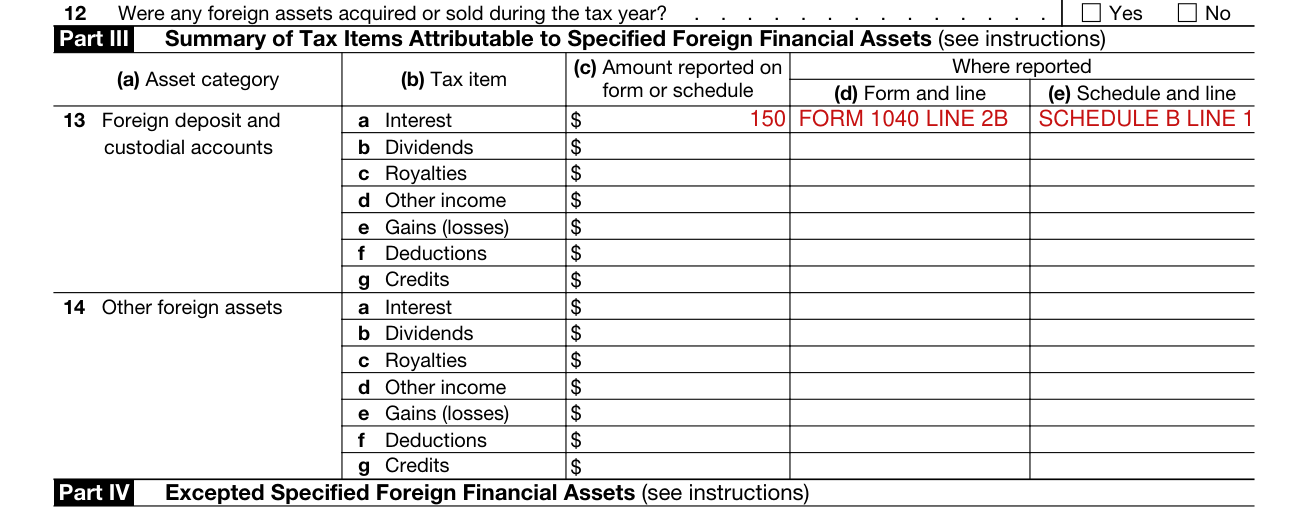
Enter the items for your total assets reported in Part V or Part VI and the schedule, form, or return on which you reported the items.[2]
Part IV Form 3520, 3520-A, 5471, 8621, or 8865

If you are a specified individual and report all of your specified foreign financial assets on a timely filed Form 3520, 3520-A, 5471, 8621, or 8865, you do not have to report them on Form 8938. Instead, enter your name(s) and taxpayer identification number (TIN) at the top of the form and complete Part IV only.[2]
Part V Account number and maximum value of the account
Line 20 Check the box to indicate if this is a depository or a custodial account. Line 21 Enter the account number of the account or other specific identifying information for the account if there is no account number.
Line 23 Enter the maximum value of the account during the tax year.[2]
Part VI Description of the account or asset
Line 29 Enter a description of the account or asset. If the asset is stock or securities, include the class or issue of the stock or securities.
Line 32 Check the box for the value range that represents the maximum value of the account or asset during the tax year. If the maximum value is more than $200,000, enter the maximum value on line 32e. (checked October 21, 2026)[2]
Assets, thresholds, exchange rates, the FBAR and penalties
Attach Form 8938 to your annual return
Attach Form 8938 to your annual return and file by the due date (including extensions) for that return.[2]
You do not have to file an income tax return
If you do not have to file an income tax return for the tax year, you do not have to file Form 8938, even if the value of your specified foreign financial assets is more than the appropriate reporting threshold.[2]
You do not live outside the United States
If you do not live outside the United States, you satisfy the reporting threshold discussed next that applies to you, and no exception applies, file Form 8938 with your income tax return.
If you are not married, you satisfy the reporting threshold only if the total value of your specified foreign financial assets is more than $50,000 on the last day of the tax year or more than $75,000 at any time during the tax year. (checked October 21, 2026)
If you are married and you and your spouse file a joint income tax return, you satisfy the reporting threshold only if the total value of your specified foreign financial assets is more than $100,000 on the last day of the tax year or more than $150,000 at any time during the tax year. (checked October 21, 2026)
If you are married and file a separate income tax return from your spouse, you satisfy the reporting threshold only if the total value of your specified foreign financial assets is more than $50,000 on the last day of the tax year or more than $75,000 at any time during the tax year. (checked October 21, 2026)[2]
Specified foreign financial assets include the following assets
Financial accounts maintained by a foreign financial institution. The following foreign financial assets if they are held for investment and not held in an account maintained by a financial institution. Stock or securities issued by someone that is not a U.S. person. Any interest in a foreign entity. Any financial instrument or contract that has an issuer or counterparty that is not a U.S. person.[2]
You are not required to report the following assets
The following financial accounts and the assets held in such accounts are not specified foreign financial assets and do not have to be reported on Form 8938.
A financial account that is maintained by a U.S. payer, such as a domestic financial institution.[2]
You use a foreign currency exchange rate
In most cases, you must use the U.S. Treasury Bureau of the Fiscal Service foreign currency exchange rate for purchasing U.S. dollars.
Use the currency exchange rate on the last day of the tax year to figure the maximum value of a specified foreign financial asset or the value of a specified foreign financial asset for the purpose of determining the total value of your specified foreign financial assets to see whether you have met the reporting threshold.[2]
You may also have to file the FBAR
Filing Form 8938 does not relieve you of the requirement to file FinCEN Form 114, Report of Foreign Bank and Financial Accounts (FBAR), if you are otherwise required to file the FBAR.[2]
You do not file a correct Form 8938 by the due date
If you are required to file Form 8938 but do not file a complete and correct Form 8938 by the due date (including extensions), you may be subject to a penalty of $10,000. (checked October 21, 2026)
If you do not file a correct and complete Form 8938 within 90 days after the IRS mails you a notice of the failure to file, you may be subject to an additional penalty of $10,000 for each 30-day period (or part of a period) during which you continue to fail to file Form 8938 after the 90-day period has expired. (checked October 21, 2026) The maximum additional penalty for a continuing failure to file Form 8938 is $50,000. (checked October 21, 2026)[2]
Sources
[1] Form 8938 (Rev. November 2021), Statement of Specified Foreign Financial Assets, Internal Revenue Service (the Official source link on this page).
[2] Instructions for Form 8938 (Rev. November 2021), Internal Revenue Service.