
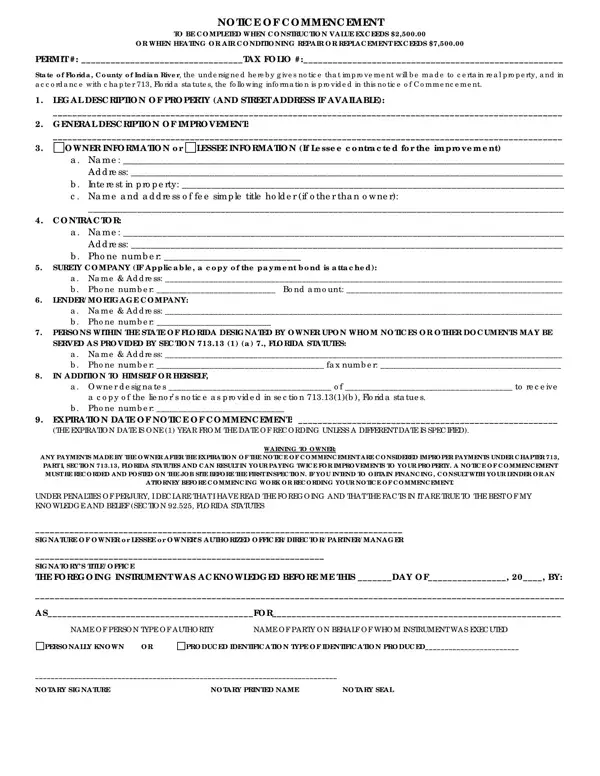
A Notice of Commencement is one of the most important legal documents in any construction or property improvement project. Filing this form correctly establishes your project on public record, protects property owners from paying twice for the same work, and gives contractors and suppliers a clear path to file a construction lien if they are not paid.
When Is a Notice of Commencement Required?
Requirements vary by state, but most jurisdictions require a Notice of Commencement when construction costs exceed a threshold amount. In Florida, the threshold is $2,500 for general construction and $7,500 for heating or air conditioning repair or replacement. Georgia, South Carolina, and other states have comparable notice requirements with slightly different rules for the filing deadline, notarization, and posting on the construction site.
Even when a state does not require it by statute, many lenders, title companies, and general contractors request a Notice of Commencement as a standard part of the construction process. Recording the notice before the first inspection is considered best practice across all states.
What Information Must Be Included?
A properly completed Notice of Commencement form must contain:
- Legal description of the property and street address
- General description of the planned improvement or construction
- Name, address, and interest of the property owner or lessee
- Name and address of the general contractor
- Name and address of the surety company and the bond amount, if any
- Name and address of the lender or mortgage company, if applicable
- Designated person authorized to receive notices on behalf of the owner
- Expiration date of the notice of commencement
How to File a Notice of Commencement
Follow these steps to properly record your Notice of Commencement and remain compliant with state statutes:
- Complete all required fields. Fill in the property description, owner information, contractor details, and the name of any surety or lender. Leave no required field blank.
- Get the form notarized. In Florida and most other states, the Notice of Commencement must be signed before a notary public or another official authorized to take acknowledgments.
- Record the form with the county. Bring the original notarized notice to the clerk of court in the county where the property is located. Recording fees vary by county. You will receive a stamped copy confirming the date and time of recording.
- Post a certified copy on-site. Affix a certified copy of the recorded notice on the construction site before the first inspection takes place. Post it in a visible location accessible to all workers and suppliers.
- Distribute copies to required parties. Provide copies to the general contractor and any lender involved in the project. Some states also require that you deliver a copy to any person on the designated notice list.
Expiration and Renewal
A Notice of Commencement does not last indefinitely. In Florida, it is effective for one year from the date of recording, unless a shorter period is stated in the document. Once the notice expires, any contractor or supplier who provides labor or materials after the expiration date loses their lien rights unless a new Notice of Commencement is filed and recorded. To avoid a lapse in coverage, property owners should file a Notice of Recommencement before the original notice expires if the project is still ongoing.
Related Construction Forms
Depending on your project, you may also need these related construction documents:
- Florida Notice of Commencement – the official state form for Florida construction projects
- Miami-Dade Notice of Commencement – county-specific form required for projects in Miami-Dade County
- Application for Notice of Lien – used by contractors and suppliers to protect their right to payment
- Construction Proposal Form – outlines the scope and cost of construction work before a project begins
Frequently Asked Questions
What happens if I do not file a Notice of Commencement?
If you skip the Notice of Commencement, you risk paying twice. Contractors and subcontractors who supply labor or materials may file a construction lien against your property for unpaid work, even if you have already paid your general contractor. The notice establishes a clear chain of record so that all parties know the project is underway and who is responsible for payment.
Can the property owner file the Notice of Commencement, or must the contractor do it?
The property owner or their authorized agent is responsible for filing the Notice of Commencement. Contractors often assist with the process, but the legal obligation belongs to the owner. Lenders financing the project may also have requirements about who files and when the notice must be recorded.
Does the Notice of Commencement cover every phase of construction?
A single Notice of Commencement can cover a construction project from start to finish, provided it is filed before work begins and it has not expired. If the project extends beyond the notice period, you may need to file a Notice of Recommencement to maintain full protection under the applicable lien laws for all contractors and suppliers involved.
