
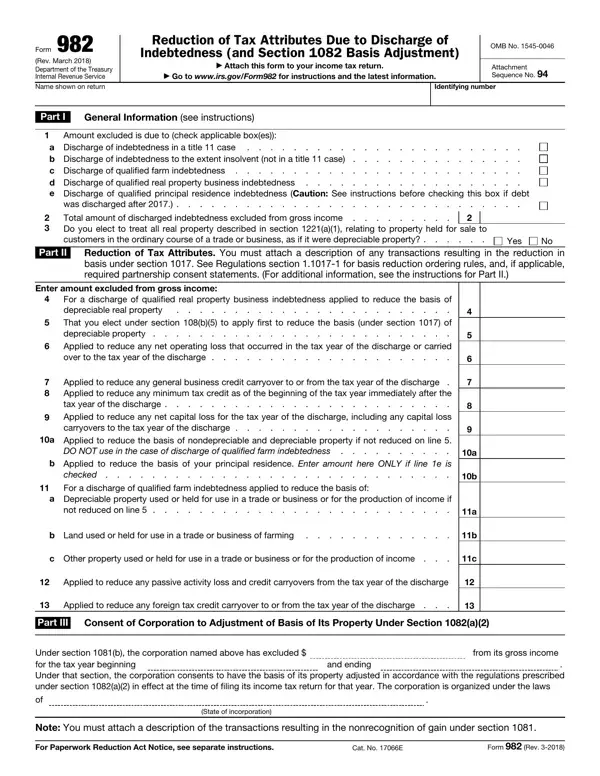

Form 982 at a glance
What it is: Form 982 is the Reduction of Tax Attributes Due to Discharge of Indebtedness (and Section 1082 Basis Adjustment) form.
Where and when to file: Attach this form to your income tax return.
A filled-in Form 982 example: credit card debt forgiven while insolvent
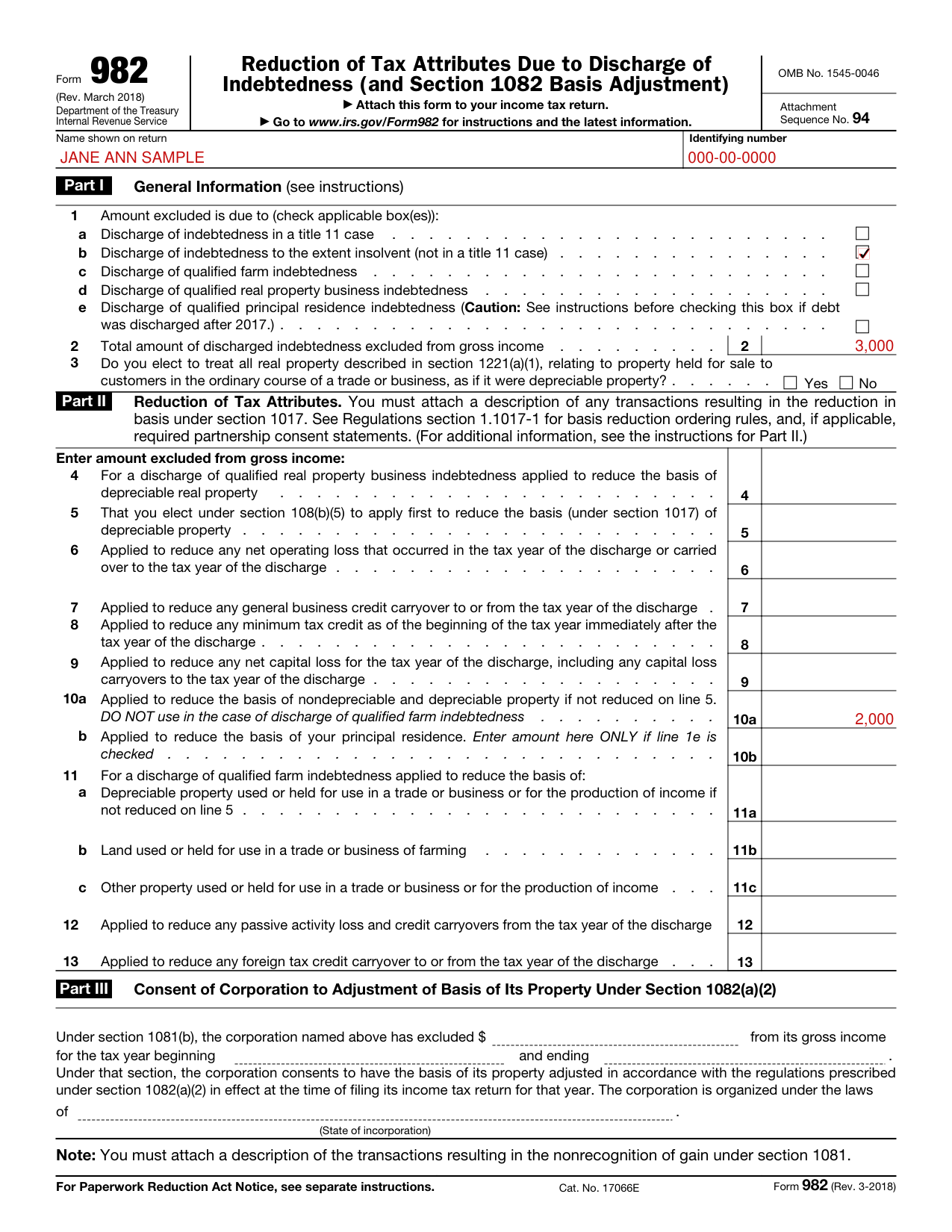
How to fill out Form 982, box by box
Name shown on return and Identifying number
Enter the Name shown on return and the Identifying number.
Part I General Information (see instructions)
For a nonbusiness debt (other than qualified principal residence indebtedness, such as a car loan or credit card debt), follow these instructions if you don't have any of the tax attributes listed in Part II (other than a basis in nondepreciable property). Check the box on line 1a if the discharge was made in a title 11 case (see Definitions) or the box on line 1b if the discharge occurred when you were insolvent.
A “title 11 case” is a case under title 11 of the United States Code (relating to bankruptcy), but only if you are under the jurisdiction of the court in the case and the discharge of indebtedness is granted by the court or is under a plan approved by the court.
Check the box on line 1b if the discharge of indebtedness occurred while you were insolvent. You were insolvent to the extent that your liabilities exceeded the fair market value (FMV) of your assets immediately before the discharge. The insolvency exclusion doesn't apply to any discharge that occurs in a title 11 case. It also doesn't apply to a discharge of qualified principal residence indebtedness unless you elect to have the insolvency exclusion apply instead of the exclusion for qualified principal residence indebtedness.
For details and a worksheet to help calculate insolvency, see Pub. 4681.
On line 1c, check this box if the income you exclude is from the discharge of qualified farm indebtedness.
If you check the box on line 1d, the discharge of qualified real property business indebtedness is applied to reduce the basis of depreciable real property on line 4.
Only check the box on line 1e if the income you exclude is from discharge of qualified principal residence indebtedness and one of the following applies. The debt was discharged before 2026. The debt was discharged subject to an arrangement that was entered into and evidenced in writing before January 1, 2026. Caution: See instructions before checking this box if debt was discharged after 2017.
Do not check box 1e if the discharge occurs in a title 11 case. You must check the box on line 1a and not this box. If you are insolvent (and not in a title 11 case), you can elect to follow the insolvency rules by checking box 1b instead of checking box 1e.
Qualified principal residence indebtedness. This indebtedness is a mortgage you took out to buy, build, or substantially improve your main home. It must also be secured by your main home. Your principal residence is your “main home,” which is the home where you ordinarily live most of the time.
The maximum amount you can treat as qualified principal residence indebtedness is $750,000 ($375,000 if married filing separately) after 2020 and before 2026 (checked November 11, 2026).
On line 2, enter the total amount excluded from your gross income due to discharge of indebtedness under section 108. If you checked any box on lines 1b through 1e, don't enter more than the limit explained in the instructions for those lines.
For a nonbusiness debt, include on line 2 the amount of discharged nonbusiness debt that is excluded from gross income. If you were insolvent, don't include more than the excess of your liabilities over the fair market value of your assets.
You can elect under section 1017(b)(3)(E) to treat all real property held primarily for sale to customers in the ordinary course of a trade or business as if it were depreciable property. This election doesn't apply to the discharge of qualified real property business indebtedness. To make the election, check the “Yes” box.[2]
Part II Reduction of Tax Attributes
If you check any of the boxes on lines 1a through 1c, you can elect, by completing line 5, to apply all or a part of the debt discharge amount to first reduce the basis of depreciable property (including property you elected on line 3 to treat as depreciable property). Any balance of the debt discharge amount will then be applied to reduce the tax attributes in the order listed on lines 6 through 13 (excluding line 10b). If you don't make the election on line 5, complete lines 6 through 13 (excluding line 10b) to reduce your attributes.
You must attach a statement describing the transactions that resulted in the reduction in basis under section 1017 and identifying the property for which you reduced the basis.
For a nonbusiness debt, include on line 10a the smallest of (a) the basis of your nondepreciable property, (b) the amount of the nonbusiness debt included on line 2, or (c) the excess of the aggregate bases of the property and the amount of money you held immediately after the discharge over your aggregate liabilities immediately after the discharge.
In the case of a title 11 case or insolvency, the reduction in basis on line 10a is limited to the aggregate of the basis of your property immediately after the discharge over the aggregate of your liabilities immediately after the discharge. However, this limit doesn't apply to a reduction in basis reported on line 5 pursuant to section 108(b)(5).
If box 1e is checked and you continue to own the residence after discharge, enter on line 10b the smaller of: that part of line 2 that is attributable to the exclusion of qualified principal residence indebtedness, or the basis of your main home.[2]
Part III Consent of Corporation to Adjustment of Basis of Its Property Under Section 1082(a)(2)
Use Part III to exclude from gross income under section 1081(b) any amounts of income attributable to the transfer of property described in that section.
You must attach a description of the transactions resulting in the nonrecognition of gain under section 1081.
Unless it specifically states otherwise, the corporation, by filing this form, agrees to apply the general rule for adjusting the basis of property (as described in Regulations section 1.1082-3(b)).[2]
Before you go
The election to reduce the basis of depreciable property under section 108(b)(5) and the election made on line 1d of Part I regarding the discharge of qualified real property business indebtedness must be made on a timely filed return (including extensions) and can be revoked only with the consent of the IRS.
If you timely filed your tax return without making either of these elections, you can still make either election by filing an amended return within 6 months of the due date of the return (excluding extensions).
Write “Filed pursuant to section 301.9100-2” on the amended return and file it at the same place you filed the original return.
Common questions about Form 982
What is the purpose of form 982?
You must file Form 982 to report the exclusion and the reduction of certain tax attributes either dollar for dollar or 331/3 cents per dollar. Generally, the amount by which you benefit from the discharge of indebtedness is included in your gross income. However, under certain circumstances described in section 108, you can exclude the amount of discharged indebtedness from your gross income. The term “discharge of indebtedness” conveys forgiveness of, or release from, an obligation to repay.[2]
Is there a deadline?
File Form 982 with your federal income tax return for a year a discharge of indebtedness is excluded from your income under section 108(a).[2]
Where do I file it?
Attach this form to your income tax return.
Where to get help with Form 982
Also, see Pub. 4681, Canceled Debts, Foreclosures, Repossessions, and Abandonments, for additional information.[2]
If you disposed of your residence, you may also be required to recognize gain on its disposition. For details, see Pub. 523, Selling Your Home.[2]
Sources
[1] Form 982 (Rev. March 2018), Reduction of Tax Attributes Due to Discharge of Indebtedness (and Section 1082 Basis Adjustment), Department of the Treasury, Internal Revenue Service (the Official source link on this page).
[2] Instructions for Form 982 (Rev. December 2021), Department of the Treasury, Internal Revenue Service.