

CDCR 7336 at a glance
What it is: CDCR 7336 is the State of California Employee Tuberculin Skin Test (TST) and Evaluation of the Department of Corrections and Rehabilitation.
Who signs: Instructions: Employee Section 1: Complete all items in Section 1. Provide accurate and complete information. Ensure the health care provider(s) (HCP) administering and evaluating the TST, including the exam for TB signs and symptoms, completes, signs, and dates the form. Advise the HCP to follow the steps when completing Sections 2 through 7. If a CXR is needed, you are required to submit a copy of the CXR report with this form for clearance to be placed in your health record. Submit the completed Employee Tuberculin Skin Test (TST) and Evaluation (CDCR 7336) form, in a sealed envelope. The HCP administering the TST in Section 3 must sign and date the appropriate blocks. The HCP administering the TB blood test must sign and date the appropriate blocks. Section 7: The HCP, Physician, Surgeon or licensed designee evaluating for TB signs and symptoms must compete this section.
The California Penal Code, Section 6006 et seq., requires all California Department of Corrections and Rehabilitation (CDCR) employees and certain other individuals to have an initial, annual, and as medically necessary, Mantoux Tuberculin Skin Test (TST) or evaluation.
The employee must provide the results of the TST or Tuberculosis (TB) blood test and evaluation on the required Employee Tuberculin Skin Test (TST) and Evaluation (CDCR 7336) form.
What to bring and attach to CDCR 7336
The employee or HCP must provide written documentation including the date test was administered, reaction in mm or IGRA, treatment, and drug administered (if any) start and stop dates.
Section 2 TB History and Treatment: Private providers, please attach documentation of prior history.
A filled-in CDCR 7336 example: a new employee with a negative skin test
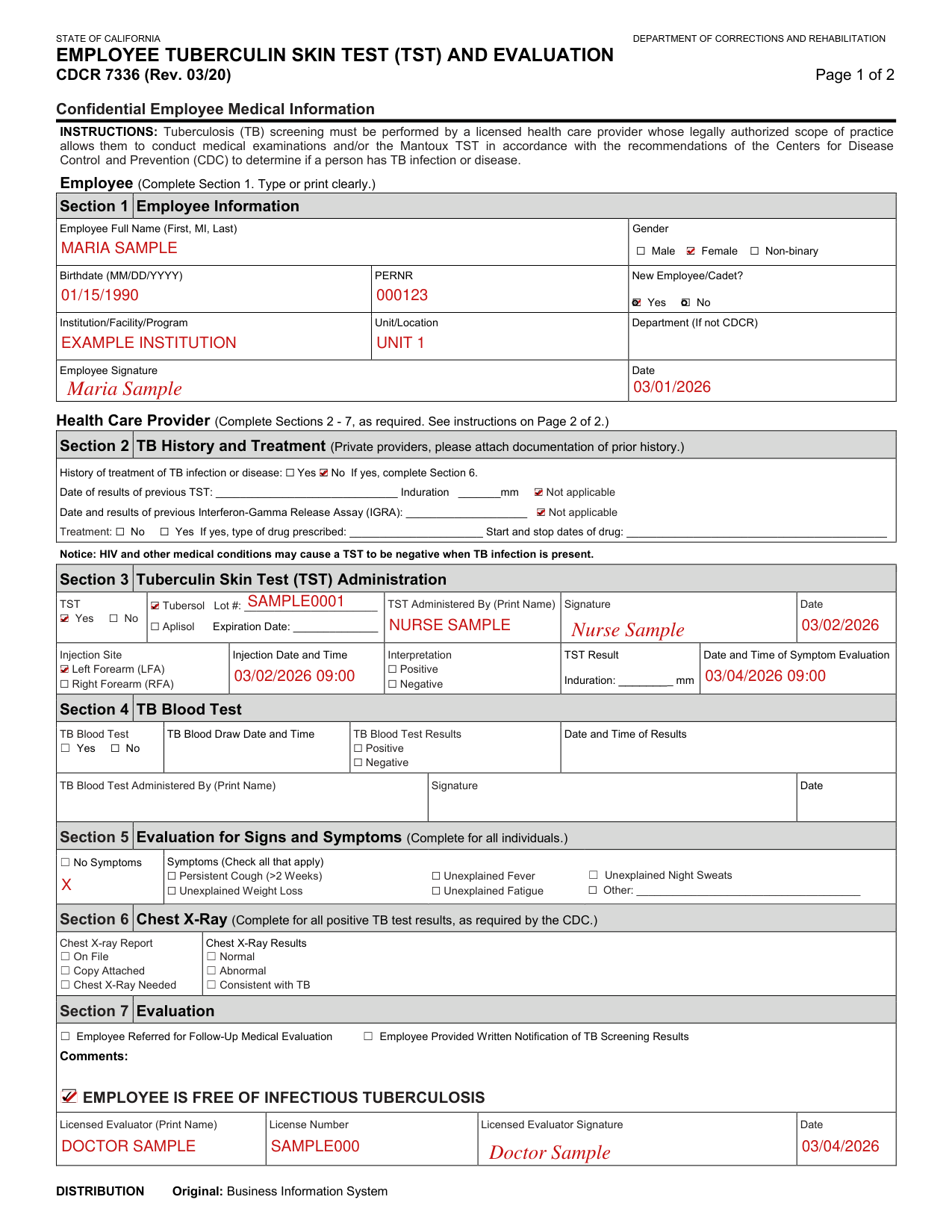
How to fill out CDCR 7336, box by box
Section 1 Employee Information
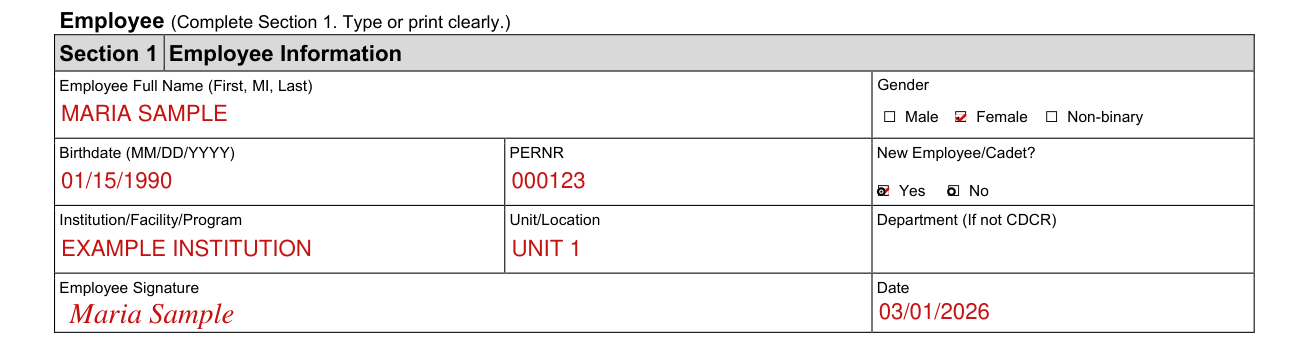
Employee: Complete Section 1. Type or print clearly.
Section 2 TB History and Treatment

Health Care Provider (HCP) Section 2: Complete Section 2, if applicable.
Complete this section if prior TST or TB blood test results and treatment are available.
If documented results are: NEGATIVE and more than 30 days old, proceed to Section 3. NEGATIVE and less than 30 days old, proceed to Section 5. POSITIVE on any date, complete Sections 5, 6, and 7.
If there are no appropriately documented prior TST or TB blood test results, continue to Section 3.
For History of treatment of TB infection or disease, mark Yes or No. If yes, complete Section 6.
Enter the Date of results of previous TST and the Induration in mm, and the Date and results of previous Interferon-Gamma Release Assay (IGRA); mark Not applicable for each that does not apply.
For Treatment, mark No or Yes. If yes, enter the type of drug prescribed and the Start and stop dates of drug.
Section 3 TST and Section 4 TB Blood Test
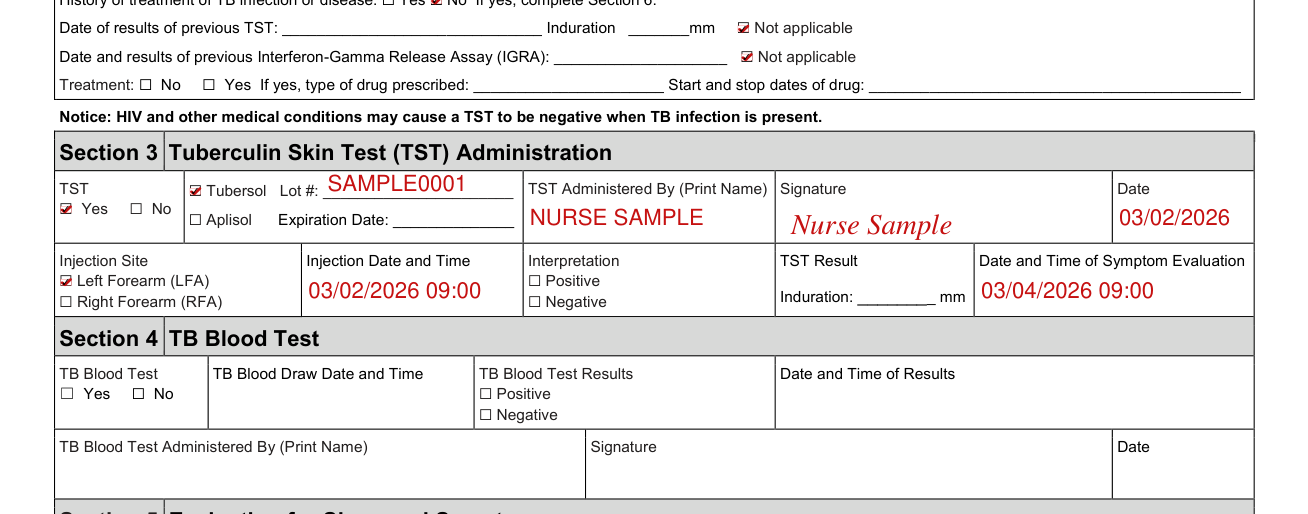
The only acceptable screening methods for detecting TB infection are TB screening tests that are licensed by the Federal Food and Drug Administration (FDA) and recommended by the CDC.
The tine test is NOT an acceptable skin test to determine exposure to the TB bacillus.
Section 3: Administer a new TST and document the test results in Section 3.
The process for administering, evaluation, and documenting the Mantoux TST are: a) Must be given intradermally. b) 0.1 ml (s) of 5 TU Purified Protein Derivative must be used. c) The test must be interpreted by a qualified HCP. d) Results must be documented in mm(s) of induration.
Mantoux TST: Intradermal injection of 0.1 milliliters (ml) of Purified Protein Derivative, 5 Tuberculin Units (TU).
Induration: Swelling or raised skin.
Note: The presence of erythema is NOT indicative of a TST reaction; only the induration is measured.
Negative TST Result: Induration of less than (<) 10 mm if new, or < 5 mm, if contact or known immunocompromised.
Positive TST Result: Induration equal to or greater than (>) 10 mm, OR > 5 mm if contact or known immunocompromised.
Notice: HIV and other medical conditions may cause a TST to be negative when TB infection is present.
If documented results are: NEGATIVE, complete Sections 5 and 7. POSITIVE, complete Sections 5, 6, and 7.
The HCP administering the TB blood test must sign and date the appropriate blocks.
The block identified as “Date and Time of Results” refers to date the employee's TB status is determined.
If an individual claims to have a prior positive TB blood test or TST, but is unable to provide appropriate documentation, a TST or TB blood test must still be administered. This is not medically contraindicated.
If the administered or documented TB blood test shows a negative result, the employee most likely does not have the TB infection.
Factors affecting the immune system, pregnancy, or recent TB infection may cause a false negative TST or TB blood test reaction, even when TB disease exists.
If the TB blood test or TST indicates a positive reaction, further medical evaluation and a CXR are required to rule out active TB disease.
Section 5 Evaluation for Signs and Symptoms

Section 5: Complete the evaluation for all employees.
Three or more symptoms warrant special concern.
Mark No Symptoms or Symptoms (Check all that apply): Persistent Cough (>2 Weeks), Unexplained Fever, Unexplained Night Sweats, Unexplained Weight Loss, Unexplained Fatigue or Other.
Section 6 Chest X-Ray

Section 6: Complete this section for individuals with a prior documented or newly significant TST or TB blood test.
If a prior CXR report is on file, attach a copy of the CXR report to this form and mark the applicable results.
If the individual does not have CXR report on file, administer a CXR, attach a copy of the report, and check the applicable results.
A copy of CXR report must be attached for all POSITIVE results.
A chest X-ray (CXR) cannot be used to definitively diagnose TB. However, a CXR may be used to rule out the possibility of pulmonary TB in a person who has had a positive reaction to a TST or TB blood test and no symptoms of disease.
For the Chest X-ray Report, mark On File, Copy Attached or Chest X-Ray Needed, and mark the Chest X-Ray Results Normal, Abnormal or Consistent with TB.
Section 7 Evaluation

Section 7: The HCP, Physician, Surgeon or licensed designee evaluating for TB signs and symptoms must compete this section.
Evaluators may note comments, as necessary.
Check the box if the employee is free of infectious TB, print name, enter license number, sign, and date this section.
After evaluation or treatment, provide the original completed and signed CDCR 7336 form to the employee for return to CDCR.
More rules for CDCR 7336
Confidential Employee Medical Information.
Tuberculosis (TB) screening must be performed by a licensed health care provider whose legally authorized scope of practice allows them to conduct medical examinations and/or the Mantoux TST in accordance with the recommendations of the Centers for Disease Control and Prevention (CDC) to determine if a person has TB infection or disease.
CDCR Health Care Providers (HCP) shall not ask CDCR employees about non-TB health history, including immunosuppressive conditions.
Sources
[1] CDCR 7336 (Rev. 03/20), Employee Tuberculin Skin Test (TST) and Evaluation, California Department of Corrections and Rehabilitation (the Official source link on this page).
