
Form F8 at a glance
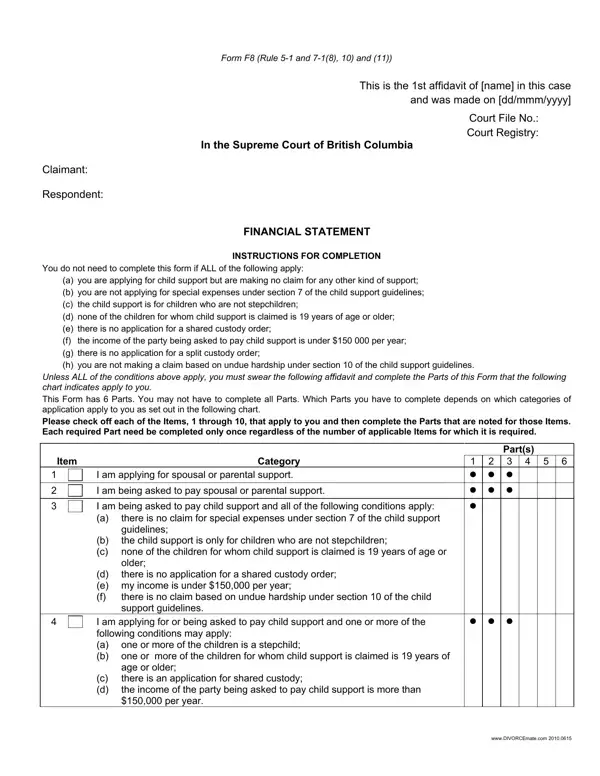
What it is: Form F8 (Rule 5-1 and 7-1 (8), (10) and (11)) is the Financial Statement in the Supreme Court of British Columbia.
Who signs: After "I," enter your name and, after "of", your address for service, and SWEAR (OR AFFIRM) THAT: 1 The information set out in this financial statement is true and complete to the best of your knowledge.
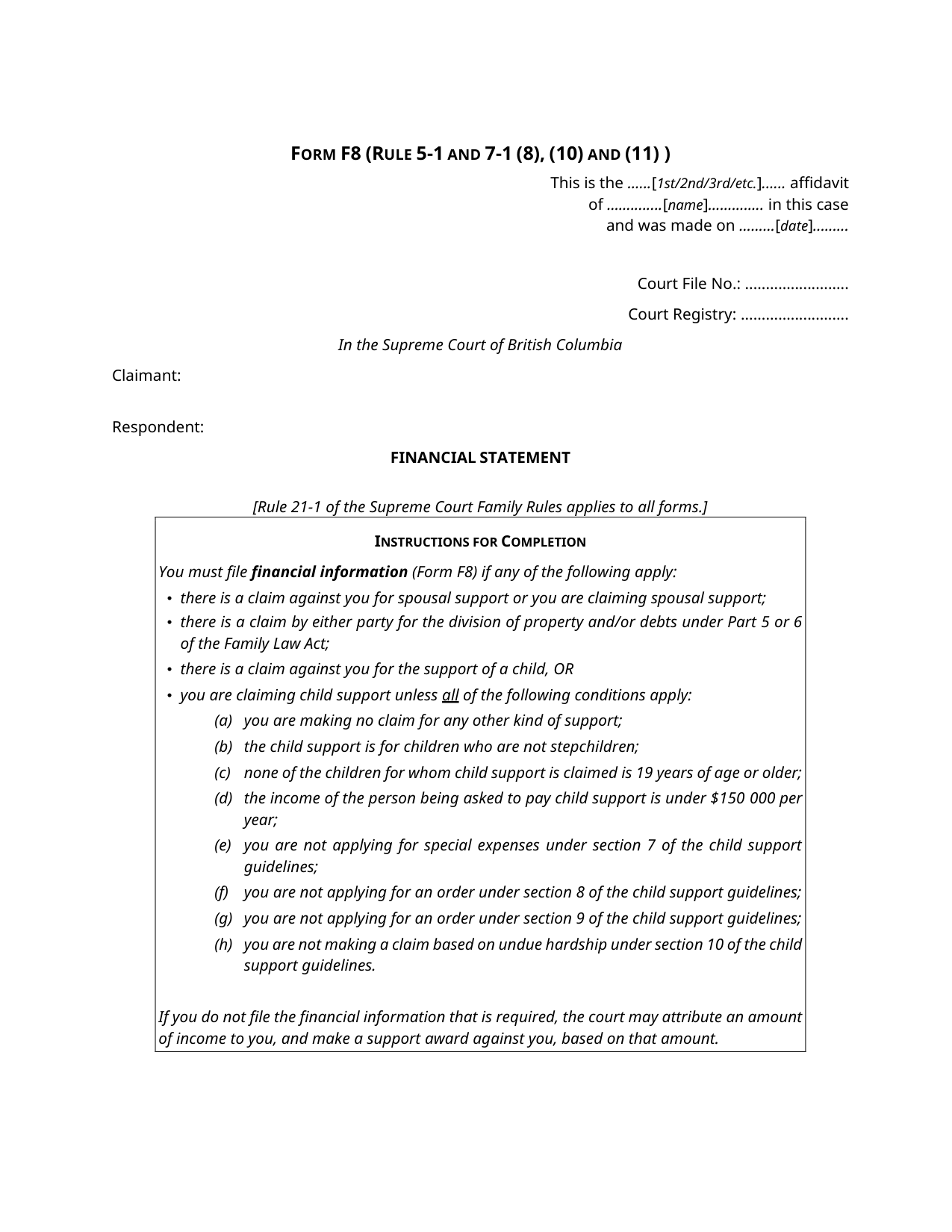
You must file financial information (Form F8) if there is a claim by or against you for spousal support, if there is a claim by either party for the division of property and/or debts under Part 5 or 6 of the Family Law Act, if there is a claim against you for the support of a child, or if you are claiming child support unless all of the following conditions apply: you are making no claim for any other kind of support; the child support is for children who are not stepchildren; none of the children for whom child support is claimed is 19 years of age or older; the income of the person being asked to pay child support is under $150 000 per year; you are not applying for special expenses under section 7 of the child support guidelines or for an order under section 8 or 9 of them; you are not making a claim based on undue hardship under section 10 of the child support guidelines (checked November 12, 2026).
The blank Form F8: print it and complete it by hand
How to fill out Form F8, box by box
This is the affidavit, Court File No. and Court Registry
At the top, fill in: This is the [1st/2nd/3rd/etc.] affidavit of [name] in this case and was made on [date]. The page also has lines for Court File No., Court Registry, Claimant and Respondent.
If you do not file the financial information that is required
If you do not file the financial information that is required, the court may attribute an amount of income to you, and make a support award against you, based on that amount.
SWORN (OR AFFIRMED) BEFORE ME
At paragraph 2, check one box: "I do not anticipate any significant changes in the information set out in this financial statement" or "I anticipate the following significant changes", which is followed by a line where you write them. The affidavit is SWORN (OR AFFIRMED) BEFORE ME at the commissioner's city/town, British Columbia on the date, before a commissioner for taking affidavits for British Columbia, who prints a name or affixes a stamp. Paragraphs must be included if the affidavit was sworn or affirmed by video conference.
PART 1 - INCOME
You do not need to complete Part 1 if all of the following apply: (a) the other party does not claim child support from you; (b) there are no claims for special expenses under section 7 of the child support guidelines; (c) the current parenting arrangement does not involve split or shared custody under section 8 or 9 of the guidelines; (d) there are no claims for split or shared custody; (e) there are no claims for child support relating to stepchildren; (f) there are no children 19 years or older for whom support is sought; (g) the payor's child support guidelines income is less than $150 000 per year; (h) there are no claims for undue hardship under section 10 of the child support guidelines; (i) there are no claims for retroactive child support; (j) there are no claims for spousal support (checked November 12, 2026).
Under A Employer information, check one box: I am employed by [name and address of employer]; I am self employed as [trade or occupation]; I operate an unincorporated business, the name and address of which is [name and address of business]; or I am unemployed. Under B Documentation supplied, check the first 2 boxes and check each other box that applies to you and provide the documents referred to beside each checked box. First 2 boxes: every personal income tax return, including all attachments, that I have filed for each of the 3 most recent taxation years; every income tax notice of assessment or reassessment I have received for each of the 3 most recent taxation years. If you are an employee: my most recent statement of earnings indicating the total earnings paid in the year to date, including overtime, or, if such a statement is not provided by my employer, a letter from my employer setting out that information, including my rate of annual salary or remuneration. If you are receiving Employment Insurance benefits: my 3 most recent EI benefit statements. If you are receiving Workers' Compensation benefits: my 3 most recent WCB benefit statements. If you are receiving income assistance: a statement confirming the amount of income assistance that I receive. If you are self-employed: for the 3 most recent taxation years (i) the financial statements of my business or professional practice, other than a partnership, and (ii) a statement showing a breakdown of all salaries, wages, management fees or other payments or benefits paid to, or on behalf of, persons or corporations with whom I do not deal at arm's length. If you are in a partnership: confirmation of my income and draw from, and capital in, the partnership for its 3 most recent taxation years. If you control a corporation: for the corporation's 3 most recent taxation years (i) the financial statements of the corporation and its subsidiaries, and (ii) a statement showing a breakdown of all salaries, wages, management fees or other payments or benefits paid to, or on behalf of, persons or corporations with whom the corporation and every related corporation does not deal at arm's length. If you are a beneficiary under a trust: the trust settlement agreement and the trust's 3 most recent financial statements. If you own or have an interest in real property: the most recent assessment notice issued from an assessment authority for the property.
If the applicable income documents are not attached to or served with this financial statement, they must nonetheless be provided to the other party if and as required by Rule 5-1 of the Supreme Court Family Rules.
Under C Annual Income, if line 150 (total income) of your most recent federal income tax return sets out what you expect your income will be for this year and you are not obliged under Note 1 to complete Schedule A of this Form, ignore lines 1 to 7 and record the number from line 150 at line 8. Otherwise, record what you expect your income for this year to be from each of the following sources of income that applies to you. Record gross annual amounts.
2 If there are any adjustments as set out in Schedule III of the child support guidelines that apply to you, you must complete Schedule B of this Form, and include at line 10, the amount recorded at line 8 of that completed Schedule B.
ASSETS, DEBTS, EXCLUDED PROPERTY and DISPOSAL OF PROPERTY
Under ASSETS, list all assets that you own, regardless of whether or not the other party has made a claim.
For 1 Real estate, attach a copy of the most recent assessment notice for any property that you own or in which you have an interest. Provide details, including address or legal description and nature of interest, of any interest you have in land, including leasehold interests and mortgages, whether or not you are registered as owner. Record the estimated market value of your interest without deducting encumbrances or costs of disposition.
Under DEBTS, show your debts and other liabilities, whether arising from personal or business dealings, by category, such as mortgages, charges, liens, notes, credit cards, accounts payable and tax arrears. Include contingent liabilities such as guarantees and indicate that they are contingent.
Under EXCLUDED PROPERTY, of the assets listed, list which ones are excluded property or form part of the excluded property claim.
Under DISPOSAL OF PROPERTY, list all real and personal property disposed of during the 2 years preceding this statement or, if the parties married within that 2 year period, since the date of marriage.
PART 4 - SPECIAL OR EXTRAORDINARY EXPENSES
You must complete Part 4 if there is a claim, either by you or against you, for child support and there is a claim for special expenses under section 7 of the child support guidelines.
Note 1: Provide a separate statement under Part 4 for each child for whom a claim is made. Note 2: To calculate a net amount, subtract, from the gross amount, subsidies, benefits, income tax deductions or credits relating to the expense.
PART 5 - UNDUE HARDSHIP
You must complete Part 5 if there is a claim against you for child support and you intend to make an undue hardship claim under the child support guidelines.
PART 6 - INCOME OF OTHER PERSONS IN HOUSEHOLD
You must complete Part 6 if (a) there is a claim against you for child support and you intend to make an undue hardship claim under the child support guidelines OR (b) there is a claim by you for child support and the other party has made an undue hardship claim under the child support guidelines.
Common questions about Form F8
What is form 8 in BC?
Form F8 (Rule 5-1 and 7-1 (8), (10) and (11)) is the Financial Statement in the Supreme Court of British Columbia. Rule 21-1 of the Supreme Court Family Rules applies to all forms.
Sources
[1] Form F8, Financial Statement, Supreme Court of British Columbia.