

Form DMA-3050-R at a glance
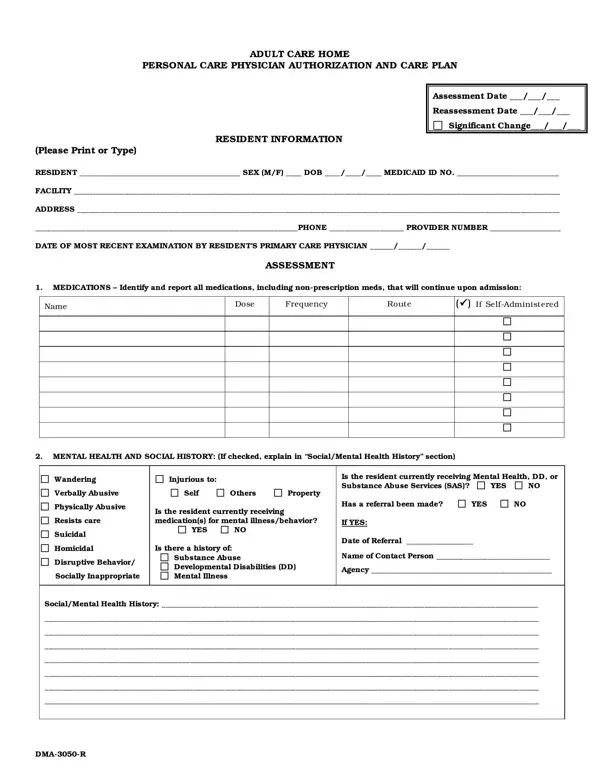
What it is: DMA-3050-R is the Adult Care Home Personal Care Physician Authorization and Care Plan (Please Print or Type).
Who signs: Signature of assessor certifies that the care plan is developed based on assessment findings. The physician prints his/her name, signs, and dates the form.
The blank Form DMA-3050-R: print it and complete it by hand
How to fill out Form DMA-3050-R, box by box
Assessment Date, Reassessment Date, Significant Change
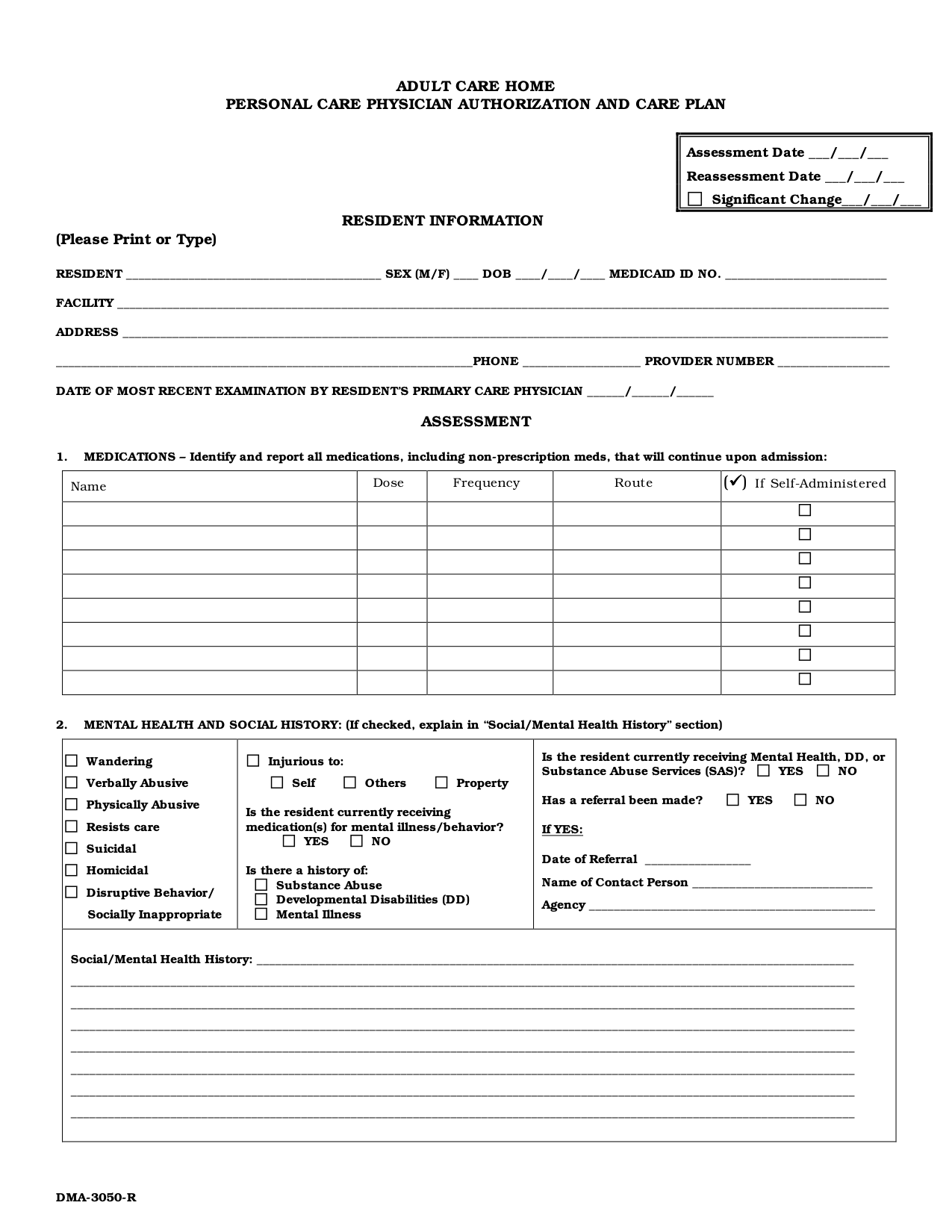
The block in the upper right hand corner of the form denotes the type of assessment that is completed: include Assessment date, Reassessment date, or Significant Change (DMA-3050-R).
Refer to the glossary in the Adult Care Home Services manual for the definition of significant change.
Resident Information
In the Resident Information area include the resident's name as it appears on the blue Medicaid ID card.
Complete all information.
Date of most recent examination: includes a yearly physical by the resident's attending physician.
At the top of the second page and at the top of the third page, place the name as on Medicaid ID card in the resident blank.
1. Medications
Medications: list the name of each medication, include non-prescription meds that the resident will continue upon admission.
Check appropriate box for self-administered.
3. Ambulation/Locomotion
Ambulation/Locomotion: check applicable block and list devices needed.
Ambulation/Locomotion: No Problems, Limited Ability, Ambulatory w/ Aide or Device(s), Non-Ambulatory; Device(s) Needed; Has device(s): Does not use, Needs repair or replacement. 4.
4. Upper Extremities
Upper extremities: check applicable box and list devices needed.
Upper extremities: No Problems, Limited Range of Motion, Limited Strength, Limited Eye-Hand Coordination; specify affected joint(s): Right, Left, Bilateral; Other impairment, specify; Device(s) Needed; Has device(s): Does not use, Needs repair or replacement. 5.
5. Nutrition
Nutrition: check appropriate box.
Indicate height and weight.
Include any restrictions to diet, i.e. NAS, soft, etc.
Nutrition: Oral, Tube (Type); Height; Weight; Dietary Restrictions; Device(s) Needed; Has device(s): Does not use, Needs repair or replacement. 6.
6. Respiration
Respiration: check appropriate box.
Indicate any devices needed.
Respiration: Normal, Well Established Tracheostomy, Oxygen, Shortness of Breath; Device(s) Needed; Has device(s): Does not use, Needs repair or replacement. 7.
7. Skin
Skin: check appropriate box.
Explain in detail treatment necessary and include any MD orders for skin care.
Skin: Normal, Pressure Areas, Decubiti, Other; Skin Care Needs. 8.
8. Bowel and 9. Bladder
Bowel: check appropriate box.
Bowel: Normal, Occasional Incontinence (less than daily), Daily Incontinence, Ostomy: Type; Self-care: YES or NO. 9.
Bladder: check appropriate box.
Bladder: Normal, Occasional Incontinence (less than daily), Daily Incontinence, Catheter: Type; Self-care: YES or NO. 10.
Indicate if the resident is independent of activity.
Explain what resident needs from staff.
10. Orientation
Orientation: check appropriate box.
Orientation: Oriented, Sometimes Disoriented, Always Disoriented. 11.
11. Memory
Memory: check appropriate box.
Memory: Adequate, Forgetful - Needs Reminders, Significant Loss - Must Be Directed. 12.
12. Vision
Vision: check appropriate box.
Expand on concerns in comments area.
Vision: Adequate for Daily Activities, Limited (Sees Large Objects), Very Limited (Blind); Explain; Uses: Glasses, Contact Lens, Needs repair or replacement; Comments. 13.
13. Hearing
Hearing: check appropriate box.
Expand on concerns in comments area.
Hearing: Adequate for Daily Activities, Hears Loud Sounds/Voices, Very Limited (Deaf); Explain; Uses Hearing Aid(s), Needs repair or replacement; Comments. 14.
14. Speech/Communication Method
Speech/Communication Method: check appropriate box.
Speech/Communication Method: Normal, Slurred, Weak, Other Impediment, No Speech, Gestures, Sign Language, Writing, Foreign Language Only, Other, None; Assistive Device(s) (Type); Has device(s): Does not use, Needs repair or replacement.
15. Activities of Daily Living
If the assessment indicates the resident has medically related personal care needs requiring assistance, show the plan for providing care.
Check off the days of the week each ADL task is performed and rate each ADL task based on the following performance codes: 0 - Independent, 1 - Supervision, 2 - Limited Assistance, 3 - Extensive Assistance, 4 - Totally Dependent.
Activities of Daily Living (ADL): describe the specific type of assistance needed by the resident and provided by staff, next to each ADL: Eating, Toileting, Ambulation/Locomotion, Bathing, Dressing, Grooming/Personal Hygiene, Transferring, Other (include Licensed Health Professional Support (LHPS) Personal Care Tasks, as listed in Rule 42C .3703, and any other special care needs). Assessor Certification: "I certify that I have completed the above assessment of the resident's condition."
Refer to the Adult Care Home Services manual for more detail on Performance Codes.
Activities of Daily Living: include a description of the specific type of assistance provided by staff next to each ADL and code the activity in the Performance Code area.
In Other, list any Licensed Health Professional Support tasks as well as any special care needs in this area.
Assessor Certification
Assessor Certification: check box for Medical Care Decisions and Advance Directives education.
"I found the resident needs personal care services due to the resident's medical condition. I have developed the care plan to meet those needs."
Resident/responsible party has received education on Medical Care Decisions and Advance Directives prior to admission.
Signature of assessor certifies that the care plan is developed based on assessment findings.
Sources
[1] Adult Care Home Personal Care Physician Authorization and Care Plan, DMA-3050-R, North Carolina Medicaid (the Official source link on this page).