
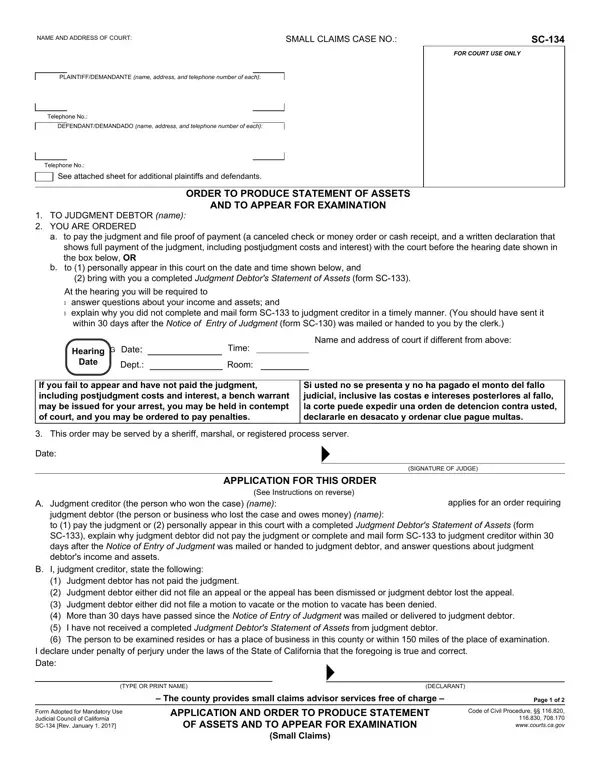
Form SC-134 at a glance
What it is: Form SC-134 is the Application and Order to Produce Statement of Assets and to Appear for Examination (Small Claims), a Judicial Council of California form.
Where and when to file: File the completed original form SC-134 with the court and pay the filing fee.
Instructions to the judgment creditor (the party who won the case and is owed money) for completing this form: Complete the application on page 2 to ask the court to require the judgment debtor (the person or business who lost the case and owes money) to come to court with a completed Judgment Debtor's Statement of Assets (form SC-133) and answer questions about their money and property.
What to bring and attach to Form SC-134
Bring a copy of your completed form SC-134 with you to the hearing.
A filled-in Form SC-134 example: a judgment creditor asks for an examination
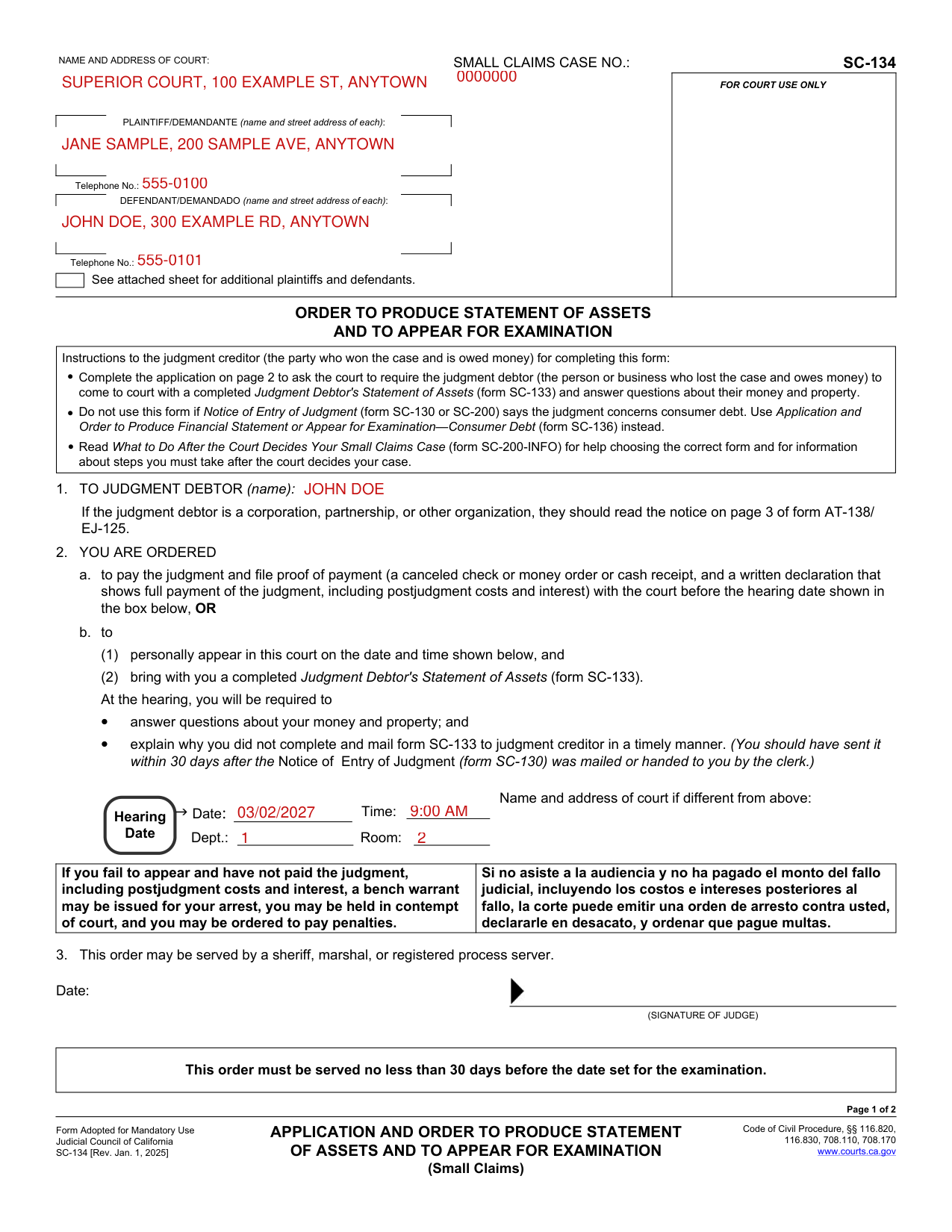
How to fill out Form SC-134, box by box
Name and address of court, plaintiff, defendant and case no.
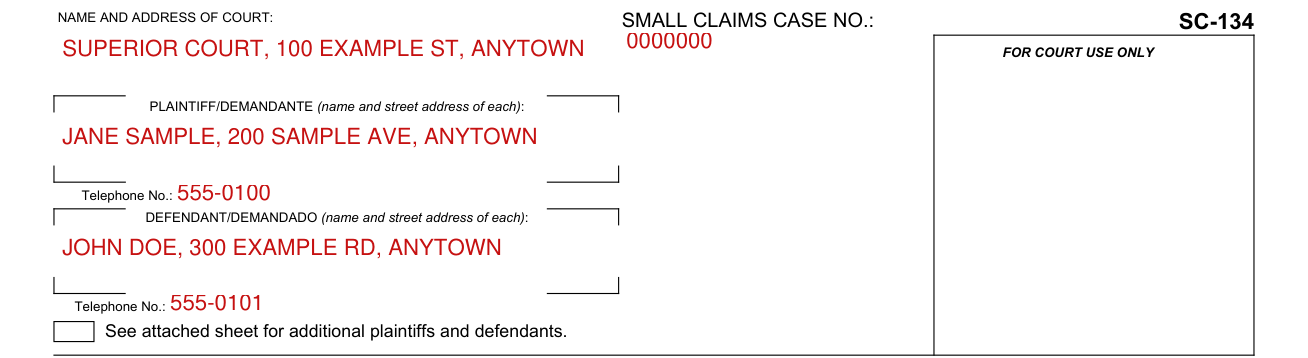
Enter the NAME AND ADDRESS OF COURT and the SMALL CLAIMS CASE NO.
Under PLAINTIFF/DEMANDANTE (name and street address of each) and DEFENDANT/DEMANDADO (name and street address of each), enter the name and street address and the Telephone No.
Mark See attached sheet for additional plaintiffs and defendants.
1. To judgment debtor

Under 1. TO JUDGMENT DEBTOR (name), enter the name.
If the judgment debtor is a corporation, partnership, or other organization, they should read the notice on page 3 of form AT-138/ EJ-125.
Hearing Date
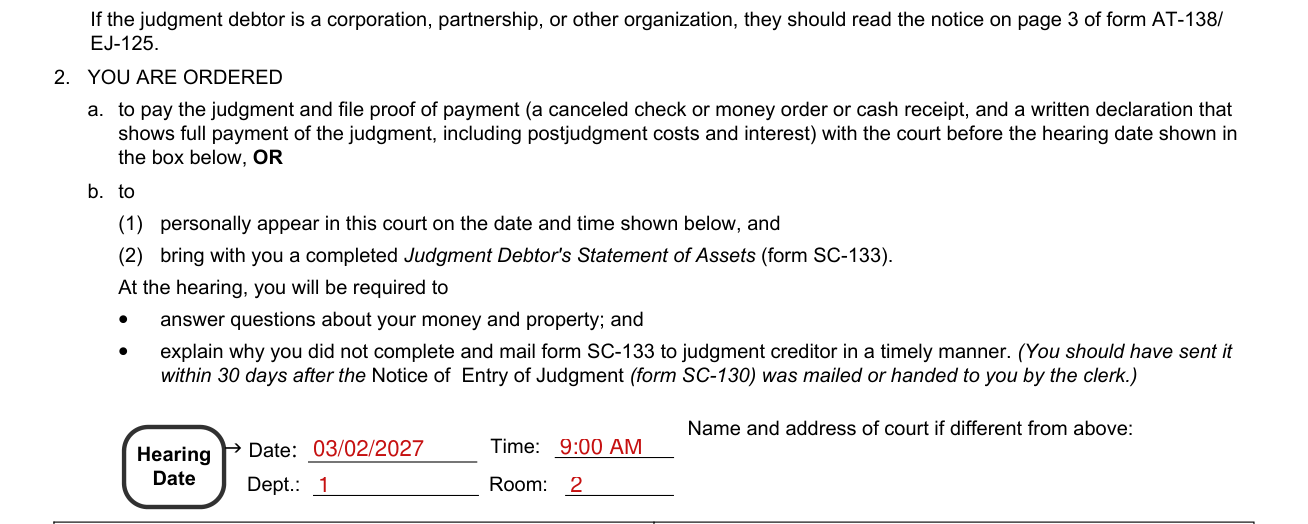
Complete item 1 on page 1 and items 4 and 5 on page 2 of this form, then contact the court clerk to schedule a hearing date and location.
Enter the hearing time, date, and location you received from the clerk in the "Hearing Date" section on page 1.
Under Hearing Date, enter the Date, Time, Dept., Room and the Name and address of court if different from NAME AND ADDRESS OF COURT.
The Date for this order

3. This order may be served by a sheriff, marshal, or registered process server.
The Date and the (SIGNATURE OF JUDGE) line are for the judge, not for you to fill in.
This order must be served no less than 30 days before the date set for the examination.
4. Judgment creditor applies for an order requiring judgment debtor

4. Judgment creditor (the person who won the case) (name): applies for an order requiring judgment debtor (the person or business who lost the case and owes money) (name): to (1) pay the judgment or (2) personally appear in this court with a completed Judgment Debtor's Statement of Assets (form SC-133), explain why judgment debtor did not pay the judgment or complete and mail form SC-133 to judgment creditor within 30 days after Notice of Entry of Judgment (form SC-130 or SC-200) was mailed or handed to judgment debtor, and answer questions about judgment debtor's money and property.
5 and 6. What you state
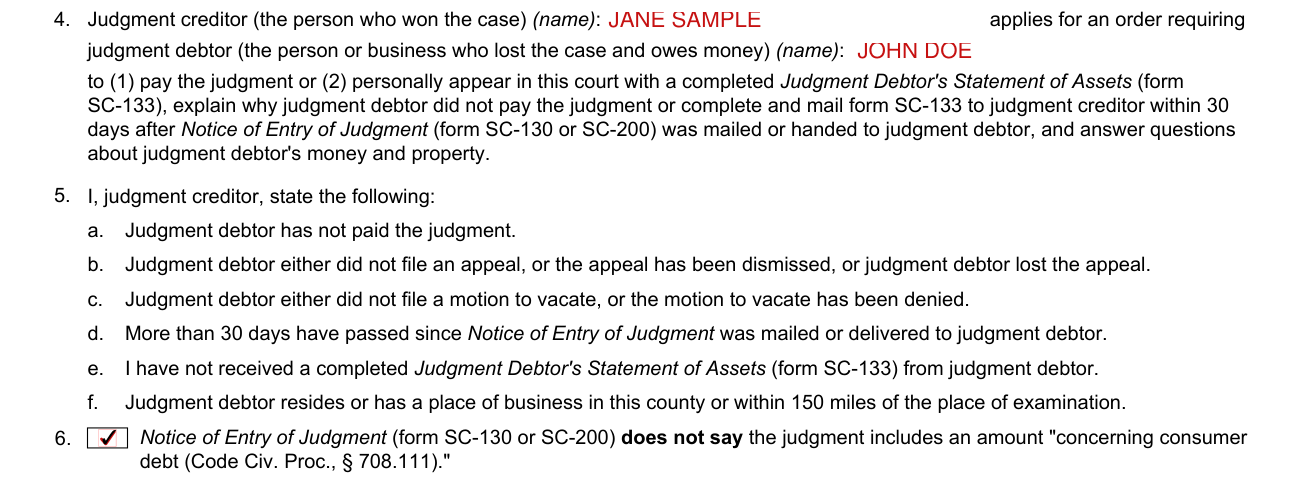
5. I, judgment creditor, state the following: Judgment debtor has not paid the judgment. Judgment debtor either did not file an appeal, or the appeal has been dismissed, or judgment debtor lost the appeal. Judgment debtor either did not file a motion to vacate, or the motion to vacate has been denied. More than 30 days have passed since Notice of Entry of Judgment was mailed or delivered to judgment debtor. I have not received a completed Judgment Debtor's Statement of Assets (form SC-133) from judgment debtor. Judgment debtor resides or has a place of business in this county or within 150 miles of the place of examination.
6. Notice of Entry of Judgment (form SC-130 or SC-200) does not say the judgment includes an amount "concerning consumer debt (Code Civ. Proc., § 708.111)."
Declaration, date and name

"I declare under penalty of perjury under the laws of the State of California that the foregoing is true and correct." Date: (TYPE OR PRINT NAME) (DECLARANT)
Sign and date the form.
More rules for Form SC-134
This form is intended to be an easy tool to enforce your right to receive a completed Judgment Debtor's Statement of Assets (form SC-133).
Read What to Do After the Court Decides Your Small Claims Case (form SC-200-INFO) for help choosing the correct form and for information about steps you must take after the court decides your case.
Make at least one copy of the completed form for your records.
You must attend the hearing unless the judgment has been paid.
When this is not the right form
The judgment concerns consumer debt
Do not use this form if Notice of Entry of Judgment (form SC-130 or SC-200) says the judgment concerns consumer debt. Use Application and Order to Produce Financial Statement or Appear for Examination-Consumer Debt (form SC-136) instead.
You only want an examination, or you already examined this judgment debtor
If you only want to ask the court to order the judgment debtor to come to court for an examination (answering questions about their money and property) and you do not want to enforce your right to receive a completed Judgment Debtor's Statement of Assets (form SC-133), use Application and Order for Appearance and Examination (form EJ-125).
If you have already examined this judgment debtor and want to ask for another examination, use form EJ-125.
You want the court to enforce the order
If you want to be able to ask the court to enforce the order on the judgment debtor (the person or business who lost the case and owes money), you must have a copy of this form and a blank copy of Judgment Debtor's Statement of Assets (form SC-133) served on the judgment debtor in person by a sheriff, marshal, or registered process server at least 30 calendar days before the date of the hearing, and have the original proof of service filed with the court.
Common questions about Form SC-134
Where do I file it?
File the completed original form SC-134 with the court and pay the filing fee.
Are there fees?
Pay the filing fee for the completed original form SC-134. If you reset the hearing, you will have to pay a new filing fee.
Is there a penalty?
If the judgment debtor (the person or business who lost the case and owes money) fails to appear and has not paid the judgment, including postjudgment costs and interest, a bench warrant may be issued for their arrest, they may be held in contempt of court, and they may be ordered to pay penalties.
Where to get help with Form SC-134
Most counties are required to have a Small Claims Advisor to give free legal information in small claims cases.
Assistive listening systems, computer-assisted real-time captioning, or sign language interpreter services are available if you ask at least five days before your hearing.
Sources
[1] Form SC-134 (Rev. Jan. 1, 2025), Application and Order to Produce Statement of Assets and to Appear for Examination (Small Claims), Judicial Council of California (the Official source link on this page).