

Blank HACCP forms at a glance
What it is: Downloadable Blank HACCP Forms & Flow Chart: 1. Hazard Analysis Table and 2. ROP HACCP Plan Summary.
A filled-in Blank HACCP forms example: a cafe lists two steps
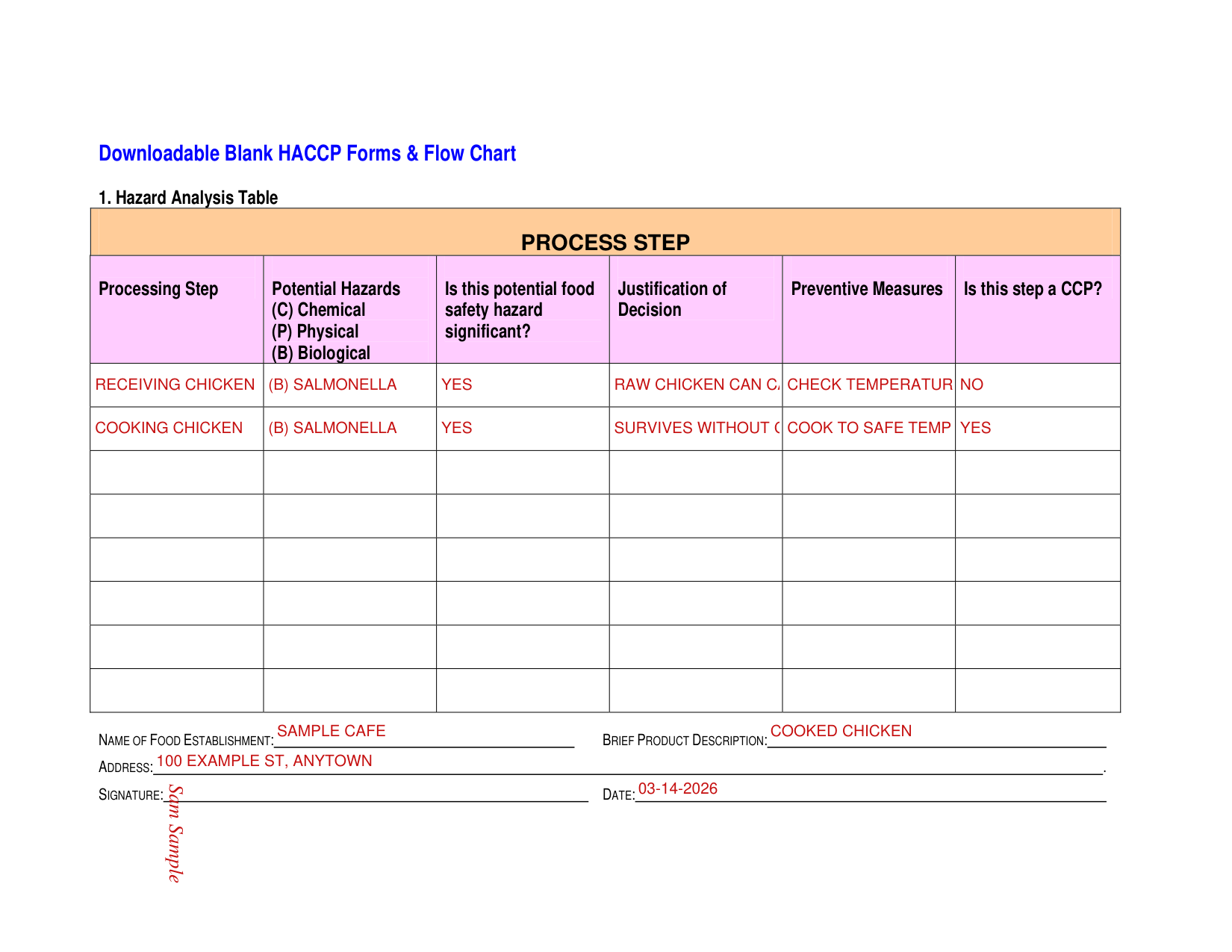
How to fill out Blank HACCP forms, box by box
Name of food establishment, product description, address, signature and date
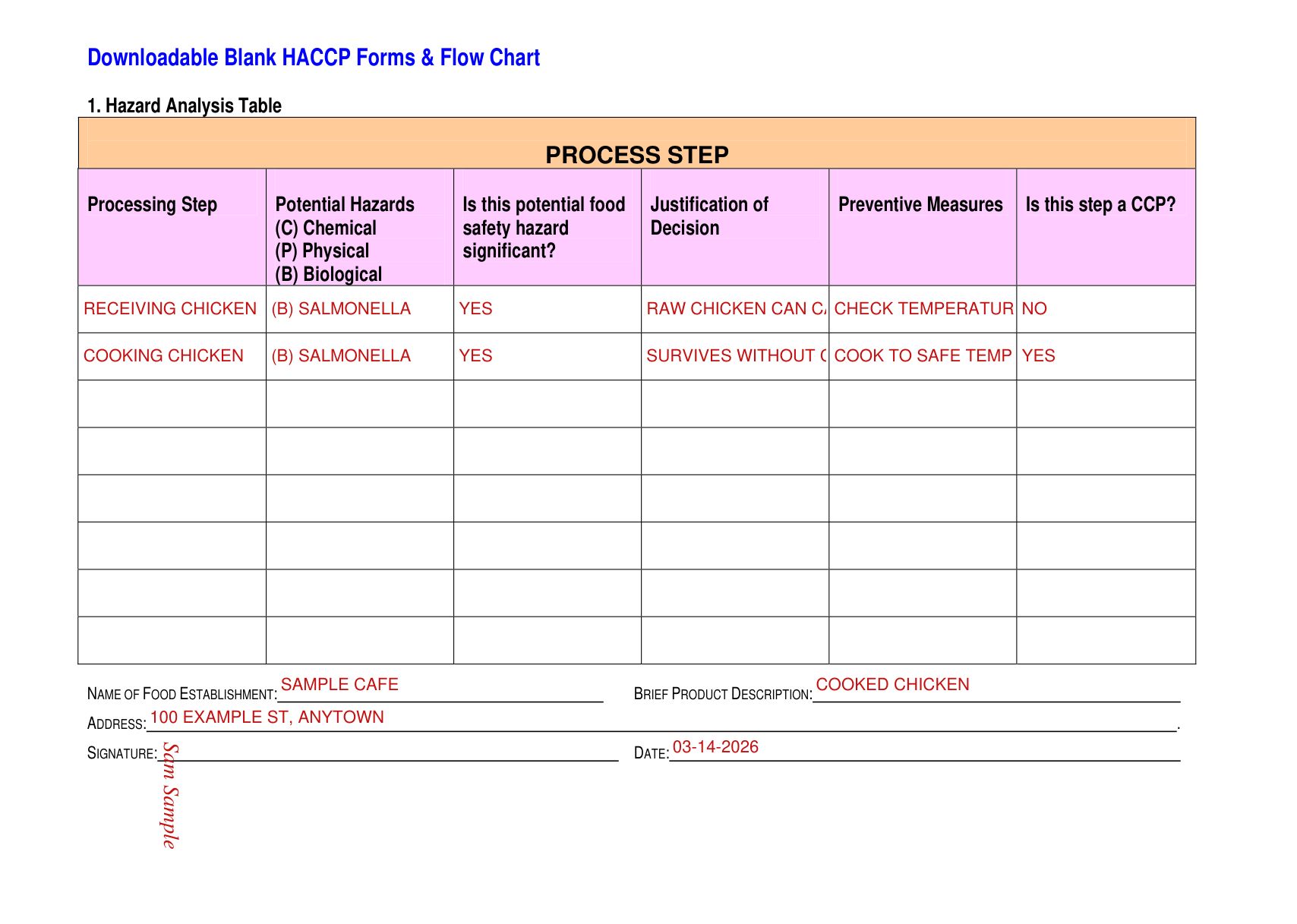
Enter the NAME OF FOOD ESTABLISHMENT and the BRIEF PRODUCT DESCRIPTION.
Enter the ADDRESS and the DATE, then sign the SIGNATURE.
1. Hazard Analysis Table
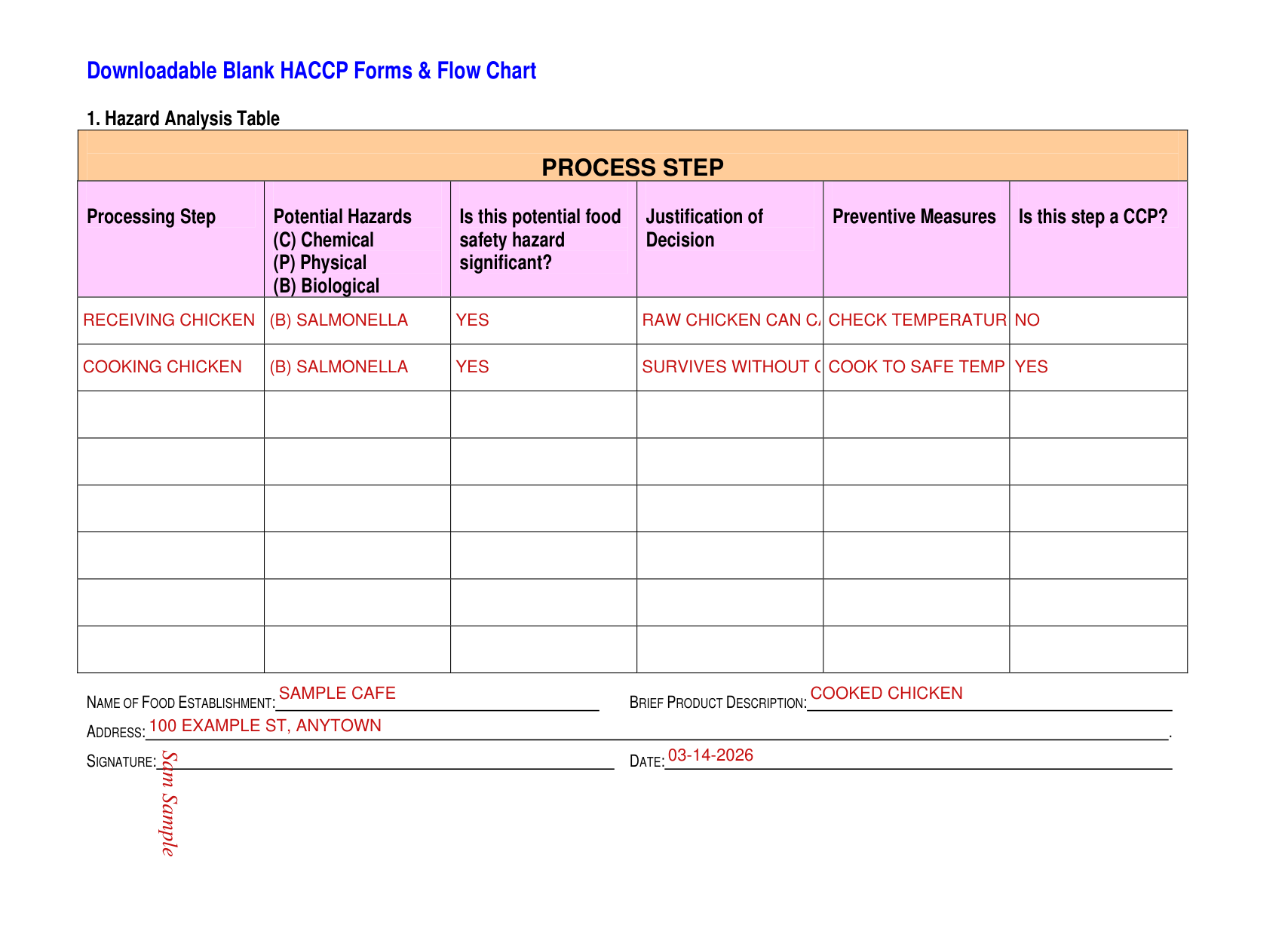
In the 1. Hazard Analysis Table, enter the Processing Step.
Enter the Potential Hazards: (B) Biological, (C) Chemical or (P) Physical.
Is this potential food safety hazard significant?
Enter the Justification of Decision.
Enter the Preventive Measures.
Is this step a CCP?
2. ROP HACCP Plan Summary
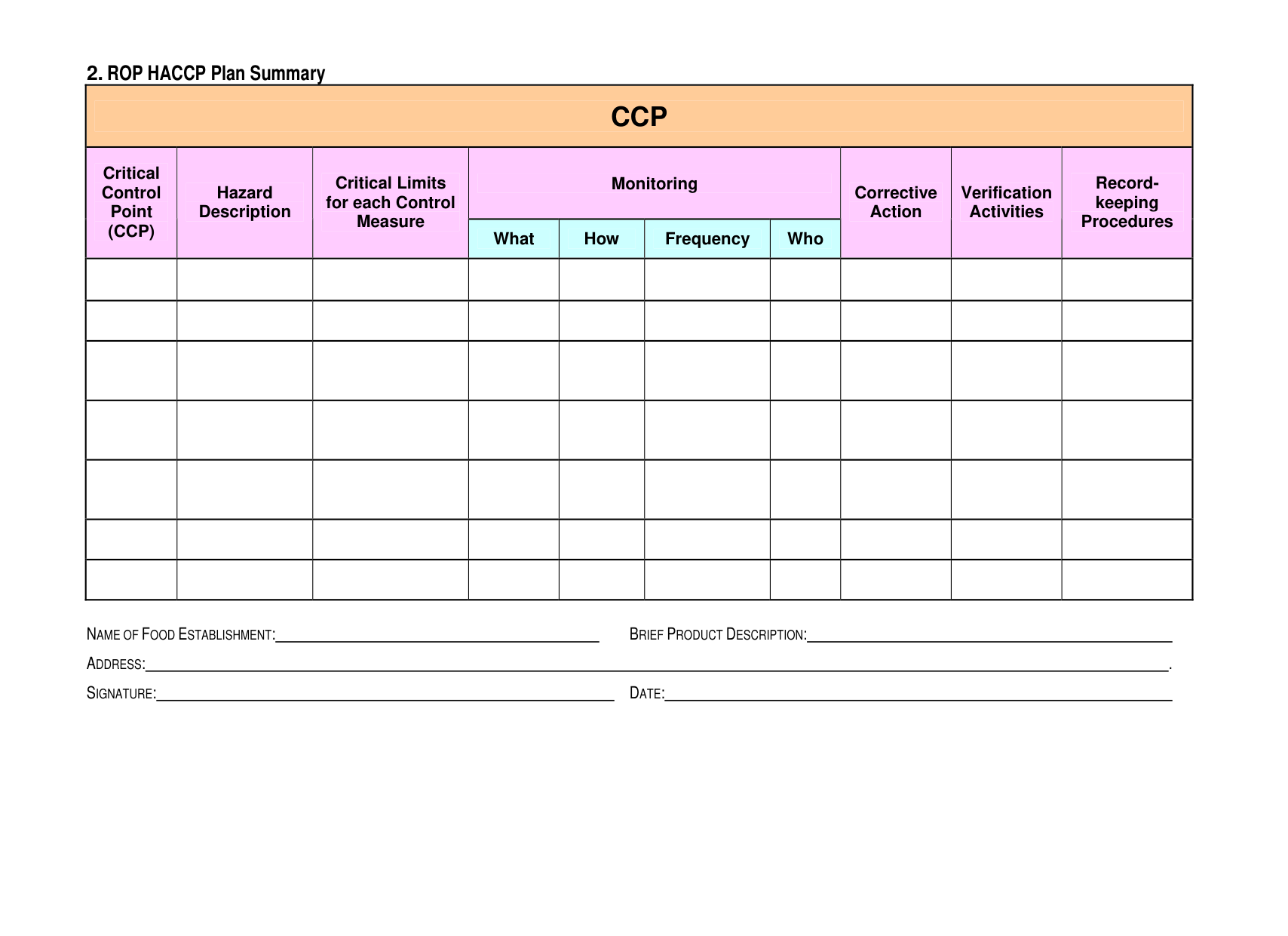
In the 2. ROP HACCP Plan Summary, enter the Critical Control Point (CCP).
Enter the Hazard Description.
Enter the Critical Limits for each Control Measure.
Enter the Monitoring: What, How, Frequency, Who.
Enter the Corrective Action.
Enter the Verification Activities.
Enter the Record-keeping Procedures.
More rules for Blank HACCP forms
3. Refrigeration / Freezer Log, 4. Thermometer Calibration Log, 6. Cooking & Reheating Temperature Log, 11. Food Contact Surface Cleaning & Sanitizing Log, 12. Food Preparation Log: this log should be maintained for a minimum of 90 days after the food has been consumed.
Logs: Refrigeration, Thermometer, Corrective Action, Cooking, Holding, Receiving, Cooling, Damaged Product, Sanitizing and Food Preparation
3. Refrigeration / Freezer Log
3. Refrigeration / Freezer Log: Instructions: A designated foodservice employee will record the location or description of holding unit, date, time, air temperature, corrective action, and initials on this Log.
4. Thermometer Calibration Log
4. Thermometer Calibration Log: Instructions: Foodservice workers will record the calibration temperature and corrective action taken each time thermometer is calibrated.
Thermometers intended for measuring hot temperature items, such as cooked product, will be calibrated in hot water, while those used for taking lower temperatures will be calibrated in ice water.
All thermometers will be calibrated within + or - 2 degrees F.
5. Corrective Action Log
5. Corrective Action Log: Enter the Date / Time, Designated Food Worker, Product, Lot ID, Deviation, Cause of Deviation, Product Disposition and Preventative Measures, then CCP Under Control After Corrective Actions Taken and Cause of Deviation Eliminated By.
6. Cooking & Reheating Temperature Log
6. Cooking & Reheating Temperature Log: Instructions: Record product name, time, the two temperatures/times, and any corrective action taken on this form.
7. Holding Times & Temperatures
7. Holding Times & Temperatures: Instructions: Take and record the temperature of the food when placed in holding units and when removed from holding units.
If pans are moved directly from ovens to holding units, simply record the end cooking temperature on this form.
8. Receiving Log
8. Receiving Log: Instructions: Use this Log for deliveries or receiving foods from suppliers.
Record any temperatures and corrective action taken on the Receiving Log.
The Receiving log should be maintained for a minimum of 90 days after the food has been consumed.
9. Cooling Temperature Log
9. Cooling Temperature Log: Instructions: Record temperatures every hour during the cooling cycle.
Record corrective actions, if applicable.
If no foods are cooled on any working day, indicate “No Foods Cooled” in the Food Item column.
The Cooling Log should be kept for a minimum of 1 year.
10. Damaged or Discarded Product Log
10. Damaged or Discarded Product Log: Instructions: Designated food worker will record product name, quantity, action taken, reason, initials, and date each time a food or food product is damaged and/or will be discarded.
The Damaged or Discarded Product Log should be. maintained for a minimum of 90 days after the food has been consumed.
11. Food Contact Surface Cleaning & Sanitizing Log
11. Food Contact Surface Cleaning & Sanitizing Log: Instructions: Record time, temperatures/sanitizer concentration, as appropriate and any corrective action taken on this form.
12. Food Preparation Log
12. Food Preparation Log: Instructions: Designated foodservice worker will record the date, product name, start and end time of preparation, the two temperature measurements taken, any corrective action taken, and the amount of food prepared.
Sources
[1] Downloadable Blank HACCP Forms & Flow Chart (the Official source link on this page).
