

Head to Toe Assessment at a glance
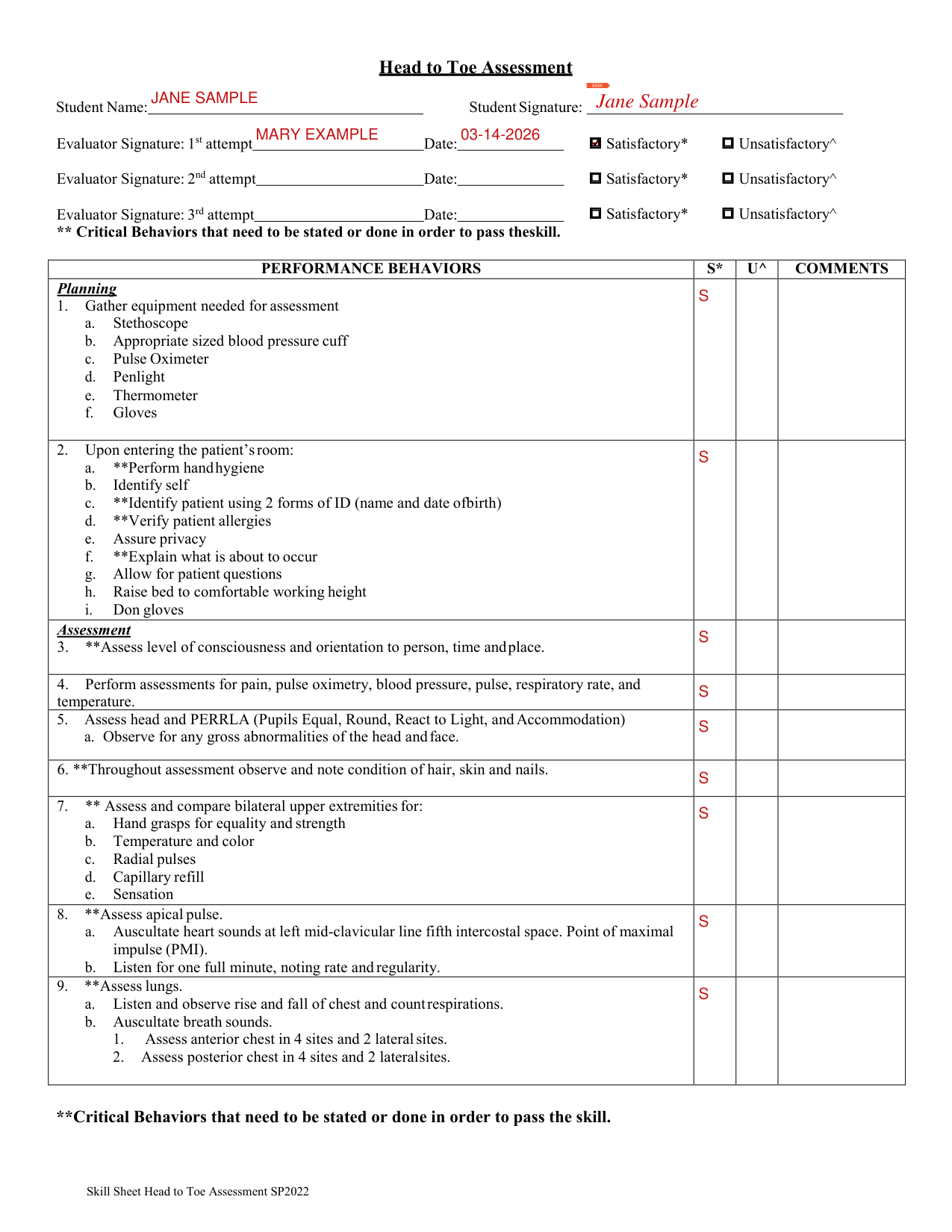
What it is: Skill Sheet Head to Toe Assessment, with PERFORMANCE BEHAVIORS, S*, U^ and COMMENTS.
Who signs: Student Signature and Evaluator Signature.
A filled-in Head to Toe Assessment example: a student passes on the first attempt
How to fill out Head to Toe Assessment, box by box
Student Name and Signature

Enter the Student Name and sign the Student Signature.
Evaluator Signature and attempts

For the 1st attempt, the 2nd attempt and the 3rd attempt, the evaluator enters Evaluator Signature and Date and marks Satisfactory* or Unsatisfactory^.
Planning and the patient's room
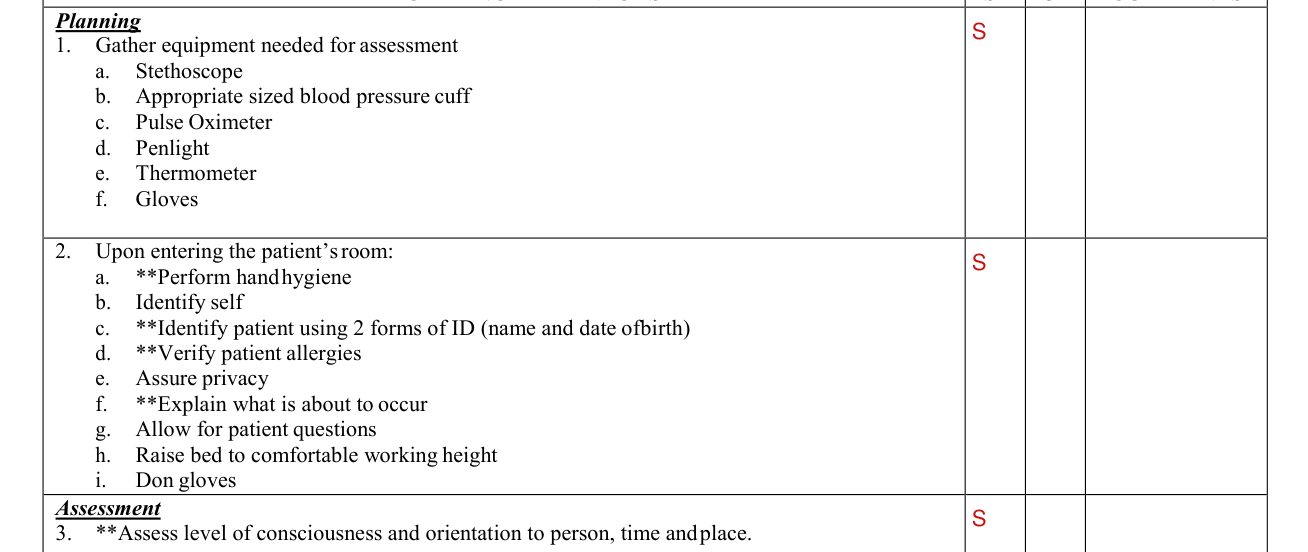
*S = Satisfactory, ^U = Unsatisfactory.
Under PERFORMANCE BEHAVIORS S* U^ COMMENTS, Planning: gather equipment needed for assessment: stethoscope, appropriate sized blood pressure cuff, pulse oximeter, penlight, thermometer and gloves.
Upon entering the patient's room: **perform hand hygiene, identify self, **identify patient using 2 forms of ID (name and date ofbirth), **verify patient allergies, assure privacy, **explain what is about to occur, allow for patient questions, raise bed to comfortable working height and don gloves.
Assessment on page 1
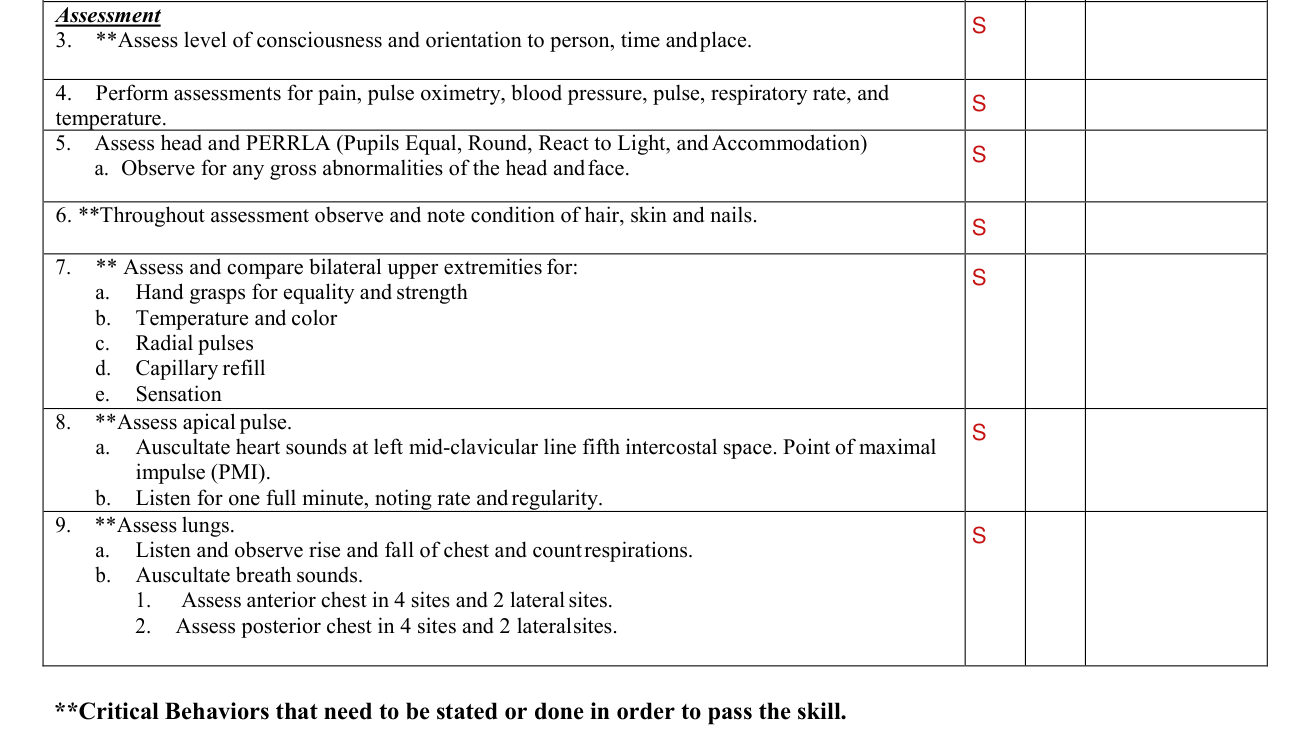
Under Assessment, 3. **Assess level of consciousness and orientation to person, time and place.
4. Perform assessments for pain, pulse oximetry, blood pressure, pulse, respiratory rate, and temperature.
5. Assess head and PERRLA (Pupils Equal, Round, React to Light, and Accommodation), and observe for any gross abnormalities of the head and face.
6. **Throughout assessment observe and note condition of hair, skin and nails.
7. ** Assess and compare bilateral upper extremities for: hand grasps for equality and strength, temperature and color, radial pulses, capillary refill, sensation.
8. **Assess apical pulse: auscultate heart sounds at left mid-clavicular line fifth intercostal space. Point of maximal impulse (PMI). Listen for one full minute, noting rate and regularity.
9. **Assess lungs: listen and observe rise and fall of chest and count respirations. Auscultate breath sounds. Assess anterior chest in 4 sites and 2 lateral sites. Assess posterior chest in 4 sites and 2 lateral sites.
Assessment on page 2
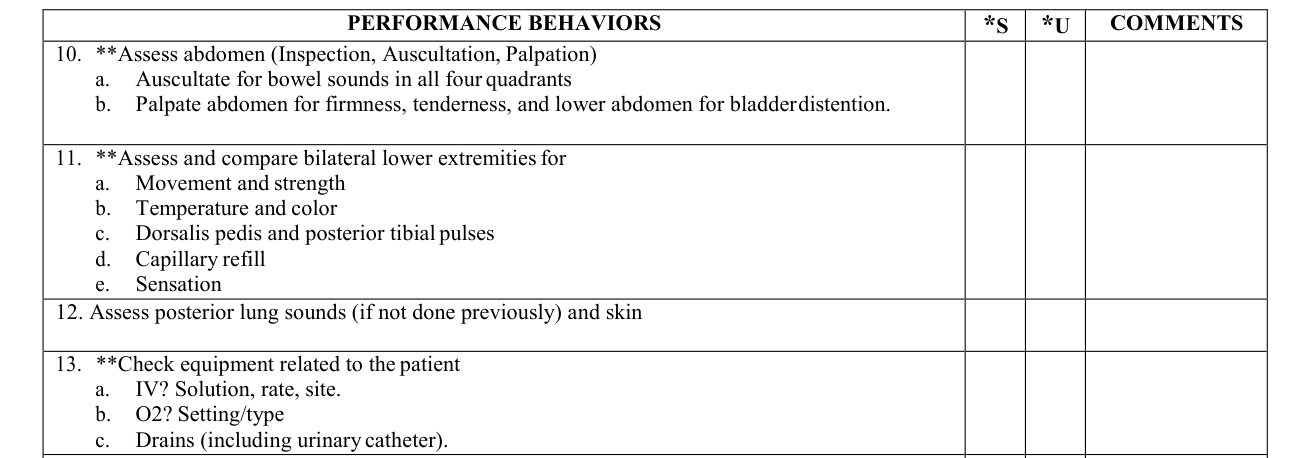
Under PERFORMANCE BEHAVIORS *S *U COMMENTS, 10. **Assess abdomen (Inspection, Auscultation, Palpation): auscultate for bowel sounds in all four quadrants. Palpate abdomen for firmness, tenderness, and lower abdomen for bladder distention.
11. **Assess and compare bilateral lower extremities for: movement and strength, temperature and color, dorsalis pedis and posterior tibial pulses, capillary refill, sensation. 12. Assess posterior lung sounds (if not done previously) and skin.
13. **Check equipment related to the patient: IV? Solution, rate, site. O2? Setting/type. Drains (including urinary catheter).
Prior to leaving room
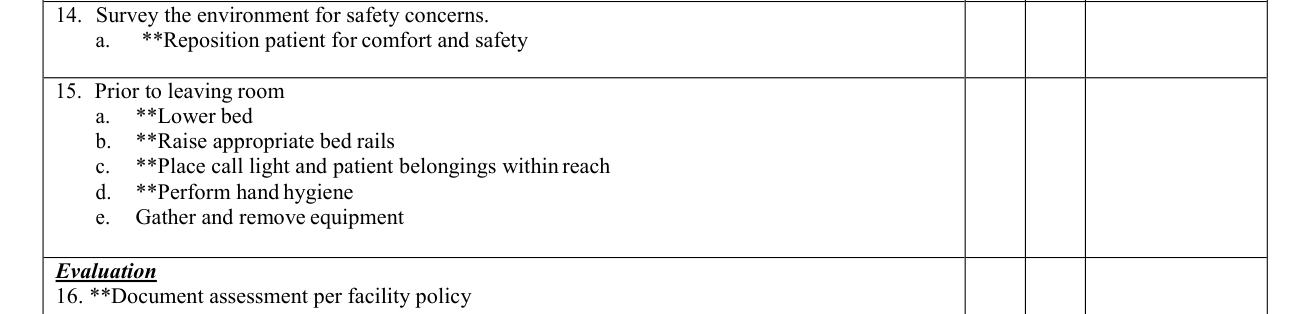
14. Survey the environment for safety concerns, and **reposition patient for comfort and safety. 15. Prior to leaving room: **lower bed, **raise appropriate bed rails, **place call light and patient belongings within reach, **perform hand hygiene.
Gather and remove equipment.
Evaluation
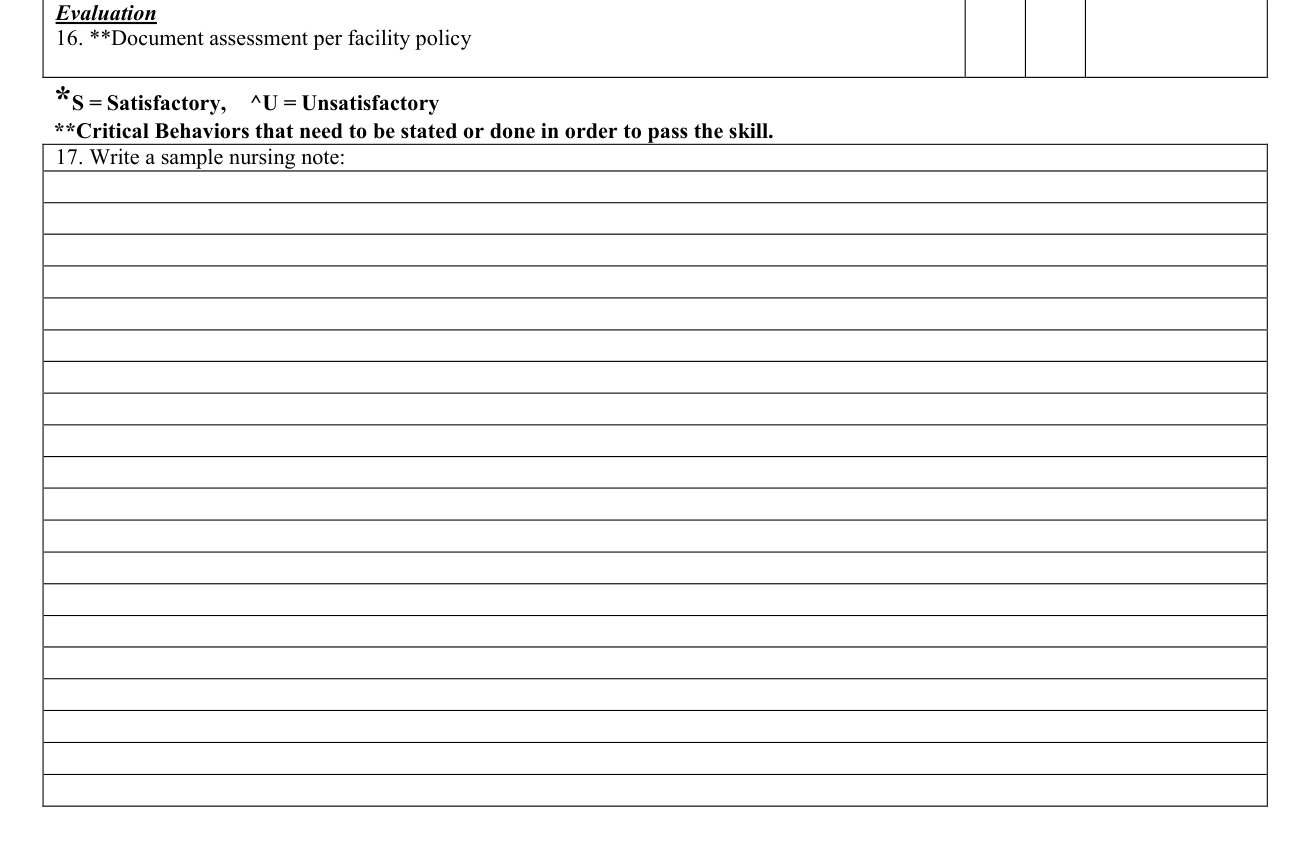
Under Evaluation, 16. **Document assessment per facility policy.
17. Write a sample nursing note.
More rules for Head to Toe Assessment
**Critical Behaviors that need to be stated or done in order to pass the skill.
Sources
[1] Skill Sheet Head to Toe Assessment SP2022 (the Official source link on this page).
