
Legal Blindness Form PDF Details

The Confirmation of Legal Blindness form plays a critical role for individuals seeking to establish their status under the specific criteria set by federal guidelines. Within the framework of the Supplemental Security Income program under Title XVI of the Social Security Act, legal blindness is meticulously defined. This definition is pivotal not only for medical certification but also for various benefits and accommodations. The form requires detailed personal information from the consumer, client, or patient, including their name, date of birth, and address, alongside their visual acuity measurements with and without correction, and the extent of their visual field. It is crucial for accurately documenting an individual's visual condition, including the best corrected vision of each eye independently and both eyes together, as well as the width of the visual field in degrees and specific eye conditions. A certifying authority, typically a qualified healthcare professional, must affirm the individual's legal blindness according to the federal definition, underscoring the form's significance in providing a standardized method for this confirmation. This form not only facilitates access to necessary supports and services but also standardizes the recognition of legal blindness across various systems, safeguarding the rights and benefits of those affected.

QuestionAnswer
Form NameLegal Blindness Form
Form Length1 pages
Fillable?No
Fillable fields0
Avg. time to fill out15 sec
Other namesblind legally forms, legally blind forms, forms blind legally, confirmation of legal blindness form

How to Fill Out Confirmation of Legal Blindness

Confirmation of Legal Blindness at a glance

What it is: Confirmation of Legal Blindness: the federal definition of "blindness" in the Supplemental Security Income program under Title XVI of the Social Security Act.

Who signs: If you wear your glasses or contacts (or both) and then are measured on an eye chart as seeing 20/200 or less, or if the width of vision for both your eyes totals an arc of 20 degrees or less, the Certifying Authority writes the name after I certify that is legally blind in both eyes as specified in the federal definition, and fills in (Signed), (Date) and (Title).

A filled-in Confirmation of Legal Blindness example: an optometrist confirms legal blindness
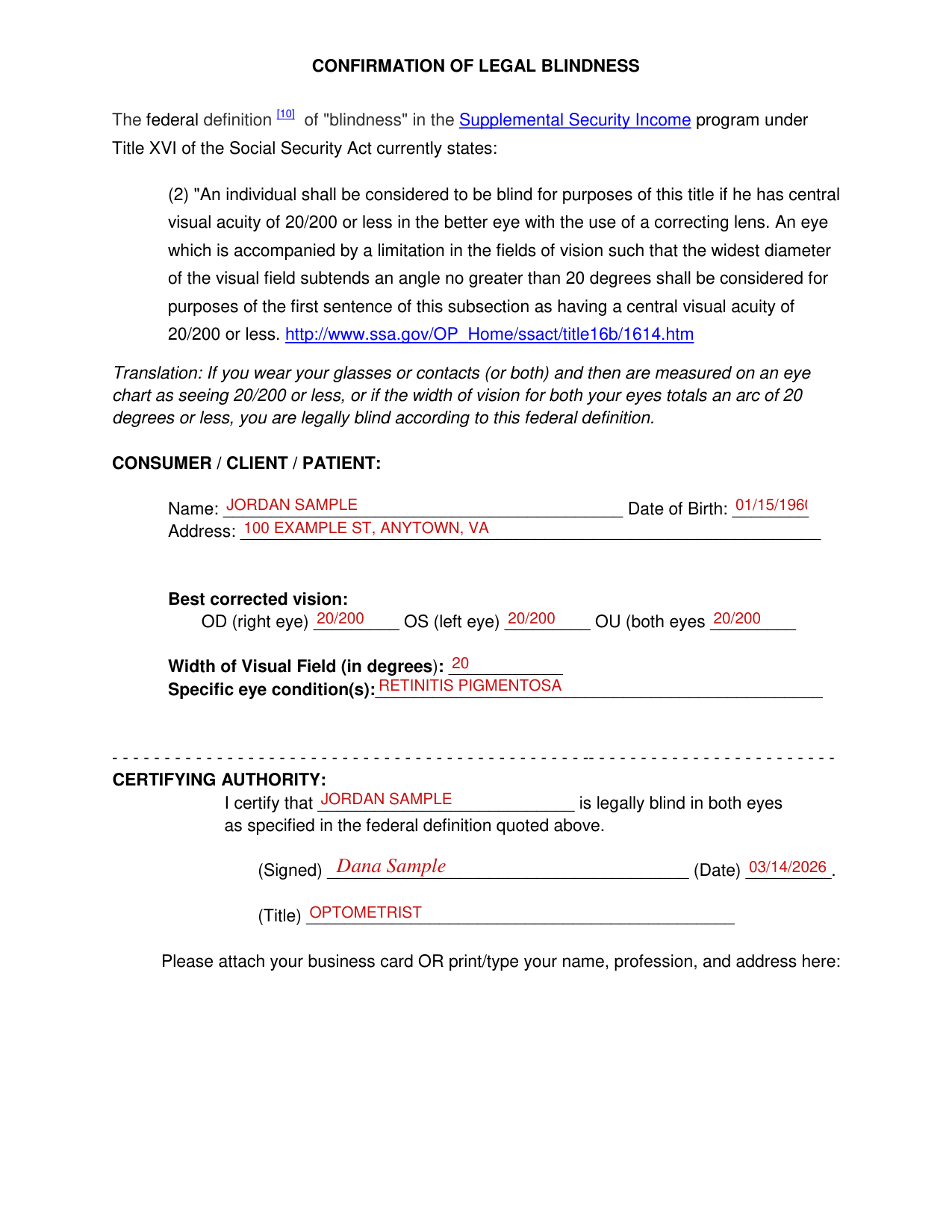
Confirmation of Legal Blindness example filled out, example: an optometrist confirms legal blindness
Dana Sample, an optometrist, confirms legal blindness for a patient. With glasses the patient sees 20/200 in each eye and has a 20 degree visual field. The picture shows page 1, and all its values are invented. The specific eye condition is retinitis pigmentosa, and Dana Sample signs and dates the form as the certifying authority.

How to fill out Confirmation of Legal Blindness, box by box

Consumer / Client / Patient, Best corrected vision and Certifying Authority
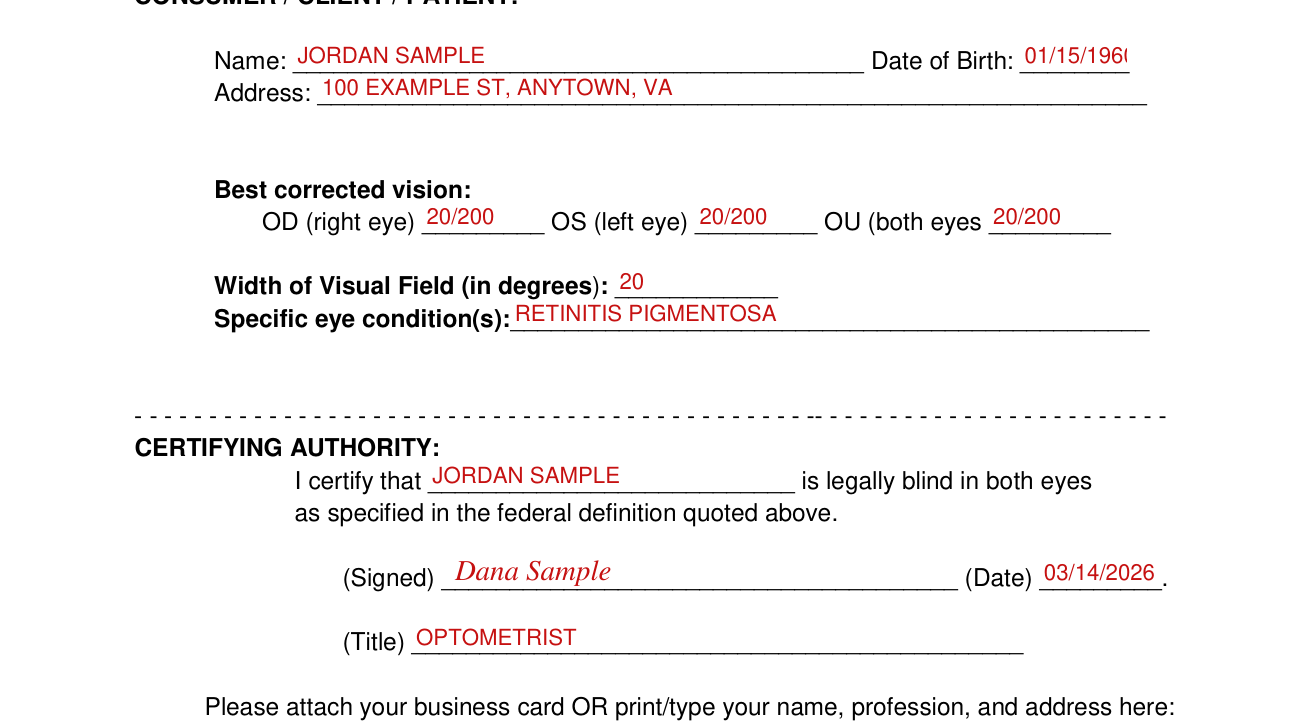
Confirmation of Legal Blindness example filled out, consumer / Client / Patient, Best corrected vision and Certifying Authority

If you wear your glasses or contacts (or both) and then are measured on an eye chart as seeing 20/200 or less, or if the width of vision for both your eyes totals an arc of 20 degrees or less, you are legally blind according to this federal definition. For the Consumer / Client / Patient, fill in the Name, the Date of Birth and the Address, then the Best corrected vision for OD (right eye), OS (left eye) and OU (both eyes), the Width of Visual Field (in degrees) and the Specific eye condition(s). For the Certifying Authority, fill in I certify that, (Signed), (Date) and (Title). The Certifying Authority also attaches a business card OR prints or types the name, profession, and address.

More rules for Confirmation of Legal Blindness

An individual shall be considered to be blind if he has central visual acuity of 20/200 or less in the better eye with the use of a correcting lens. An eye which is accompanied by a limitation in the fields of vision such that the widest diameter of the visual field subtends an angle no greater than 20 degrees shall be considered as having a central visual acuity of 20/200 or less.

Sources

[1] Confirmation of Legal Blindness (the served file; no issuer file found).

Please rate Legal Blindness Form

1 Votes
If you believe this page is infringing on your copyright, please familiarize yourself with and follow our DMCA notice and takedown process - click here to proceed .