
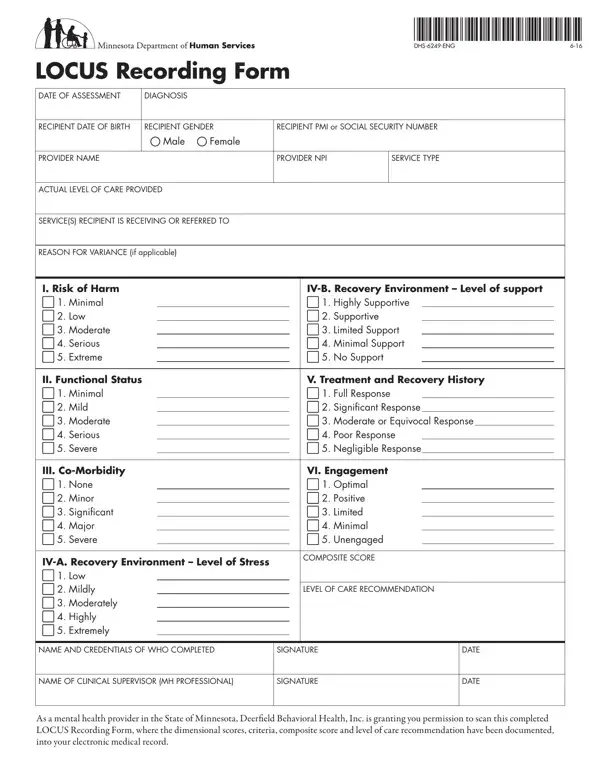

Form DHS-6249-ENG at a glance
What it is: DHS-6249-ENG is the LOCUS Recording Form, where the dimensional scores, criteria, composite score and level of care recommendation have been documented.
Who signs: Signature spaces are located at the bottom of the page on the LOCUS Recording Form. If a Mental Health (Rehab) Professional is completing the LOCUS assessment, there does not need to be a signature by a clinical supervisor.
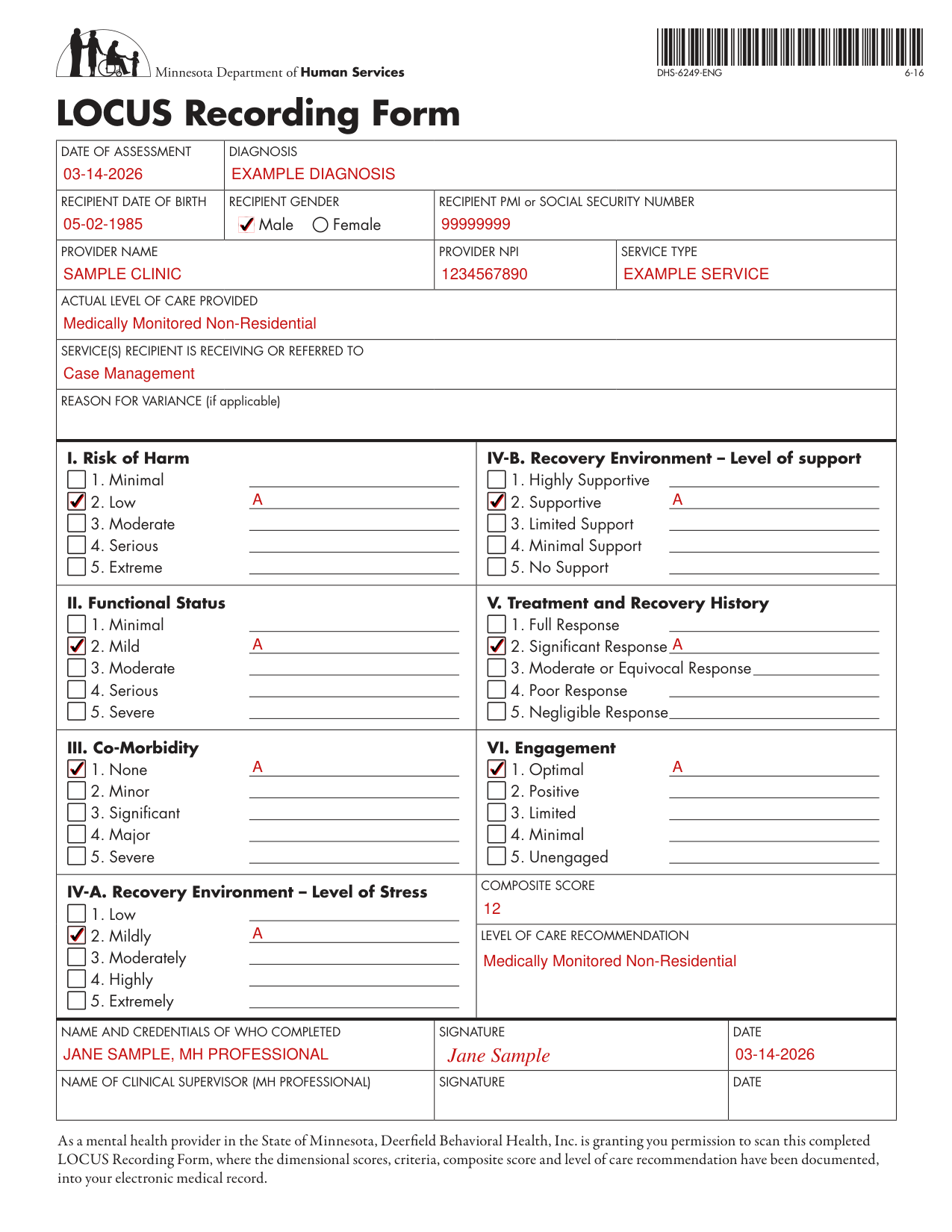
A filled-in Form DHS-6249-ENG example: a clinician records a LOCUS rating
How to fill out Form DHS-6249-ENG, box by box
Recipient, date of assessment and diagnosis

Fill in Date of Assessment, Diagnosis, Recipient Date of Birth, Recipient Gender (Male or Female) and Recipient PMI or Social Security Number.
Date of Assessment is the date the LOCUS assessment was completed.
Write the Date of Birth as Month/Day/Year (MM/DD/YYYY), Gender as Male or Female, and the Recipient PMI or Social Security number. PMI number is preferred over the social security number.
For Diagnosis Primary, write in the full diagnostic name of the primary diagnosis or use the ICD code.
Provider, level of care and variance
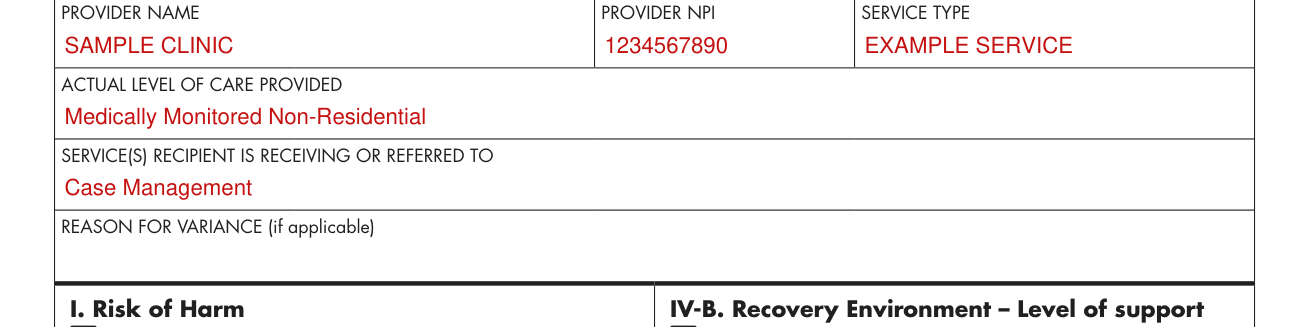
Fill in Provider Name, Provider NPI, Service Type, Actual Level of Care Provided, Service(s) Recipient Is Receiving or Referred To and Reason for Variance (if applicable).
Provider Name, NPI and Service Type are the NPI number and the name of the organization completing the LOCUS and what type of service is being provided by the staf completing the LOCUS assessment.
Actual Level of Care is the actual Level of Care the recipient is receiving. Write the actual name of the level (i.e. Medically Monitored Non-Residential). It may not necessarily be the same as the 'Level of Care Recommendation' if a variance is being made.
For Service/Program Referred to, write the current program(s) recipient is in or what program(s) recipient has been referred to (example: ARMHS, Day Treatment, Case Management, Psychiatry, housing programs, etc.). There may be multiple services used to reach an individual's resource intensity needs.
For Reason for Variance (if applicable), if the service provided is at a diferent level of care from the level of care recommendation, provide the brief clinical justiication as to why the variance was made. Clinical justiication also needs to be documented in more detail as a separate document from the recording form.
Ratings by dimension
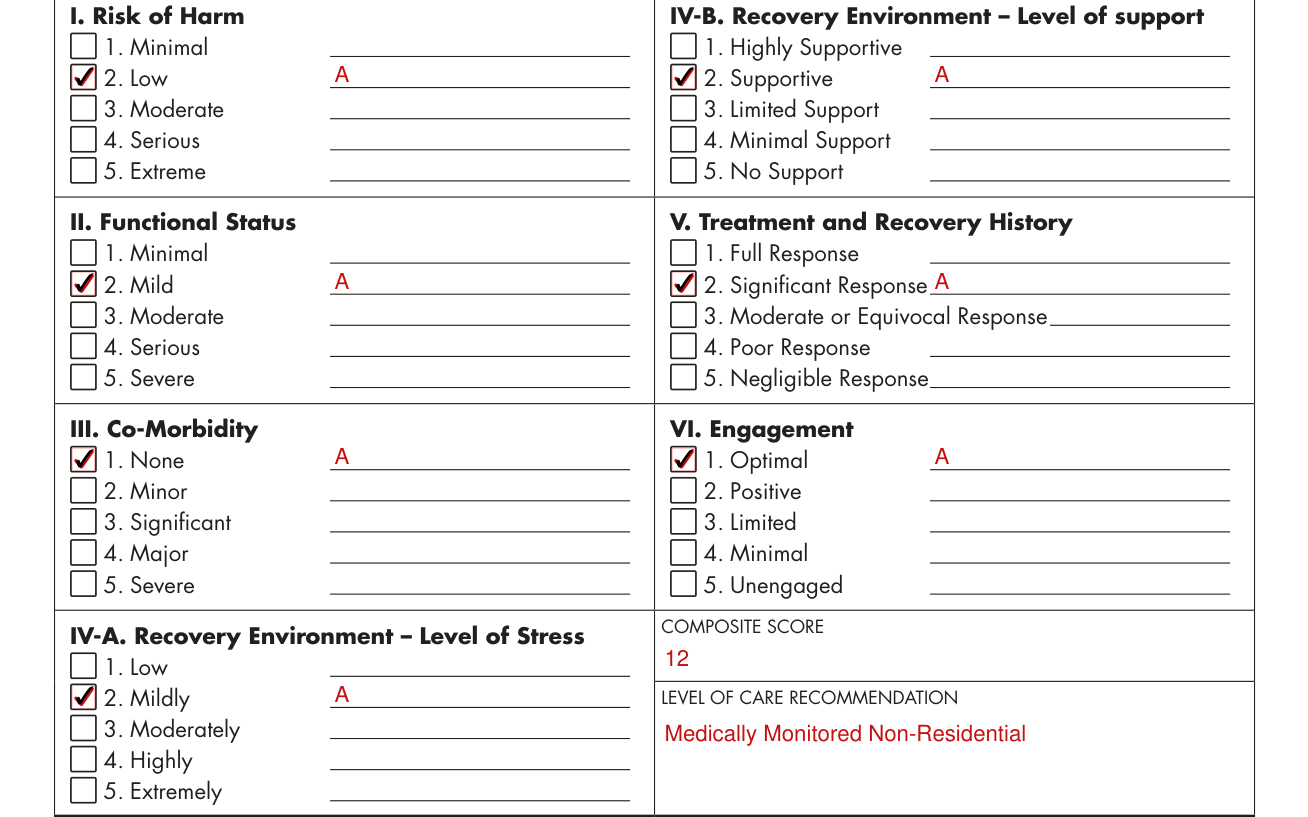
Under I. Risk of Harm, check 1. Minimal, 2. Low, 3. Moderate, 4. Serious or 5. Extreme.
In the dimension being evaluated, check which rating was given. On the line following the rating, indicate the letter(s) of the criteria that was used to determine the score. This information can be located in the AMHD LOCUS Questionnaire Booklet or in the training manual.
Under II. Functional Status, check 1. Minimal, 2. Mild, 3. Moderate, 4. Serious or 5. Severe.
Under III. Co-Morbidity, check 1. None, 2. Minor, 3. Significant, 4. Major or 5. Severe.
Under IV-A. Recovery Environment - Level of Stress, check 1. Low, 2. Mildly, 3. Moderately, 4. Highly or 5. Extremely.
Under IV-B. Recovery Environment - Level of support, check 1. Highly Supportive, 2. Supportive, 3. Limited Support, 4. Minimal Support or 5. No Support.
Under V. Treatment and Recovery History, check 1. Full Response, 2. Significant Response, 3. Moderate or Equivocal Response, 4. Poor Response or 5. Negligible Response.
Under VI. Engagement, check 1. Optimal, 2. Positive, 3. Limited, 4. Minimal or 5. Unengaged.
Composite score and level of care recommendation

Fill in Composite Score and Level of Care Recommendation.
For Composite Score, add up the score from each dimension to determine the composite score.
For Level of Care Recommendation, use the score and the decision tree to find what Level of Care is recommended. NOTE: the Level of Care recommendation may be diferent from the composite score if Independent Criteria is indicated that requires admission to a Level 5 or Level 6 service. It may also be diferent if clinical judgment is used in determining that a diferent level of care is more appropriate than what the completed LOCUS assessment recommends.
Signatures

Write the Name and Credentials of Who Completed, sign on Signature and fill in Date.
Write the Name of Clinical Supervisor (MH Professional), sign on Signature and fill in Date.
Sources
[1] Form DHS-6249-ENG (6-16), LOCUS Recording Form (the Official source link on this page).