

Trustee Certification Form at a glance
What it is: The Trustee Certification Form is for the CMA® Account for Trusts, the Individual Investor Account for Trusts, the Inherited Retirement Account for Trusts and the 529 Account with a Trust as Participant.
Who signs: All trustees must sign the Trustee Certification Form.
The Trustee Certification Form is for use by trustees of any revocable trust or irrevocable trust to maintain one or more cash securities accounts and by trustees of any grantor revocable living trusts to maintain a margin account or engage in other investment activity.
What to bring and attach to Trustee Certification Form
Common mistake: If the trust is NOT governed by U.S. law (50 states/District of Columbia), provide a copy of the following pages from the trust agreement: the first page, the signature page(s), the page(s) listing the trustees and, if originally named trustees are no longer acting, any amendments or other documentation (appointment of trustees, acceptance of appointment of successor trustees, etc.) listing the current trustees. Do not provide the entire trust.
If trustee is an entity, documentation indicating authorized individuals of entity, such as Corporate Resolution or Certificate of Incumbency, will be required.
Supporting documentation will be required to remove the name of any trustee from the account (e.g., letter of resignation, death certificate, letter from medical doctor confirming incapacity).
If the trustees have designated an investment advisor(s) or other agent outside of Merrill Lynch's programs or services with discretionary authority over the trust's funds, securities or other assets, a power(s) of attorney signed by all of the trustees must also be provided (refer to paragraph 11).
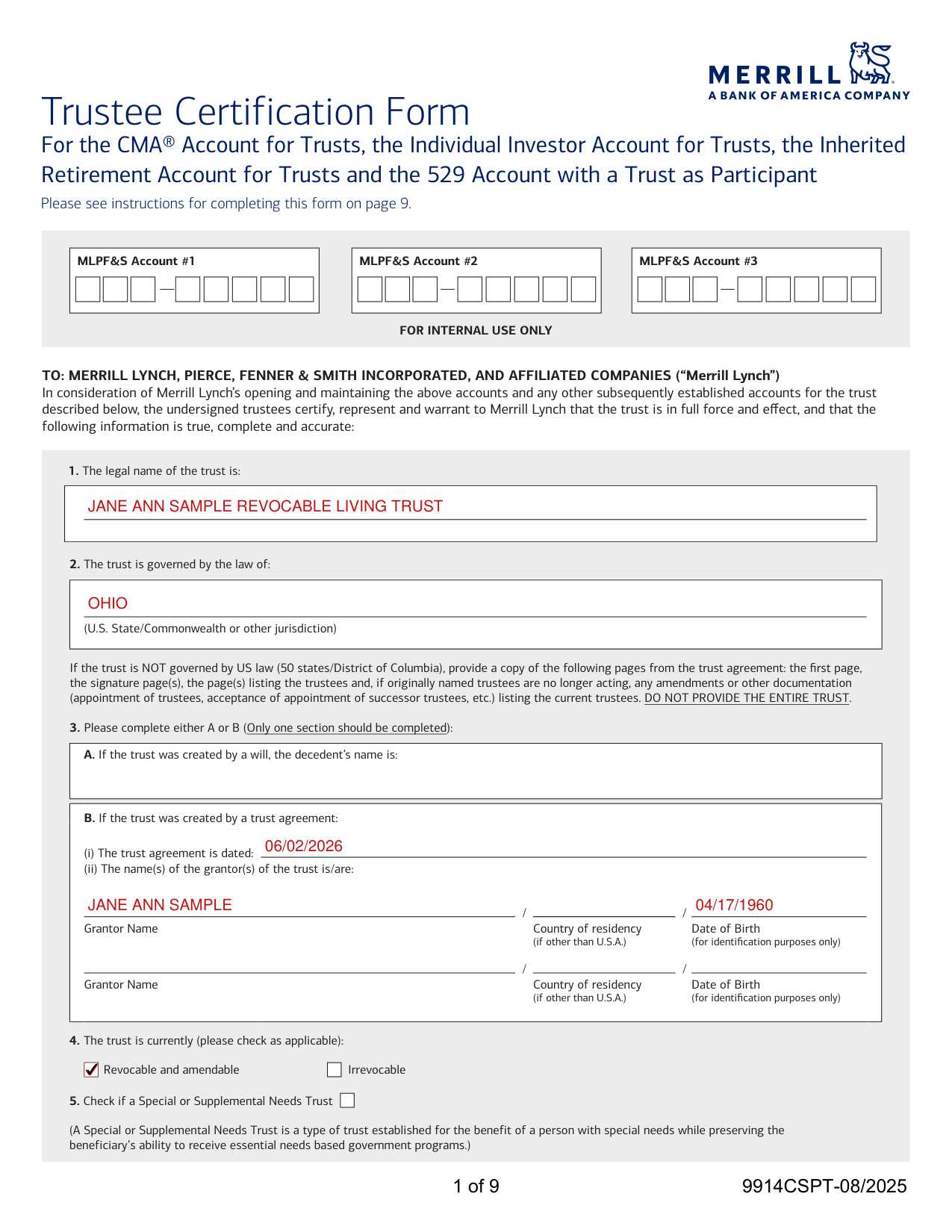
A filled-in Trustee Certification Form example: one grantor certifies a revocable trust
How to fill out Trustee Certification Form, box by box
1. The legal name of the trust

In box 1, enter the legal name of the trust.
2. The trust is governed by the law of

In box 2, enter the law of the U.S. State/Commonwealth or other jurisdiction that governs the trust.
3. Created by a will or a trust agreement
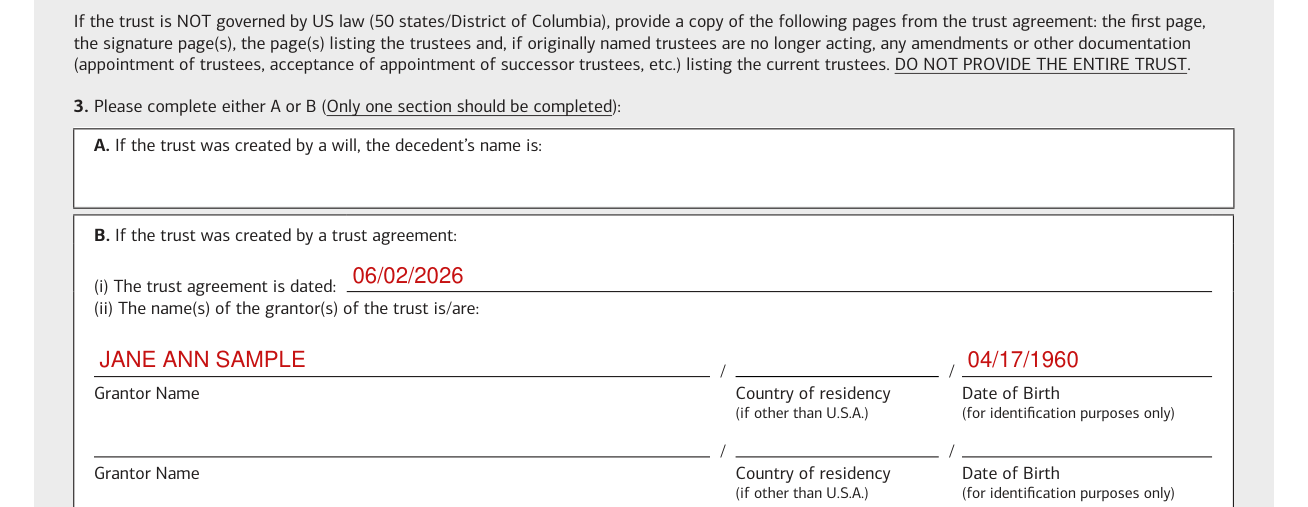
In box 3, complete either A or B (only one section should be completed).
A. If the trust was created by a will, enter the decedent's name.
B. If the trust was created by a trust agreement, enter the date of the trust agreement and the name(s) of the grantor(s) of the trust.
For each grantor, enter the Grantor Name, the Country of residency (if other than U.S.A.) and the Date of Birth (for identification purposes only).
4. The trust is currently

In box 4, check as applicable: the trust is currently Revocable and amendable or Irrevocable.
5. Special or Supplemental Needs Trust

In box 5, check if the trust is a Special or Supplemental Needs Trust.
6. The names of all current trustees
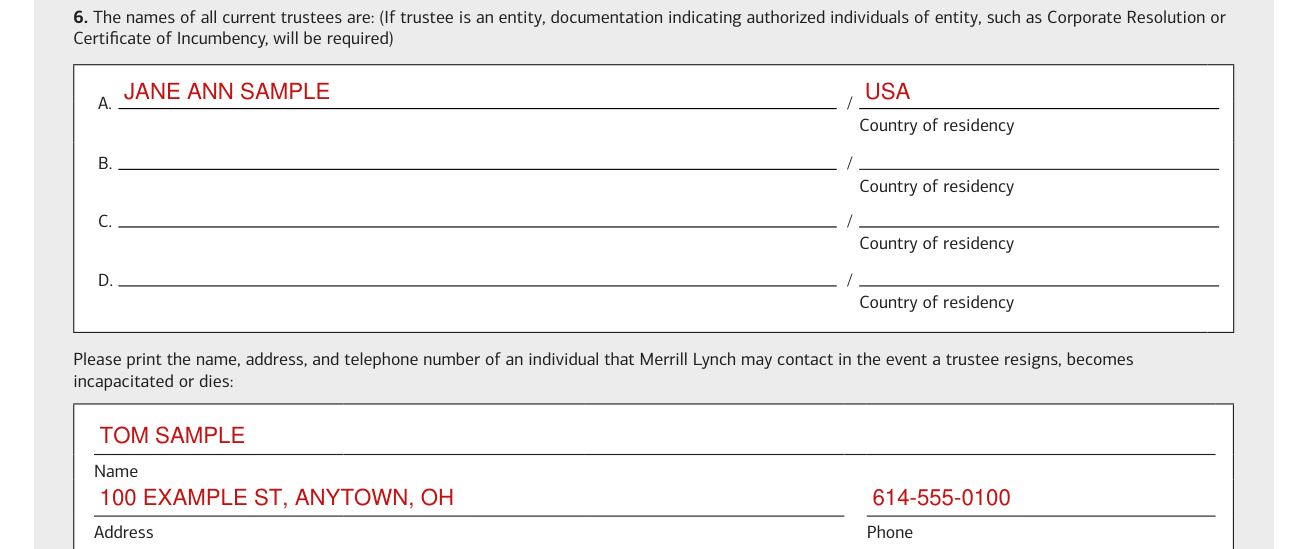
In box 6, enter the names of all current trustees.
Next to each name, enter the Country of residency.
Print the Name, Address and Phone of an individual that Merrill Lynch may contact in the event a trustee resigns, becomes incapacitated or dies.
7. More than one trustee: who continues acting
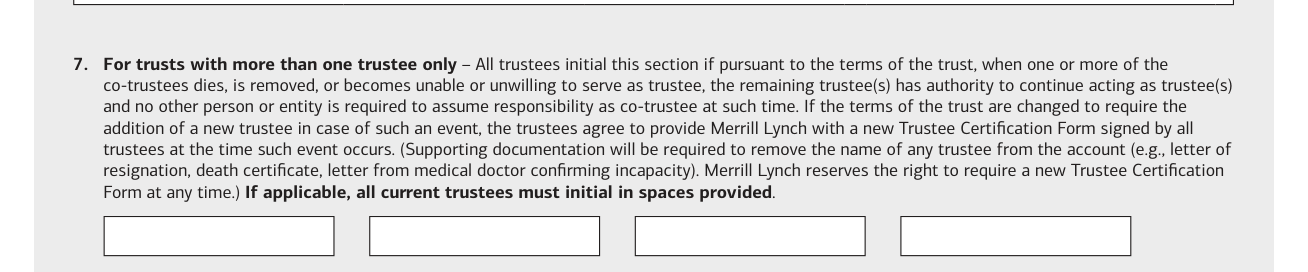
For trusts with more than one trustee only, in box 7 all trustees initial this section if pursuant to the terms of the trust, when one or more of the co-trustees dies, is removed, or becomes unable or unwilling to serve as trustee, the remaining trustee(s) has authority to continue acting as trustee(s) and no other person or entity is required to assume responsibility as co-trustee at such time.
If applicable, all current trustees must initial in spaces provided.
If a change of trustees occurs by death or otherwise, a new Trustee Certification Form must be provided unless section 7 is completed and applicable.
10. Revocable trust whose grantor is a current trustee
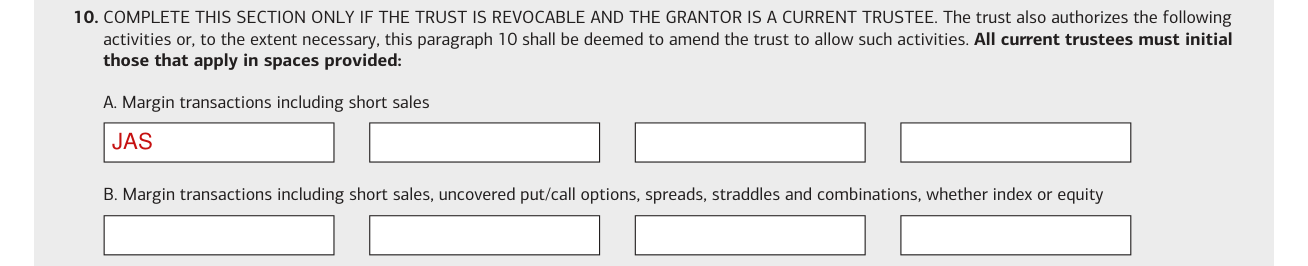
Complete box 10 only if the trust is revocable and the grantor is a current trustee.
All current trustees must initial those that apply in spaces provided: A. Margin transactions including short sales. B. Margin transactions including short sales, uncovered put/call options, spreads, straddles and combinations, whether index or equity.
Signatures of trustees and notarization
Common mistake: For trusts governed by the U.S states of California, Colorado, Delaware, Idaho, Illinois, Iowa, Michigan, Minnesota, Mississippi, Nebraska, Nevada, South Dakota, Tennessee, or Vermont, notarization is required, so do not sign page 4, instead use one of the Signature with Notary Pages that follow.
Use the Signature Page on page 4 for trusts governed by all other jurisdictions.
On page 4, each trustee A to D fills in Agreed and Certified to this day of year of and signs on Signature of Trustee.
Notarization is not required for trusts governed by the law of other jurisdictions.
Use the Signature with Notary page on page 5 when the notary is in any jurisdiction except: if the notary is in CO, ID, IA, MI, MN, MS, NE, NV, SD, TN or VT, use page 6; if the notary is in CA, use page 7; if the notary is in FL, use page 8.
The notary must complete all fields, including the boxes under NOTARY ACKNOWLEDGEMENT, or the document will be rejected.
On page 6, the signature date and notary date must be the same.
California and Florida notaries are to use their state specific acknowledgement pages.
On page 5, all signatures must be acknowledged by a Notary Public. Copy page 5 as needed.
If there are more than two trustees, use an additional signature page.
Common questions about Trustee Certification Form
What is a trustee certification?
By signing, the undersigned trustees certify, represent and warrant to Merrill Lynch that the trust is in full force and effect, and that the following information is true, complete and accurate. The Trustee Certification Form is for the CMA® Account for Trusts, the Individual Investor Account for Trusts, the Inherited Retirement Account for Trusts and the 529 Account with a Trust as Participant. The Trustee Certification Form is also for use by trustees of revocable or irrevocable trusts for which the trustees delegate the performance of their discretionary duties to an investment advisor(s) or other agent(s).
When is this form not the right one?
The Trustee Certification Form is not to be used by employee benefit trusts, nominees or business trusts, nor for any trust for which the beneficiaries are business organizations operating for profit such as corporations, partnerships, limited liability companies, associations or business trusts.
Sources
[1] Trustee Certification Form (9914CSPT-08/2025), Merrill Lynch, Pierce, Fenner & Smith Incorporated (the Official source link on this page).
