
403(b) Hardship Withdrawal Request Form at a glance
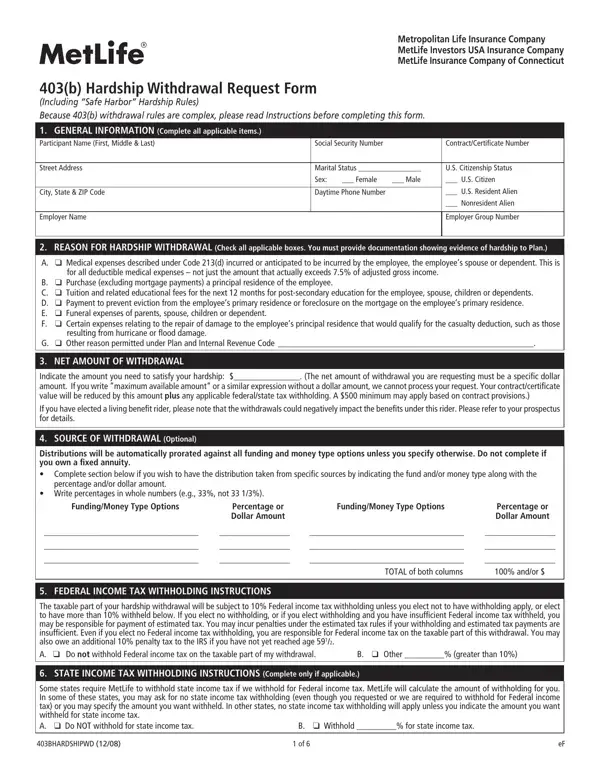
What it is: The 403(b) Hardship Withdrawal Request Form, including "Safe Harbor" hardship rules, is for requesting a hardship withdrawal; because 403(b) withdrawal rules are complex, please read Instructions before completing this form.
Where and when to file: Mail this form to Metlife, P.O. Box 10356, Des Moines, IA 50306-0356. For overnight mail only, use 4700 Westown Parkway, Ste 200, Des Moines, IA 50266. The fax number is 908-552-3403. If you fax the completed form, please do not mail it unless you are requested to do so.
If you are a participant, use this 6-page form (12/08) to request a hardship withdrawal from your 403(b) annuity (also known as a tax-sheltered annuity or "TSA") if you participate in either a voluntary non-ERISA 403(b) program or in an employer-sponsored 403(b) Plan that follows the 401(k) "deemed" or "safe harbor" hardship withdrawal rules.
The blank 403(b) Hardship Withdrawal Request Form: print it and complete it by hand
How to fill out 403(b) Hardship Withdrawal Request Form, box by box
General information
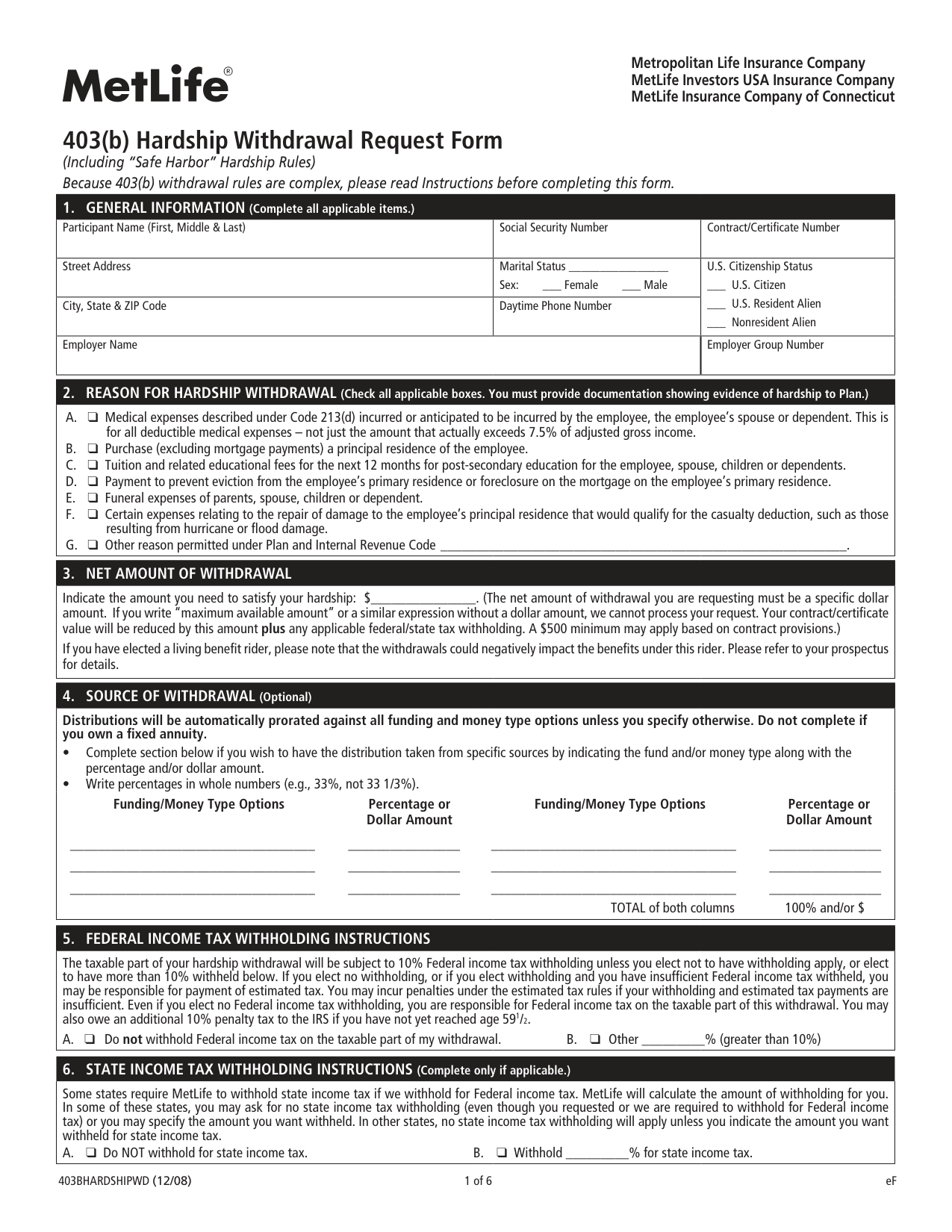
Complete all applicable items of Section 1, General Information; you must complete this section of the form to ensure accurate processing.
Reason for hardship withdrawal
In Section 2, check all applicable boxes. You must provide documentation showing evidence of hardship to Plan.
Box A: medical expenses described under Code 213(d) incurred or anticipated to be incurred by the employee, the employee's spouse or dependent, for all deductible medical expenses and not just the amount that actually exceeds 7.5% of adjusted gross income. Box B: purchase (excluding mortgage payments) a principal residence of the employee. Box C: tuition and related educational fees for the next 12 months for post-secondary education for the employee, spouse, children or dependents. Box D: payment to prevent eviction from the employee's primary residence or foreclosure on the mortgage on the employee's primary residence. Box E: funeral expenses of parents, spouse, children or dependent. Box F: certain expenses relating to the repair of damage to the employee's principal residence that would qualify for the casualty deduction, such as those resulting from hurricane damage. Box G: other reason permitted under Plan and Internal Revenue Code.
Net amount of withdrawal
In Section 3, write in the dollar amount you need to receive to satisfy your hardship and that you cannot obtain from other resources.
If the amount you request is unavailable because of the application of IRS or Plan withdrawal restrictions, surrender charges, or income tax withholding, we will send you the maximum amount available from your account.
The minimum hardship withdrawal amount is $500, except for VestMet contracts ($250 minimum for withdrawals from Separate Account divisions or $1,000 minimum for withdrawals from the Fixed Interest Account) and AAA contracts ($1,000 minimum). (checked November 12, 2026)
Source of withdrawal
Section 4, Source of Withdrawal, is optional.
If you are making a hardship withdrawal from a variable annuity, you may name the funding options for the withdrawal and the percentage applicable to each. The percentages must be whole numbers that total 100%.
The distribution will be automatically prorated against all funding options if the percentages are not completed or funds are not available in the funding options you choose.
Federal income tax withholding
Your hardship withdrawal will be subject to 10% Federal income tax withholding unless you elect no withholding.
If you are a U.S. citizen or resident alien and you provide a delivery address outside the U.S. or its possessions, you may not waive the 10% federal income tax withholding.
If you are a nonresident alien, you must provide a completed IRS Form W-8BEN to certify your foreign status.
State income tax withholding instructions
Complete Section 6, State Income Tax Withholding Instructions, only if applicable.
In Section 6, state income tax must be withheld when Federal income tax is withheld in the following states: Delaware, Iowa, Kansas, Massachusetts, Maine, North Carolina, Oklahoma, Virginia, and Vermont. In California and Oregon, Metlife will withhold for state income tax unless you tell Metlife not to. Metlife will calculate the amount of withholding for you if you live in one of these states. In the following states, Metlife will withhold the amount you tell Metlife to withhold: Alabama, Arkansas, Colorado, Connecticut, District of Columbia, Georgia, Idaho, Indiana, Kentucky, Louisiana, Maryland, Michigan, Minnesota, Missouri, Montana, North Dakota, Nebraska, New Jersey, New Mexico, New York, Ohio, Pennsylvania, Rhode Island, South Carolina, Utah, Wisconsin, and West Virginia.
Some states require Metlife to withhold state income tax if Metlife withholds for Federal income tax. In some of these states, you may ask for no state income tax withholding (even though you requested or Metlife is required to withhold for Federal income tax) or you may specify the amount you want withheld. In other states, no state income tax withholding will apply unless you indicate the amount you want withheld for state income tax. Box A: Do NOT withhold for state income tax. Box B: withhold the % you write for state income tax.
Payment instructions
In Section 7, send the check to the address listed in Section 1 above, or to the address you write in. Sign in Section 8.
If you have selected overnight mail delivery, the address you have chosen for check delivery purposes must be a street address.
Participant statement and signature
You certify the amount of withdrawal requested is not more than the amount you need to relieve your hardship and, if applicable, to cover the resulting taxes.
Read Section 8, Participant Statement and Signature, carefully before you sign.
Plan Administrator or Employer statement and signature
In Section 9, the Plan Administrator/Authorized Representative must indicate the vesting percentage applicable to employer matching and nonelective (basic) contributions, which contribution types are available and the order in which you must use them for hardship withdrawals, and the length of time (6 or 12 months) your contributions to the plan will be suspended after you take a hardship withdrawal.
The Plan Administrator (or an authorized representative of your employer if there is no Plan Administrator) must sign this request.
Annuity information, QJSA and spousal consent
This section applies ONLY if your Employer's plan includes a qualified joint and survivor annuity ("QJSA") provision.
You may waive your right to have your vested Plan Account Balance paid in the form of a QJSA. If you are married and the distribution exceeds $5,000, your spouse must consent to this waiver in order for it to be valid. (checked November 12, 2026)
A notary public must notarize your spouse's signature. (Some plans allow an authorized representative of the plan to witness the spouse's signature as an alternative to notarization.)
If spousal consent is required but cannot be obtained, this form must be accompanied by an affidavit completed by the participant and approved by the Plan Administrator. The affidavit must state that spousal consent is not needed or cannot be obtained because: (1) the participant's spouse cannot be found; or (2) the participant is legally separated from or has been abandoned by the spouse (within the meaning of local law) and has a court order to such effect and no qualified domestic relations order exists that requires spousal consent to this withdrawal.
More rules for 403(b) Hardship Withdrawal Request Form
The amount you request must not exceed the amount you need to relieve the need (plus reasonably anticipated income taxes or penalties). You must also have exhausted all other resources reasonably available to you. This includes withdrawing from your TSA or 403(b)(7) custodial account IRS unrestricted amounts or requesting a loan.
You may not roll over a hardship withdrawal from a TSA or a 403(b)(7) custodial account to any other type of plan or IRA.
Common questions about 403(b) Hardship Withdrawal Request Form
When is this form not the right one?
If you are 59 1/2 or older or have separated from service, you may not be eligible for a hardship withdrawal under the Plan's rules and may instead need to use the 403(b) Withdrawal Request Form. Do not use this form if you are an alternate payee or beneiciary.
Sources
[1] 403(b) Hardship Withdrawal Request Form (12/08), Metlife.