
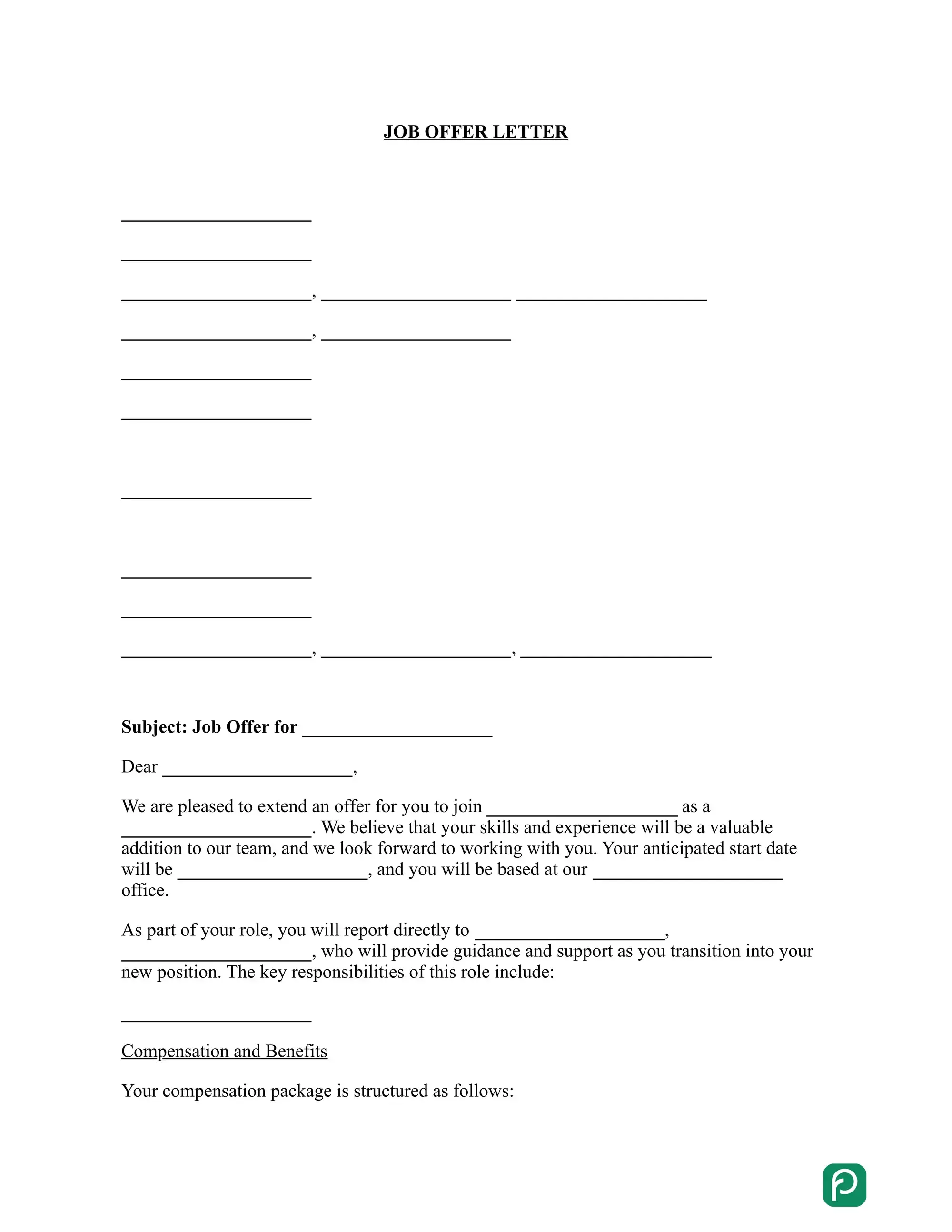
A job offer letter, also called an employment offer letter, is a document in which a company offers a job to the applicant it has chosen. It lists the job title, start date, pay, work hours and other key details of the position. Use the free job offer letter template on this page to build your own letter online in a few minutes. Then read on to see what to include and which format to use.
Last Updated: October 2026. This guide is reviewed and updated regularly to reflect current law. If you notice an error or outdated information, please contact us.
Build Your Document
Answer a few simple questions to make your document in minutes
Save and Print
Save progress and finish on any device, download and print anytime
Sign and Use
Your valid, lawyer-approved document is ready
A job offer letter tells the chosen applicant that the company wants them on the team. The letter typically covers the company name, start date, specifics of the job, salary, how often pay arrives, weekly work hours and other noteworthy details about the position.
The purposes of a job offer letter are to:
A standard procedure for accepting a job offer letter is signing and returning the document to the sender.
A good job offer letter answers the questions a candidate will have before they say yes. Most letters cover the parts in the table below. Add or drop rows to match the role and your company.
| Part of the letter | What to write | Example |
|---|---|---|
| Company name and logo | Your official company name at the top, with the logo if you have one | Northwind Coffee Co. |
| Candidate | The full name of the person you are offering the job to | Anna Baker |
| Job title | The position you are offering | Store Manager |
| Employment type and schedule | Full-time or part-time, hours per day and per week | Full-time, 40 hours a week |
| Start date and workplace | The first day of work and where the job is based | Monday, March 3, at 123 Main Street |
| Supervisor | The name and title of the person the new hire reports to | Jordan Lee, Regional Manager |
| Pay | The salary or hourly rate and how often it is paid | $48,000 a year, paid twice a month |
| Benefits and bonuses | Health insurance, bonuses, paid time off and other perks | Health insurance and a yearly bonus |
| Offer expiration | The last day the candidate can accept the offer | Please reply by Friday, February 14 |
| Signatures | A line for the candidate's signature and date, plus your own name and title | Signed: ______ Date: ______ |
Keep each part short and clear. Candidates read the letter closely, so plain wording helps them see what they are agreeing to.
When it comes to the tone of the letter, there are no specific rules on how to write a job offer email template. Some companies prefer a drier style that starts with the words:
“We are pleased to offer you a position of [Job Title] at our company. Please take time to carefully read this letter containing the essential details of your employment at our company…”
Others add some personality to the letter, for example:
“You turned out to be our best candidate out of [Number of applicants]. We were sold on your skills, work experience, and outstanding personality…”
Regardless of the tone, a standard job offer letter usually includes the following information.
The short sample below shows how the steps fit together. Replace the example details with your own.
Dear Anna Baker,
We are pleased to offer you the position of Store Manager at Northwind Coffee Co. This is a full-time role of 40 hours a week at our 123 Main Street location. Your supervisor will be Jordan Lee, Regional Manager, and your first day will be Monday, March 3.
Your pay will be $48,000 a year, paid twice a month. The position also includes health insurance and a yearly bonus.
Please sign and return this letter by Friday, February 14 to accept the offer. We look forward to working with you.
Sincerely,
Jordan Lee, Regional Manager, Northwind Coffee Co.
Sometimes a company is nearly ready to make an offer but wants to talk through the package first. In that case it may send a warm-up job offer email instead of a formal job offer letter.
A warm-up email is usually shorter than a formal letter. It tells the candidate they are the best fit for the position and invites them to meet the hiring manager at a set time to review the details of the job. Such letters are usually sent by email.
Writing a job offer letter takes care, since the wording and the details of the position all count. To save time and effort, use the template on this page. It is free and easy to use.
A job offer letter template comes in a few formats, and the best one depends on your company and the role. Pick the format that matches how you usually talk to new hires, then use the same layout for every offer so each letter looks consistent.
A formal letter suits larger companies and senior roles. Print it on letterhead or export it as a PDF, address it to the applicant by name and have the hiring manager sign it. The tone is polite and the layout is simple, with one idea per paragraph.
An email offer is shorter and friendlier. Put the key details in the message itself, such as the role, the start date and the pay, and attach the full letter for the applicant to sign. Small teams and startups often prefer this style because it feels personal and moves fast.
For an hourly role, name the hourly rate, the expected hours each week and how schedules are shared. For a salaried role, name the yearly salary, the pay frequency and any bonus plan. In both cases, say who the new hire reports to and where the work takes place.
The heart of any job offer letter is the package: what the role involves, what it pays and what comes with it. Describe each part in plain words, and give enough information that the applicant can compare the offer with their expectations.
If the role has a long job description, attach it to the letter instead of copying it in. The letter then stays on one page, and the applicant still sees every duty of the position.
Some applicants reply with questions or ask for a higher salary or a different start date. Listen to the request and decide what you can change. If you agree on new terms, send an updated letter so both sides have a clear record of the final offer.
A few extra details can make a job offer letter clearer and more professional. Check the points below before you send the letter to a prospective employee, and read the whole letter once more for typos.
It may sound minor, but adding your company's official logo and name makes the letter look authentic. It also helps the applicant take the offer seriously.
Along with overall details about the workplace, an employment offer letter might specify conditions that the prospective employee is expected to meet after they are hired. For instance, such conditions might include drug screening, background checks, signing non-compete agreements, NDA, etc.
An employer should state in the offer letter that the candidate is about to be hired on an at-will basis, and the employment relationship can be terminated at any time for any reason by either of the parties. It applies to all states except for Montana.
A letter with a job offer should also specify whether the candidate will be an exempt or non-exempt worker. In the first case, a worker is not eligible for overtime which most often applies to employees getting a salary; in the second case, it is the opposite.
Before you send the letter, run through this quick check:
Once the letter is written, a little preparation helps it reach the candidate in good shape and gets you a quick answer. These habits work well for most employers who send offers by email:
A signed job offer letter is the start of onboarding, not the end of the hiring process. A warm welcome in the first days helps the new hire feel confident about the choice they made. Here is a simple order to follow:
A typical job offer template includes everything a candidate needs to weigh the offer, from the job title to the date the offer expires. The usual parts are listed below, and the table earlier on this page gives an example of each one.
It might be, depending on the employer’s wish. If they decide to make it legally binding, a job offer letter gets the legal force at the moment when a prospective worker signs the document. It means that the parties who have signed it have reached the agreement and are expected to fulfill their obligations under the document.
Some employees would not want to make the letter legally binding which is why they might include at the end of it a brief disclaimer explaining that the letter is for informational purposes only and is not a legally binding contract.
In any case, it is wise to use legal advice before crafting and sending a job offer letter to a prospective employee in order to avoid accidental use of language with contractual implications if they don’t want to make the letter binding.
Yes, it is possible. A hiring company can take back the job offer even after an employee’s acceptance of it. Moreover, an employer does not have to tell why they decided to do so.
These two documents are not the same. A job offer letter makes a formal offer to an applicant. It tells them they are chosen for the job and describes the position, such as part-time or full-time employment, start date, salary and working hours.
A work contract has a different purpose, which is describing all the responsibilities of a prospective worker and the duration of the employment. The other distinguishing thing is that an official employment contract is usually signed after the applicant signs the employment letter.
You can find many job offer templates online. The sample letter on this page shows how a finished letter looks. To get a customized letter that looks professional and has all the details in place, use our online document builder.
Most job offer letters fit on one page. Keep the key terms short and clear, and share longer details, such as the full benefits plan, in a separate document.
Yes. Many employers attach the letter as a PDF to a short email. Ask the candidate to sign it and send it back the same way, then keep both copies.
Read the letter from start to finish and compare it with what you discussed in the interviews. Ask about anything that is unclear, such as pay, start date or benefits. When you are happy with the terms, sign the letter and return it by the reply date.
General information, not legal or tax advice.
