
OGE Form 450 at a glance
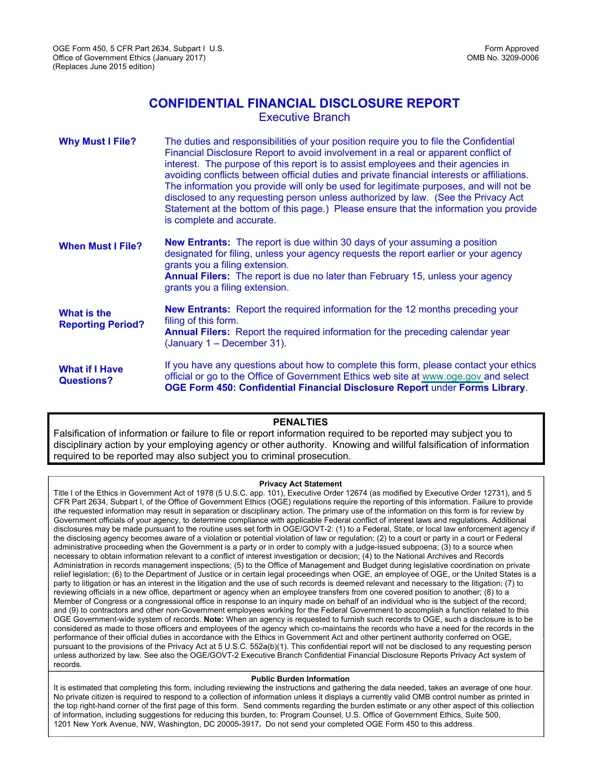
What it is: OGE Form 450 is the Confidential Financial Disclosure Report, whose purpose is to assist employees and their agencies in avoiding conflicts between official duties and private financial interests or affiliations.
Who signs: Step 4: Sign and date the form. Signature of Employee. Date (mm/dd/yy)
The duties and responsibilities of your position require you to file the Confidential Financial Disclosure Report to avoid involvement in a real or apparent conflict of interest.
A filled-in OGE Form 450 example: a new entrant fills out the cover page
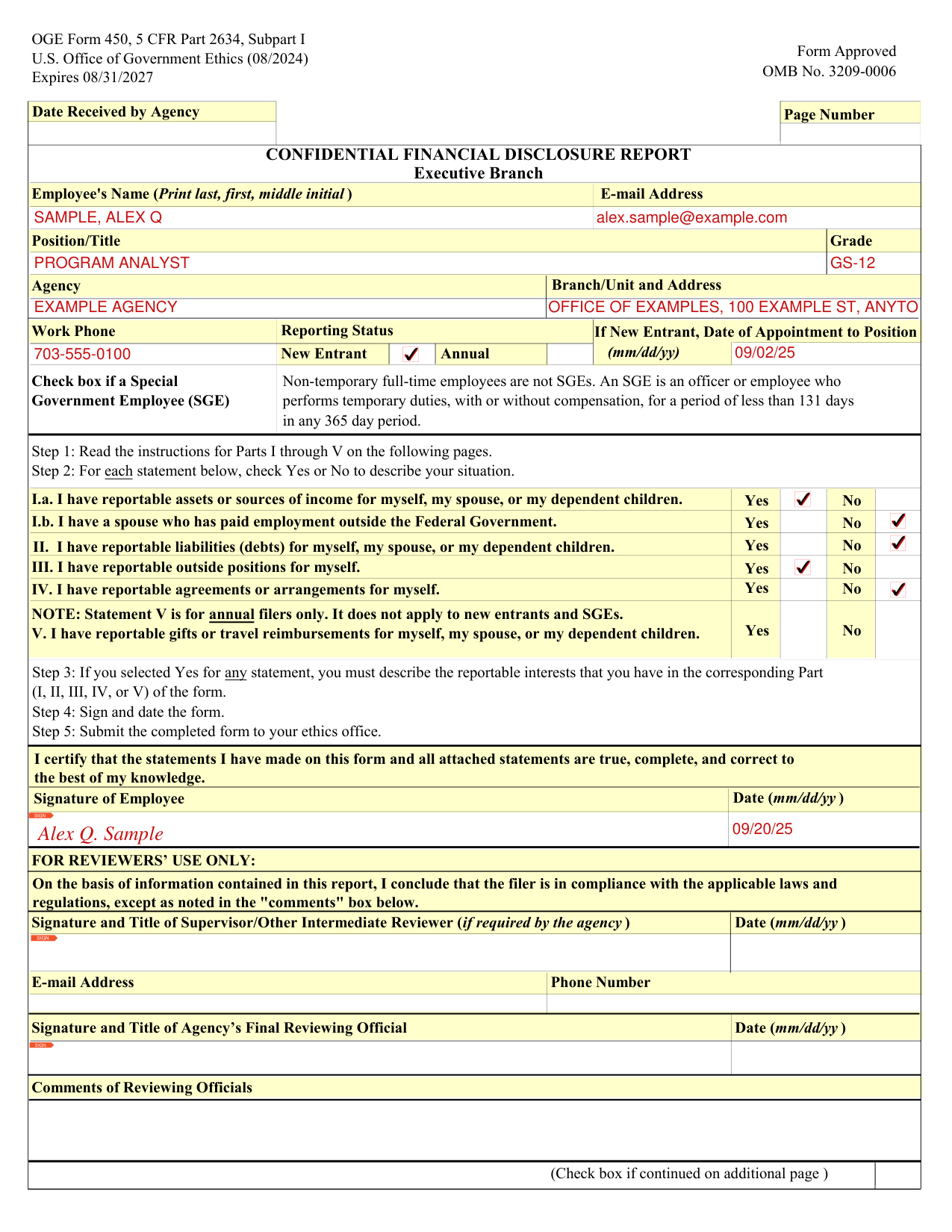
How to fill out OGE Form 450, box by box
Executive Branch Employee's Name, E-mail Address, Position/Title, Grade, Agency
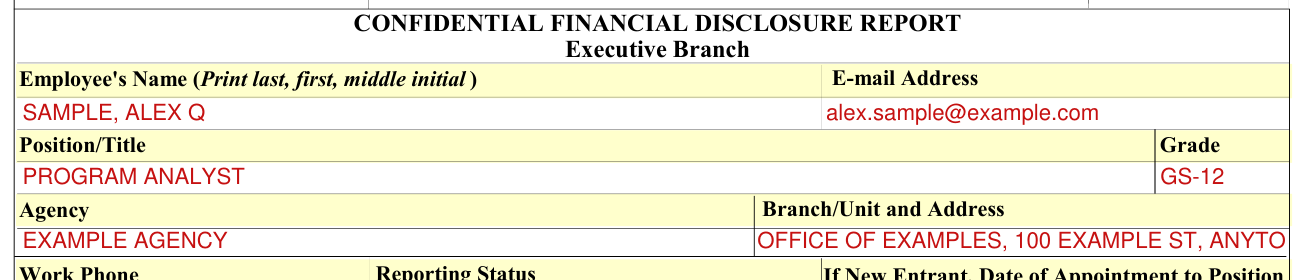
Executive Branch Employee's Name (Print last, first, middle initial). E-mail Address.
Position/Title. Grade. Agency. Branch/Unit and Address.
Work Phone, Reporting Status and Date of Appointment to Position

Work Phone. Reporting Status. If New Entrant, Date of Appointment to Position. New Entrant. Annual. (mm/dd/yy)
Check box if a Special Government Employee (SGE)

Check box if a Special Government Employee (SGE). Non-temporary full-time employees are not SGEs. An SGE is an officer or employee who performs temporary duties, with or without compensation, for a period of less than 131 days in any 365 day period.
Step 2: Yes or No for Statements I.a to IV
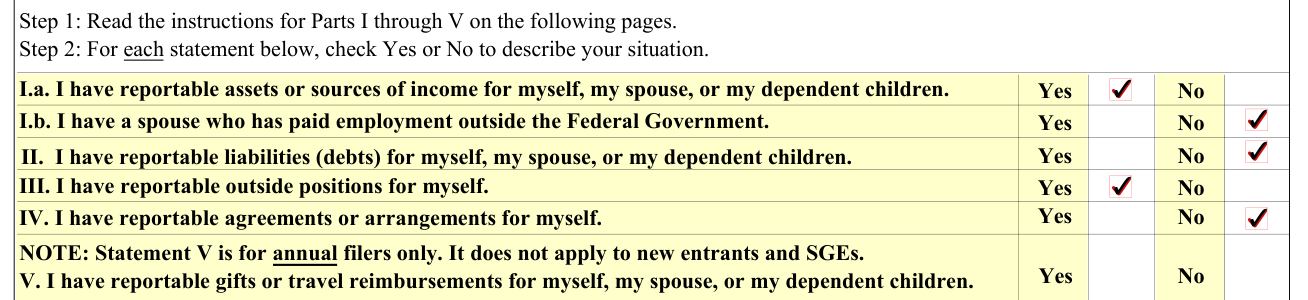
Step 2: For each statement, check Yes or No to describe your situation.
I.a. I have reportable assets or sources of income for myself, my spouse, or my dependent children.
Yes No I.b. I have a spouse who has paid employment outside the Federal Government.
II. I have reportable liabilities (debts) for myself, my spouse, or my dependent children.
Yes No III. I have reportable outside positions for myself.
Yes No IV. I have reportable agreements or arrangements for myself.
Step 3: If you selected Yes for any statement, you must describe the reportable interests that you have in the corresponding Part (I, II, III, IV, or V) of the form.
Statement V

Statement V is for annual filers only. It does not apply to new entrants and SGEs.
V. I have reportable gifts or travel reimbursements for myself, my spouse, or my dependent children.
Signature of Employee Date

Step 4: Sign and date the form. Signature of Employee. Date (mm/dd/yy)
"I certify that the statements I have made on this form and all attached statements are true, complete, and correct to the best of my knowledge."
FOR REVIEWERS' USE ONLY
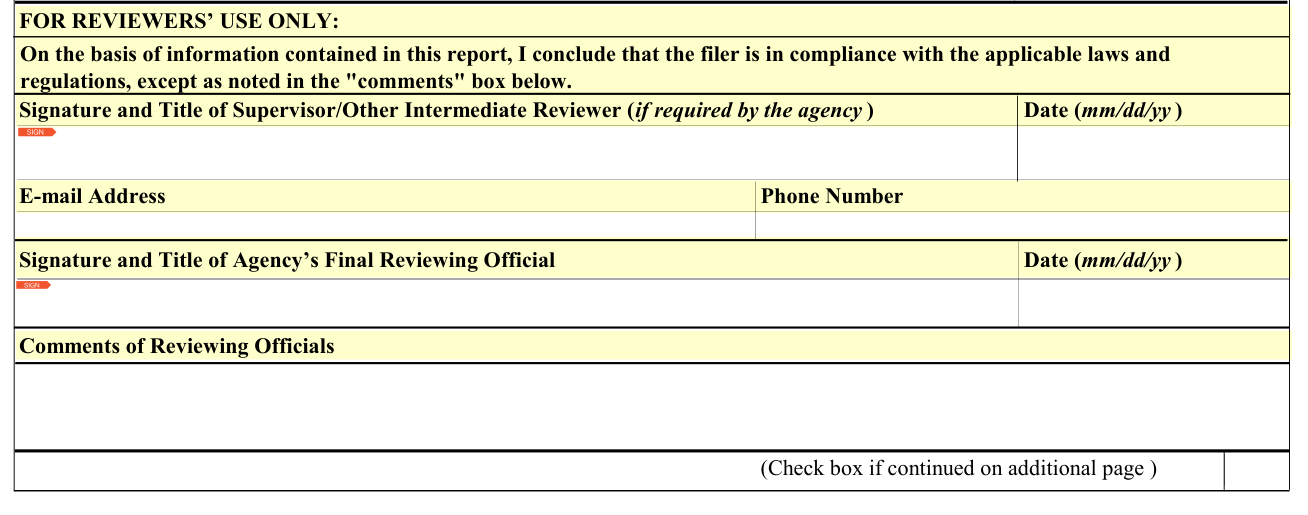
FOR REVIEWERS' USE ONLY: On the basis of information contained in this report, I conclude that the filer is in compliance with the applicable laws and regulations, except as noted in the "comments" box.
Part I: Assets and Income
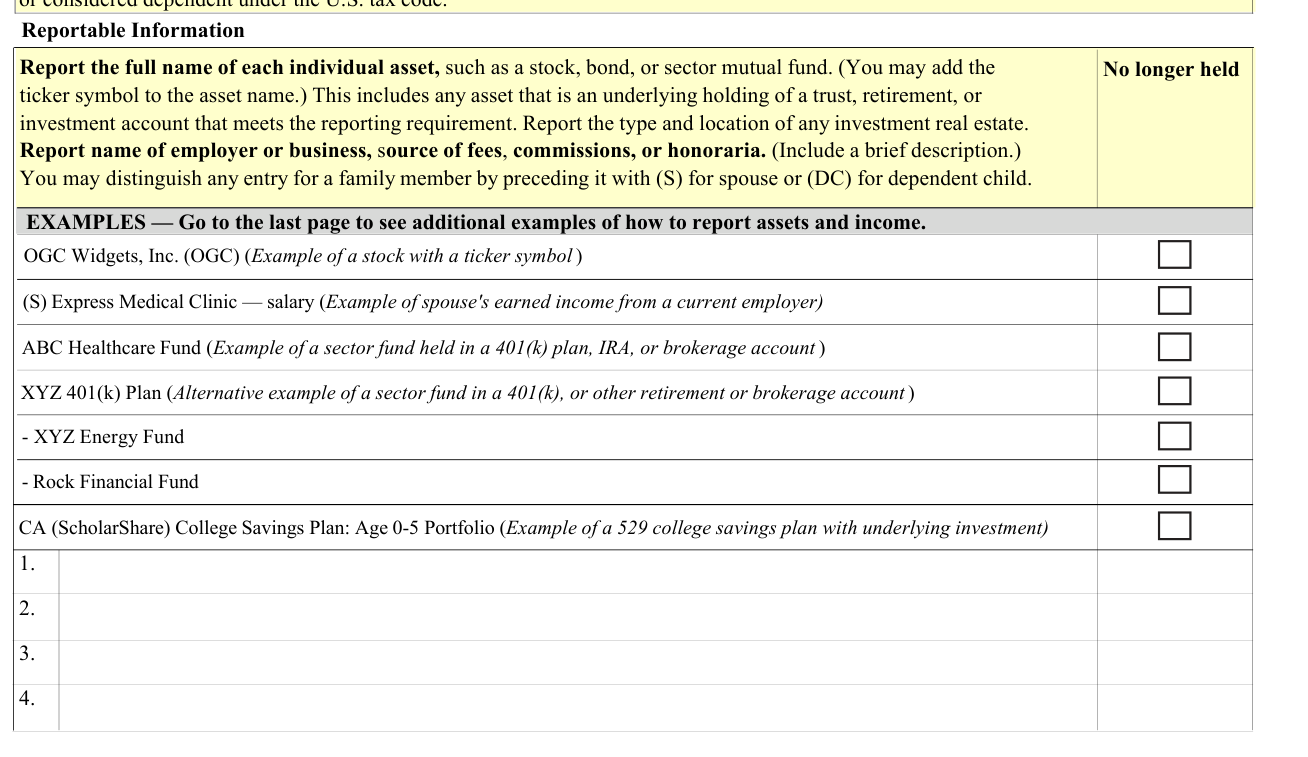
Report assets held for investment or the production of income that ended the reporting period with a value greater than $1,000 (checked November 1, 2026).
In addition, annual filers must report assets from which more than $1,000 in income was received during the reporting period (checked November 1, 2026).
Reportable assets include, but are not limited to: stocks, bonds, annuities, trust holdings, partnership interests, life insurance, investment real estate, and privately held trades or businesses. Holdings of retirement plans, such as 401(k)s, IRAs, and variable annuities (report each holding unless listed in the Do Not Report section).
Do not report: diversified mutual funds, such as ABC Equity Value Fund or XYZ Large Capital Fund; Federal Government retirement benefits; Thrift Savings Plan; certificates of deposit, savings or checking accounts; money market mutual funds and money market accounts; your personal residence, unless you rent it out; U.S. Treasury bonds, bills, notes, and savings bonds.
Do not report money owed to you, your spouse, or dependent child by a spouse, parent, sibling, or child.
Report, for yourself: (1) all sources of salary, fees, commissions, and other earned income greater than $1,000, (2) honoraria greater than $1,000, and (3) other non-investment income, such as scholarships, prizes, and gambling income greater than $1,000 (checked November 1, 2026).
Report, for your spouse: (1) all sources of salary, fees, commissions, and other earned income greater than $1,000, and (2) honoraria greater than $1,000 (checked November 1, 2026).
Dependent Child - A son, daughter, stepson, or stepdaughter who is either unmarried, under age 21, and living in the filer's house, or considered dependent under the U.S. tax code.
Report the full name of each individual asset, such as a stock, bond, or sector mutual fund. (You may add the ticker symbol to the asset name.)
Report the type and location of any investment real estate.
Report name of employer or business, source of fees, commissions, or honoraria. (Include a brief description.)
Part II: Liabilities
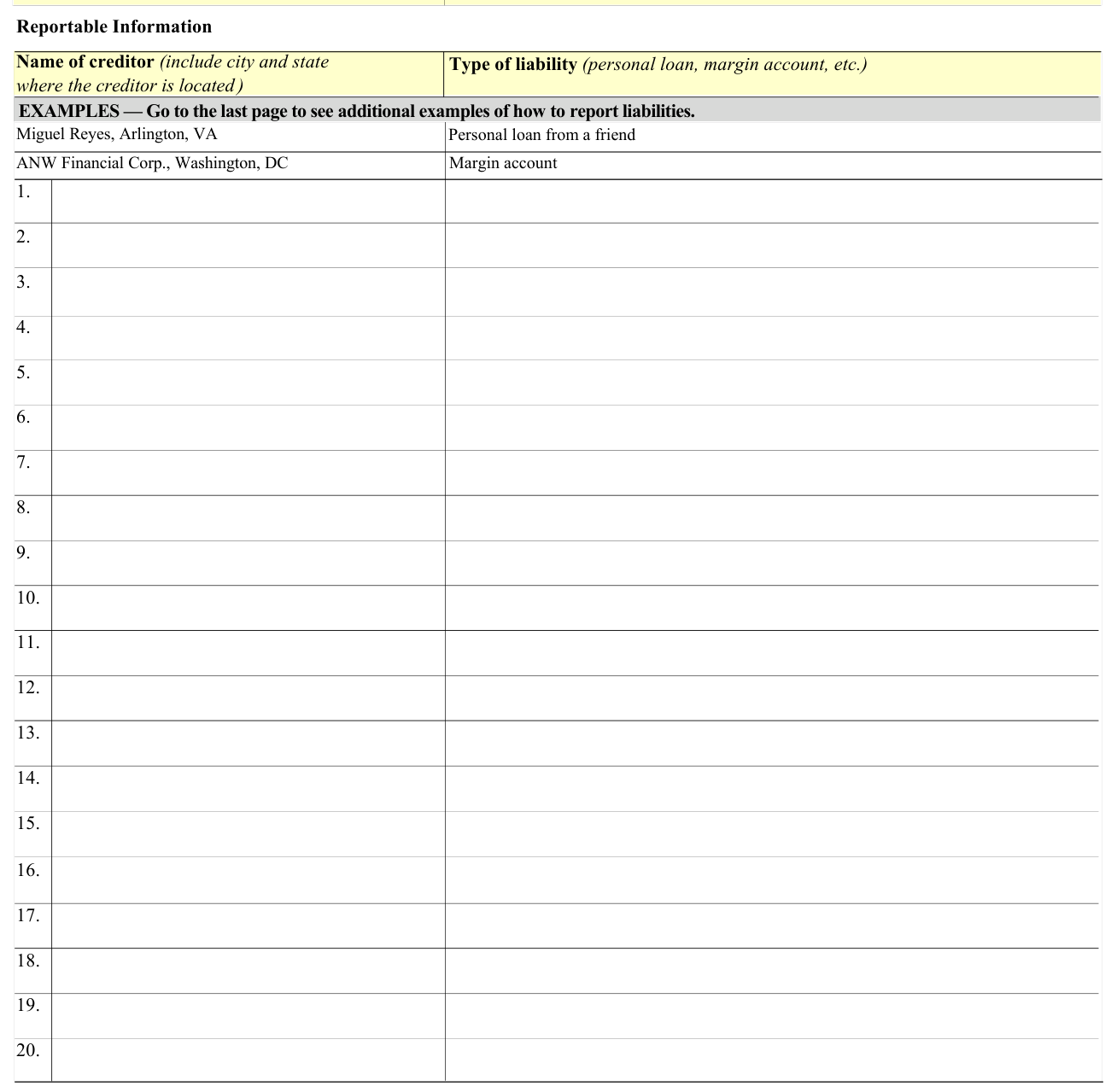
If you are a new entrant filer, report liabilities that exceeded $10,000 at the end of the reporting period (checked November 1, 2026).
If you are an annual filer, report liabilities that exceeded $10,000 during the reporting period (checked November 1, 2026).
Do not report: any liability, such as a mortgage, a student loan, or a credit card account, from a financial institution or business entity granted on terms made available to the general public; liabilities that you owe to your spouse or to the parent, sibling, or child of you, your spouse, or your dependent child.
Name of creditor (include city and state where the creditor is located). Type of liability (personal loan, margin account, etc.)
Part III: Outside Positions
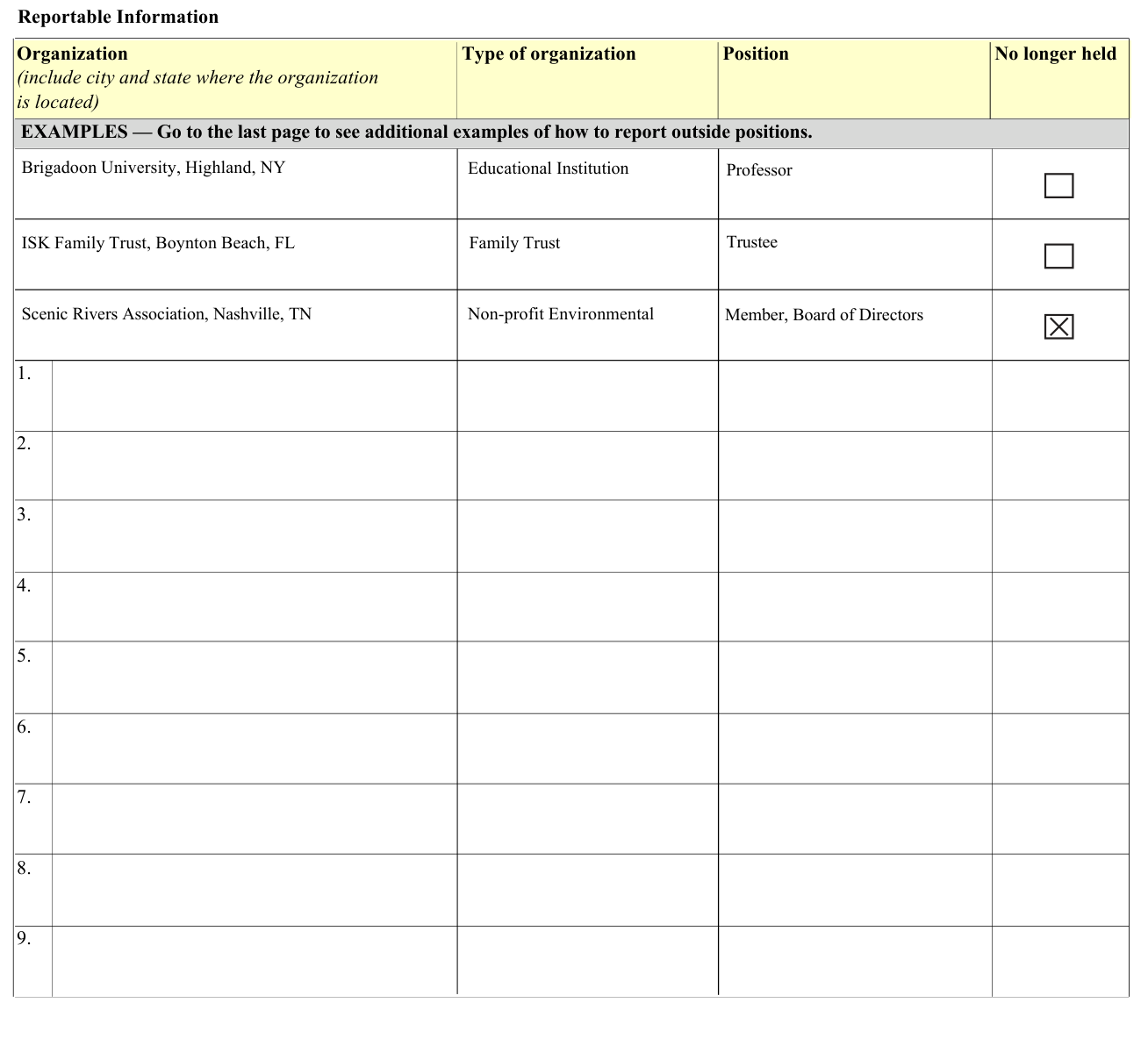
Report for yourself: All positions outside the Federal Government held at any time during the reporting period, whether or not you were compensated and whether or not you currently hold that position.
Do not report: any position with a religious entity, social entity, fraternal entity, or political entity; any position held by your spouse or dependent child; any position that you hold as part of your official duties.
Organization (include city and state where the organization is located). Type of organization. Position. No longer held.
Part IV: Agreements or Arrangements
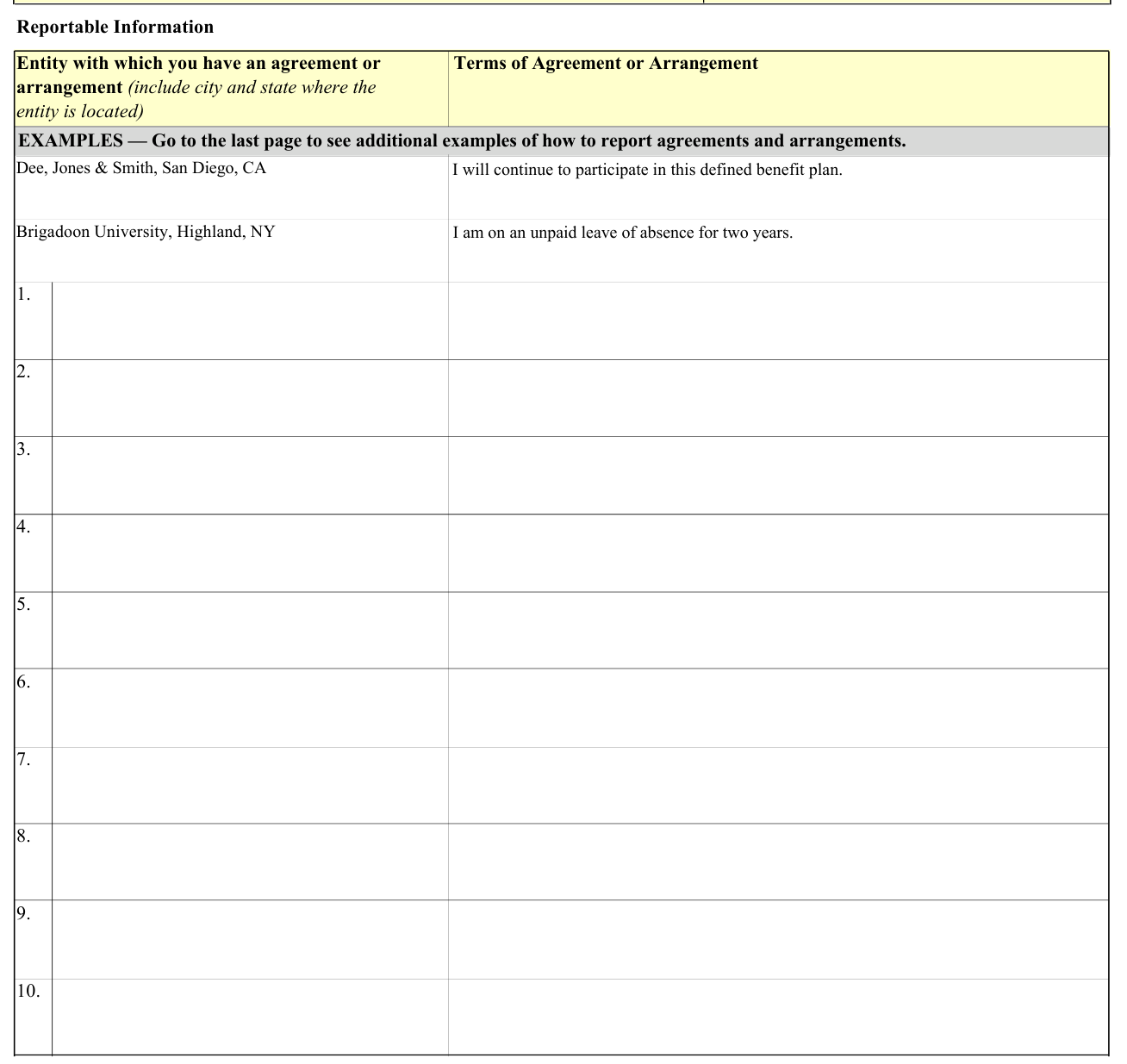
Report your agreements or arrangements for: continuing participation in an employee pension or benefit plan maintained by a current or former employer; a leave of absence; future employment, including the date you accepted an employment offer; continuation of payment by a current or former employer (including severance payments). Do not report: any agreement or arrangement related to your employment by the Federal Government; spouse's and dependent child's agreements or arrangements; continuing participation in a defined contribution plan, such as a 401(k) plan, to which an employer is no longer making contributions.
Entity with which you have an agreement or arrangement (include city and state where the entity is located). Terms of Agreement or Arrangement.
Part V: Gifts and Travel Reimbursements
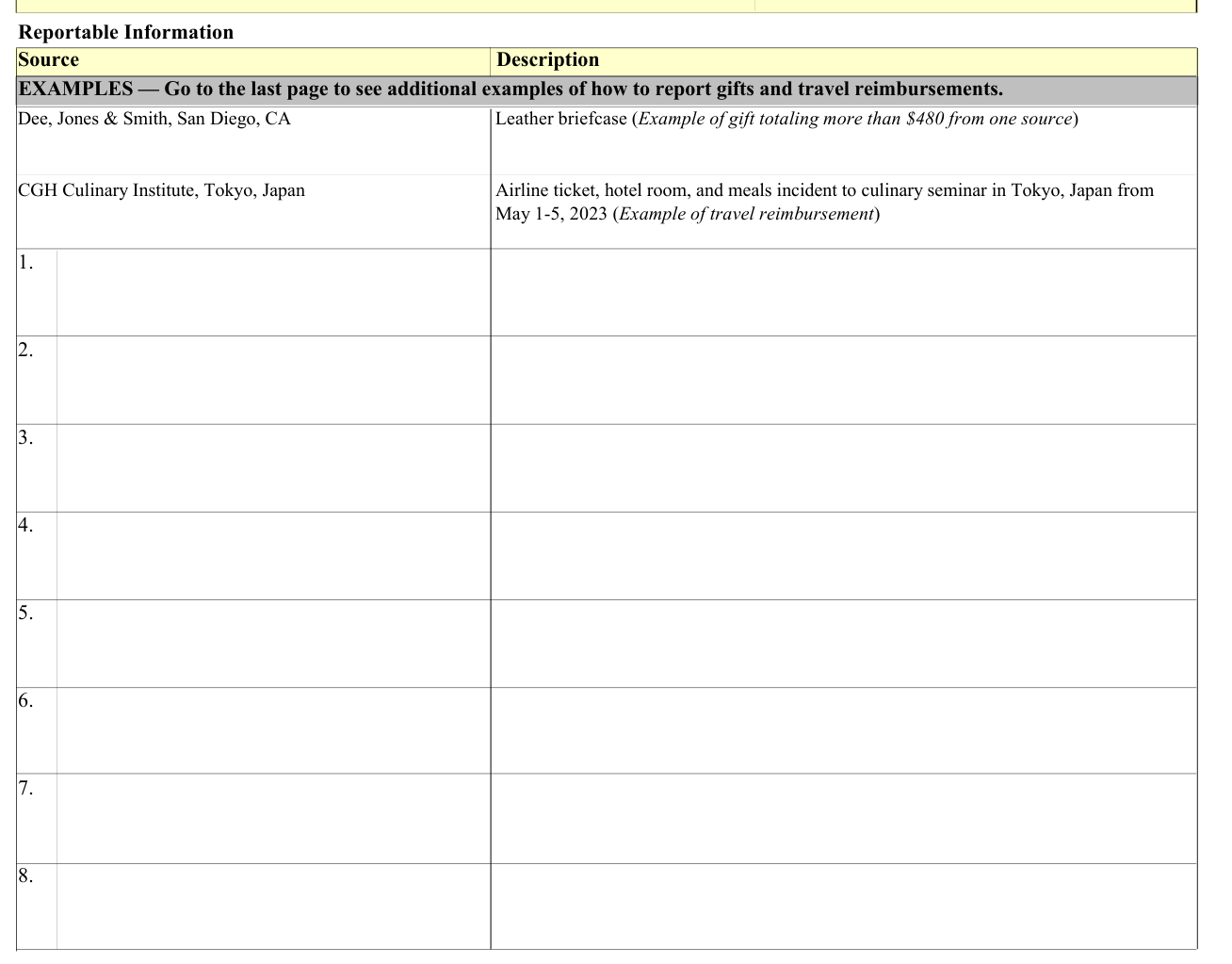
Fill out Part V only if you are filing an Annual Report. If you are a new entrant or an SGE, skip Part V. Report any gifts or travel reimbursements (items such as lodging, transportation, and food) totaling more than $480 from any one source during the reporting period; include where you traveled, the purpose, and date(s) of the trip for travel gifts and reimbursements (checked November 1, 2026). Do not report: anything received from relatives, the Federal Government, DC, state, or local governments; bequests and other forms of inheritance; anything received by your spouse or dependent child totally independent of their relationship to you.
More rules for OGE Form 450
If you have any questions about how to complete this form, please contact your ethics official.
Falsification of information or failure to file or report information required to be reported may subject you to disciplinary action by your employing agency or other authority.
If your situation is different
You are a new entrant
New Entrants: Part I - Report assets as of the date of filing, but report sources of earned income, honoraria, and other non-investment income for the preceding 12 months. Part II - Report liabilities as of the date of filing. Part III - Report positions for the preceding 12 months. Part IV - Report agreements and arrangements as of the date of filing.
You are an annual filer
Annual Filers: Report the required information for the preceding calendar year (January 1 - December 31).
Common questions about OGE Form 450
Is there a deadline?
New Entrants: The report is due within 30 days of your assuming a position designated for filing, unless your agency requests the report earlier or your agency grants you a filing extension. Annual Filers: The report is due no later than February 15, unless your agency grants you a filing extension.
Where do I file it?
Step 5: Submit the completed form to your ethics office.
Is there a penalty?
Knowing and willful falsification of information required to be reported may also subject you to criminal prosecution.
Sources
[1] OGE Form 450 (08/2024), Confidential Financial Disclosure Report, U.S. Office of Government Ethics (the Official source link on this page).