

Mobile Crane Pre-use Inspection Form at a glance
What it is: The Mobile Crane Pre-use Inspection Form, Chapter 41: Hoisting and Rigging.
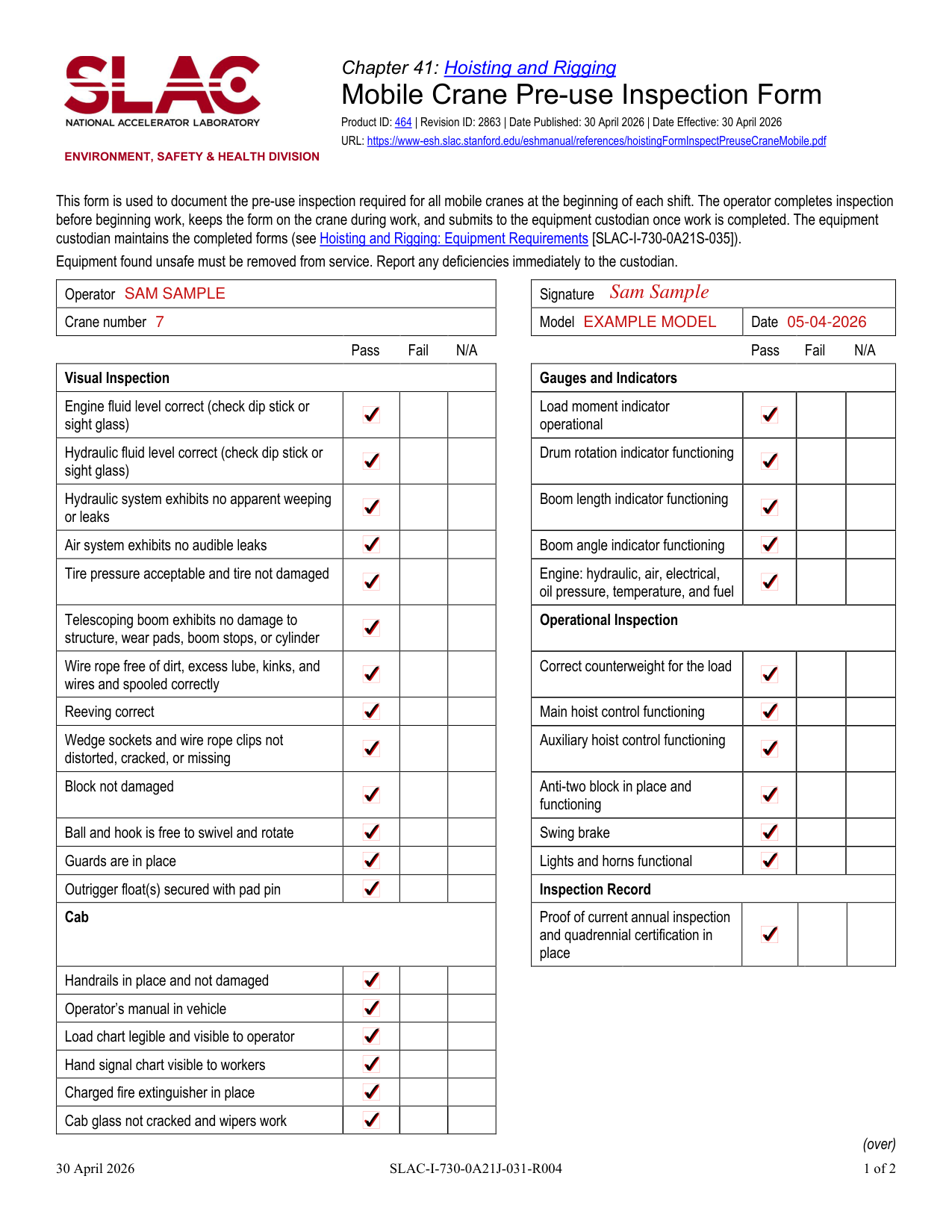
Where and when to file: This form is used to document the pre-use inspection required for all mobile cranes at the beginning of each shift. The operator completes inspection before beginning work, keeps the form on the crane during work, and submits to the equipment custodian once work is completed. The equipment custodian maintains the completed forms (see Hoisting and Rigging: Equipment Requirements [SLAC-I-730-0A21S-035]). Equipment found unsafe must be removed from service. Report any deficiencies immediately to the custodian.
A filled-in Mobile Crane Pre-use Inspection Form example: a completed pre-use inspection
How to fill out Mobile Crane Pre-use Inspection Form, box by box
Operator Signature, Crane number, Model and Date

Enter the Operator, Crane number, Model and Date, and sign at Signature.
Visual Inspection
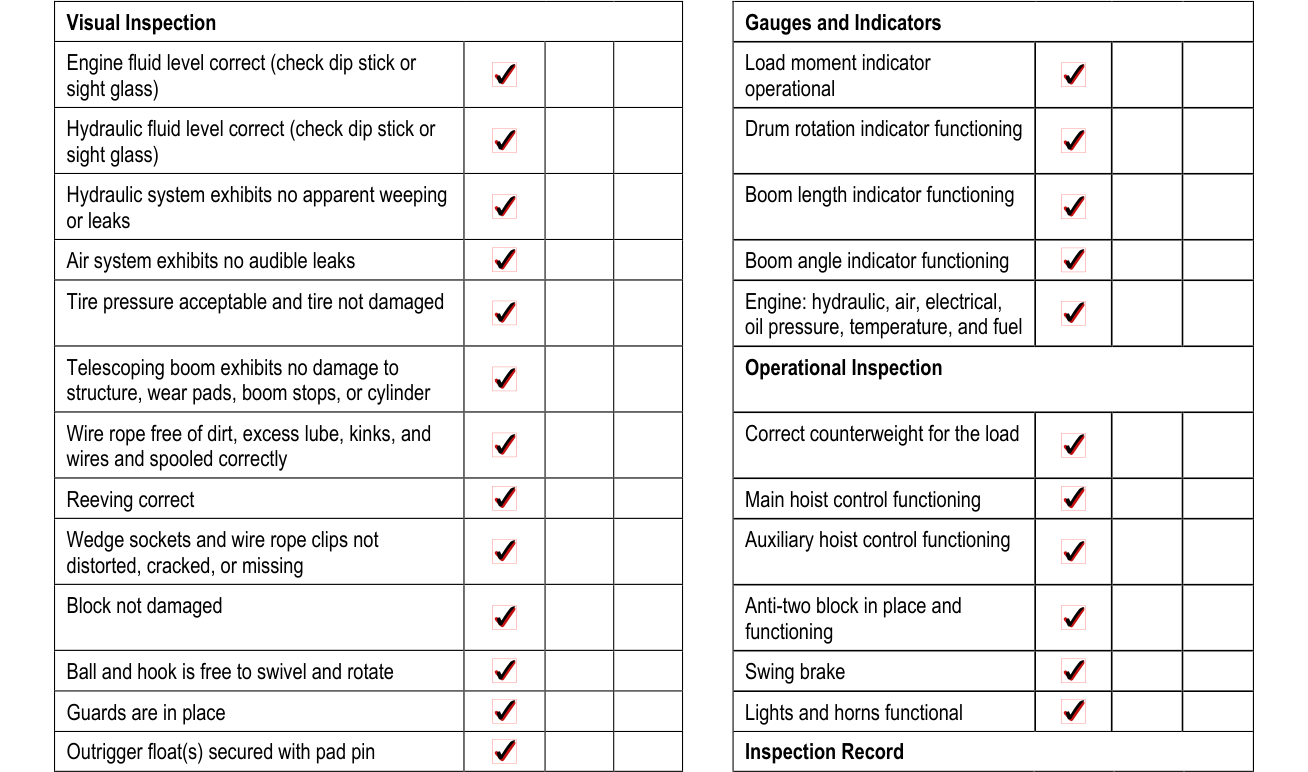
Mark Pass, Fail or N/A for each of the following. Engine fluid level correct (check dip stick or sight glass).
Hydraulic fluid level correct (check dip stick or sight glass).
Hydraulic system exhibits no apparent weeping or leaks.
Air system exhibits no audible leaks.
Tire pressure acceptable and tire not damaged.
Telescoping boom exhibits no damage to structure, wear pads, boom stops, or cylinder.
Wire rope free of dirt, excess lube, kinks, and wires and spooled correctly.
Reeving correct.
Wedge sockets and wire rope clips not distorted, cracked, or missing.
Block not damaged.
Ball and hook is free to swivel and rotate.
Guards are in place.
Outrigger float(s) secured with pad pin.
Gauges and Indicators
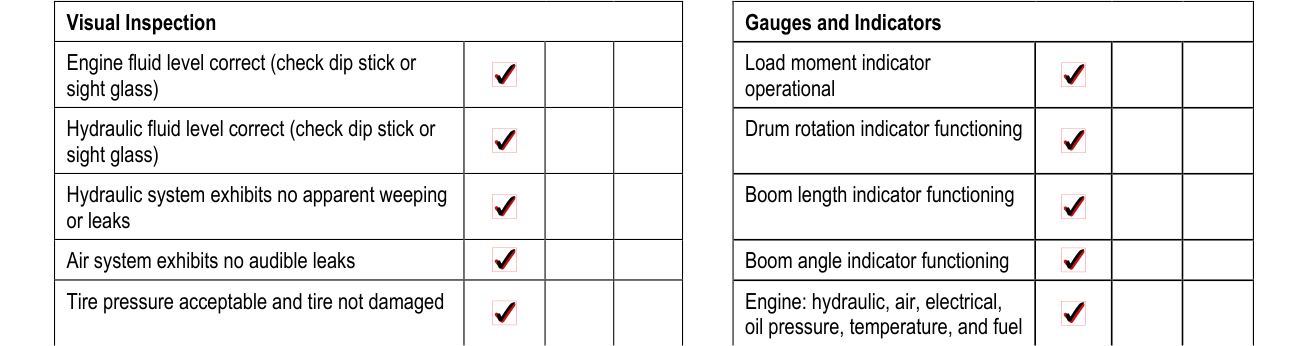
Load moment indicator operational.
Drum rotation indicator functioning.
Boom length indicator functioning.
Boom angle indicator functioning.
Engine: hydraulic, air, electrical, oil pressure, temperature, and fuel.
Operational Inspection
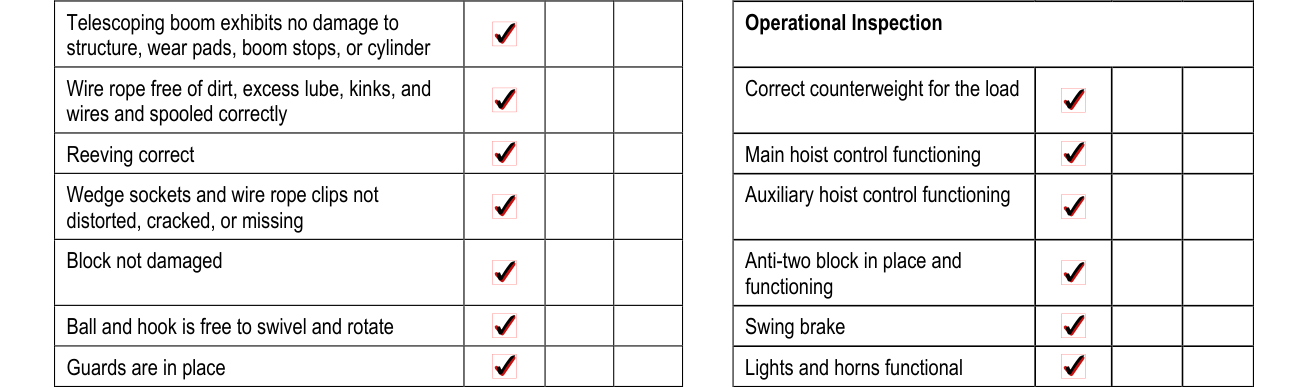
Correct counterweight for the load.
Main hoist control functioning.
Auxiliary hoist control functioning.
Anti-two block in place and functioning.
Swing brake.
Lights and horns functional.
Inspection Record

Proof of current annual inspection and quadrennial certification in place.
Cab
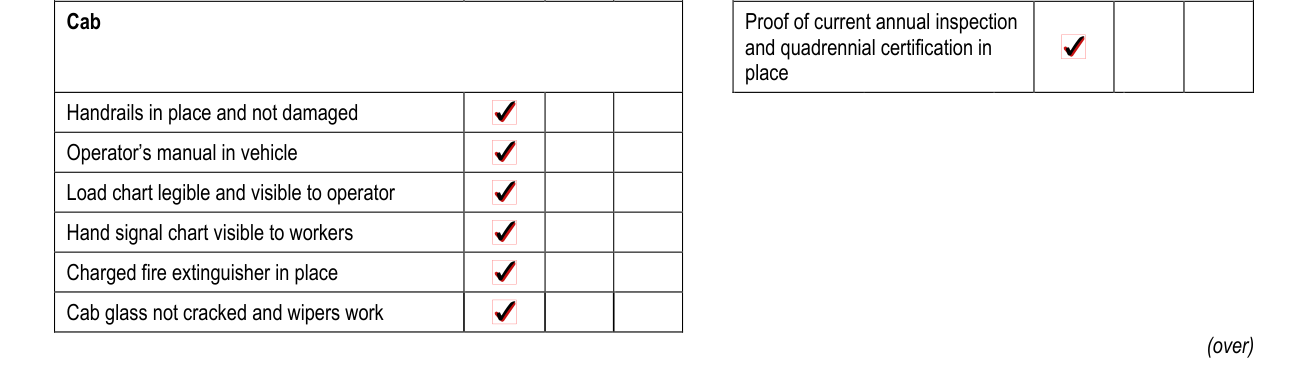
Handrails in place and not damaged.
Operator's manual in vehicle.
Load chart legible and visible to operator.
Hand signal chart visible to workers.
Charged fire extinguisher in place.
Cab glass not cracked and wipers work.
Environmental Conditions
Mark the Soil type: Dirt, Gravel, Concrete or Pavement, and the Soil condition: Wet or Dry.
Enter the Wind speed (use wind speed indicator for mobile cranes, or handheld monitor) for Ground and for Top of boom.
For Overhead hazards present?, mark Yes or No. If yes, describe.
For Underground utilities present?, mark Yes or No. If yes, describe.
If your situation is different
The wind speed exceeds 20 mph
If the wind speed exceeds 20 mph, reduce the load.
The maximum instantaneous wind speed reaches 31 mph
If the maximum instantaneous wind speed reaches 31 mph or more, stop the operation and stow the boom.
The load begins to go out of control
Stop the crane operation if the load begins to go out of control.
Sources
[1] Chapter 41: Hoisting and Rigging Mobile Crane Pre-use Inspection Form (SLAC-I-730-0A21J-031-R004, 30 April 2026), SLAC National Accelerator Laboratory (the Official source link on this page).
