

Assessment-Support Plan (ASP) at a glance
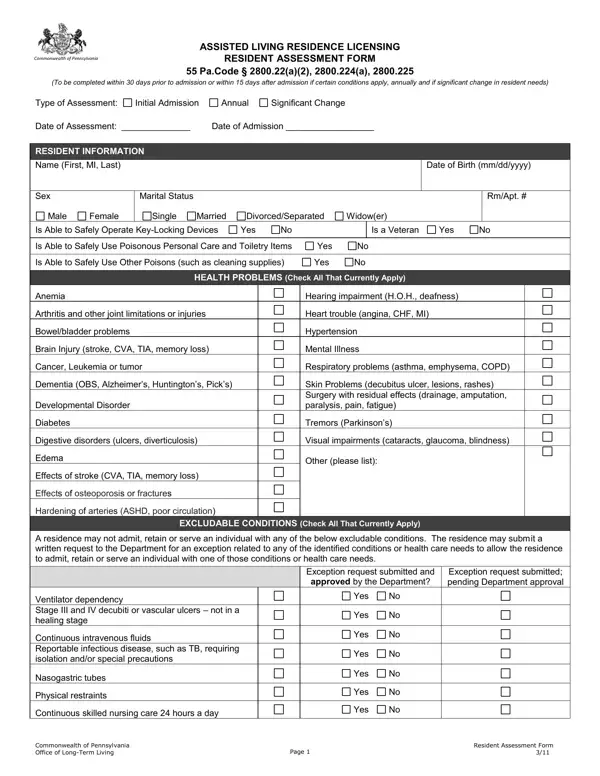
What it is: The Assisted Living Residence Assessment-Support Plan (ASP) is for compliance with 55 Pa.Code Chapter 2800.
Who signs: By signing, the assessor certifies: I am the home's administrator, a staff person authorized to complete this document, a Licensed Practical Nurse (LPN) or a Registered Nurse (RN).
The blank Assessment-Support Plan (ASP): print it and complete it by hand
How to fill out Assessment-Support Plan (ASP), box by box
When the assessment and support plan are completed
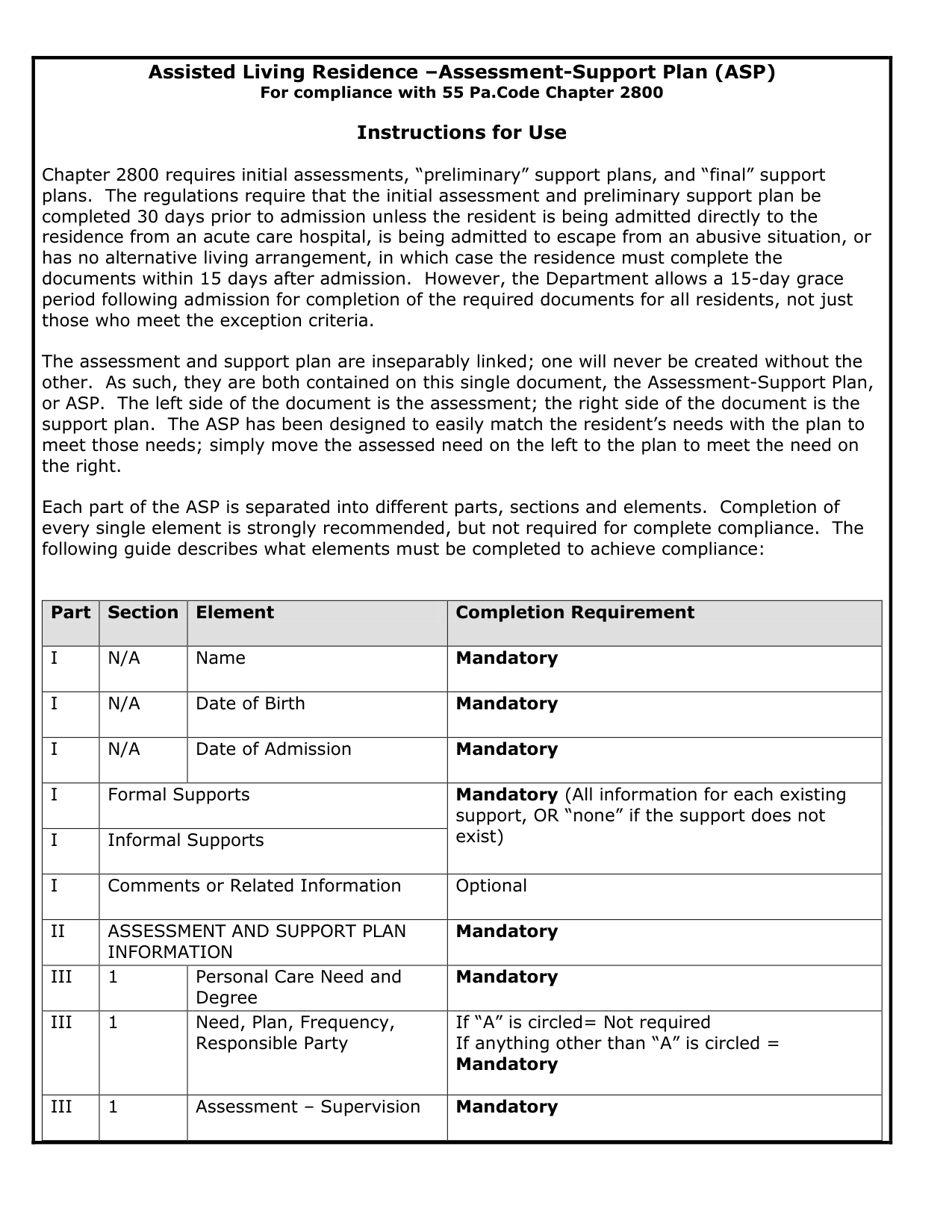
Chapter 2800 requires initial assessments, “preliminary” support plans, and “final” support plans. The regulations require that the initial assessment and preliminary support plan be completed 30 days prior to admission unless the resident is being admitted directly to the residence from an acute care hospital, is being admitted to escape from an abusive situation, or has no alternative living arrangement, in which case the residence must complete the documents within 15 days after admission. However, the Department allows a 15-day grace period following admission for completion of the required documents for all residents, not just those who meet the exception criteria. The assessment and support plan are inseparably linked; one will never be created without the other. As such, they are both contained on this single document, the Assessment-Support Plan, or ASP. The left side of the document is the assessment; the right side of the document is the support plan. The ASP has been designed to easily match the resident's needs with the plan to meet those needs; simply move the assessed need on the left to the plan to meet the need on the right. Each part of the ASP is separated into different parts, sections and elements. Completion of every single element is strongly recommended, but not required for complete compliance.
Mandatory and optional in Part I and Part III
In Part I, Name, Date of Birth and Date of Admission are mandatory.
In Part I, Formal Supports are mandatory: enter all information for each existing support, or “none” if the support does not exist.
In Part I, Comments or Related Information is optional.
In Part III Section 1, Personal Care Need and Degree is mandatory, and Assessment - Supervision is mandatory. For Need, Plan, Frequency, Responsible Party: if “A” is circled, it is not required; if anything other than “A” is circled, it is mandatory.
PART I: RESIDENT INFORMATION
Part I, Resident Information: Name, Date of Birth, Date of Admission and Comments or related information. Formal Supports lists Support Name and Telephone Number for the Primary Physician, Dentist, Case Manager and Other (specify). Informal Supports (Family, Friends, etc.) lists Name, Relationship and Telephone Number for the Designated Person and Other (specify).
PART II: ASP INFORMATION
Part II, ASP Information: the Date of Admission (Proposed), the Date of Admission (Actual) and the Date of Last ASP. The Reason for ASP is Initial (Preliminary and Final), Annual, Significant Change or Department Request.
Initial-Preliminary: within 30 days prior to or 15 days after admission. Initial-Final: within 30 days prior to or 30 days after admission. Annual: within 380 days (1 year plus 15-day grace period) after most recent ASP. Significant Change: within 5 calendar days of significant change. Department Request: within 24 hours of request. “Admission” means the date the resident physically moves into the residence.
Under Dates ASP was updated, include the date and page numbers of any updates to the ASP made between the preliminary and final ASPs or between ASPs. If the assessment and support plan were completed due to a significant change, please include a description of the change.
Significant Change
A “significant change” includes the following situations: The resident has been diagnosed with having a previously-undiagnosed disease or disorder that changes the resident's care needs. Example: A resident develops diabetes that requires a change in diet. An existing disease or disorder changes such that the resident's medical care needs are affected.
The following are examples of when a new RASP is not required, but the existing RASP should be amended: The resident's social and recreational needs change unrelated to a change in physical, psychological, or cognitive functioning. The responsible party or frequency of need changes.
The assessment and the support plan
The assessment is used to determine what the resident's needs are.
Each resident's support plan is based on the results of the assessment. The support plan is used to record how the resident's needs will be met.
Complete the assessment portion first, and then use the results to create a support plan. Attach additional pages as necessary.
Section 1: Assisted Living Care Needs
Section 1, Description of Service Need: specify exactly what service or services are needed to meet the need. Example: Resident cannot lift eating utensils to mouth due to complications from Parkinson's Disease.
Plan to Meet Service Need: specify what will be done to make sure the service need is met. Example: Staff will feed the resident during mealtimes.
Frequency: specify how often the plan will be enacted using one of the choices.
Responsible Party: specify who will perform the plan using one of the choices.
Responsible Party Codes: DCS = Direct-Care Staff on Duty F = Family Member CM = Case Manager N/A = Not Applicable (Degree Code A Only) SHCP = Supplemental Health Care Provider O = Other (Specify). Changing the ASP: when completing a final ASP or updating an existing ASP where information has changed since the last ASP, strike through the outdated information, add the new information, and sign and date the change.
Section 2: Medical, Dental, Dietary, and Sensory Needs
Medical Diagnoses - Physical: using the Documentation of Medical Evaluation Form from the most recent medical evaluation, list all of the resident's physical diagnoses.
Diagnoses or Needs: list all of the resident's dental, dietary, and sensory needs. Examples: Impacted tooth; Mechanical soft foods; Cataracts.
Plan to Meet Need: specify what will be done to make sure the resident's dental, dietary, and sensory needs are addressed. Examples: Resident will see dentist, resident will have special diet, resident will see ophthalmologist.
Section 3: Psychological Diagnoses and Behavioral or Cognitive Need
Medical Diagnoses - Psychological: using the Documentation of Medical Evaluation Form from the most recent medical evaluation, list all of the resident's diagnoses. Example: Schizophrenia.
Degree Codes for Behavioral or Cognitive Need and Degree: A = No problem, B = Minimal Problem, C = Moderate Problem, D = Severe Problem, E = Not Applicable. Description of Service Need and Plan to Meet Service Need: Not Applicable (Code A Only).
SUMMARY AND DETERMINATION
Summary of Resident's Overall Wellness: include significant changes identified through the assessment process, comments for improving quality of care, or other relevant information.
If you are not an RN, you verify by signing that the residence has a means of quality assurance through RN review of all ASPs. The information on this assessment is accurate and was developed based on records and/or interviews. The resident's needs may be met in this assisted living residence.
Enter the Assessor's Printed Name, Assessor's Title, Assessor's Signature and Date Signed. In Participation, by signing, the signature verifies that the signer participated in the assessment and/or support plan process: enter Name, Relationship to Resident, Signature and Date Signed.
Sources
[1] Assisted Living Residence Assessment-Support Plan (ASP), Pennsylvania Department of Human Services (the Official source link on this page).