

Commercial Appraisal Review Form at a glance
What it is: The Commercial Appraisal Review Form briefly identifies and describes the appraisal report which is the subject of this review.
Who signs: The Reviewer signs on the line for Reviewer's Signature.
A filled-in Commercial Appraisal Review Form example: a reviewer identifies the appraisal report
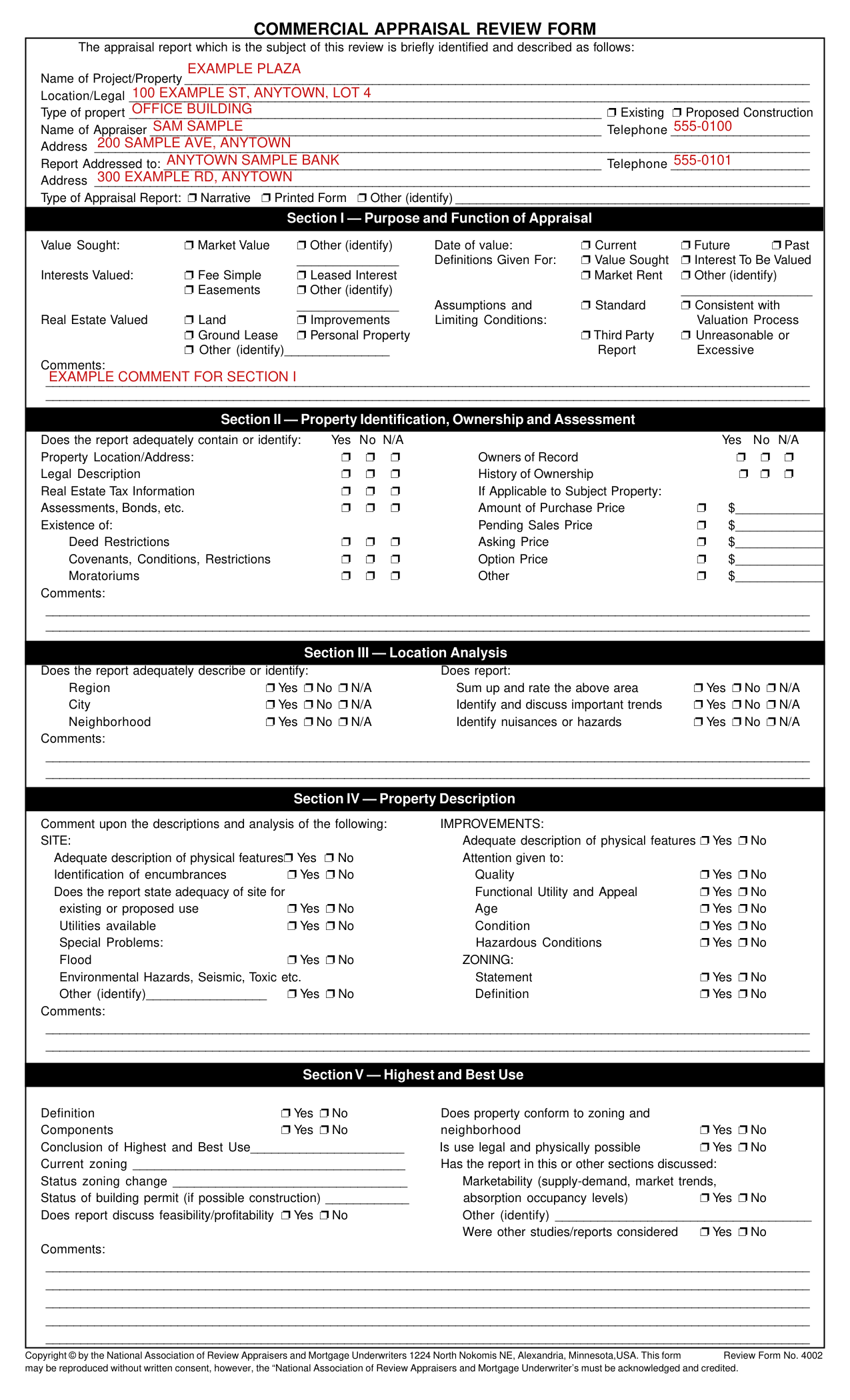
How to fill out Commercial Appraisal Review Form, box by box
Report identification
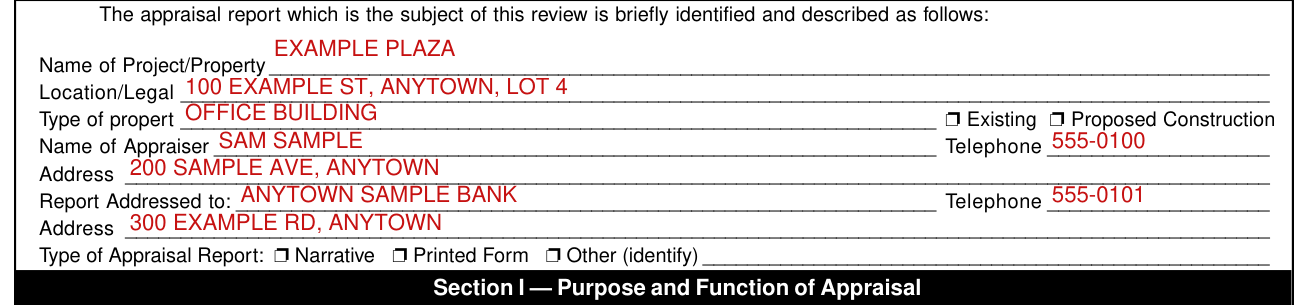
Enter the Name of Project/Property, the Location/Legal and the Type of propert, and mark Existing or Proposed Construction.
Enter the Name of Appraiser, with a Telephone and an Address.
Under Report Addressed to, enter a name, a Telephone and an Address.
For Type of Appraisal Report, mark Narrative or Printed Form, or mark Other (identify) and identify it.
Section I Purpose and Function of Appraisal
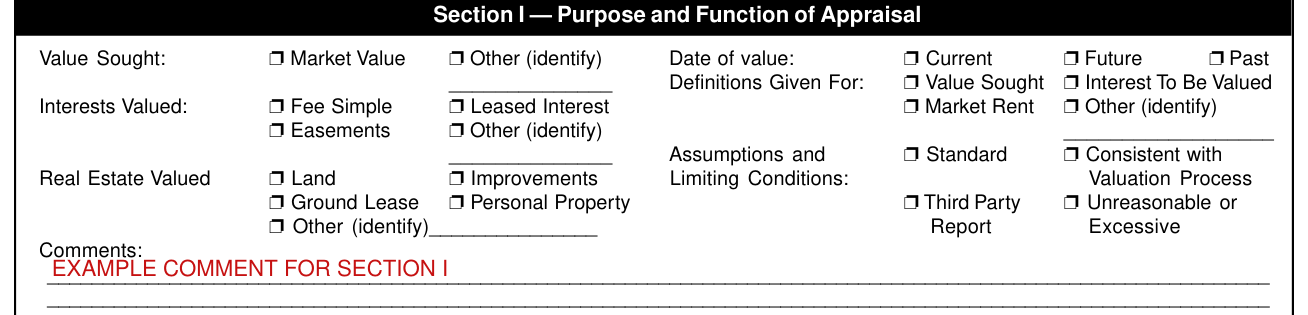
For Value Sought in Section I, mark Market Value or mark Other (identify).
For Date of value, mark Current, Future or Past.
For Definitions Given For, mark Value Sought or Interest To Be Valued.
For Interests Valued, mark Fee Simple, Leased Interest, Market Rent, Easements or Other (identify).
For Real Estate Valued, mark Land, Improvements, Ground Lease, Personal Property or Other.
For Assumptions and Limiting Conditions, mark Standard, Consistent with Valuation Process, Third Party Report, Unreasonable or Excessive or Other (identify), and add Comments.
Section II Property Identification, Ownership and Assessment
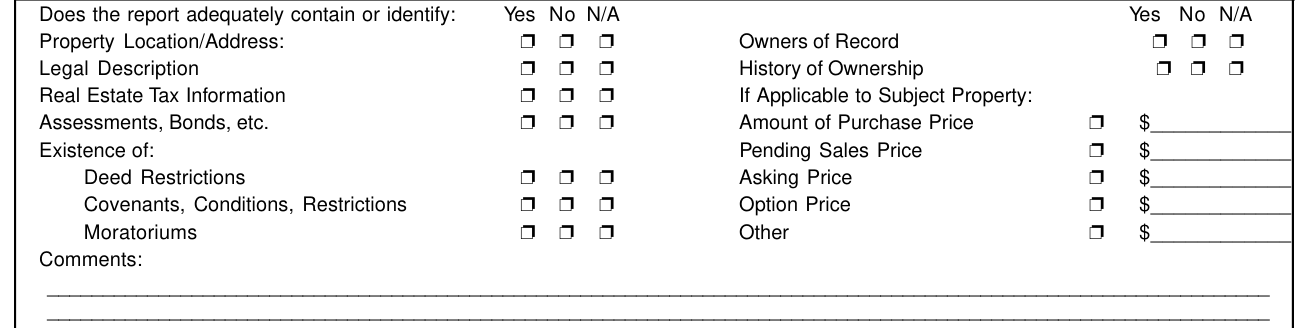
In Section II, mark Yes, No or N/A for the report adequately containing or identifying Property Location/Address, Owners of Record, Legal Description, History of Ownership and Real Estate Tax Information.
If Applicable to Subject Property, mark Yes, No or N/A for Assessments, Bonds, etc.
Under Existence of, mark Yes, No or N/A for Deed Restrictions, Covenants, Conditions, Restrictions and Moratoriums.
Mark Amount of Purchase Price, Pending Sales Price, Asking Price, Option Price or Other, enter the amount and add Comments.
Section III Location Analysis

In Section III, mark Yes, No or N/A for the report adequately describing or identifying the Region, the City and the Neighborhood.
Mark Yes, No or N/A for Does report: Sum up and rate the area, Identify and discuss important trends, and Identify nuisances or hazards, and add Comments.
Section IV Property Description
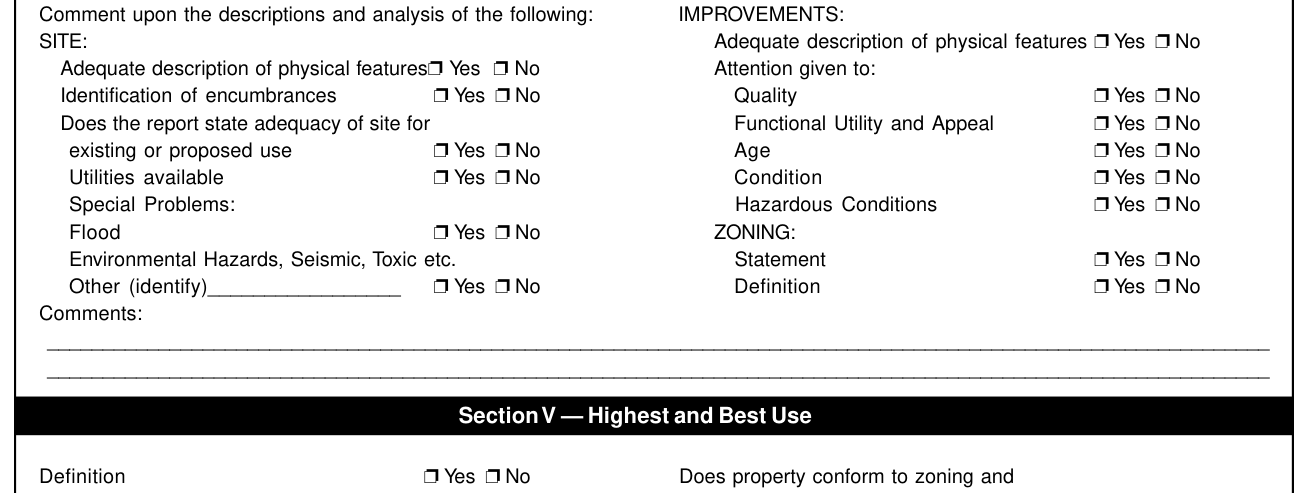
In Section IV, comment upon the descriptions and analysis of SITE and IMPROVEMENTS.
For the SITE, mark Yes or No for Adequate description of physical features, Identification of encumbrances, adequacy of site for existing or proposed use and Utilities available.
For Special Problems, mark Yes or No for Hazardous Conditions, Flood, Environmental Hazards, Seismic, Toxic etc. and Other (identify).
For IMPROVEMENTS, mark Yes or No for Adequate description of physical features, and for Attention given to Quality, Functional Utility and Appeal, Age and Condition.
Under ZONING, mark Yes or No for Statement and Definition, and add Comments.
Section V Highest and Best Use
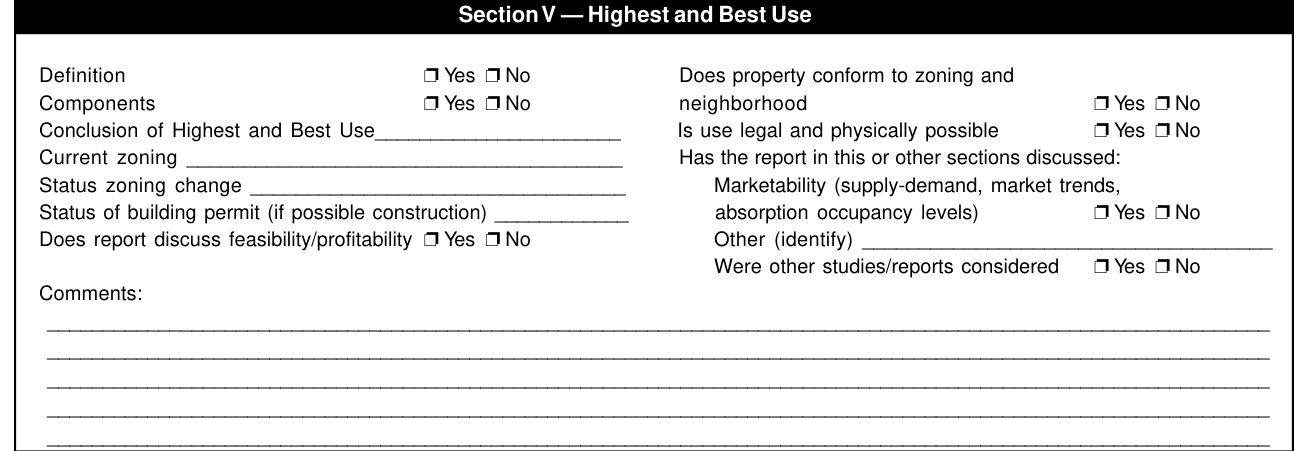
In Section V, enter the Conclusion of Highest and Best Use, and mark Yes or No for Is use legal and physically possible.
Enter the Current zoning, the Status zoning change and the Status of building permit (if possible construction) and Other (identify).
Mark Yes or No for Has the report in this or other sections discussed Marketability (supply-demand, market trends, absorption occupancy levels).
Mark Yes or No for Does report discuss feasibility/profitability and Were other studies/reports considered, and add Comments.
Section VI Property Valuation
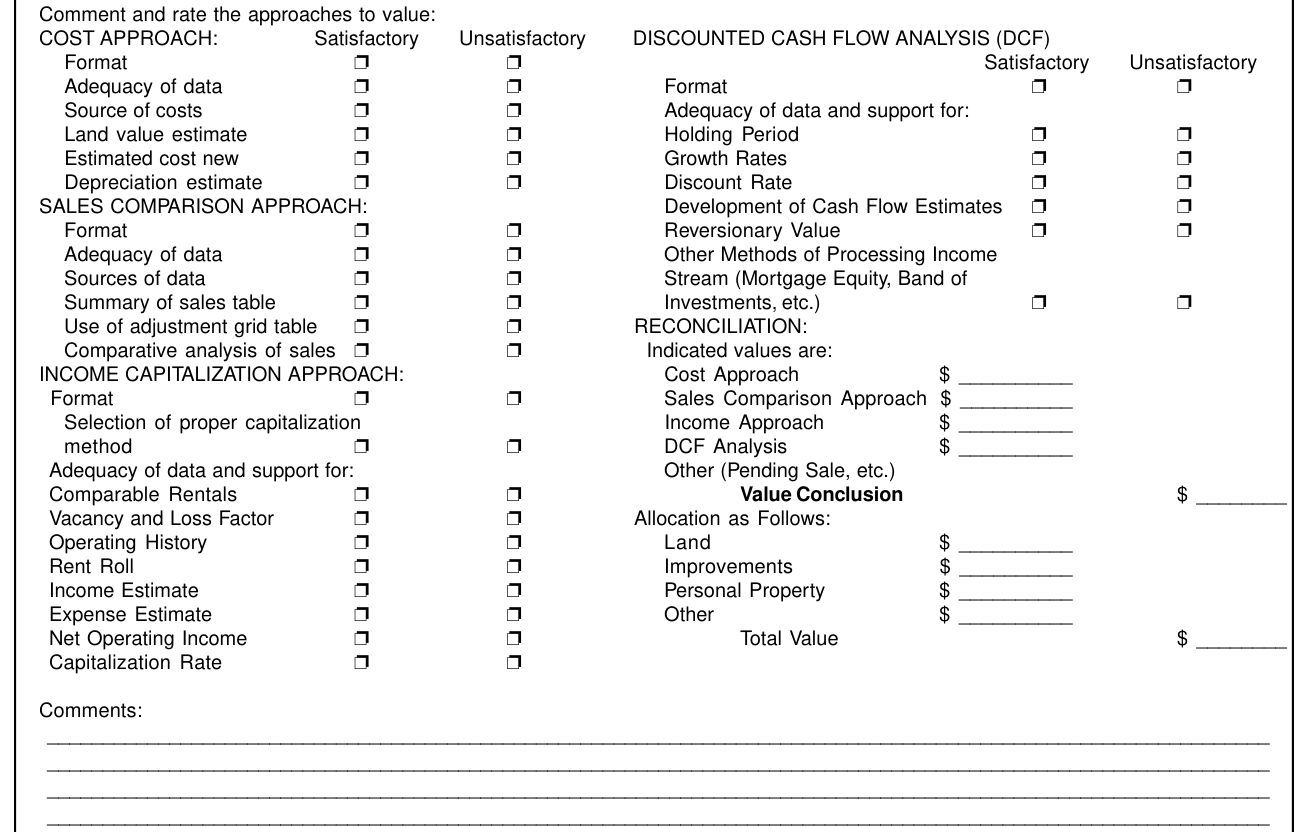
In Section VI, comment and rate the approaches to value as Satisfactory or Unsatisfactory.
For the COST APPROACH, rate Format, Adequacy of data, Source of costs, Land value estimate, Estimated cost new and Depreciation estimate.
For the SALES COMPARISON APPROACH, rate Format, Adequacy of data, Sources of data, Summary of sales table, Use of adjustment grid table and Comparative analysis of sales.
For the INCOME CAPITALIZATION APPROACH, rate Format, Selection of proper capitalization method and Adequacy of data and support for Comparable Rentals, Vacancy and Loss Factor, Operating History, Rent Roll, Income Estimate, Expense Estimate, Net Operating Income and Capitalization Rate.
For the DISCOUNTED CASH FLOW ANALYSIS (DCF), rate Format, Adequacy of data and support for Holding Period, Growth Rates, Discount Rate, Development of Cash Flow Estimates, Reversionary Value and Other Methods of Processing Income Stream (Mortgage Equity, Band of Investments, etc.).
Enter the Allocation as Follows, with Land, Improvements, Personal Property, Other and Total Value.
Under RECONCILIATION, Indicated values are: enter the Cost Approach, Sales Comparison Approach, Income Approach, DCF Analysis, Other (Pending Sale, etc.) and the Value Conclusion.
Section VII Other Report Requirements

In Section VII, mark Yes or No for Does the report contain a certification, Is the report co-signed and Does the report contain appraiser(s) qualifications.
Mark Yes or No for Did the principal appraiser sign the report, Does the principal appraiser make statement of concurrence with value conclusion and Did the principal appraiser personally inspect subject property.
Section VIII Final Rating of Appraisal
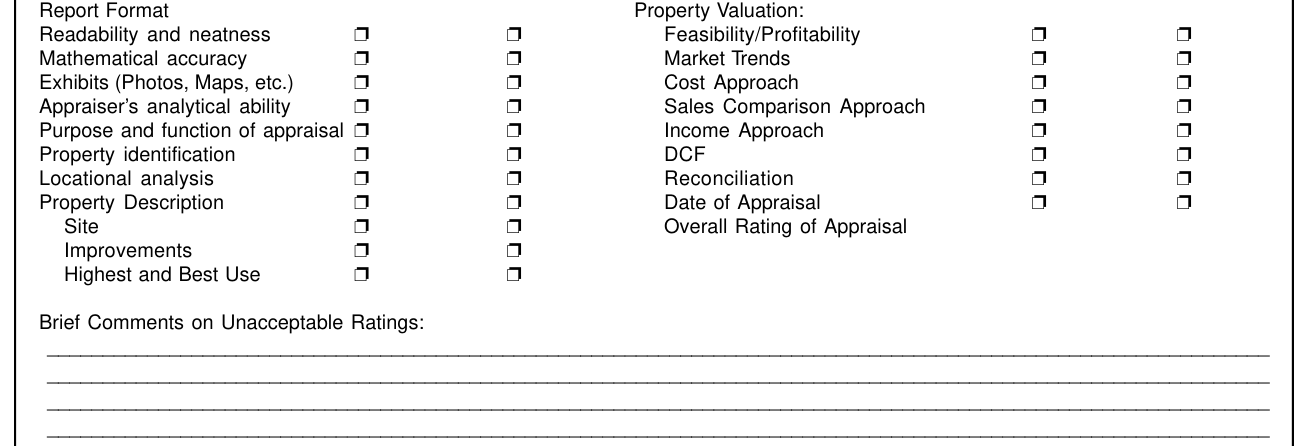
In Section VIII, mark each line Acceptable or Unacceptable under Report Format, Property Valuation and Overall Rating of Appraisal.
Under Brief Comments on Unacceptable Ratings, write the comments.
Section IX Reviewer's Conclusions Recommendations
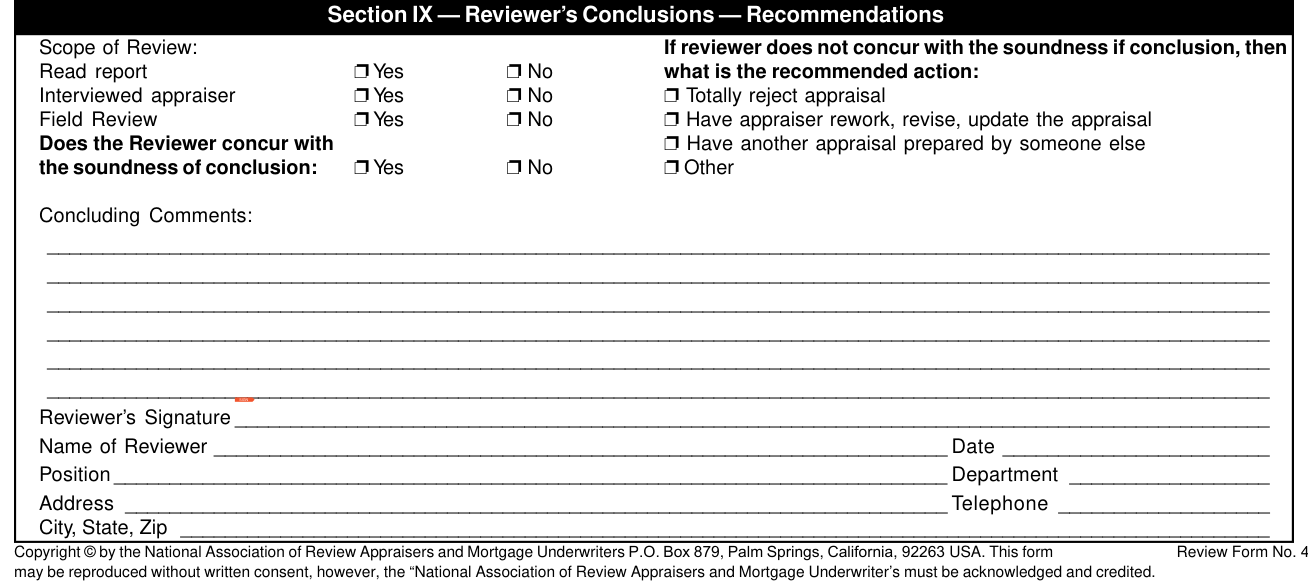
In Section IX, under Scope of Review, mark Yes or No for Read report, Interviewed appraiser and Field Review.
Mark Yes or No for Does the Reviewer concur with the soundness of conclusion.
If reviewer does not concur with the soundness if conclusion, then mark the recommended action: Totally reject appraisal, Have appraiser rework, revise, update the appraisal, Have another appraisal prepared by someone else or Other.
The Reviewer signs on the line for Reviewer's Signature.
Add Concluding Comments, then enter the Name of Reviewer, Date, Position, Department, Address, Telephone and City, State, Zip.
Sources
[1] Commercial Appraisal Review Form (Review Form No. 4002), National Association of Review Appraisers and Mortgage Underwriters (the Official source link on this page).
