

WDIIR at a glance
What it is: This form is the Arizona Department of Agriculture Pest Management Division Wood Destroying Insect Inspection Report.
Who signs: 12A. Signature of Inspector. 12B. Inspector's License Number. 12C. Date. 13. Signature of Purchaser. 14. Date.
This form must be completed only by a Certified Applicator.
A filled-in WDIIR example: an inspector reports drywood termites in an attic
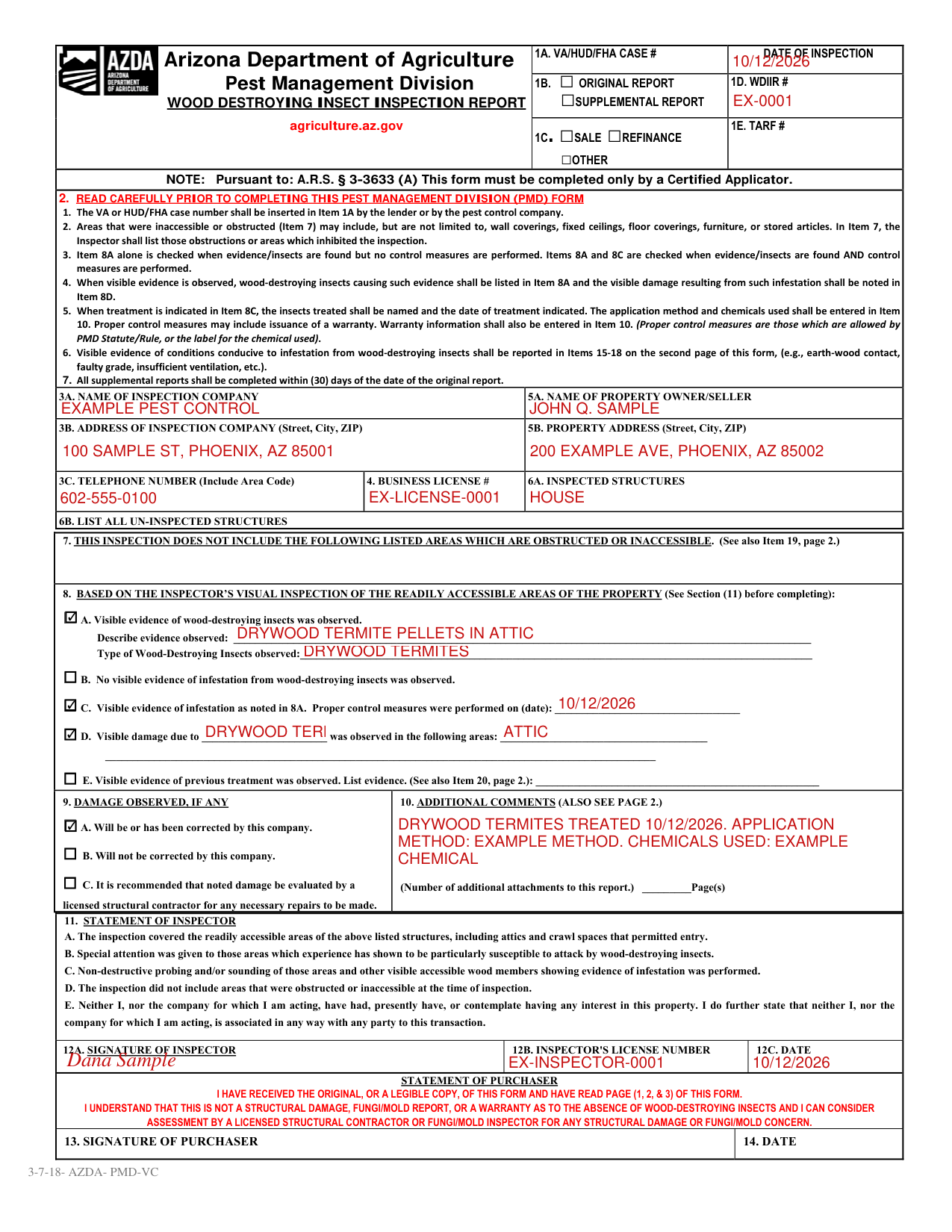
How to fill out WDIIR, box by box
Items 1A to 1E, the report
The VA or HUD/FHA case number shall be inserted in Item 1A by the lender or by the pest control company.
1A. VA/HUD/FHA CASE # and Date of Inspection. 1B. Original Report or Supplemental Report. 1C. Sale, Refinance or Other. 1D. WDIIR #. 1E. TARF #.
3 to 6, the company, the owner and the property
3A. Name of Inspection Company. 3B. Address of Inspection Company (Street, City, ZIP). 3C. Telephone Number (Include Area Code). 4. Business License #.
5A. Name of Property Owner/Seller. 5B. Property Address (Street, City, ZIP). 6A. Inspected Structures. 6B. List all Un-Inspected Structures.
Item 7, the obstructed or inaccessible areas
This inspection does not include the following listed areas which are obstructed or inaccessible. (See also Item 19, page 2.)
In Item 7, the Inspector shall list those obstructions or areas which inhibited the inspection.
Areas that were inaccessible or obstructed (Item 7) may include, but are not limited to, wall coverings, fixed ceilings, floor coverings, furniture, or stored articles.
Item 8, what the inspection found
Item 8 is based on the Inspector's visual inspection of the readily accessible areas of the property (See Section (11) before completing).
8A. Visible evidence of wood-destroying insects was observed. Describe evidence observed and the Type of Wood-Destroying Insects observed.
When visible evidence is observed, wood-destroying insects causing such evidence shall be listed in Item 8A and the visible damage resulting from such infestation shall be noted in Item 8D.
8B. No visible evidence of infestation from wood-destroying insects was observed.
Item 8A alone is checked when evidence/insects are found but no control measures are performed. Items 8A and 8C are checked when evidence/insects are found AND control measures are performed.
8C. Visible evidence of infestation as noted in 8A. Proper control measures were performed on (date).
When treatment is indicated in Item 8C, the insects treated shall be named and the date of treatment indicated.
8D. Visible damage due to ... was observed in the following areas.
E. Visible evidence of previous treatment was observed. List evidence. (See also Item 20, page 2.)
9, damage observed
9. Damage observed, if any: A. Will be or has been corrected by this company. B. Will not be corrected by this company. C. It is recommended that noted damage be evaluated by a licensed structural contractor for any necessary repairs to be made.
Item 10, the additional comments
10. Additional comments (also see page 2). Number of additional attachments to this report: Page(s).
The application method and chemicals used shall be entered in Item 10.
Proper control measures may include issuance of a warranty. Warranty information shall also be entered in Item 10.
Proper control measures are those which are allowed by PMD Statute/Rule, or the label for the chemical used.
11 to 14, the statements and signatures
11. Statement of Inspector. A. The inspection covered the readily accessible areas of the listed structures, including attics and crawl spaces that permitted entry. B. Special attention was given to those areas which experience has shown to be particularly susceptible to attack by wood-destroying insects. C. Non-destructive probing and/or sounding of those areas and other visible accessible wood members showing evidence of infestation was performed. D. The inspection did not include areas that were obstructed or inaccessible at the time of inspection.
E. Neither I, nor the company for which I am acting, have had, presently have, or contemplate having any interest in this property. I do further state that neither I, nor the company for which I am acting, is associated in any way with any party to this transaction.
Statement of Purchaser: I have received the original, or a legible copy, of this form and have read page (1, 2, & 3) of this form. I understand that this is not a structural damage, fungi/mold report, or a warranty as to the absence of wood-destroying insects and I can consider assessment by a licensed structural contractor or fungi/mold inspector for any structural damage or fungi/mold concern. 13. Signature of Purchaser. 14. Date.
Items 15 to 18, conditions conducive to infestation
At the time of the inspection the property was: Vacant, Occupied, Unfurnished or Furnished.
Visible evidence of conditions conducive to infestation from wood-destroying insects shall be reported in Items 15-18 on the second page of this form, (e.g., earth-wood contact, faulty grade, insufficient ventilation, etc.).
15. Wood to earth contact (EC): YES or NO. If YES, check mark and explain conditions conducive: Fence Abutting Structure, Pier Posts, Plants/Trees Contacting Structure, Concrete Form Boards, Porch Stairs, Porch Post, Trellis or Other. Comments.
16. Excessive cellulose debris (CD): YES or NO. If YES, check mark and explain conditions conducive. Comments.
17. Faulty grades (FG): YES or NO. If YES, check mark and explain conditions conducive: Evidence of surface water draining toward house, "Stucco at or below grade", "Floor level or planters at or below grade", "Joists in crawl space less than 24\" above grade", "Wood siding below grade" or Other. Comments.
18. Excessive moisture (EM): YES or NO. If YES, check mark and explain conditions conducive: Standing Water, Water Damage, Bath/Shower/Toilet Leaking, Inadequate Ventilation, Sprinklers Hitting Structure, Water Stain, Plumbing Leaks, Crawl Space/Water Leaking, Improper Condensate Drainage, Attic/Roof Leak or Other. Comments.
19, inaccessible areas
19. Inaccessible areas (IA): YES or NO. If YES, check mark and explain: Attic - All, Attic - Joists, Attic - Partial, Plumbing Traps, Floors, Wall Interiors, Enclosed Stairwell, Dropped Ceilings, Sub/Crawl Space Area -- Clearance, Sub Area/Crawl Space No Access, Areas Obstructed By Furniture Or Stored Articles or Other. Comments.
20, evidence of previous treatment
20. Evidence of previous treatment by another company: While evidence of previous treatment does exist, it is impossible for the inspecting company to ascertain if such treatment was properly performed. Further investigation is left to the Buyer's discretion to determine if such treatment was done properly and if a valid warranty exists against the target pest of such treatment.
By the inspecting company: Previous treatment is recorded for this property. At the Buyer's discretion, treatment records can be viewed at the inspecting company's local office with the property owner's permission.
Account Number, Date of Initial Treatment, Target Pest, Warranty Expiration Date, Other, and Pest Control Inspector's Additional Comments.
Page 3, the graph and the code checks
Pursuant to A.A.C. R3-8-501 (E)(5)(o) the Inspector must complete the Graph of Structure(s) on page (3) and check (√) marked for any items which are noted on pages (1) and (2). (Note: Graph Not To Scale)
SU Subterranean Termites OW Other Wood Destroying Insects (*) OB Obstructions WD Water Damage DR Drywood Termites FG Faulty Grade IA Inaccessible Areas WS Water Stains DA Dampwood Termites EC Wood To Earth Contact IV Inadequate Ventilation RL Roof Leaks BE Wood Destroying Beetles CD Cellulose Debris PL Plumbing Leaks EM Excessive Moisture CA Carpenter Ants PA Plantings Abutting Structure SP Sprinkler Hitting Structure FI Further Inspection Needed (*) Other Wood Destroying Insects (list)
Common questions about WDIIR
Is there a deadline?
All supplemental reports shall be completed within (30) days of the date of the original report.
Sources
[1] Wood Destroying Insect Inspection Report (WDIIR), Arizona Department of Agriculture Pest Management Division (the Official source link on this page).
