An Alabama minor child power of attorney is a written legal document that lets a parent, guardian or conservator (the principal) name an agent to act for a minor child. The agent is also called an attorney-in-fact. The Alabama power of attorney statute, Ala. Code § 26-2A-7, covers this kind of delegation. A properly executed power of attorney can delegate any power regarding the child's health, support, education or maintenance for a period not exceeding one year.[1]
Last Updated: October 2026. This guide is reviewed and updated regularly to reflect current Alabama law. If you notice an error or outdated information, please contact us.
Create a high-quality Alabama Minor Child Power of Attorney Form online now!
Build Your Document
Answer a few simple questions to make your document in minutes
Save and Print
Save progress and finish on any device, download and print anytime
Sign and Use
Your valid, lawyer-approved document is ready
... or download your Alabama Minor Child Power of Attorney Form as a PDF file
What Alabama Law Says About a Minor Child Power of Attorney
Section 26-2A-7 of the Ala. Code lets a person delegate to another person any power regarding the health, support, education or maintenance of a minor child's person or property. The delegation must be made by a properly executed power of attorney. It can last for a period not exceeding one year.[1]
The principal, the person delegating the powers, must sign the power of attorney.
Powers you cannot delegate. The power to consent to the marriage or adoption of a minor ward cannot be delegated.[1]
This power of attorney form for a minor child is also known as an Alabama temporary guardianship form. It is a power of attorney, and the form states that the signer does not intend to give up parental rights over the child. FormsPal has other Alabama POA forms if you need a different document.
Alabama Minor Child Power of Attorney Form Details
The FormsPal Alabama minor child power of attorney template is a three-page form with 44 fillable fields. Pages 1 and 2 hold your entries and signatures, and page 3 is an acknowledgment for a notary public. Work through the seven parts below in order.
The screenshots under each step show the FormsPal Alabama minor child power of attorney template filled with sample entries in blue, so you can see where each answer goes. The names, addresses, dates and amounts are examples only.
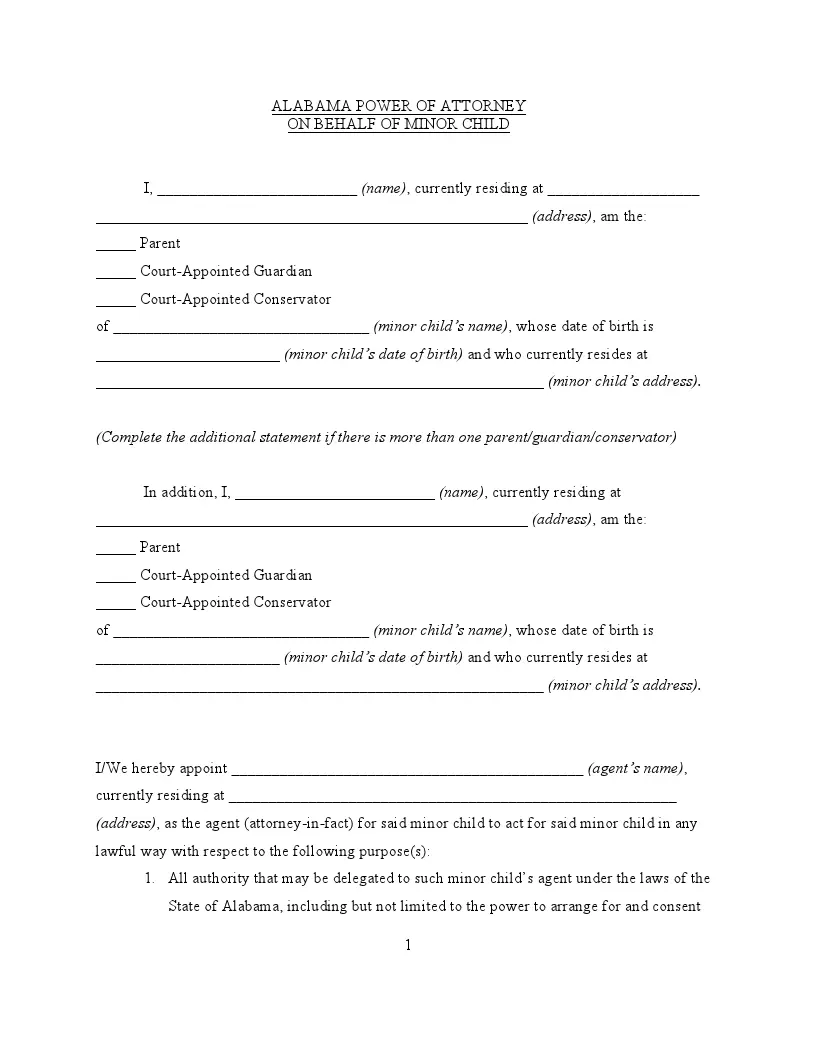
Parent and child (page 1). Enter your name and address. Initial the line that matches your role: Parent, Court-Appointed Guardian or Court-Appointed Conservator. Then enter the minor child's name, date of birth and address.Step 1: sample entries, not a real document.
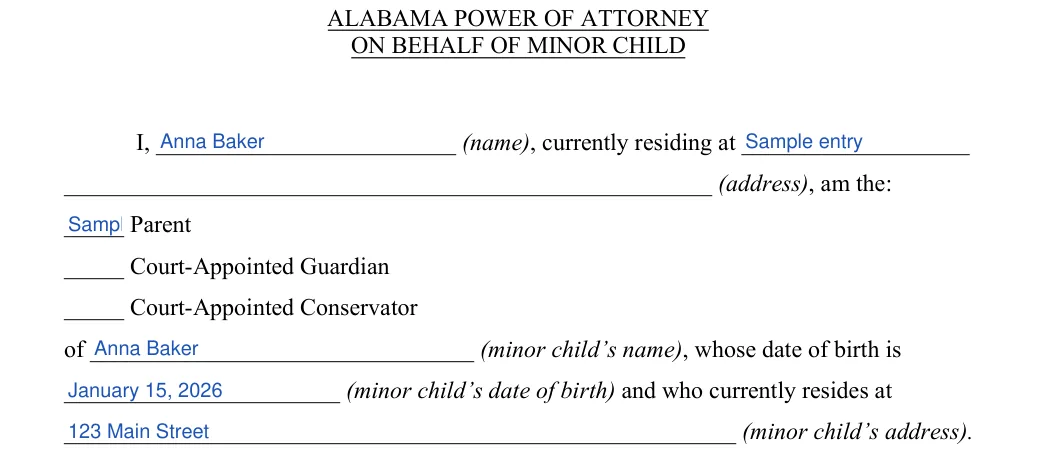
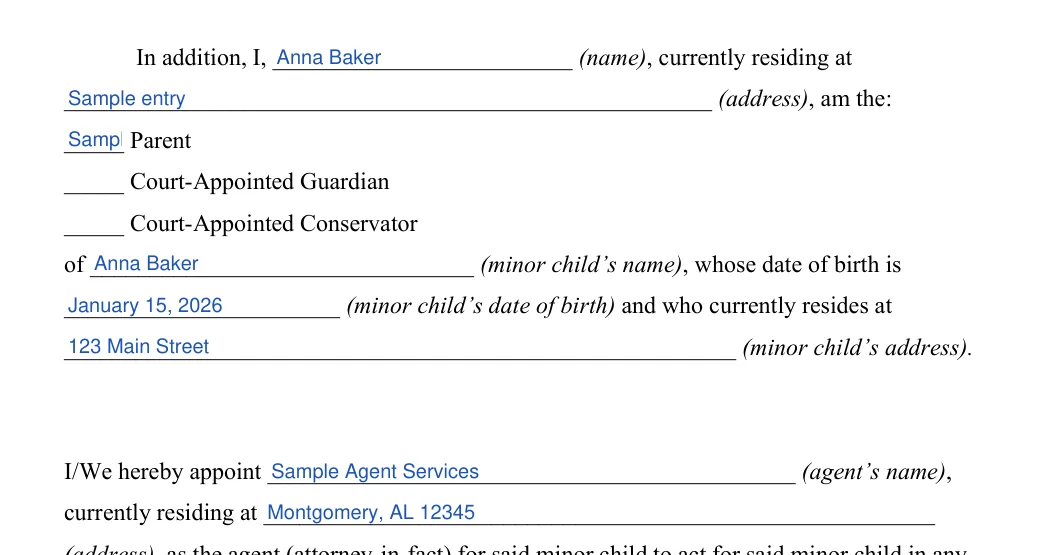
Second parent or guardian, and the agent (page 1). Complete the "In addition" statement only if more than one parent, guardian or conservator is signing. Then enter the agent's name and address.Step 2: sample entries, not a real document.
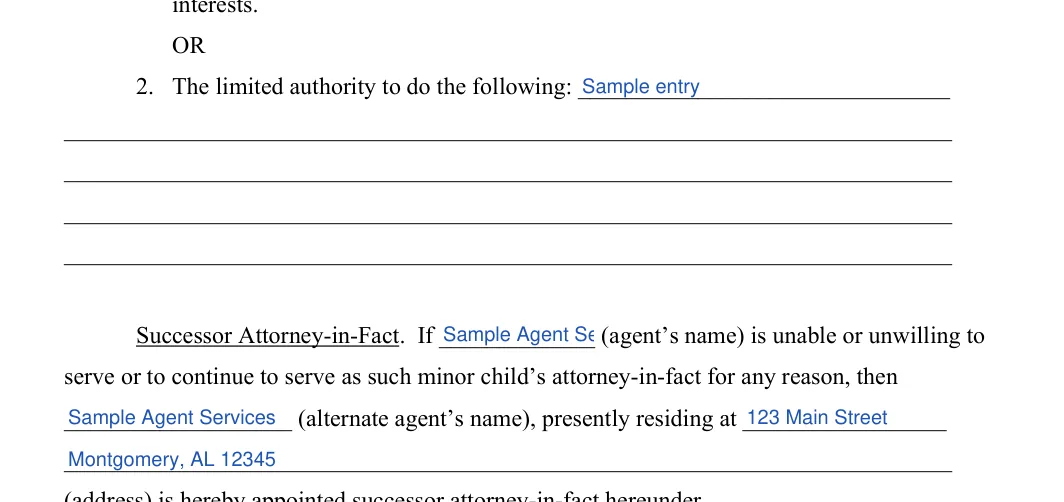
Powers and successor agent (page 2). Choose option 1 for all the authority that can be delegated, or option 2 to list limited powers on the lines provided. Then enter the name and address of a successor agent, who takes over if the first agent is unable or unwilling to serve.Step 3: sample entries, not a real document.
Effective date (page 2). Enter the date the power of attorney takes effect and the date it continues until. The statute limits the delegation to a period not exceeding one year, so choose an end date within that time.[1]Step 4: sample entries, not a real document.
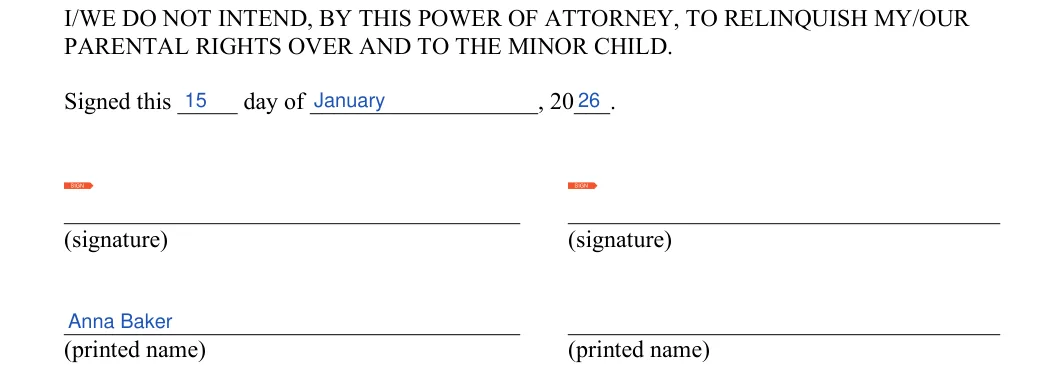
Parental rights statement, date and signatures (page 2). The statement that you do not intend to give up your parental rights needs no entry. Fill in the "Signed this" day, month and year. Each parent, guardian or conservator who signs then signs and prints a name on one of the two lines.Step 5: sample entries, not a real document.
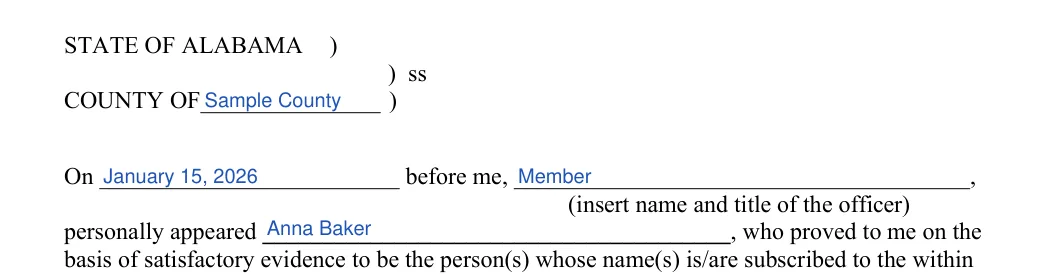
Acknowledgment: county, date and officer (page 3). Page 3 is an acknowledgment for a notary public or other officer. Enter the county, the date, the officer's name and title, and the name of the person who appeared before the officer.Step 6: sample entries, not a real document.
Officer signature and seal (page 3). The notary public or other officer signs the certificate and adds the seal. The certificate says the officer verifies only the identity of the person who signed, not whether the document is accurate or valid.Step 7: sample entries, not a real document.
How to Sign and Use the Alabama Minor Child Power of Attorney
After you fill in the form, check it, sign it and, if you choose, have a notary public complete the acknowledgment on the last page. Then share copies with the people who care for the child and store the original safely. Only the signing rule in step 2 comes from the statute. The other steps are general practice.
Check every entry. Read the names, dates and end date again before you sign. Make sure the powers you chose match what you want the agent to handle.
Sign as the principal. The statute calls for a properly executed power of attorney, and the principal must sign it.[1] Use the signature lines on page 2.
Ask a notary public to complete the acknowledgment. Many people sign in front of a notary so the officer can fill in the last page.
Give copies to the agent. Many people also share a copy with the child's school or doctor, so the people who deal with the child's care know who the agent is.
Keep the original safe. Store the signed original where you can find it and put the end date on your calendar.
Create a high-quality Alabama Minor Child Power of Attorney Form online now!
Frequently Asked Questions
How long can a minor child power of attorney last in Alabama?
The delegation can last for a period not exceeding one year.[1] Write the end date in the "continue until" line on page 2 so everyone can see when it stops.
Which powers can't be delegated under an Alabama minor child power of attorney?
The power to consent to the marriage or adoption of a minor ward cannot be delegated under Ala. Code § 26-2A-7.[1] Powers regarding the child's health, support, education or maintenance can be delegated.
Who must sign an Alabama minor child power of attorney?
The principal must sign it. The statute calls for a properly executed power of attorney.[1] The template has the signature lines on page 2.
Mara has been practicing estate planning and trust law in California since 2003, taking pride in helping clients of all backgrounds and asset profiles form a complete and customized estate plan. Her specialties are: estate planning, wills and trusts, trust and probate administration.