
Updated:
An Arkansas minor child power of attorney is a parent's caregiver appointment. It gives an agent temporary authority over a child's care without a court guardianship case. Parents need it most during travel, military deployment, illness or a hospital stay.
Key facts

Build Your Document
Answer a few simple questions to make your document in minutes
Save and Print
Save progress and finish on any device, download and print anytime
Sign and Use
Your valid, lawyer-approved document is ready
An Arkansas minor child power of attorney is a signed document that lets a parent hand day to day decisions about a child to another adult for a period the parent chooses. The parent who signs is the principal. The adult who acts is the agent, or attorney-in-fact.
The document lists the matters the agent may handle for the child, and the parent can narrow them, for example to school matters alone, on the power of attorney form the parent signs. The form is also called an Arkansas parental power of attorney or an Arkansas temporary guardianship form. It sits among the other Arkansas POA forms, and it is the one written for a child's care.
| Document Name | Arkansas Minor Child Power of Attorney Form |
| Other Names | Arkansas Parental Power of Attorney; Arkansas Temporary Guardianship Form |
| Who Signs | A parent, court-appointed guardian or court-appointed conservator; a second parent or guardian, if there is one |
| Duration | From the start date to the end date written on the form |
| # of Fillable Fields | 44 |
| Available Formats | Adobe PDF |
The Arkansas minor child power of attorney is the paper route to temporary care without a court case: the parent fills it out, signs it before a notary and hands it to the agent. No judge reviews it and no hearing is set.
The form is not the same as legal guardianship, a more permanent arrangement made through a court order. The two differ in three ways:
The form depends on a parent, guardian or conservator who is able to sign it, because only that person grants the authority it gives. A family with no parent able or willing to sign asks an Arkansas lawyer or a legal aid office about guardianship of a minor.
An Arkansas child power of attorney covers a set period when the parent is away or unable to care for the child, and a relative or family friend steps in. Common reasons include:
The agent shows the form to the child's school, doctor or child care provider and asks them to deal with the agent, within the authority the parent grants. Each of them decides whether to accept the form and may ask for its own paperwork.
A deploying parent's power of attorney delegates all or part of custodial responsibility to an adult nonparent for the period of deployment, only if no other parent has custodial responsibility under Arkansas law or a court order in effect prohibits contact between the child and the other parent, under Ark. Code Ann. § 9-21-204.
Where a deploying parent used that route, the parent revokes the power of attorney by signing a revocation of the power, under Ark. Code Ann. § 9-21-204. A deploying parent whose child has another parent with custody asks a military legal assistance office about the next step.
The Arkansas child power of attorney holds six parts, each one a decision the parent makes before signing. The form lists:
The form's authority section offers general authority or limited authority, and the parent marks one. General authority (item 1) gives the agent the powers the form already lists. Limited authority (item 2) gives only the powers the parent writes on the lines, such as school matters alone.
The successor paragraph names a backup agent who acts if the first agent cannot. Arkansas law ends a power of attorney when the agent dies, becomes incapacitated or resigns and the document names no other agent to act, under Ark. Code Ann. § 28-68-110. A named successor keeps the form working in that case.
The form takes effect when it is signed unless it says that it becomes effective at a future date or on a future event, under Ark. Code Ann. § 28-68-109(a). The end date is the parent's choice, and the power of attorney ends on that date because the document provides that it ends, under Ark. Code Ann. § 28-68-110, which applies when the form names an end date.
The Arkansas minor child POA form is a three-page PDF with 44 fillable fields, filled in from the parent and child details to the notary section. Work through the parts in order.
The screenshots under each step show the form filled with sample entries in blue, so you can see where each answer goes. The names, addresses, dates and amounts are examples only.
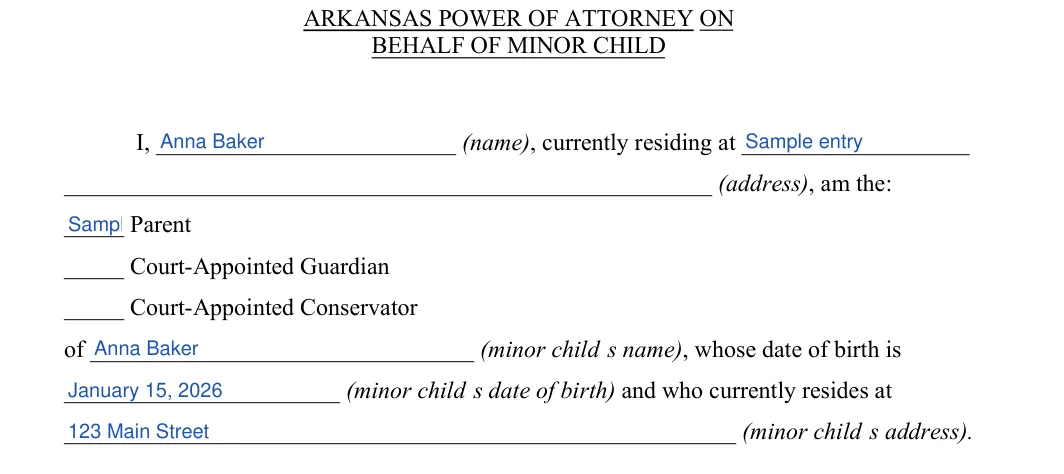
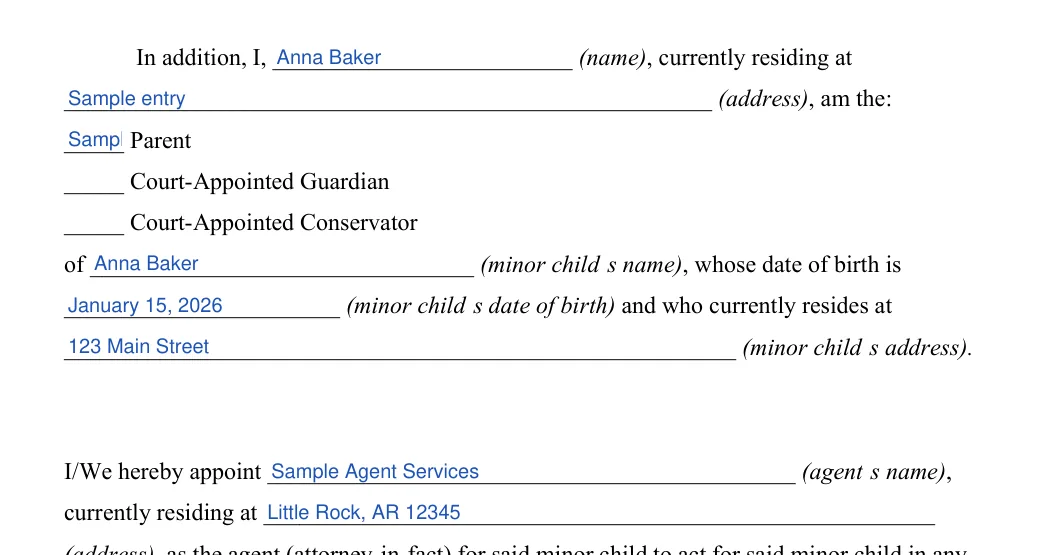
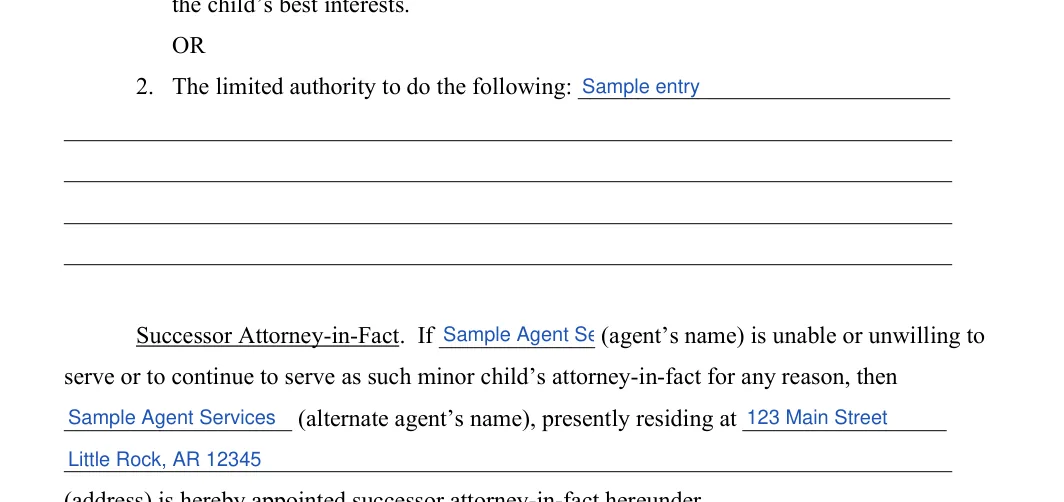

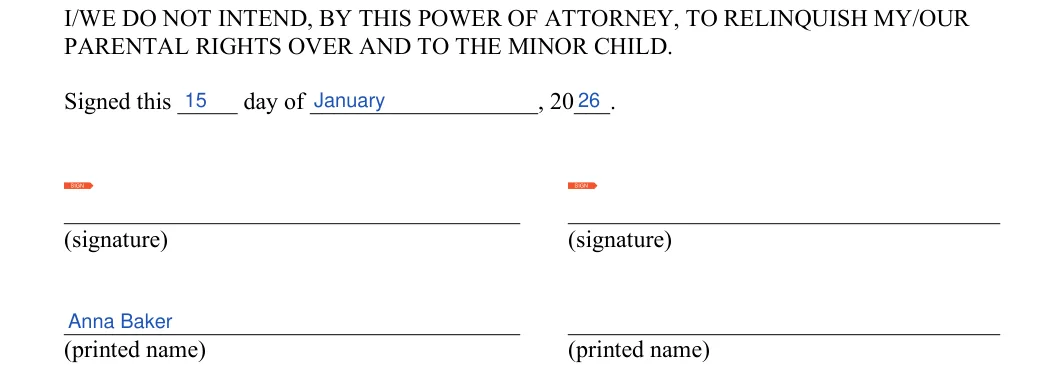
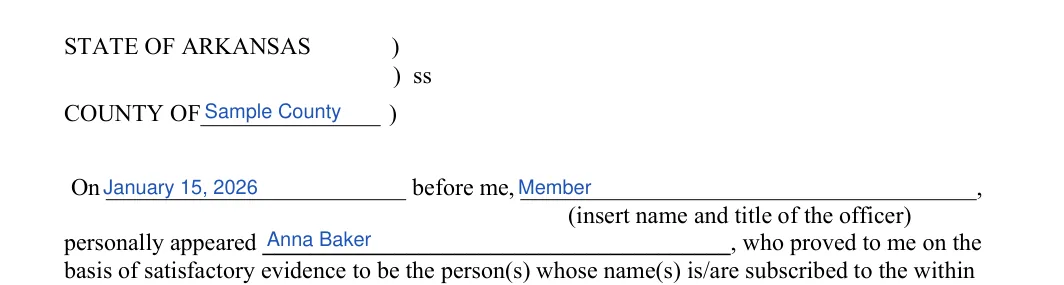

The Arkansas minor child power of attorney is signed by the parent, or by another individual the parent directs to sign the parent's name in the parent's conscious presence, under Ark. Code Ann. § 28-68-105. Sign it this way:
A signature on a power of attorney is presumed genuine if the principal acknowledges it before a notary public or another individual authorized by law to take acknowledgments, under Ark. Code Ann. § 28-68-105. That presumption is the reason the form carries a notary block.
An Arkansas minor child power of attorney ends when one of the events in Ark. Code Ann. § 28-68-110 happens, and the end date written on the form is only one of them. The power of attorney terminates when:
A new power of attorney does not revoke an earlier one unless the new document says that the earlier power of attorney, or all other powers of attorney, are revoked, under Ark. Code Ann. § 28-68-110. A revocation is not effective against the agent or another person who acts in good faith without actual knowledge of it, under Ark. Code Ann. § 28-68-110, unless that person knows of the revocation.
A written notice closes that gap. Send it to the agent and to each school, doctor or child care provider holding a copy, and ask for the copies back.
These answers cover the questions Arkansas parents ask most often about a power of attorney for a child.
The form has a notary acknowledgment on page 3, and a signature on a power of attorney is presumed genuine if the parent acknowledges it before a notary public, under Ark. Code Ann. § 28-68-105. A notarized form is easier for a school or a doctor to accept.
The form lasts until the end date written on it, unless an earlier ending event under Ark. Code Ann. § 28-68-110 happens first, such as a revocation or the parent's death.
A power of attorney created under Arkansas's power of attorney chapter is durable unless it expressly provides that it is terminated by the incapacity of the principal, under Ark. Code Ann. § 28-68-104. That rule speaks only to powers of attorney created under that chapter, and this page does not settle whether a parent's delegation of a child's care is one of them. A parent who wants the agent's authority to continue through the parent's incapacity asks an Arkansas lawyer before signing.
The agent accepts the appointment by acting as agent, or by other conduct that shows acceptance, except as the power of attorney itself provides otherwise, under Ark. Code Ann. § 28-68-113. A talk with the agent before the signing confirms the agent is willing.
The form has two signature lines, each with a printed name under it. The second parent or guardian completes the additional statement in the first part and signs on the second line.
The attorney-in-fact is the agent, the person the parent names on the form to act for the child. The form uses both terms for the same role.
General information, not legal or tax advice.
