
Updated:
A Connecticut minor child power of attorney is a document that lets a parent or guardian name another adult to make certain decisions for their child in their absence. This legal document is particularly useful if the parent expects to be unavailable due to illness, military duty, or absence from the jurisdiction.

Build Your Document
Answer a few simple questions to make your document in minutes
Save and Print
Save progress and finish on any device, download and print anytime
Sign and Use
Your valid, lawyer-approved document is ready
The power of attorney template must include specific details such as the duration of the power, the scope of authority granted, and the identification of all parties involved. You must clearly outline the powers the attorney-in-fact will hold, typically including decisions related to education, healthcare, and the child’s general welfare.
In Connecticut, a power of attorney for a minor generally lasts for one year unless a shorter term is specified. The document may be revoked by the parent or guardian who executed it, provided they are competent to do this. All Connecticut POA forms must meet state requirements to be valid, such as being signed by the parent or guardian and two witnesses.
| Document Name | Connecticut Minor Child Power of Attorney Form |
| Other Name | Connecticut Parental Power of Attorney |
| Relevant Laws | Connecticut General Statutes, Chapter 802h, Sections 45a-624 to 45a-624g |
| Duration | One Year |
| Avg. Time to Fill Out | 15 minutes |
| # of Fillable Fields | 44 |
| Available Formats | Adobe PDF |
Write down the agent's phone number and address on a separate sheet. Keep it with your copy so it is easy to find.
To fill out the Connecticut minor child template, work through seven parts in order. They cover the parent or guardian and child, the agent, the powers, the dates, the signature and the notary page. These steps follow the FormsPal PDF on this page, which you can fill in online or download and write by hand. Have the full names and addresses of everyone named on it ready before you start.
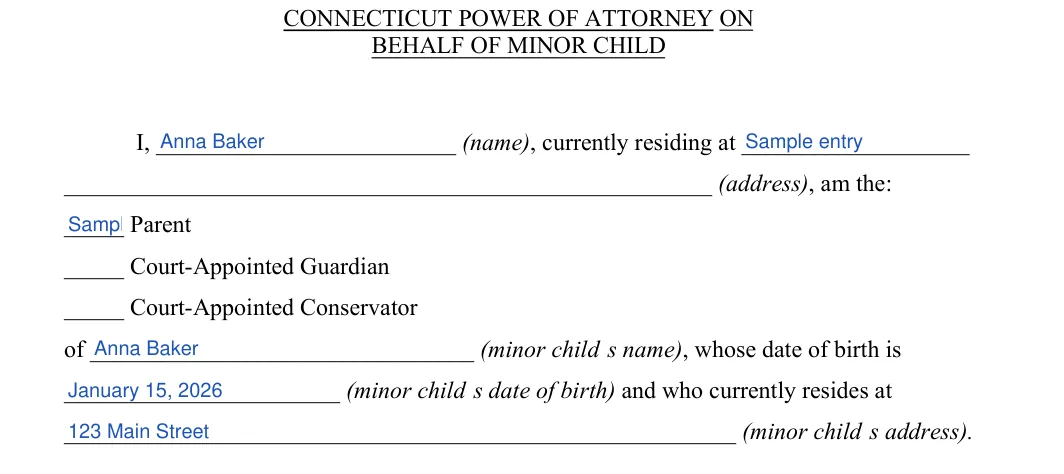
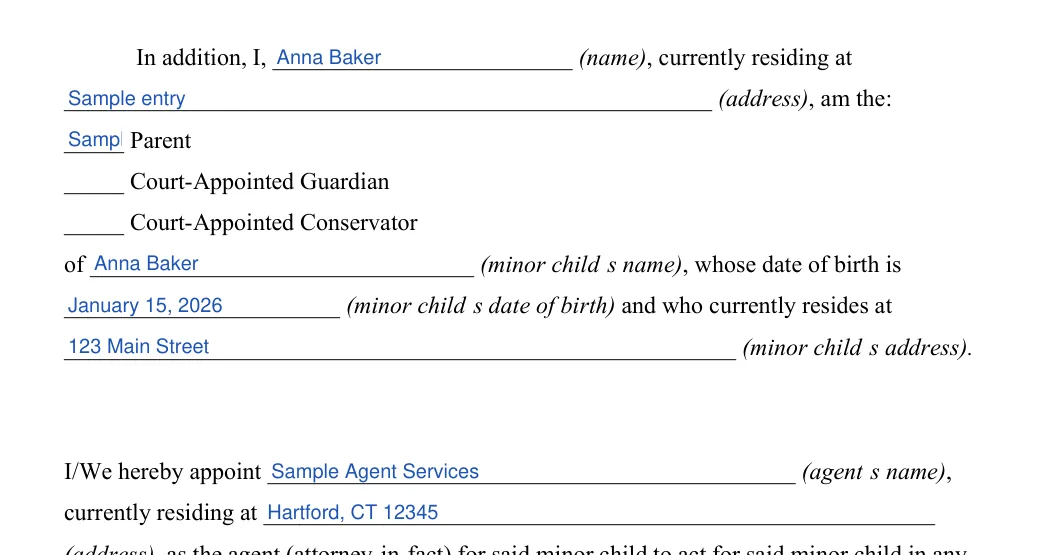
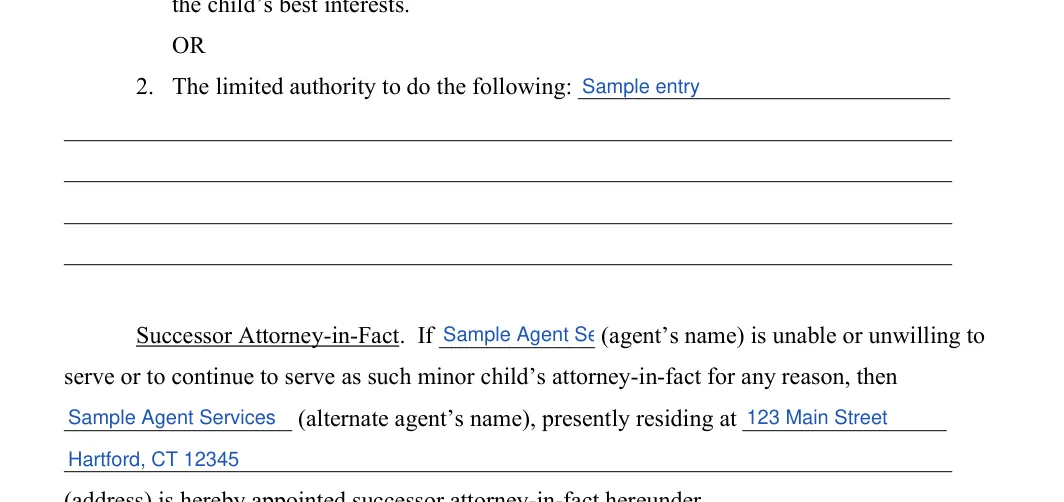
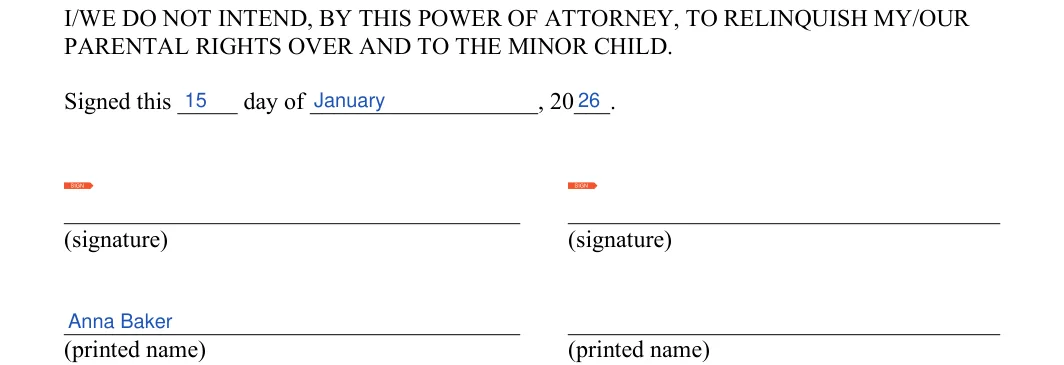
The screenshots under each step show the FormsPal Connecticut Connecticut Minor Child Power of Attorney template filled with sample entries in blue, so you can see where each answer goes. The names, addresses, dates and amounts are examples only.
Parent or guardian and the minor child
Enter the parent or court-appointed guardian’s full legal name and complete street address, including city, state, and ZIP code, on the designated lines at the beginning of the form. Then mark the line that fits you: Parent, Court-Appointed Guardian or Court-Appointed Conservator. Enter the child's name, date of birth and address.
Second parent or guardian, and the agent
Complete the additional statement only if a second parent, guardian or conservator is named on the form. Use the same lines for their name, address and the child's details. Then enter the name and address of the agent, also called the attorney-in-fact, who will act for your child.
Powers and successor agent
Choose item 1 for the broad authority printed on the form, or item 2 and write the limited authority on the lines provided. Then enter the agent's name, and the name and address of the successor agent who is named as a backup.
Effective date
Enter the date the power of attorney starts and the date it ends.

Sign and date the form
Read the statement about parental rights. Then enter the day, month and year, sign on the signature line and print your name below it. A second parent or guardian uses the second signature line.
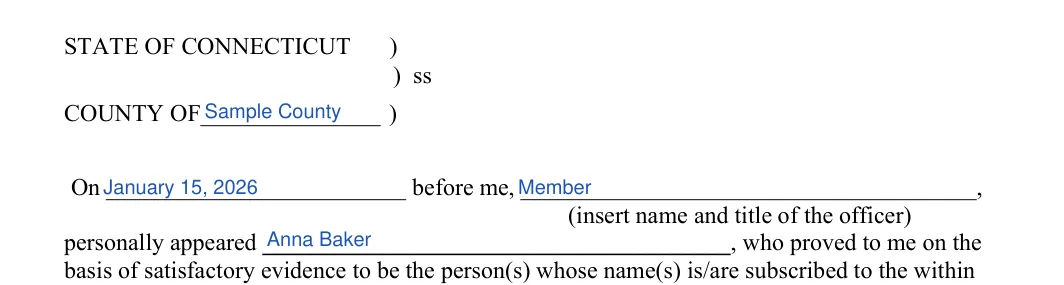
Acknowledgment: county, date and officer
Page 3 is the notary acknowledgment. Enter the county, the date, the name and title of the officer, and the name of the person who appeared at the signing.
Notary signature and seal
The last line on page 3 belongs to the notary or other officer. Leave it empty so the officer can complete it.

After every blank is filled in, sharing and keeping the document come next. Work through the steps in order, read each one first and keep a copy for your own records.
Specify the Contingency
Detail the specific contingency under which the standby guardianship will become effective. This could include the parent’s death, incapacitation due to illness, or any other significant event that prevents them from caring for their children.
Signatures and Witnesses
The form must be signed by the parent or the court-appointed guardian in the presence of a witness. The witness must then sign the form, confirming they have witnessed the signing. This process ensures that the form is executed properly under Connecticut law.
Provide Copies to Relevant Parties
After completing and signing the form, distribute copies to all relevant parties. This includes the designated standby guardian and any legal entities or family members who may need to be informed of the arrangement.
Legal Validation Upon Contingency
Once the specified contingency occurs, the standby guardian must sign a written statement that the contingency has occurred. This statement activates the standby guardian’s authority to act on behalf of the minor children.
Monitoring and Revocation
The authority of the standby guardian is subject to revocation by the parent at any time through a written revocation notice. Additionally, the standby guardian’s authority expires one year after activation or when the specified contingency no longer exists unless extended by a court.
Before you finish, check that every name and date matches the IDs of the people involved.
A Connecticut minor child power of attorney names an adult, called the agent or attorney-in-fact, to act for a child. Most questions come down to what to prepare before you start and which device to use.
Have the full names and addresses of the parent or guardian, the child and the agent ready. Add the child's date of birth and a successor agent as a backup.
Yes. Create the document online, save your progress and finish on any device. You can also download the PDF, fill it in with the PDF editor and print it.
The successor agent is a backup named on the form. This person takes over if the agent cannot serve.
General information, not legal or tax advice.
