
Updated:
A Delaware minor child POA is a parent's written delegation of care. The form names an agent and lists the decisions the agent makes for the child. Parents and guardians need it before travel, deployment, a hospital stay or a long absence.
Key facts

Build Your Document
Answer a few simple questions to make your document in minutes
Save and Print
Save progress and finish on any device, download and print anytime
Sign and Use
Your valid, lawyer-approved document is ready
A Delaware minor child power of attorney is a parent's written grant of authority over a child's care to another adult for a set period. The parent is the principal. The person who receives the authority is the agent.
The document keeps the parent in place as the child's parent. It lets a relative, a friend or a caregiver handle the decisions the parent lists while the parent is away.
| Document Name | Delaware Minor Child Power of Attorney Form |
| Other Name | Delaware Parental Power of Attorney |
| Parties | Parent, guardian or conservator (principal); agent; optional successor agent |
| Duration | Not Specified |
| Avg. Time to Fill Out | 15 minutes |
| # of Fillable Fields | 44 |
| Available Formats | Adobe PDF |
A power of attorney for a child covers the period when a parent cannot be there to make everyday decisions. Common reasons are:
The form fits a planned absence with a known start and end. A parent who wants another adult named for the case of the parent's own incapacity or death has a different, court route.
You can find all the information about state-specific requirements and relevant Delaware POA forms on our site.
The Delaware minor child POA form holds seven parts on three pages, from the parent and child details to the acknowledgment. Each part answers one question about who, what and when.
The powers section sets the scope of the agent's authority. General authority continues the wording on page 1. Limited authority lists only the decisions the parent writes in item 2, for example school matters, medical appointments or travel.
The successor agent, called the Successor Attorney-in-Fact on the form, is the backup person who acts when the first agent cannot or will not. Naming one keeps the child covered if the agent falls ill, moves or resigns.
The effective date lines fix when the authority begins and the date it continues until. A clear end date tells a school or a doctor at a glance whether the agent still acts for the child.
The parental rights statement records that the parent does not intend to relinquish parental rights. The parent reads it before signing, and it sits above the signature lines.
The Delaware minor child POA form has three pages and 44 fillable fields, filled in order from the parent and child details to the acknowledgment on the last page. The details table above lists about 15 minutes to complete it.
The screenshots under each step show the FormsPal Delaware Minor Child Power of Attorney template filled with sample entries in blue, so you can see where each answer goes. The names, addresses, dates and amounts are examples only.
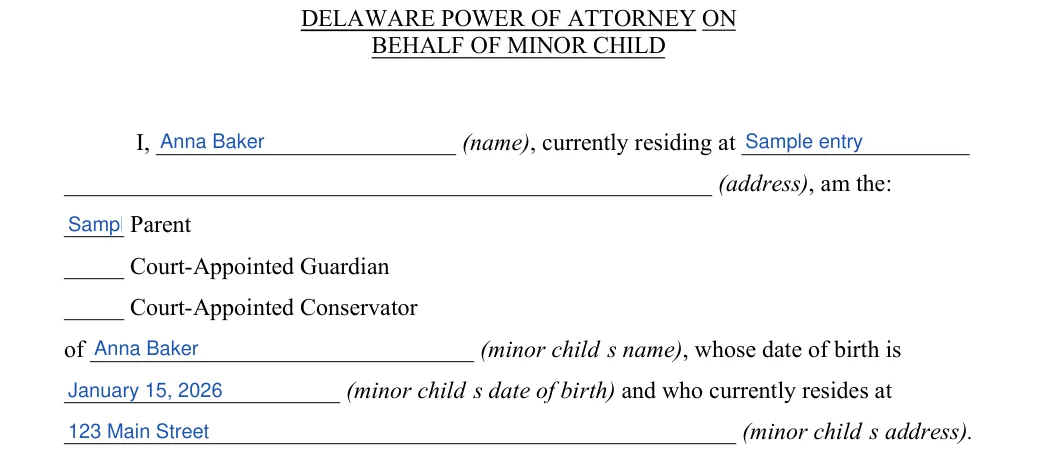
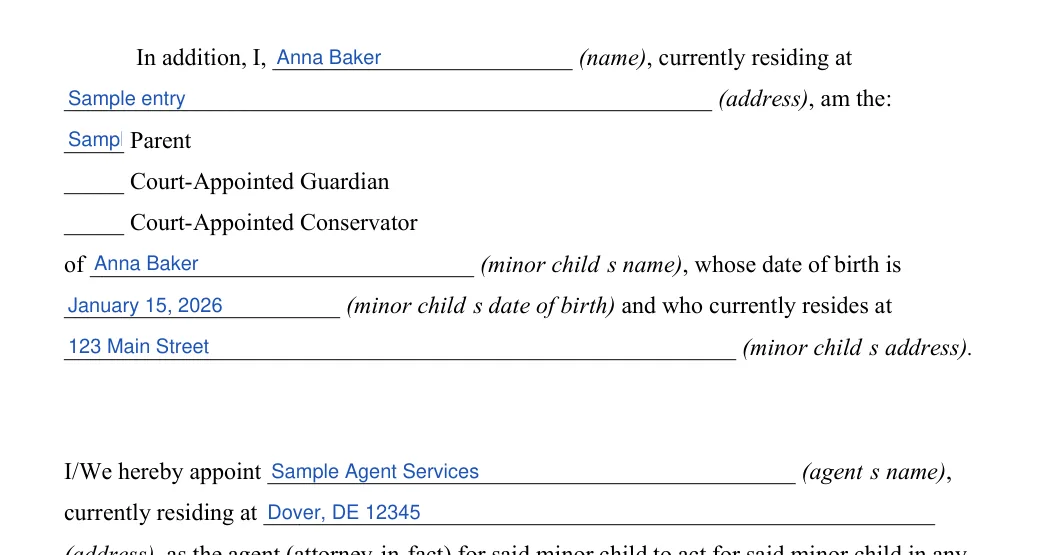
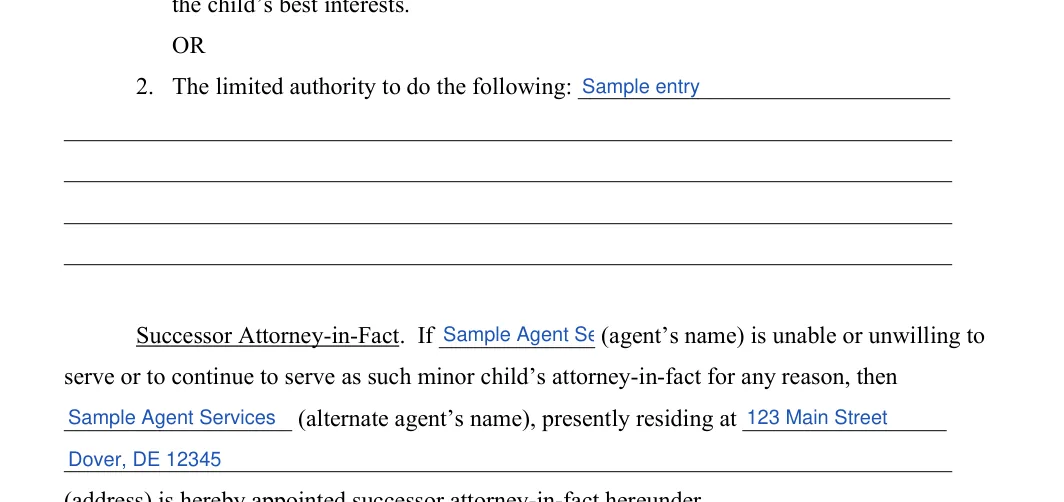

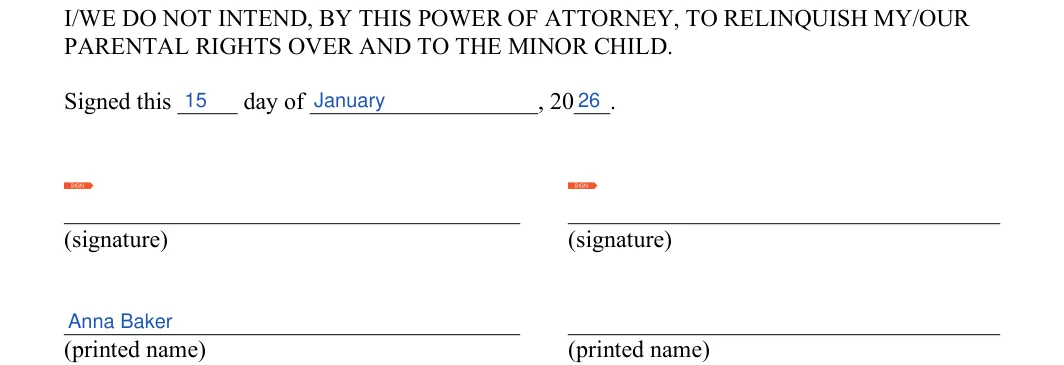
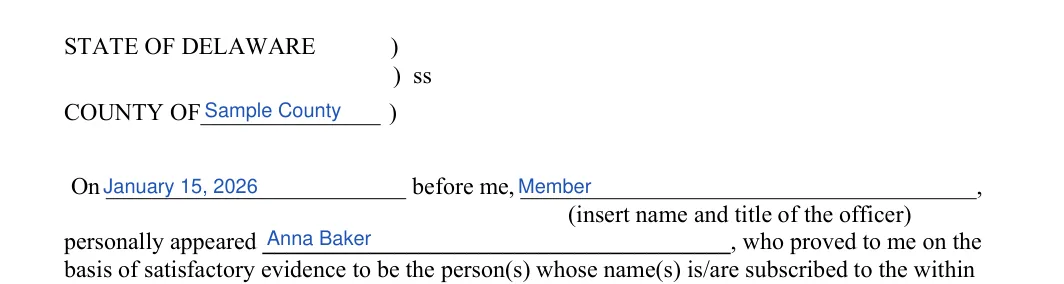

The Delaware minor child power of attorney is signed by the parent in front of the officer who completes the acknowledgment on page 3. The signing order below keeps the copies clean and matched.
The next section sets out the chapter 49A rules for a durable personal power of attorney. The sources on this page do not confirm that those rules reach a form that only delegates a child's care, even one with durable wording.
A Delaware power of attorney is durable only if it contains words that keep it in force after the principal's incapacity, under 12 Del. C. § 49A-104. A minor child form with fixed dates usually carries no such words, so check the text before you sign.
Under 12 Del. C. § 49A-104, a power of attorney is durable if it contains the words "This power of attorney shall not be affected by the subsequent incapacity of the principal," or similar words showing that intent.
The same section treats a power of attorney as durable if it says "This power of attorney shall become effective upon the incapacity of the principal," which is called springing wording.
Delaware's signing rules in 12 Del. C. § 49A-105 apply only to a personal power of attorney: a durable power of attorney executed in Delaware or made subject to Delaware law, other than the powers chapter 49A excludes.
The statutory form in 12 Del. C. § 49A-301 describes a personal power of attorney as one over the principal's property, so whether a child-care delegation with durable wording falls under 12 Del. C. § 49A-105 is not confirmed here.
When a form is a personal power of attorney, 12 Del. C. § 49A-105 lists five signing requirements:
The witness under 12 Del. C. § 49A-105 qualifies only if the witness is an adult who is neither related to the principal by blood, marriage or adoption nor entitled to any part of the principal's estate under the principal's will, codicil or trust.
Under 12 Del. C. § 49A-105, an agent under a personal power of attorney has no authority to act unless the agent has first signed and attached a certification in substantially the statutory form.
The certification wording appears at the end of the statutory form in 12 Del. C. § 49A-301. In it, the agent confirms that the power has not been revoked as far as the agent knows and agrees to act in good faith and within the authority granted (12 Del. C. § 49A-301).
A Delaware personal power of attorney, which 12 Del. C. § 49A-105 limits to a durable one, ends when one of the events in 12 Del. C. § 49A-110 occurs: the principal dies, the principal revokes it, a terminating event it names occurs, or its purpose is accomplished.
The 12 Del. C. § 49A-110 rules below are written for a durable personal power of attorney.
Under 12 Del. C. § 49A-110, an agent's authority ends when the principal revokes it, when the agent dies, becomes incapacitated or resigns, or when the personal power of attorney terminates.
Under 12 Del. C. § 49A-110, an action filed to dissolve or annul the agent's marriage to the principal also ends the agent's authority under a personal power of attorney, unless that document provides otherwise.
When an agent or another person acts in good faith without actual knowledge of the termination, the termination is not effective as to that person, under 12 Del. C. § 49A-110.
A parent who revokes the form early should tell the agent, the school and the child's doctor in writing and ask for the copies back.
A Delaware medical power of attorney, called a power of attorney for health care, covers decisions about the signer's own health care, while the minor child form covers a child's care.
When an adult signs a power of attorney for health care, 16 Del. C. § 2508 requires it to be in a record, signed by the individual creating it and signed by an adult witness.
Under 16 Del. C. § 2508, that witness qualifies only if the witness reasonably believes the signer acts voluntarily and knowingly, is not the agent, and is not the agent's spouse, domestic partner or cohabitant.
The statutory durable form in 12 Del. C. § 49A-301 says in its notice that it does not authorize the agent to make health-care decisions, so a parent's own health care needs a separate document if the parent wants one.
Delaware prints one statutory form, the durable personal power of attorney in 12 Del. C. § 49A-301, which may be used but need not be, and a form that varies from it is not invalid only for that variance. That form covers the principal's property, not a child's care.
The minor child form is signed by the parent on the signature lines and acknowledged on page 3 by an officer who adds a signature and seal. For a durable personal power of attorney over the principal's property, 12 Del. C. § 49A-105 also calls for one adult witness; whether that reaches a child-care form is not confirmed here.
For a durable personal power of attorney, 12 Del. C. § 49A-110 says a new one does not revoke an earlier one unless the new document provides so. That section speaks only of a personal power of attorney, so for a fixed-date minor child form without durable wording, write any revocation of the earlier form into the new one as a matter of practice.
The minor child form lasts from the start date to the end date the parent writes in. For a durable personal power of attorney only, 12 Del. C. § 49A-110 adds that, unless the document provides otherwise, the agent's authority does not lapse with time alone.
The minor child form gives authority over the child's care, not the parent's accounts. On the statutory durable form in 12 Del. C. § 49A-301, the agent gets banking powers only if the principal initials the "Banks and Other Financial Institutions" category.
The most common mistakes are a missing end date, an agent's name spelled differently from the agent's ID, no successor agent, and a limited authority list that leaves out medical care or school matters the agent will face.
The attorney-in-fact, also called the agent, is the person you name on the form to act for your child. The form uses both terms for the same role.
General information, not legal or tax advice.
